2CV: Rear brake overhaul

During the 2CV’s rebuild, most mechanical items were considered off-limits. The focus was to get the car back on the road, and as it was running fine when it came off the road, I was hoping not to have to do much. After putting the body back on, I had to refit the brake master cylinder. As that had been off, I then had to bleed the system. This is where problems started, as the nearside rear bleed nipple made it apparent that it wasn’t for moving. It was the iron oxide. The poor nipple had lost its cover, and Welsh weather had caused it to rust. I decided not to fight with it, as the last thing I wanted to do was render the brake system inoperable. Instead, I reasoned that in all likeliness, very little air would have got into the line, and I could get rid of any fresh air via the other nipple. In this, amazingly, I was proved correct. A lot of air came out – trapped between the old fluid and the new stuff in the refitted master cylinder. The brakes passed muster for the MOT.

Obviously, this wasn’t a situation I was happy to live with. I would far rather have a fully bled brake system. So, the other day, I had a go at freeing of the nipple. It snapped off in response. So, today, I booked in with Sparrow Automotive for some very necessary overhaul work. You see, the problem is, you need a 44mm socket to remove a 2CV rear brake drum and bearing. You also need a whopping 250-290lb/ft of torque to undo it. That’s ten times what the 2CV’s engine can produce! I have neither of these requirements, so a visit to Sparrow was in order. I had to get up horribly early for this, though as it happens, George the cat decided to wake us up ten minutes before my 7am alarm… About an hour later, I was here.
A very good morning.

A very good morning.

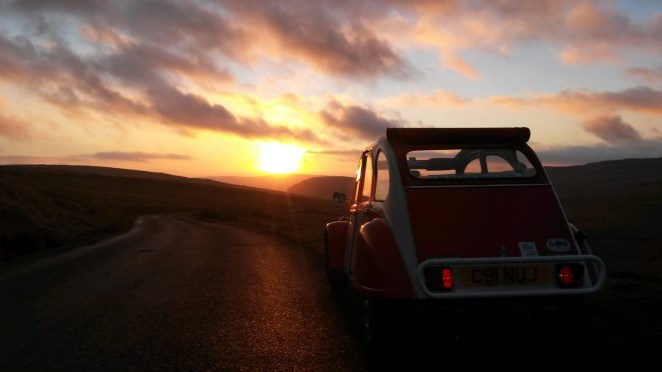
Yes, roof back on the Elan Valley Mountain road, enjoying the sunrise. Gosh, sometimes it really does feel good to be alive! I’d wrapped up well, and it wasn’t that cold, so I thought I’d leave the roof off.

Some miles later, that plan changed.
See? England just isn't as pleasant.

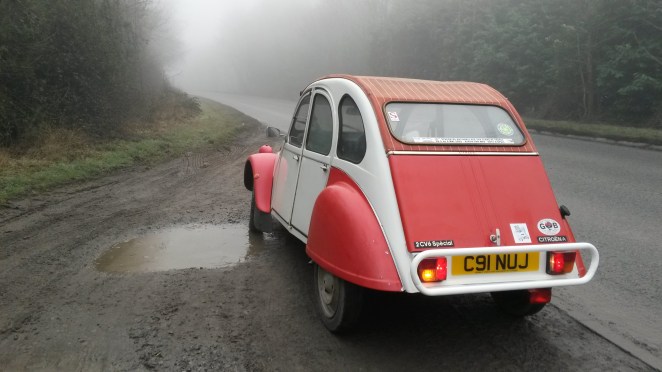
See? England just isn’t as pleasant.

I’d started to see frost at the side of the road as I neared the border, and then it turned foggy. Suddenly, I found myself rather suffering from excessive cold air. Time to stop and put the roof back on. It was so cold that the straps that hold the roof back had shrunk! I couldn’t get them to fit in their ‘rest’ position. I was certainly justified in keeping the grille muff on. The heater was working well and I soon defrosted.

What a mucky drive!

What a mucky drive!

There were other issues though. I got through so much screenwash. At times, I seemed to be pressing the squeezy-button with my thumb almost constantly. Headlamp performance was certainly rather worse by the time I arrived in Hereford.

Time to crack on, as Elly was squeezed into the workshop along with some custom vehicles of the type Sparrow Automotive rather excels at.

A BMW-bike engine installation, and a hot rod 2CV. Ace!

A BMW-bike engine installation, and a hot rod 2CV. Ace!

Work began and, with the benefit of air tools, the hub nut (ahem) was soon removed, and the wheel cylinder replaced with a fresh one – that didn’t have a broken nipple in it.

Bye bye knackered nipple.

Bye bye knackered nipple.

At this stage, we discovered that the pivots for the shoes were in a pretty poor state. One clue to this was the rather firm brake pedal. The pivots often seize up but, because the rear brakes do still operate, 2CVs can often pass an MOT test even when the brakes are not doing much stopping! Another clue for me is when I went hooning last Saturday. After a particularly long descent, the front brakes started groaning. That’s a sign that they’ve been working hard. Given I hadn’t been braking that hard, it suggested they were doing most of the stopping. So, everything was stripped and cleaned up.

Oddly, the 2CV appeared to be wearing a mis-matched set of shoes. It’s years since I last had a peek at the rear brakes (due to that nut issue), so I’d taken the liberty of bringing a fresh set of shoes that had come to me in a rather large collection of 2CV bits. Well, they might as well be fitted now we’re here. The only problem was that the four adjusters (one for each shoe) were very seized. Three responded to smacks with a hammer and a dose of penetrating oil, but one just wanted to round. There was only one thing to do. Deploy a Joey!
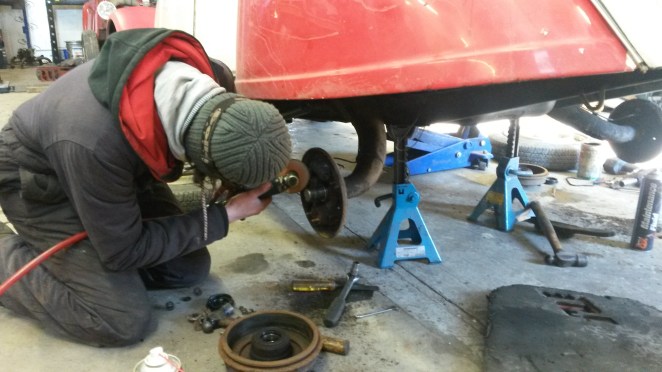
Chop chop!

Chop chop!

Joey is the very-talented friend who welded up Elly’s front wings. She’s darned good at what she does, and far safer with an angle grinder than I am. In other words, she only cuts what actually needs cutting…

A new adjuster from Dutch 2CV specialists Burton was fitted, then the new shoes and, finally, a pair of brand spanking new hub nuts. Now, the brake system could be bled properly at last.

Oh what a difference! Now, the brake pedal travels much more. In fact, Pete Sparrow told me that customers often complain that the brakes feel worse after he’s sorted them out, because they’re not used to the pedal actually travelling! The shoes still need to be bedded in, so I haven’t been pushing the brakes hard, but the car now squats much more evenly when I brake, without the comedic nose-down stance it had previously had. If you own a 2CV, I certainly recommend that you make sure the rear brakes are working properly. You might not know just how bad they actually are!

With the work done, I could then set about the 1.5-hour drive back home.
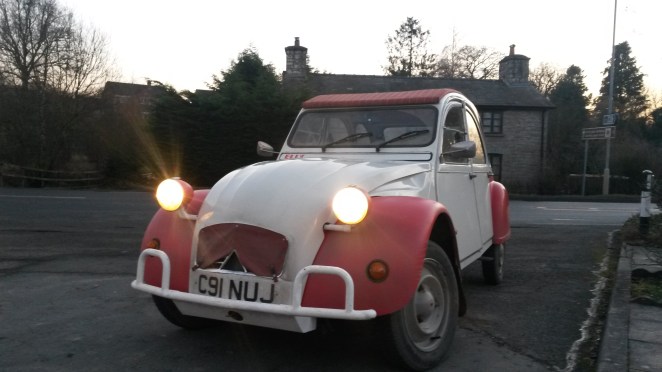
A filthy Elly pauses on the way home.

A filthy Elly pauses on the way home.

It’s very nice to have that job done, though the trip did remind me of two other things. One, I need to do something about noise levels. Two, I need to do something about comfort! I may have to refit the bench seat…
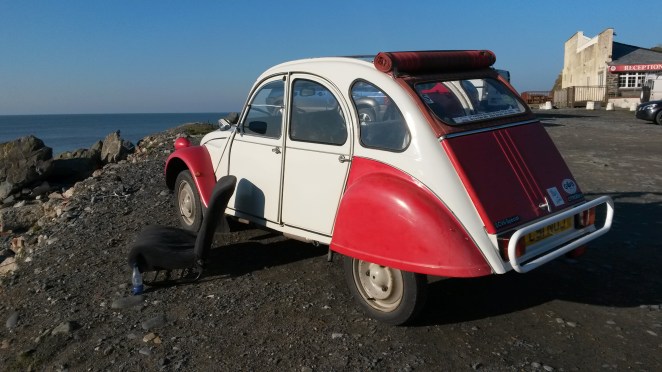
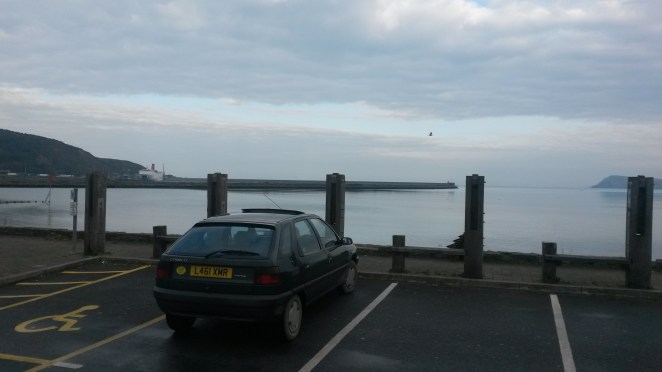
Citroen outings

My life, for the past six years, has been rather relaxed in terms of working hours. I’ve worked when I’ve felt like it, and not worked when there was something better to do. It’s been grand to be honest.

However, I find myself increasingly busy these days, with lots of writing and editing work. This is good! But, the flipside is that I’m having to get a bit more disciplined about working. It makes sense to broadly follow normal working hours, as that’s what most of the people (colleagues, specialists etc) do. It’s no good me being raring to go on writing a feature at 11pm on a Sunday night, as I can’t get hold of the people I need to speak to. As it happens, I was finishing off a feature for MG Enthusiast at 11pm last night, but I’ll try to ignore that for the sake of narrative.

What I’ve drifted away from is the original point. I’m starting to rediscover weekends again! Work levels have reached the point where I need dedicated time off. It’s quite novel.

On Saturday, Rachel was out but the sun was shining. It was time to get Elly’s roof off and go for a drive. So I did.

A rather lovely Saturday.

A rather lovely Saturday.

I had a good hoon around the mountains, then ate my lunch on the beach at Clarach – with the front passenger seat making a handy deckchair. It was fanastic – so enjoyable I made another video.

Sunday dawned with rather less sunshine. I say dawned – it was Sunday, so we didn’t get out of bed until gone 10am. And to think. People sometimes ask us if we’d like children. Ha!

For reasons that aren’t entirely clear, we decided to head to Pembrokeshire. It’s not a part of the country we’ve really explored before, which was reason enough. Having already clocked up 300 miles in the 2CV within a week, and with rain looking a possibility, we elected to take the ZX instead.

Oh how lovely it is! Compared to the frantic nature of a 2CV, the slow-slogging power of the ZX’s 68bhp XUD diesel engine is a complete contrast. Furthermore, it’s smooth ride is a complete contrast to the MG GS and Nissan Qashqai I’ve been mucking about with recently. How did manufacturers forget how to make cars ride and handle this well?

The good handling is essential, as the engine isn’t really powerful enough for you to consider slowing down desirable. Much like a 2CV. We pushed on down the A487 coast road, marvelling at the scenery as the cloud lifted and sunshine peeked through. Though it was miserable again by the time we reached Fishguard.

Different Citroen, different beach.

Different Citroen, different beach.

We lovingly watched the ferry clag up over lunch, before it departed to Ireland. Then it rained quite a lot, so we drove away. Not before we’d found an Iron Age fort to have a mooch at, and a lovely old chapel.

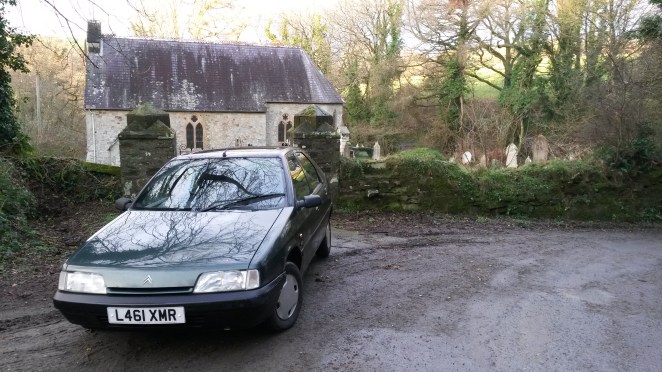
ZX poses outside a rather old, and lovely, chapel.

ZX poses outside a rather old, and lovely, chapel.

Then we pushed on home, via a brief stop at Aberaeron. The ZX lapped up the miles, though the squeak of the rear wiper blade reminds me that I must change it at some point. The engine was struggling for fuel at times too, or at least, that’s what it felt like. This is a reminder that I really must give the poor thing a service at some point. I suspect a clogged fuel filter.

Overall though, what a lovely weekend. It certainly set me up nicely for the working week ahead. I’ve had a really busy day!

Wash and push up (tyre pressures)

I’m still feeling a bit groggy this week, the result of a heavy cold followed by gripey guts. I think the 281-mile drive in the 2CV may not have helped. It was hard work! I have no regrets though. It was a top day out.

Still, it left the 2CV filthy and, despite grogginess, I felt I had to give her a wash – seeing as Wales had decided to be rather pleasant in the weather stakes. That doesn’t necessarily happen often.

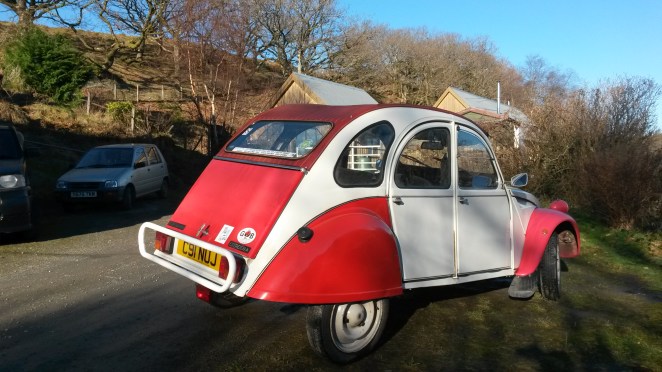
Clean again!

Clean again!

In this shot, you really can see how ‘pink’ the front wings are compared to the rears. I’ll be painting all the red bits to match at some point, honest! I still need to sort out some side stripes as well.

It was the first time I’ve washed this car in getting on for two years, and there wasn’t much point doing it last time! It feels more rewarding when the car looks nice at the end of it. There are still areas where there’s wax clearly visible – down the rear door for a start. I’d rather have those areas protected by wax than looking immaculate though.

After a break, in which I may have watched snooker, I decided to give the other members of the fleet a check-over. I’m glad I did, as the tyre pressures were low on the Honda and the Nippa – not vastly so on the Honda, but 20psi at the front of the Nippa when it should be 32! I’m forced to admit, I haven’t checked the pressures on that car since the tyres were fitted almost two years ago…

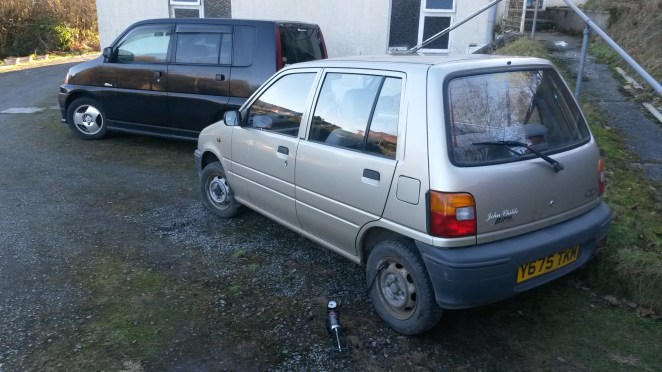
Check your tyre pressures! These were all low.

Check your tyre pressures! These were all low.

The final bit of ‘maintenance’ was to open up the ZX while it sat in the sun, to try and allow the floors to dry out. There’s clearly a bad water leak somewhere (thankfully it doesn’t smell of engine coolant, so not the heater matrix, which is common) but my appetite to investigate is not really there.

To return to the Nippa, it’s been an awesome buy for £300. For the first MOT in our ownership, it needed a steering rack gaiter. For the second, it needed wiper blades. It’s due again in March. We’ll see how it does this time. Motoring does not get a lot cheaper though.

EV News: Tesla not crash-proof, Zoe goes further

There’s actually some very interesting news in the world of modern cars at the moment, so I’ve taken some time to explore.

Let’s start with Tesla. The BBC has reported that Tesla has been cleared of any responsibility for a collision in which the driver of a Model S was killed. It does raise a serious point though, which is that, despite all the clever gizmos fitted to many modern cars (certainly not just Teslas), the driver (for now at least) remains in control, and should deal with any incidents as they arise.

Model S

Tesla – ruled only dangerous if you don’t pay attention.

It seems that in this case, a truck drove across the car, which is a scenario most cars seem unable to deal with. Many new cars (including the Qashqai I drove recently) have an in-built emergency brake system, where the car will put the brakes on to avoid a collision. Here’s the thing though. They tend to be radar-based, and have a pretty narrow field of view – they need to or they’d be trying to stop you every time a car approached on the correct side of the road. The message is pretty clear here – do not trust the technology to save you. Pay attention! What this says for the future of truly autonomous cars is that there’s still a long way to go. Which is good news! Autonomous cars sound like a truly terrible idea for those of us who like driving. People who don’t like driving should perhaps consider, er, not driving! Get a lift. Catch the train. Maybe even consider a bus. Then you can check your smartphone without crashing…

In other news, I’ve been pleased to see that Renault has launched a new version of its Zoe electric car, now with a 41kwh battery back. The original Zoe had a 22kwh battery, while the upgraded LEAF I drove last summer boasted 30kwh. Clearly, as EV sales rise, the technology is moving on. The new battery is 15kg heavier, but no larger. That’s pretty remarkable.

Renault ZOE racer

Renault Zoe is to get a greater range. By a long way!

It takes the expected range way beyond 150 miles to maybe 180 in mixed conditions. Realistically, that’s about the same as my 2CV and enough for a full three hours of National Speed Limit single-carriageway routes, or over two hours of motorway. I find this very exciting. Even better, Renault are offering the chance to buy the batteries outright. Now, if you’re buying new, then a battery lease maybe makes sense, especially if you’re leasing the car itself (as 81% of new car buyers apparently do). Second-hand, the picture is much more muddied. You can buy a second-hand Zoe for less than £5000, but it seems very difficult to get a feel for what you’ll be paying in terms of battery lease. It varies depending on annual mileage and some other things. So, £5000 to buy your new car, but then you will be faced with £49 or more a month leasing the battery. The good news is that it protects you against battery failure, as Renault will replace it if it can no longer reach a certain level (70 or 75% it seems). The bad news is that it’s a regular outgoing on a car which otherwise has free road tax and, potentially, very cheap fuel (if you charge at home on a preferable night-time rate). It shoves up your pence per mile, and doesn’t make it look like a favourable option compared to a  50mpg diesel. Or even a 40mpg petrol to be honest. Let’s break for sums.

Zoe – 6000 miles per year, £59 per month battery lease (£69 for the Zoe 40) = £708 per year, with fuel costs on top – probably £180-200, though this really depends where you charge. Total fuel cost per year, £908 let’s say.

MG3 1.5 petrol – 6000 miles per year. Fuel cost based on 40mpg at £1.20 per litre = £817.20. Mind you, you’ll also have to pay £130 vehicle tax, though you will actually be able to ‘charge’ your petrol car in Wales. It gets a bit harder with EVs. Total annual cost £947.

I should point out that none of these figures include any servicing, with the petrol car needing more – like oil, plugs and filters and things.

So, electric cars don’t necessarily deliver when it comes to sums. Nor do they necessarily deliver an environmental benefit – it does rather depend where the electricity comes from. I don’t much care. I just love the way electric vehicles drive. They just need to get a little bit more affordable but I definitely will own one. Hopefully relatively soon.


The first long run

Today, I needed to be in Nuneaton, near Coventry, for work-related reasons. I spent yesterday agonising about which car to take – this can often be a problem when you have four vehicles. I even resorted to asking the good people of Twitter. These sensible folk democratically picked the ZX as the vehicle to take. I was surprised.

I very nearly did their bidding too. In fact, I opened my front door with the ZX keys in my hand, and very nearly stepped through. But then, this happened.

Morning Elly! Fancy a drive?

Morning Elly! Fancy a drive?

I wasted valuable minutes grabbing spares, ‘useful’ stuff and tools and headed out into the gloom. I’m sorry to report that leaving the house at 7:40am is rather a shock for me. I waved at the school bus as I departed the village, opting for the Elan Valley Mountain Road for a proper hoon session.

By the time I reached Ludlow, my sat nav was revealing the bad news that I was going to be six minutes late arriving in Nuneaton. Earlier, I had been seven minutes late, but had managed to make up a minute – not easy in a 2CV, but good fun nonetheless. Then it all went wrong. The slog between Ludlow and Droitwich saw me stuck behind the same two trucks for pretty much the whole way. I was not impressed. I lost a full 15 minutes behind this pair. It was time to call ahead and admit I was going to be late.

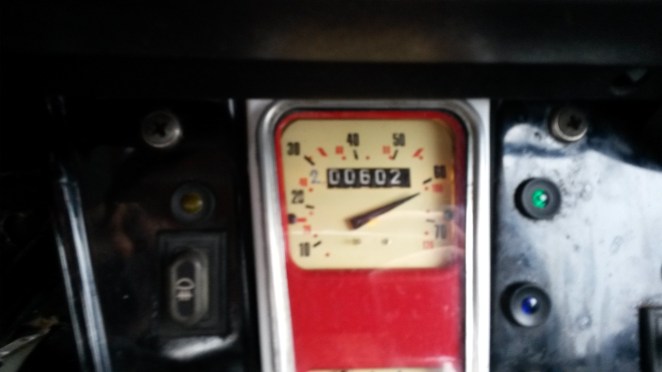
On the M42, this milestone occurred, with the photo definitely taken by the passenger.

602! For the third time in her life.

602! For the third time in her life.

My celebration was short lived though as, just out of shot, the fuel gauge was looking rather scarily low. In a 2CV, there’s low, and then there’s “doing a weave doesn’t move the needle” low. It was in that category. Bother!

So, I zipped off the motorway at Monkspath near Solihull, where I knew there was a Tesco with far more reasonable prices than most motorway services. I got 22 litres into the 25 litre tank, so it was a good job I stopped.

About 30 miles later, I arrived at Martin Robey Engineering Group in Nuneaton, where there was much gawping at heavy industry. Oh, and a photo opportunity of rather lighter engineering.

The ideal car for a quick 120-mile drive to the West Midlands?

The ideal car for a quick 120-mile drive to the West Midlands?

It had been a lovely drive, despite frustrating trucks. Elly was absolutely flying, though I’m not sure why. She dealt with the big hill on the M6 almost as if it wasn’t there. I even overtook stuff! We hit a sat nav 71mph at one point, and she felt very comfortable. My ears were comfortable too, though only because I’d remembered to pack my 3M ear filters. These are like plugs, but reduce rather than block noise. They take a good 50db off, which makes a big difference, yet still allows you to hear sirens and worrying car noises. Thankfully, there were not many of either.

With the engineering drooling completed, it was time for the journey home. This time, I’d be simply using the M6 and M54 to get home as quickly as possible. Again, Elly seemed very happy to zip alomg at the legal limit, which varied from 50-70 along the M6. The only real problem is traffic bunching. When it all slows down, then speeds up, a poor 2CV can be left in the lurch, unable to match the turbo-aided torque of pretty much every other vehicle out there.

Still, before too long, we had returned to Wales.

Almost home.

Almost home.

After this pause, purely for artistic effect, I pushed on home. The only incident was when I cut a corner slightly, and caught the cats eyes while on a fair degree of hoon. The car skipped alarmingly across the road, towards a rather solid looking crash barrier. We managed to avoid it, but it has left me thinking there’s work to do on the suspension. The front shock absorbers are certainly not fresh – I bought a set in about 2004 I think – and the rears are Monroes, which do not seem to work well in this application. There is also the MOT advisory regarding both kingpins to consider, though I’ve not had kingpins cause this handling foible before (they can rattle when cornering, which feels more alarming than it is. These don’t do that yet).

Oh, and one more tiny problem. As I went to turn into my driveway, the offside front indicator decided it didn’t want to work anymore, which I suspect is either a duff bulb or the fault of my wiring. Overall, that’s been a pretty decent shakedown run. I’m glad I swallowed the brave pill and went for it! After all, I’ve put some serious effort into getting this car back on the road. It’s about time she covered some miles!

Honda S-MX: Not sure why I like it, but I do

I haven’t spoken on the Honda S-MX for a while, and that’s probably because I haven’t driven it much over the past month or so. Instead, I’ve been hurtling around the UK in borrowed cars, collecting the ZX (then breaking down in it) or been stuck in my garage trying to remember how to put a 2CV back together. It was telling that when I jumped in it yesterday, the brakes made that horrible BANG noise that suggests they were rusting up…

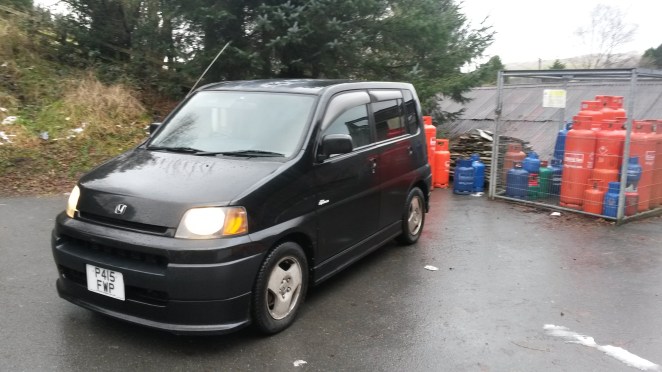
It has probably been glad of the rest, seeing as most of the 3300 miles I’ve done it in were completed in the first two months of ownership. Even yesterday, it was only required to drive around eight miles to the local petrol station as I sought fuel of various kinds (but not petrol as it happens).

Working vehicle.

Working vehicle.

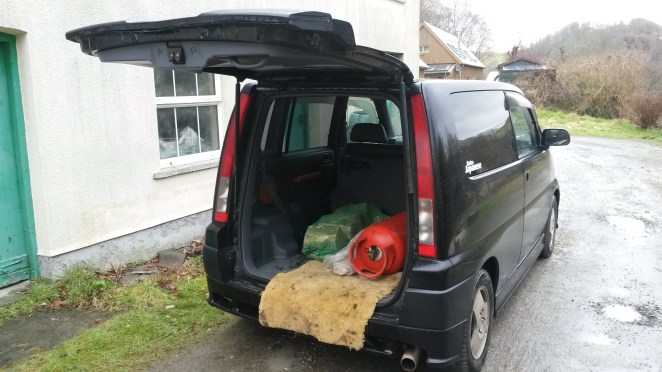
As you’ll have seen from my anti-SUV rant, I prefer a car with a low loading lip, and the S-MX certainly delivers on that score.

Beautifully low!

Beautifully low!

Certainly, it’s a very easy car to get large gas bottles in and out of, with plenty of room for a bag of logs too (our promised wood delivery last week didn’t arrive due to courier error). Remember, the Honda has a footprint slightly smaller than that of an MG3, yet has a load area that is much larger and easy to access than that of the MG GS or, to avoid questions of bias, the Nissan Qashqai.

Of course, the news isn’t all good. The lack of a rear door on the driver’s side is a pain in the backside for a start, while I’m yet to find the leak in the tailgate that causes an annoying drip. The wind deflectors have practical advantages, but destroy vision in the process.

But it’s out on the road that the S-MX really falls apart. The ride is bouncy and harsh (how very Honda) while the steering manages to be so hideously light that you sometimes wonder if the front wheels are actually on the ground at all. Then it lurches around the bend with all the grace of a surprised gazelle, generating quite remarkable levels of G force even at low speeds. Maybe it’s because, having assumed the front wheels are not on the ground, you’re surprised that it has actually made an effort to go around a bend.

Then there’s the automatic gearbox, which still has a revving issue on downshifts – I tend to pre-empt the kickdown by downshifting myself. It’s all quite rubbish really.

Yet, I can’t help loving this car. It is one of the best cars I’ve ever owned, even though I thought that driving dynamics were an absolutely key part of what makes a car appeal to me. It makes no bloody sense at all. I do quite like the looks, which is probably the root of the problem. Us humans will happily ignore a whole heap of troubles because something (or someone) looks nice. I guess we see why SUVs are so popular…

SUVs – I don’t think I get it

I’ve spent the past week tooling around in an MG GS and before that, I took a Nissan Qashqai on a Tour of the North. Just before that, I sold my own Toyota RAV4. These three vehicles have combined to make me wonder what the point of an SUV is.

Only one of those vehicles had four-wheel drive – the RAV4 – though the Qashqai can be specified with all-wheel power, as can the MG in markets other than the UK. Here’s the thing though – buyers seem to be quite happy to buy SUVs with only two-wheel drive, so what’s the appeal?

The MG GS is very, er, SUV-shaped

Extra height, but is it actually a benefit?

I will say, I do like an upright driving position, with the feet considerably lower than the buttocks. I guess years of 2CV ownership have seen me grow rather accustomed to this. I’ve never been a huge fan of low, low seating positions. I may still be in my 30s, but I really can’t be doing with getting in and out of something that’s low to the ground.

But you don’t need an enormous vehicle to get such a position. The Nippa has a decent stab at it, as did my Daewoo Matiz from many moons ago.

Sure, neither offers the height of an SUV, but what does that extra height actually deliver in the way of benefit? With SUVs becoming ever more popular, it certainly doesn’t necessarily gain you that commanding view over other traffic that you might desire. Your view will simply be blocked by another SUV. It doesn’t get you a nice, low loading lip for the boot either, so you’d better build up your muscles for loading in the weekly shop.

One of the most successful British-built cars - the Nissan Qashqai.

You can’t stray far from the beaten track in a two-wheel drive SUV

It will give you less stability. No, you won’t wobble over the first time you go around a bend, but in a collision, an SUV may be more likely to take a tumble than a regular hatchback. It’s simple physics once you start raising a vehicle’s centre of gravity.

You aren’t necessarily safer either. These cars do a marvellous job of making you feel safer – all chunky styling that looks like it should repel other cars like water meeting the impenetrable barrier of a duck’s back. But, they don’t necessarily protect you any better in a collision than a regular car. In some ways (ah, stability again), they may be worse.

Then there’s the running costs. I was impressed with the 50+mpg of the Qashqai, but that’s pretty dreary these days for a family hatchback. Citroen was delivering such figures in the 1980s in a car with pretty much the same level of space, and a far better ride (though nowhere near the same interior refinement to be fair). The MG seems to be doing a terrifying 31mpg, which can be bettered by my 20-year old Honda with the aerodynamics of a fridge-freezer. I do not see the expected progress here.

It can go greenlaning, but it's not very good.

A pioneering SUV, and one that, despite four-wheel drive, just isn’t equipped for the rough stuff.

You can’t shove an SUV through the air as efficiently as a conventional hatchback. That chunkiness and raised ground clearance do not help here. Nor does the greater weight they have, though some weight has been saved by not bothering with the four-wheel drive system that you’d expect such a vehicle to have. You can even specify a Land Rover Discovery Sport with front-wheel drive only. I just find this laughable. It’s like buying a rain hat that isn’t waterproof. Sure, it might look nice and stylish, but when conditions turn, you’re going to be left looking foolish.

That came so close to happening to me this very weekend. Travelling back from Sussex in the MG, we encountered freshly falling snow. Grip was reduced by a very large amount, but thankfully we managed to get through. However, I can say with certainty that it wouldn’t have taken very much more snow for us to really start struggling. The fat tyres needed to keep an SUV from skidding off the road are absolutely no help in snow at all. Nor is not actually having four-wheel drive (before you query it, four-wheel drive does not make you invincible in the snow, but it can help you get moving).

All three SUVs seemed hampered by their suspension too. With the need to control a high centre of gravity, there’s not as much give as you might hope for. They’re all rather firm in the springing department.

So, they cost more to buy, cost more to run and actually do a worse job of ‘being a car’ than a more conventional hatchback or estate. I shall continue to be bamboozled by the rise of the SUV.

Project Elly: The End!

EDIT – now with video! Scroll down

No, don’t worry. Not The End of Elly, I’m just formally closing Project Elly. She is back on the road and, she appears to be reliable again. Hoorah! Time to step away from the project and steer her back into regular use.

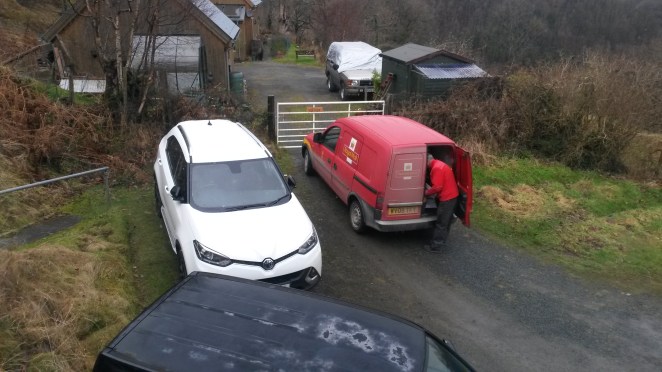
I eagerly awaited the postman this morning, because I knew he’d have goodies for me – or rather, Elly.

Hello Mr Postman! What have you got for me?

Hello Mr Postman! What have you got for me?

I wasn’t disappointed. My ECAS 2CV Parts order had arrived!

Cor! A lovely, new, resin-filled coil.

Cor! A lovely, new, resin-filled coil.

I had to pay attention fitting it, as it seems it’s imperative that the positive and negative connections are the right way around. This differs from the normal coil. In fact, it’s actually sensible to swap the connections every now and then to even up wear on the spark plugs due to the wasted spark system the 2CV employs (in short, no distributor, so it sparks on both cylinders twice during the four-stroke cycle).

With it fitted, and with the ignition now being back on the points-assisted Velleman kit, she fired very promptly into life. Brilliant! Naturally, I ignored my substantial work load and went for a drive. At last! I could drive along with the engine firing cleanly, even after pulling over and letting her tickover for a while as I took photos. There was no spluttering, no misfiring. Phew!

Finally, she is finished and healthy!

Finally, she is finished and healthy!

Of course, there’s not really any such thing as finished. The grey wheels look wrong – they should be white. I also need to get the rear seat fitted, and sort out some sound proofing as she’s LOUD. The grey felt on the interior body sides needs purchasing and fitting, the gearbox oil needs replacing, the reverse light also needs to actually be fitted and I’d like to sort out an interior light. Then there’s the rear wings that need painting, and the side stripes that need recreating (I’m pondering options here – I still fancy a bit of an art project). Oh, and the hatchback kit. That needs fitting, but I also need to get a hinge made up to complete it first.

But, she’s very much back, and that makes me very happy. A lot of people have donated funds, parts, advice and support during this project. I can’t thank you enough. Alan at Citwins turned a complete wreck of a 2CV body into what you see here, with the frightening number of replacement panels needed funded directly by your contributions. That was over £1100. If there’s anything I’ve learnt during this project, it is that the 2CV is supported SUPERBLY well when it comes to parts. We are very, very lucky.

As am I. I’m able to drive my 2CV again. For that, I’m truly grateful.

Thank you!

Thank you!


Book Review: Ben Fogle – Land Rover

Well, the full title is “The story of the car that conquered the world,” but that’s a bit long-winded to be honest. As it turns out, that’s the least of this book’s problems. The main one is that it was written by Ben Fogle. I’ll concede, I didn’t hold out high hopes for this book, but it still managed to disappoint on a level I didn’t think was previously possible.

It's fair to say, I didn't enjoy it.

It’s fair to say, I didn’t enjoy it.

I will concede that this is a book review based on two chapters. After a tedious Prologue that told me nothing, and the first chapter, I concede that I threw the book to one side. The problem here is that this is a book about cars, written by someone who knows pretty much nothing about cars. It is often said that to be a true car enthusiast, you must own an Alfa Romeo. Mr Fogle can’t even spell the name correctly. Nor can he apparently spell axles (misspelt on the very first page). Then there’s a photo of Fogle with his Series 1 Land Rover – a “wheels behind the grille” model apparently. Oh, good grief. This is a book written about cars by someone who lacks the knowledge, then proof-read by someone who seemingly has even less knowledge. I’m not sure what publisher William Collins was thinking. Well, I guess I do. Such was the fever about the end of Land Rover production, that cashing in on this does seem a sensible move. I don’t dispute that. I only dispute the end result.

Seriously, it’s like asking The Pope to write a user guide on condoms, or asking Donald Trump to write about the history of feminism. The result can only be disappointment. There must be thousands of people who would be better placed to write a book on Land Rover.

The final nail in the coffin comes in italics, right at the start of the Prologue on discussing Land Rovers. “I will sometimes refer to them all using Defender as a collective noun. Please don’t hate me.” Sorry Ben, but you leave me very little choice. I can’t even forgive Jaguar Land Rover for referring to all Series Land Rovers as Defenders. It is unforgivable.

I’ll leave the final word to the Daily Mail. If they can describe as book as “Funny, entertaining and really rather inspiring, too” then you know it’s going to be terrible.

MG GS: First impressions

Following hot on the heels of the surprisingly British Nissan Qashqai, I’m testing the British/Chinese MG GS this week. Now, I’ve only covered about 55 miles in it so far, so these are very much my first impressions. Firstly, it’s a rather different spec to the Qashqai, being  the range-topping Exclusive model, with DCT (dual clutch transmission), which is, in effect, an automatic, and a petrol engine.

It’s still a 1.5-litre engine like the Nissan, but a rather sweeter sounding petrol, with a turbocharger for extra giggle factor. Quite substantial giggle factor, as it produces over 160bhp. It also has 188lb/ft of torque, all the way from 1600rpm to 4300. That’s even more astonishing than the power output. It is the only engine though. There’s no diesel option in the UK, and no four-wheel drive option either – not a problem for most people, but you can’t back up those adventurous looks with actual adventure. What’s that? It’s going to snow later this week? Ah…

2016 MG GS

Is the range-topping MG GS worth a look?

The retail price, as tested, is a meaty £22,430, with the spec including heated leather seats with electric adjustment, 18″ alloys (in black – horrible), a fancy computer thing with bluetooth, sat nav, DAB radio and lots of other settings I’ll never explore, remote central locking, electric windows all-round and very bright headlamps. £250 gets you some black trim outside. I’ve not entirely worked out which bits yet, or whether they’re worth paying to have in black.

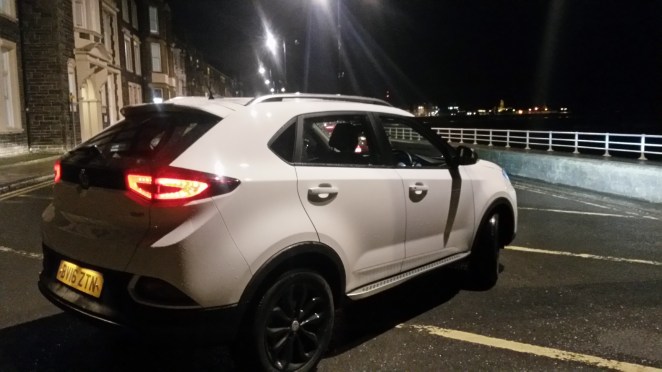
The MG GS is very, er, SUV-shaped

The MG GS is very, er, SUV-shaped

This much I gleaned from the press pack, before heading straight out for a drive. After all, that’s kind-of the important bit. Annoyingly, there is an electronic handbrake, but it works very well with a two-pedal driving experience to be fair. There’s a steep hill at the end of my driveway, which is where I first discovered that this was not a conventional automatic. In one of those, you have a torque converter and a fairly consistent application of said torque at low speeds. A DCT is an automatic manual, with computer controlled clutches and two rows of gears, with each bank also having its own clutch. If you know Volkswagen’s DSG system, then it’s like that.

1.5-litre, turbo petrol produces an impressive 160bhp, linked to DCT gearbox.

1.5-litre, turbo petrol produces an impressive 160bhp, linked to DCT gearbox.

That means you can feel the clutch biting, then releasing, much as you would yourself at low speeds to avoid a stall. The hill-hold stopped the car rolling back, and I smoothly pulled away, with my sensitive ears only just noticing the immediate change to second (of seven) gear, and pretty much missing the slushy move to third. In fact, by the time we reached 30mph, I had no idea what gear we were in. Nor did I much care. Sure, this wasn’t electric motor smooth, but I was pretty impressed.

60mph was reached pretty briskly without fuss (just under ten seconds from the official figures), with the engine settling to a smidge under 2000rpm in whichever gear it was – presumably seventh. The ride was comfortable, notably without the jiggle I’d noticed on the same section in the Qashqai. This seems slightly at odds with findings by other reviewers in this very same car. I’ll reserve final judgement until I’ve driven it on poor, city streets.

Similarly, I can’t really review it at motorway speeds yet. That’s coming later this week with a quick 600-mile roadtrip.

I can tell you that the handling seems pleasant, though with notable bodyroll if you quickly change direction. Grip levels are good though, with the steering having a very nice weight to it from the off. It’s an electric-hydraulic system. I like that, because hydraulic PAS tends to give a less numb feel than a full electric system. EDIT – I was quite wrong. It IS an electric power steering set up, but one that is weighted much more sweetly than the Nissan, even if you put the Qashqai’s steering in Sport mode.

I can also tell you that the wipers are excellent, even if there is no Auto function. There is a variable intermittent option, and the rear wiper reassuringly wipes three times before going intermittent – heritage is maintained.

Drive the GS for longer and the quirks of this type of transmission become apparent. Sometimes, when you’ve slowed down and hit the pedal, there’s a pause – almost as if the cars wonders what gear to be in. On occasion, this causes you to react by pressing harder, at which point it suddenly makes a decision, drops several cogs and opens the throttle, sending you hurtling down the road like a teenage lad in a Corsa who has spotted a lady and has found his hormones destroying his ability to use pedals. It’s really quite anti-social. The only difference is that, unlike most Corsas, this thing really can pick up its skirts and fly. It’s definitely amusingly brisk.

It’s far more relaxing not to drive like that though. Most of the time, it’s very happy to keep the revs down and ride that fat wall of torque, which makes it very relaxing. At manoeuvring speeds, then yes, it can feel a bit strange, as the clutch cuts in and out. Reach a standstill and the stop/start kicks in – it restarts as soon as you lift off the brake pedal.

Sadly, one bad thing I did notice at these slower speeds was the sound of a very tired bearing. It reminded me of the failed auxiliary belt tensioner on my ZX. I turned the air con off, and the noise stopped. That’ll be the culprit then. Oddly, I could not discern the noise outside the car, only inside it. How strange.

I found the GS very comfortable, with lots of legroom front and rear, though the rear bench is a touch low for me. The controls have a nice feel, though there’s no getting away from the acres of cheap plastic that litter the dash. It does not feel like a premium product, though nor does it feel horribly cheap – just not as pleasant as some rivals.

The boot seems a little small, though the high boot lip leads straight to a flat floor – a false one with a spacesaver spare stashed beneath it. There’s an annoying lack of lashing points – this would have been no good at all for collecting a 2CV engine. The rear parcel shelf is a bit awkward too, with a dangly bit between the main shelf and the rear seats, with clips running to the head restraints. This flappy bit is necessary because you can alter the rake of the rear seat back. Also annoying is that you need to press parts of BOTH head restraint holders to get the restraint fully lowered.

That’ll do for now though. Stay tuned for further findings and don’t worry, the 2CV Project will be back soon.