2015 Review – Well, it seems the time

Everyone is having a bash at reviewing their year, so I’ll join in. What has 2015 meant to me? Well, let’s start with the fleet. It began like this.

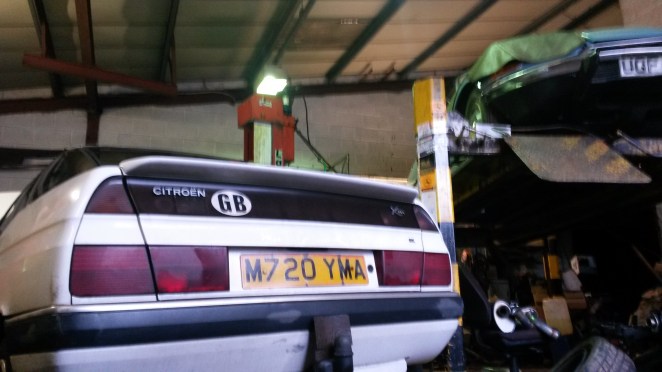
In 1989 and 1990, you could buy either of these brand new!

My fleet as 2015 began – Citroens variously.

Yes, just two cars! My 2CV of almost 15 years (back in January) and the XM that I had only owned for a couple of months. I already knew that the 2CV’s time was running out, so I needed to contemplate life without it. The primary consideration here is my wife, who views driving the XM with all the enthusiasm of a dog due a visit to the vet. There are many, many reasons why she will not drive it. Size, the fact it has power steering, the four-pedal set-up, size, the heavy clutch, size and it’s also a bit large, with many parts of its great length that you cannot see from behind the wheel. This is the problem when you introduce your partner to the world of the original Mini. EVERYTHING else is too big.

I’m not one to refuse a challenge though, so having accepted that there’s no way I was going to buy another Mini (cost being the main reason), I sought out an alternative. Step forward the Perodua Nippa. Amusingly, in my 2015 fleet prediction, I joked that I’d flog everything and buy a Perodua Kenari. As it happens, the Nippa ticked more boxes. It’s easily the most simple car you could buy in 2001 as even the Kenari usually has power steering. I found a peachy one with just 24k on the clock for £300. I still can’t quite believe it, but it has become an essential little part of the fleet. At 3.4 metres long, it’s barely any longer than a Mini and though it feels a bit unsteady, you can also corner in it at silly speeds. The steering is wonderfully direct.
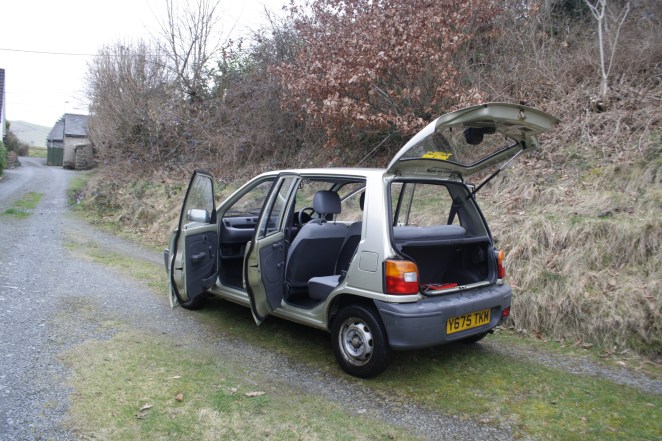
This really is a tiny motor car. Boot surprisingly big.

This really is a tiny motor car. Boot surprisingly big.

The Nippa joined the fleet in March, just in time for the 2CV to be retired in April – though I did manage to get her to her 200,000th mile before that happened, and she even managed to lead a convoy of 2CVs back in Easter time!

Elly leads a convoy before retirement.

Elly leads a convoy before retirement.

The other fleet prediction was that I would buy an Ami or Dyane. As the year wore on, that one proved more and more difficult to achieve. Income was low, perilously so and I was thankful for a short stint working at the local community bus company. I had to pause my trustee role temporarily, but was glad of a little work during a rather barren spell. The joy of freelance life.

So, buying a Dyane or Ami would have to be done with very little budget. I managed it though! Running that car with no money has been tough, and I took it off the road at the end of October to save a little road tax, and save it from corrosion. Given that it has barely stopped raining during December, that was a good call. I did at least manage to get to the Goodwood Revival in it!

Which just leaves the small matter of the Free Volvo, which heads to a new home tomorrow. Not a great addition to the fleet perhaps and it has certainly come a long way from replacing the XM. Which is still here! Amazing. The fleet ends 2015 as the XM, Perodua and Dyane – and the 2CV of course.

This project is brought to you by almost no budget at all.

This project is brought to you by almost no budget at all.

Other happenings have been fun too of course. I’ve driven a BMW-engined 2CV – on road and track – and finally managed to drive almost every 2CV spin-off too. A Slough-built 2CV, Amis 6, 8 and Super, an early Dyane and a Mehari. Shitefest gave yet more glory in the form of a Talbot Alpine, Volvo 850 diesel, Renault 16 automatic, a tuned BMW E30 Touring, Lancia Y10 and even a Honda Accord Aerodeck.

For work, I finally got to enjoy some time behind the wheel of a late-1960s Porsche 911 as well as a Jaguar E-Type V12 – though frankly, I think I preferred the Austin 3-Litre that a friend allowed me to drive to Pride of Longbridge and back in April. It was wonderful to have so long to drive a car I’ve admired for so long.

Porsche 911

Desperately seeking excellent driving roads in a 911.

Many of the cars above will be in magazine features you will be able to read in 2016 – I’ll let you know where nearer the time. The Austin 3-Litre report has already featured in Classic Car Buyer, as has my detailed report of what it was like to be part of the pit crew for a team in the 2CV 24-hour race. I thoroughly enjoyed that and it was my first night with no sleep in many, many years! Parents – how do you do it?

There have been a couple of chances to explore my love of electric vehicles too – courtesy of Volkswagen with the e-Golf and e-UP! I only took one of those vehicles greenlaning…

A City car, emphatically not in a city

A City car, emphatically not in a city

I’ve also been pushing my YouTube channel very hard in 2015. It’s lovely being completely free to pick the cars I want to drive, or just make a video on whatever happens to be to hand! I’ll never make any money at it, but it’s fun all the same, and it has been very pleasing to see my total stats go up from about 20,000 views to more than 115,000 as of today.

Work has been picking up again too, which is good. Having very little money does become rather tiresome and there are things other than cars that need my funds too!

For that reason, I’m still pondering about restoring the 2CV.. That’ll (probably) be the subject of my next Blog, which should be 2016 fleet predictions. Will the XM continue to own my heart? What will the future be of the smaller members of the fleet? Stay tuned…
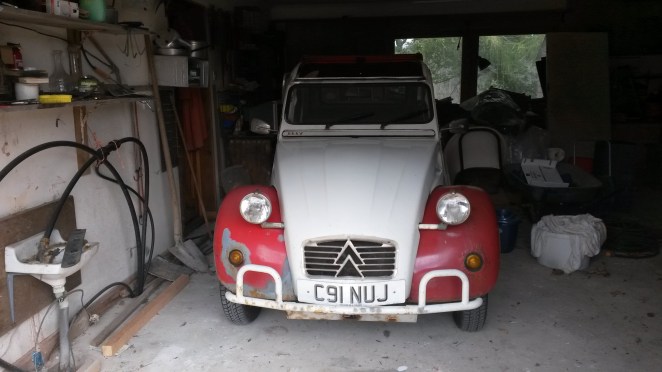
Citroen 2CV dolly

What does the future hold for this one?

Thanks for your support in 2015, especially those who glanced up at the top right-hand corner of the screen and clicked the Donate button. I appreciate those who took the trouble to leave comments either on my blog or YouTube too. It’s nice to know that the words I hurl at the screen offer some enjoyment, trivial and ridiculous as they often are. I wish you all the best for 2016.
XM brakes – conclusions

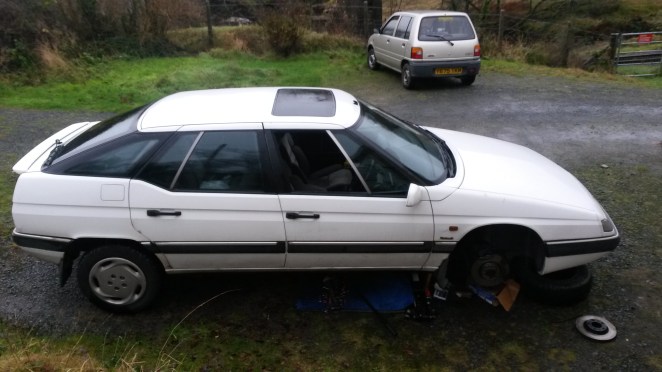
So, I haven’t quite got the XM’s brakes sorted, but I’m getting closer! The offside front caliper has a new slider and boots and new discs and pads have been fitted both sides.

XM fettling frustrated by weather.

XM fettling frustrated by weather.

It was an absolute sod of a job that just ate up hours like you would hardly believe. Especially as rain often interrupted play. Ok, so some (er maybe lots) of time was spent hunting for tools – I’ve come to expect this. But an awful lot of time was lost just faffing about with stuff. Winding the pistons back in to clear the new pads was one such task, though that became a lot easier when I discovered that a 3/4″ socket fits on the piston, so you can wind it back in with a ratchet and apply the necessary pressure for the piston to go back. Certainly a lot easier than trying to wind them back in with a screwdriver.

Fitting the new slider seals was a pain too, and I’m worried that I’ve actually managed to damage both seals as I was fitting them. Frustrating. However, the protection is still better than it was. It’s been an interesting learning experience.

Yet, there is a problem. The offside caliper’s parking brake mechanism is simply not functioning. A fairly simple set-up apparently, so when it stops raining (oh please stop raining!) I’ll have to get the wheel off and have another go.

But it’s all rather frustrating. This job was really a complete faff only because the XM uses single-pot calipers. I’m sure the brakes would be far better AND far more reliable if twin-pot calipers were used. Then there would be no need for sliders and there would simply be less to go wrong.

In a conventional car, twin-pot calipers can still cause issues, as the pistons can seize in the pots. Not so much of an issue on a Citroen. Why is that? Simply because LHM is the best brake fluid in the world.

Seriously, I have no idea why DOT fluids are used. Why could it possibly be better to use a fluid which not only absorbs moisture (which then rots out brake lines and caliper pistons) but which will seriously damage bodywork if spilt? LHM does neither of these things, which is why issues with pistons seizing in the caliper are so rare.

It is kind of indicative for me of the general decline of engineering in the 20th century. We invent something as excellent as the disc brake, then spend the next few decades cheapening the design to make it less efficient. Go humanity!

If all the brake faff wasn’t enough, I then decided to replace the bulb in the clock. This required me to remove half of the dashboard and was also a stupid, annoying, fiddly job. This really does highlight that manufacturers really don’t care if a car becomes difficult to work on. It’s not on the design brief. That for me is another failing. Why would you design something that needs maintenance to be horrible to work on?

XM dash

All this just to change the bulb in the sodding clock!

I suppose I should consider myself lucky. It is at least possible to change a headlamp bulb without having to dismantle the entire front end of the car. Sometimes, old cars really are best.

Anyway, here’s my latest video covering the above!

Volvo: Fund Raiser

The Volvo will be heading to a new home, as I revealed in my latest video. It was an amusing distraction, but I was forced to concede that I really do not need another car with another To Do list. I have enough!

VOLVOLOLROFFLERAFFLE

VOLVOLOLROFFLERAFFLE

But that left me with a problem. I couldn’t live with the thought of profiteering by selling a car I was given free, so I needed another solution. And verily, the Autoshite forum did provide salvation. A raffle! Now, if you’re feeling a bit miffed on missing out on the chance of a Volvo for a fiver, then I apologise. However, you can’t really hold a public raffle without jumping through an awful lot of hoops. So, it was better to hold it amongst friends on a car forum. I couldn’t shout about it outside that collective.

It worked too! 59 people bought a ticket, which allowed me to cover the unexpectedly high cost of collection (largely due to the £85 alternator I had to buy for it and also fuel). The rest of the money raised – £150 – I have split between two charities suggested by the previous owner’s family. So, for once, I’m not out of pocket and money has been raised for good causes. This is very pleasing.

The collection caper really was an enjoyable adventure too, even if that’s not quite what I was thinking as the electricity leaked away in Buckinghamshire on a dark and damp evening about a month ago! In fact, I may have questioned my sanity at that point. But it’s always good to try different cars as being blinkered to one make or type is rarely a good thing in the long term!

Yet, it’s the dynamic XM that is probably why I have not bonded better with the Volvo. Perhaps I would have been willing to try and improve it if it was just a bit nicer to drive. There’s much I like about the Volvo, but then there’s much I like about many cars. It doesn’t mean I want to consider a long term relationship with them. Perhaps I’m actually happy with what I already have. Can that really be true? Let’s see what 2016 has in store… Merry Christmas, Nadolig Llawen etc!

Best wishes to you all!

Best wishes to you all!

The problem with modern classics

The XM has recently reminded me just how difficult it can be to run a modern classic. The problem? Parts availability.

The XM was a car that sold over 300,000 units, so it was never exactly rare – albeit Citroen probably wanted to sell more. It was still in production just 15 years ago and was launched in 1989. Yet when I needed just one tiny brake component, I was left frustrated and unable to find what I needed.

XM brake overhaul

Discovering the problem, a month ago!

There are two problems here. One is that Citroen is generally HOPELESS at supplying parts for older cars. Unlike the German manufacturers – BMW and Mercedes-Benz seem able to supply pretty much any part you’ll need – Citroen instead starts to ramp up the cost of parts after, well, about 15 years. When demand understandably dies away, they then clear their stocks and suddenly you can’t get the parts at all. We’ve already seen this with the GS, CX and BX and now the XM is next in line.

It isn’t just Citroen to be fair, other manufacturers can be just as sniffy. They blindly refuse to support older models as they only want to deal with people who buy new. They ignore the brand loyalty that a lot of owners have – someone with a Citroen DS might well own a C5 for instance.

So yes, Citroen could supply me with a brake slider kit, but they wanted £50 for it. Ludicrous. But here’s problem number two. Something had gone wrong in the information sent to motor factors to show what size slider is fitted. When the XM moved to a larger design, it seems no-one thought to tell the wider world. So, I could buy a slider kit for a far more realistic £12, but it was the wrong size. That effectively gives Citroen a monopoly on supply. Nice! As it happens, Chevronics had one kit on the shelf, which I was able to buy for a bit less than Citroen’s price (once delivery and VAT were factored in). Still more than I’d like to have paid, but hey, I have the part now.

You can see how uneven the brake pad wear has been.

You can see how uneven the brake pad wear has been.

I can see this problem only getting worse and I’m sure it’ll be the reason that I stop using an XM as daily transport. There will come a day when some tiny but essential part needs replacing, and I won’t be able to get hold of it. The XM is in that struggle between modern car and fully-supported classic – where suppliers can invest in getting parts remade to plug the gaps. I’ve seen the 2CV go through such a transition, and I’m thrilled to see the BX heading that way too. Question is, will the XM get there before I need the bits? Time will tell.

So, I now have all the components necessary to overhaul the XM’s brakes – I now just need for it to stop raining so I can fit them! It could be a long wait, but hopefully not as long as the search for a brake slider kit…

Let’s just have a quick thing about why this has become such a problem though. Why is it still easier to find geniuine OE spares for classics that are decades old? One reason is commonality. Back in the 1950s and 1960s, parts were often shared between manufacturers. They often used the same headlamps and even brake components. Now, parts are often unique to a model.

There’s greater complexity too. The XM (and many other modern classics) are just in a different league to 1960s classics. A quick glance at the engine bay will tell you that.

I do find this worrying, but perhaps I needn’t stress. After all, if modern classics to begin to fail me, I can always jump in a nice, simple, air-cooled Citroen!

XM: Sphere changing success!

I’ve got a seriously busy workload at the moment. It’s great! I look forward to telling you more about why that is in the new year. However, it is causing me to struggle for tinkering time. I somehow found enough moments in the previous week to rip the Dyane’s engine apart, but the only reason I was working on the Dyane is that it’s in my garage. It seems to have been raining here for weeks, so working on the ‘big’ cars of the fleet is just a complete no-no. That’s a shame, as there’s plenty I could be getting on with. Like the XM’s sphere change.

As you’ll recall from a previous post, I’d run into issues trying to replace the rear centre spheres (months ago!) but a specialist had managed to crack it free for me. When I woke up this morning, it was actually not raining so after enjoying a few minutes of wondrous surprise, I got up and went straight out to work on the XM.

XM on ramps

Essential early morning workout.

The centre rear sphere lives up above the exhaust, under the rear floor. So, it was out with the ramps, suspension on full and nervously reverse the XM up the ramps (they’re about as wide as the tyres are). Then I could crack the sphere off, which would have been better if I’d cracked it the right way first time around. Hey ho. Once I forced my non-breakfasted, very sleepy brain to work out which direction the sphere should turn, it quite easily turned a few milimetres. Now I had to drop the suspension and release the system pressure by undoing the screw on the pressure regulator. This is buried right down the front of the gearbox and is best accessed from below – not an option when the nose of the car is now millimetres from the ground. I had to go in from the top. Which makes a frustratingly fiddly operation as you can’t actually see it.

Not as frustrating as trying to undo a sphere underneath an XM which is on its bumpstops, even if it is on ramps. You see, the human arm just doesn’t bend in quite enough places for you to get your hands where they need to be. Cue lots of wriggling, a lost hat and a fair amount of swearing. The neighbours probably prefer it when I have a lie in…

Eventually, I got my sphere removal tool in place once more and off it came. Almost straight into my face in fact. Naturally, LHM (liquid mineral oil) began dripping everywhere and I’m pretty sure quite a lot of it was mopped up by my hair. I chose not to shower BEFORE this activity with good reason.

Then it was a simple case of lubing the new seal, then trying to fit it in the dark, then trying to fit the new sphere without dislodging said seal. Still in the dark. While not having my hand in quite the right place. And every time i dropped it, it plunged towards my face (saved by the exhaust!).

However, I was soon able to tighten it up hand-tight (all you need) and then it was another frustrating root around the lower reaches of the engine bay to do the regulator screw back up. Then I was able to start the engine, select high and watch the car lift itself gracefully into the air – something it seems much happier to do after this sort of a job than any BX I’ve ever owned.

dead sphere

Alas poor sphere…

I had a peek under the rear, just to make sure there were no signs of escaping LHM, topped up the reservoir (every time you remove a sphere, you lose a little LHM) and dropped the car to normal height. I then gave the rear corners a good bounce. Wow! Floaty!

Back up on high, off the ramps and I was able to go for a test drive. Now, I’ll concede that it still isn’t brilliant – no strut-equipped Citroen ever is – but the ride certainly seems more refined. Still not great over really rough terrain, but out on the open road, it wafts as it should! Going over crests, you feel the car just float back down to its regular running height in a way no coil-sprung car can match. I’m quite seriously pleased. Now I’m STILL trying to find a caliper slider kit (for less than the £50 Citroen wants for what is a pretty small bit of metal) so I can finally overhaul the brakes. Another frustrating business!

XM: Sphere unchanging

I found myself visiting family in Devon this week – another 400 miles for the XM – and on the way home, decided it was about time I visited Tony Weston’s Citroen garage in Gloucestershire. Perhaps he could free the stuck rear centre sphere. It’s a place I’ve always wanted to visit anyway – and rightly so! Check out the works van.

Cripes! A Citroen GSA Service van! Exceedingly rare.

Cripes! A Citroen GSA Service van! Exceedingly rare.

The XM was lifted on the ramp and special tools were deployed. This seems to consist of a centre punch to try and break any corrosion on the threads (I presume) and a massive pair of pliers – the sort that look like you’d use them for removing teeth from a T-Rex. And? Success! They got a firm grip and sure enough, with a bit of effort from Andrew Weston, the sphere moved. Then he could depressurise the system to enable full removal. Good job I’d brought the replacement sphere with me. Oh. I hadn’t. I’d actually brought the old outer rear spheres that I’d replaced already! Idiot.

XM gets its spheres fettled. Almost.

XM gets its spheres fettled. Almost.

However, I now know that I’ll be able to remove that iffy sphere – we did confirm it was very dead. I’m just waiting for dry weather before I crawl under the XM again. I’m looking forward to seeing what difference it makes to the ride.

I’m a bit frustrated at my own stupidity, but hey, I should be used to it by now. Here’s a video of my day.

The Citroen e-Mehari – my thoughts

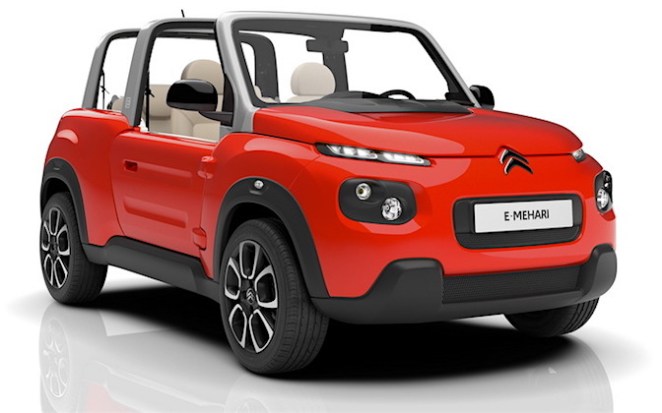
There’s exciting news today as Citroen might actually be building a car I like the look of – the e-Mehari. Dredging up the name of a fantastic 2CV-based model in its history is perhaps unforgivable but I must concede that this new model does hold some appeal – and does have quite a few Mehari styling cues.

Most interesting is that this will be an EV or electric vehicle. It was actually conceived by Bollore, which already builds a small EV car. PSA (the company that owns the Peugeot and Citroen brands) has merely squashed a C4-Cactus-esque snout upon it to create a new look.

Crivens! I actually like it!

Crivens! I actually like it!

It does look remarkably niche for a mainstream manufacturer and I must concede that I do wonder what PSA are up to. It has already dabbled with electric vehicles with the Berling Electricque, which didn’t really take off. It then went into a deal with Mitsubishi to sell the i-MIEV as the Peugeot iON and Citroen C-Zero.  A far better vehicle, but hideous pricing (£30,000 when launched, but now a far more realistic £11,995) and Japanese Kei-car looks seem to have kept buyers away. So you’d think that the last thing PSA would want to do is entertain another niche. Yet, with the e-Mehari, which appears to lack proper doors and a roof, that’s entirely what they’ve done. I do find this confusing. Nissan and Tesla have proved that if you want EV sales success, what people want is an actual, proper car with plenty of space. I’m not sure something that invites the use of the word ‘quirky’ is really going to do it for them.

Mind you, they’re already talking down production totals – 15 vehicles per day or 3500 per year seems vaguely possible. It’s clear it’ll never be a volume seller and PSA rightly admits as much. I can’t see a lot of profit in it though, especially at an asking price of 24,000 Euros, or £17,300 at current rates. Details seem a little sketchy, but it seems that you’ll probably have to pay another 80 Euros a month to rent the batteries, in a similar manner to Renault. This is disappointing and I’m sure it’ll harm resale values. What seems a reasonable extra cost for a brand new car becomes a millstone as that car ages.

A shame as with a 24kwh capacity, the range should be pretty good – over 100 miles should be possible on a charge. That’s similar to a Kia Soul EV or Nissan LEAF. It’ll be interesting to see if this is yet another EV failure for PSA, or whether this is the simple, frill-free EV that the market has been waiting for.

Fleet update: December 2015

I thought I’d better recap on the state of the fleet at the moment, which has somehow become five vehicles.

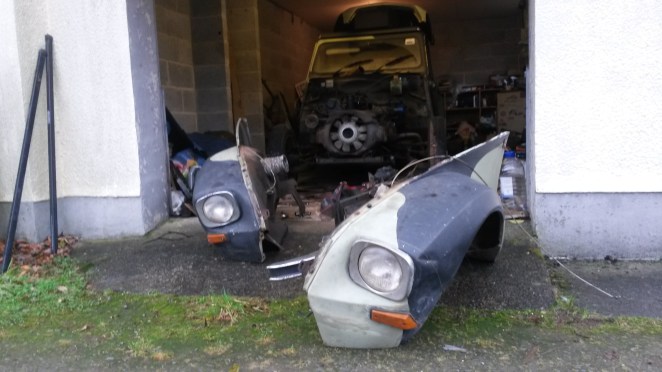
I’ll start with the 2CV, which is still snuggled up in a nearby garage awaiting resurrection. No progress here but on the plus side, I haven’t nicked any bits for the Dyane since September!

Citroen 2CV dolly

While my 2CV gently sleeps…

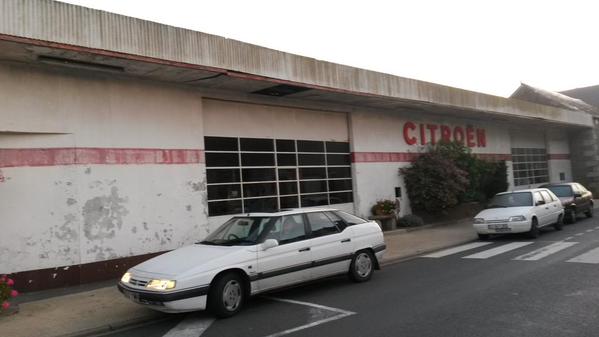
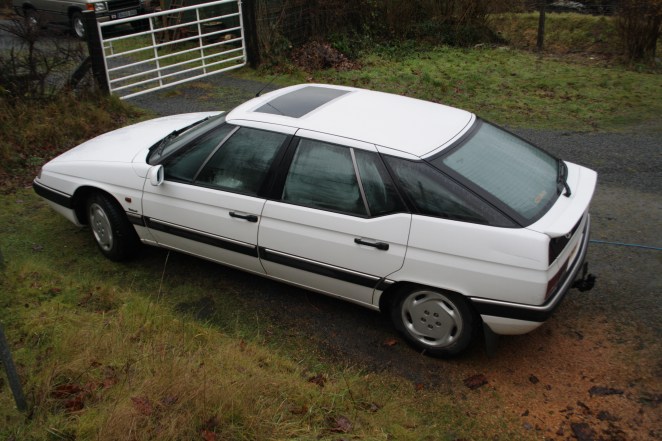
Next is the XM, which is still remarkably delivering satisfaction after more than a year in my company. In fact, my recently acquired Volvo as just reminded me how much I really like the XM. Still trying to find some small parts necessary for me to carry out a front brake overhaul and the clutch is still too heavy. I’ll sort it one day. Honest.

Citroen XM in France.

I got me an XM, it’s the size of a whale and it’s about to set sail…

Then we come to the Nippa which, after a roadtrip to Leicestershire and Northants with my lovely lady, has finally managed to clock up more than 2000 miles since purchase in March. That’s taken it to a heady 26,000 miles now. The windscreen seal keeps leaking, and keeps being cured by Captain Tolley’s Creeping Crack Cure. Otherwise, it just keeps soldiering on.

Perodua Nippa at speed. Sort of.

The Perodua I want (Nippa I really want), hoo, hoo, hooo.

Now we come to the Dyane, acquired in August. I managed to clock up over 1000 miles in it during September, which revealed quite a few flaws. It’s now sitting in my garage with the engine in pieces while I attempt to remedy some of those flaws – especially the stinky heater and oil leaks.

There's fumes leaking outta my heads, ach that stinking is all I think about.

There’s fumes leaking outta my heads, ach that stinking is all I think about.

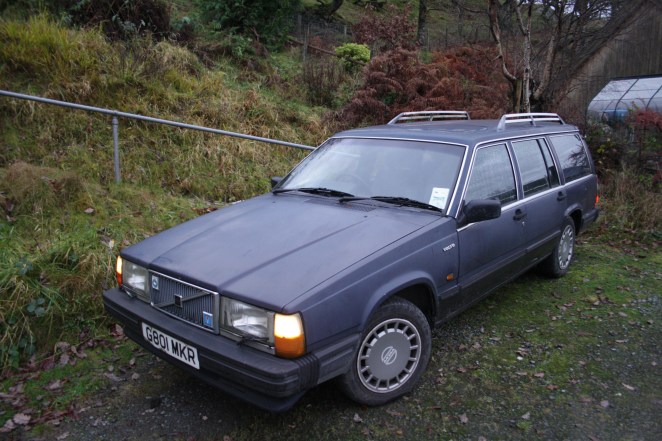
So, that’s four already and the Volvo 740 estate makes five. Being free, it was hard to say no, even if it was miles away. It’s now sitting on my driveway while I consider what to do next with it. It’s quite bad in quite a lot of ways but I’m reluctant to spend too much money on it – largely because I don’t have any. It’s also seriously cosmetically challenged – though I mind that not at all.

Not bad for Free!

The best things, in life are free. Now that I’ve discovered that it’s quite grotty.

And there we have it. Hopefully I’ll have the Dyane up and running again before Christmas, but as it’s staying off the road until the salt goes away, there’s not much point rushing. So perhaps I’ll try and improve the Volvo in the meantime and hopefully I’ll get the XM’s brakes sorted at last! As for 2016, well I’m hoping I can see my poor 2CV back on the road. I miss her!

Gullwings for the high street

Gullwing doors are a stupid idea really. Sorry Tesla, Mercedes-Benz and DeLorean but they are. Let’s not forget that the Mercedes-Benz 300SL was banned from race tracks for the simple reason that if the car rolled over, the driver could not get out. The Tesla Model X and DeLorean both remind us that making such doors a production reality is a bloody nightmare. They’re nothing more than a very silly gimmick.

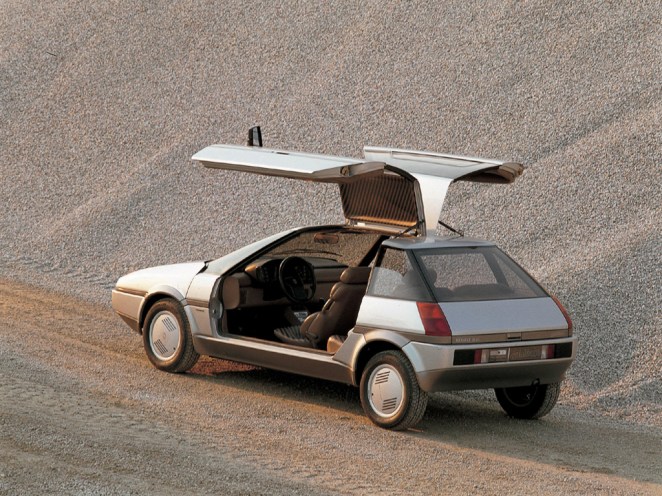
A truly scrumptious design - Giugiaro Gabbiano.

A truly scrumptious design – Giugiaro Gabbiano.

Yet, when Giorgetto Giugiaro applied them to his Gabbiano Renault 11 proposal, I must admit that I was swept away both with the beauty of the design – uncluttered and clean – and the practical case for gullwings. Very easy access to all seats being the main one and a major point Elon Musk makes about the Model X.

As a child, I studied pictures of the Gabbiano for hours. It really is Giugiaro at his very best. Yet, barely anyone knows it exists. That made me all the happier when, earlier this year, I included the Gabbiano in a feature on one-offs and cars that sadly never made production that was published in Classic Car Buyer.

Gabbiano is Italian for seagull, so there’s a clear reference to the doors. In terms of styling, there’s a very-1980s wedge profile with pop-up headlamps and another styling trait that became the rage about this time – a ‘floating’ roof where the pillars are blended into the glasswork. See also the Rover R8 200 and XX 800 and Citroen XM. Once more, Ital Design was at the cutting edge of car fashion. Yet, there’s always something very real and believable about Giugiaro’s designs. Note the really entirely normal rear lights that so neatly form part of the rear styling, while also having a bit of a nod to the original Renault 5. No fancy-pants LEDs here, or gimmicky slashes, just really practical, neat design.

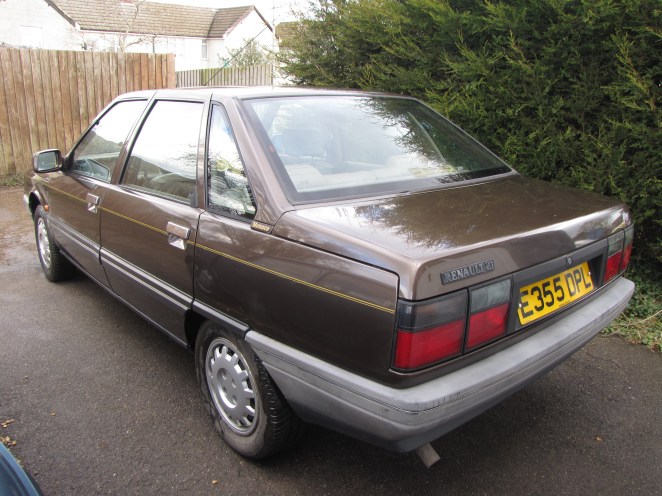
Giugiaro's talents toned down for the production 21.

Giugiaro’s talents toned down for the production 21.

My disappointment was increased at least ten-fold when Renault replaced the 11 with the dull, dull 19. Especially as Ital Design had a hand in it! Not one of its best efforts, though it did redeem itself with the 21 – not an especially exciting design but one which again, has a delightful neatness about it. I guess it goes to show that concept cars are far too often judged too radical for the real world. A shame.

XM: A story

Slotting the key into the door lock, Ian reminded himself that he really needed to replace the battery in his Citroen XM’s key. He pushed the key deep into the recess, because otherwise the XM’s clever door lock just spins. A neat anti-theft method.

Steamed up windows car

Once upon a time…

Clambering aboard, he slotted the key into the ignition barrel, turned to the ignition position and paused to contemplate the soggy state of west Wales on this wet Wednesday morning. And to allow the glow plugs to warm up. With that done, a twist of the key saw the XM’s XUD11T engine fire noisily into life, its three-valves per cylinder bouncing away under the bonnet like toddlers high on chocolate.

Moments later, the car lifted itself from its bump stops as hydraulic fluid was forced into the suspension spheres by the engine-driven pump. It then settled at the correct level for normal driving, one of four height settings controlled by a lever near the gearlever. Ian pulled the handbrake lever, mounted to the right of the steering column, and the foot-operated parking brake pedal sprang back up with a bang.

The car ambled along the driveway, with the heater settings configured to try and get rid of the effects of far, far too much damp. Yes, this was a case of steamy windows and Tina Turner had not been invited.

A pause at the end of the driveway allowed first use of the powerful, hydraulic brakes. These were legendary for their effectiveness when this car was new, yet feel quite feeble and slow compared to the horribly over-assisted systems fitted to most modern cars. As well as thinking about this, Ian also checked that there was no traffic approaching before pulling away.

The wipers were notched up to full speed. There are some types of rain that intermittent just can’t handle. Taking care to avoid Gareth who was walking his dogs, Ian negotiated a tight right hander that made him glad the XM had nicely-weighted power assisted steering.

After a gentle, 30mph climb, the National Speed Limit beckoned. However, the engine was still not at full operating temperature, so Ian elected not to get that turbo whistling too much just yet. Nonetheless, the white barge gathered pace in a far from disgraceful manner.

Tight turns required adjustment of pace, though careful planning ensured the brakes did not need much of a workout. This is west Wales, not Hollywood and progress was swift without resembling a reckless big screen car chase. Any cardboard boxes would have just disintegrated anyway. A lorry approaches. Can they squeeze past? Of course they can. There is no drama here.

A tight hairpin requires use of brakes and downshifting, highlighting the biggest weakness of many Peugeot/Citroen cars. A clunky, vague gearchange that isn’t really befitting such a pleasant car. The road then drops down dramatically towards the village of Pontrhydygroes. Sometimes, it has hyphens in it.

After crossing a folksy stone bridge, there’s a climb back up the otherside before Ian locates the vehicle he will soon be swapping to. Yes, it’s a Peugeot Boxer minibus with sexy graphics and even, luxury of luxuries, alloy wheels. How envious are you?

But that’s a tale for another day…

In other news, it’s been a really, really boring week with dreadful weather and I’ve barely done anything car-related at all.