Dyane: The Goodwood Revival Mission

I had hoped to take the Dyane to the 2CV 24hr. It was broken. I had hoped to take the Dyane to Cholmondeley Castle. It was broken. Two days before the Goodwood Revival 2015, it was broken. But I would not be defeated a third time. Frantic fettling occurred including replacing all of the rubber fuel line, opening the carburettor and cleaning the jets out (more than once) and replacing the points and condenser. Then replacing the new condenser again after it almost immediately failed.

In the week leading up to Goodwood, the Dyane was struggling to complete just one short journey without breaking. On the Tuesday before, I had even had to push it home. So, I was a bit anxious when I got up on Saturday morning. The plan? Drive to Sussex, enjoy a kip at my sister-in-law and family’s home, spend Sunday at the Revival, then drive home Monday. So, stage one was get to Sussex – about 270 miles away. The journey started well as a tractor run was visiting our village. Some classics had joined the fun.
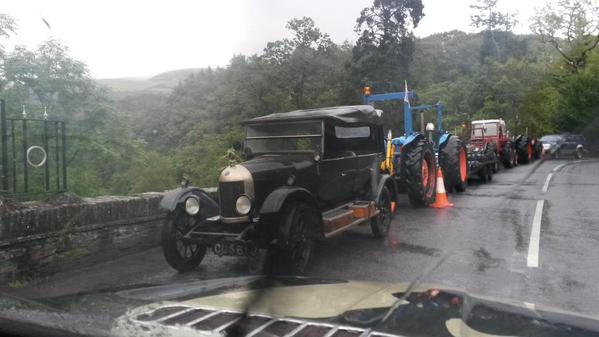
Lovely old Morris Cowley sitting in the rain.

Lovely old Morris Cowley sitting in the rain.

Not a bad start. I drove over the entertaining Elan Valley Mountain Road and tried to ignore the sound of the fanbelt trying to escape. I need to replace it but didn’t have a better one. I had a spare BX belt as emergency back-up.

After a couple of hours, I had almost reached something approaching a dual carriageway. I stopped in the pretty town of Crickhowell to visit independent traders and stock up on supplies.
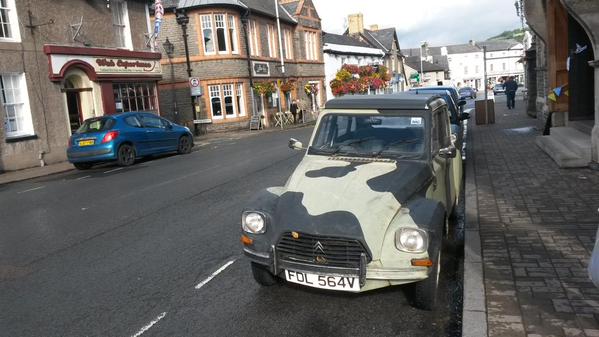
Dyane pauses in the sunshine in Crickhowell.

Dyane pauses in the sunshine in Crickhowell.

I did consider rolling the roof back, but opted not to. As I encountered fierce showers on the M4, this was the correct choice. After a great many hours, the M25 was encountered. Incredibly, the car was still running beautifully. At a previous service check, I had discovered that it had lost pretty much none of its engine oil. A far cry from the first drive back to Wales, when it seemed to lose quite a bit. Perhaps that newer breather has done the trick. Naturally, things slowed down on the M25 and as I wasn’t moving at the time, I snapped this pic.

Stationary on the M25. Quelle surprise.

Stationary on the M25. Quelle surprise.

The traffic may have been a blessing. The steering wheel obscures the fuel gauge, plus the XM has got me in the habit of rarely checking the level, because it can drive 800 miles on one tank. When I did finally look at the Dyane’s gauge, it was rather low! I managed to get to Cobham services, which was horrendously busy, but parked up away from the building to munch on pre-bought supplies, and then got 23 litres of fuel into the 25 litre tank. Close.

I made it to Sussex tired, but very, very pleased with the little Dyane. It had run majestically all the way and despite me thrashing it pretty heavily – cruising at 65-70mph where traffic levels permitted – it had returned 45mpg. The next day, I set off early and avoided the worst of the queues. Me and the Dyane had made it to the Revival!

Dyane and hippy me at the Revival.

Dyane and hippy me at the Revival.

At this point, I need to thank several people. My friend Pete Sparrow sorted me out with a complimentary ticket, as he was driving one of the safety cars. Unfortunately, I managed to leave this ticket at home, which I realised as I was driving towards the event. Oops. I secondly need to thank Andrew Page, who sell autoparts. A frantic call to a friend and they were kind enough to sort me out with a pass for the day. You can’t believe how grateful I was! The bacon was saved.

I’ll talk about the event itself some other time, but it was suitably amazing. It was my first visit in six years, but was every bit as good as I remember. Expensive too. £6.80 for a bacon roll! I was thankful that my sister-in-law had provided me with food.

My good lady wife deserves a special mention, as my colourful outfit – her handiwork – went down very well indeed. As I wandered barefoot around the aircraft displays, I realised this was the most comfortable my feet had ever been at this event. Previously, I’d always dressed smartly – and uncomfortably! The hippy look is recommended. (I had -non-sixties sandals for the gravelly bits!).

Another sleep and it was time to drive home after a really fantastic weekend. I was calling in to see the chap who sold me the Dyane on my way back, to collect a few spares. That meant driving along the south coast and that was as horrible as it always is. I’ve got to go back to Portsmouth in a week’s time to catch a ferry. Joy.

An accident on the M27 didn’t help matters, and my ‘quick’ diversion through Southampton saved me no time at all. I rejoined the motorway with the traffic I’d left behind at the previous junction. Worse, the Dyane had begun spluttering and refusing to idle again. However, that didn’t really matter on the motorway and after a couple of hours of foot-to-the-floor, it got rid of whatever was ailing it and ran beautifully again.

After finally making it to Warminster, I collected bits, drank a much-needed cup of tea and headed northwards. Actually, I thought it was probably time to look at the fuel gauge again. JEEPERS! It was some way below zero. I limped to a petrol station and fitted 25.5 litres into the 25 litre tank… I’m an idiot.

I’m utterly sick of the M4 Toll and refuse to pay it, so that meant Gloucester and the pretty roads of Monmouthshire – where this Dyane used to live. It continued to run very well. In fact, I was not doing half so well as the car. I’d replaced some seat rubbers before the trip, but none in the seat back itself. This was a mistake and backache was very much setting in! Despite the emergency measure of sticking a jumper behind my back.

I was very tired as we crossed the border and thought a short break was wise.

A quick pause in Wales

A quick pause in Wales.

It was still raining. I’d been battling through showers and mild flooding since the very start of the journey. The wipers were struggling to cope. In fact, at 70mph, they were struggling to stay on the windscreen! Side gales near Bristol left me worried that the wipers were simply going to blow away. I need to make improvements here.

But, some nine hours after leaving Sussex, I’d made it home. In three days, me and the Dyane had covered 652 miles together, which is pretty impressive! It takes our total tally to very nearly 1000 miles since purchase. Given how much of that time the Dyane has spent in the garage being broken, that’s really not so bad at all. Well done Dyane. It was the perfect bonding experience. I think I like this car.

Yes, my garage really is that messy. Have a nice rest Dyane. You deserve it.
Yes, my garage really is that messy. Have a nice rest Dyane. You deserve it.

20 years of driving – well done me

Last month, it became 20 years since I passed my driving test – at the wheel of a Vauxhall Corsa resplendent in British School of Motoring livery. This fact startles me a little. How is it two decades ago already?!

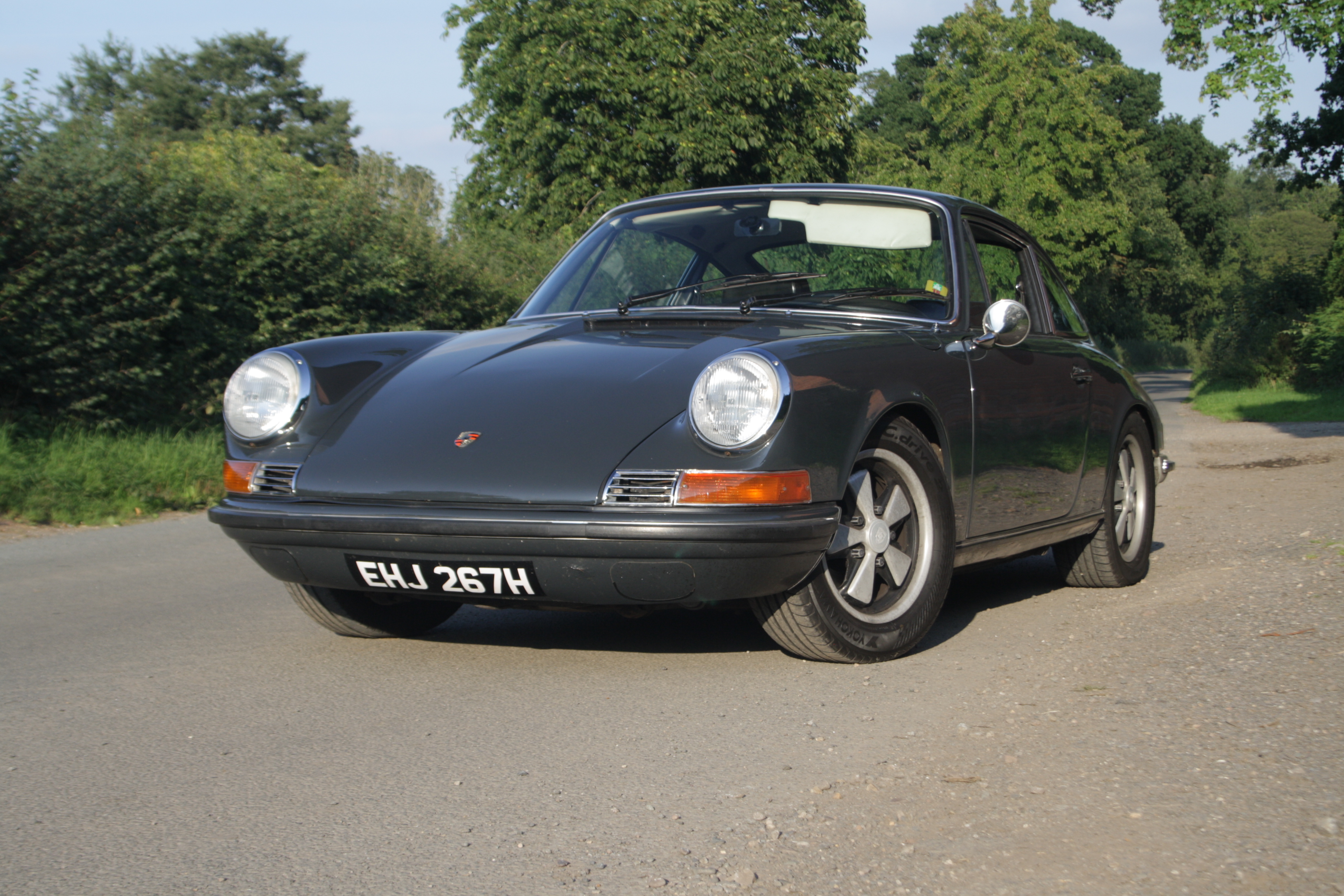
As luck would have it, I found myself yesterday driving on the roads I sometimes used when learning to drive, and very often used once I had cars of my own. Roads in what was Hereford and Worcester back then, but is a mixture of Warwickshire and plain old Worcestershire now. I remember how much fun these roads were. How fabulous then that I was getting to enjoy them from behind the wheel of a Porsche 911T – you’ll have to wait quite a while to read my full report on that I’m afraid. You can drive the car yourself at Great Escape Classic Car Hire.

Porsche 911

Desperately seeking excellent driving roads in a 911.

Alas, there was disappointment, for it seems that many of these roads have now had 50-mph speed limits imposed upon them. Even when driving a Porsche, I’m very reluctant to exceed a speed limit. This was frustrating. I should have remembered really, as these are much the same roads I used when I tested a Tesla Model S last year!

To get my 60mph kicks, I was often forced to take smaller, twistier roads where even in a 911, I didn’t really dare do 60mph. Visibility was insufficient for a start, but this is the countryside, which means horses, walkers and tractors. It’s too dangerous to drive at full chat.

A far cry from my journey home then, which saw me tackle three absolutely outstanding and very challenging roads. The first is the A4117 that goes from the A456 at Callow Hill, through to the A49 at Ludlow. As well as the staggering views from Clee Hill, the road chucks occasional very sharp bends at you, and rarely manages to be straight for any length of time. In the peaceful, dusky conditions, I was able to drive the XM very briskly (within the speed limits). It was an absolute hoot.

After a short spell on the A49, it was time for Challenge Two – the A4113 that takes you through the pretty village of Leintwardine. Before that, it is another twisty challenge, with many bends that can catch out the unwary. Concentration really does have to be set to maximum. Some bends are tight enough to require second gear.

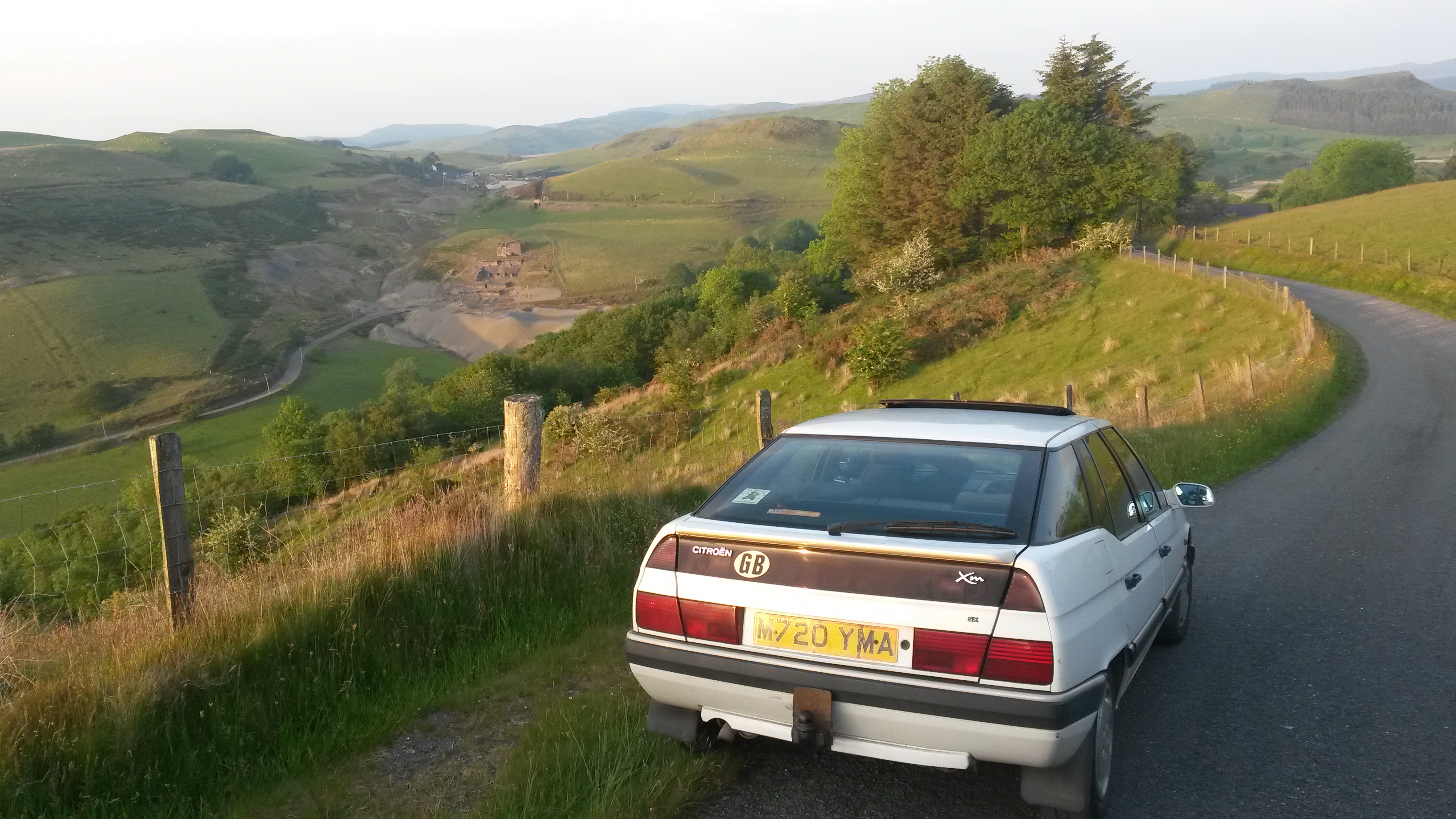
XM rear

The XM is an absolute delight on Welsh driving roads.

From Knighton, I then headed along the A488 to Pen-y-Bont. This road is another vigorous test of driver and car, and I’ve been witness to the aftermath of no fewer than three accidents along its length – albeit one of those was in snow. One of those cars was on its roof though! Again, plenty of challenges all at entirely legal speeds and with suitable consideration for stopping distances – you cannot drive a public road like a race track, because you don’t know what’s lurking around each corner.

Not that the rest of the journey home wasn’t interesting. I took the Elan Valley Mountain Road for the final leg home, and encountered many foxes in the dark. I was pleased that the sheep were not attempting to sleep on the road. This cannot be guaranteed.

It all left me feeling very glad that I was driving my XM. It has fabulously secure handling, and the low-revving engine lugs you from corner to corner without screaming at you. While it certainly seems that you have to travel a fair way to find good driving roads, I’m glad that twenty years after passing my test, it is still very possible to have a good time on British roads.

Dyane: A greenlane, more issues

I spent yesterday trying to get to the bottom of the Dyane’s occasional poor running. Sometimes it’ll idle very nicely. Sometimes it’ll idle not at all. I’m having to employ a lot of heel and toe – using all three pedals at once. This is bothersome.

What I actually ended up doing was splitting the carburettor, then somehow dislodging the floats so that when I tried starting the engine, it filled one cylinder with petrol.

Floats in the wrong place. ie my hand.

You can probably see the issue here. With the carburettor rebuilt, I then had to remove the spark plugs as so much petrol had flooded in that the engine would not turn. The pretty, potentially-explosive fountain thankfully was not ignited. I’d cleaned out all of the jets while the carb was in bits, but this seems to have made no difference. More work to do.

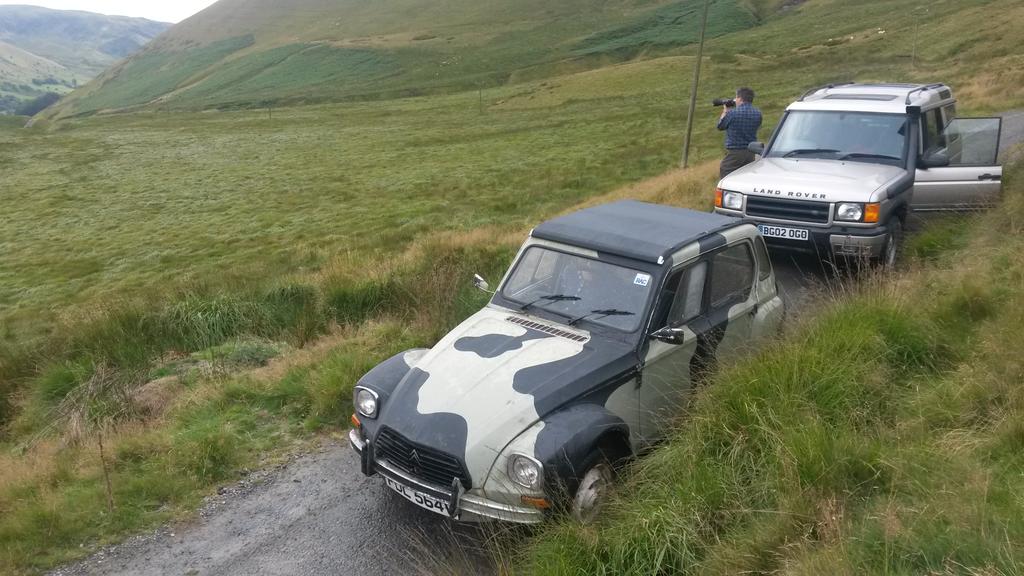
Or, I could go greenlaning instead. Guess which option I went for!

Dyane off-road Greenlaning Dyane in the hills of mid-Wales
Yes, greenlaning. That is, seeing “Unsuitable for Motor Vehicles” and going for it anyway. The Land Rover is our neighbours, who were joining us as we went Vulcan spotting. Sadly, we failed as the Vulcan was actually running late. This particularly scenic part of mid-Wales lacks any phone signal, so we had no idea. This was the first time I’d tried this Byway – checked on an OS Map and then with local greenlaner types. You’d struggle in a modern, but the Dyane lapped it up. Must do the whole lane at some point.

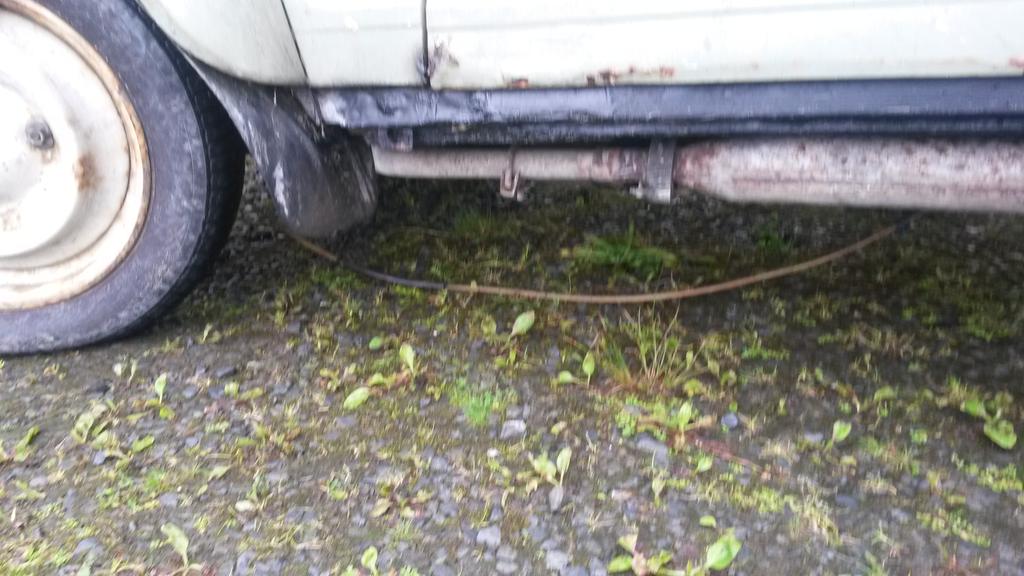
Having failed at plane spotting, we turned around and headed home. When I got there, I found this:

Yikes

Ah. The fuel line really shouldn’t be on the ground.

Not good. The fuel line must have got snagged on some long grass and had been pulled away from the chassis. Thankfully, there’s a short metal section near the front, which was so firmly bonded to the rubber either side that the pipe had not come away entirely. Just enough to cause a minor leak. I like this car. It seems to refuse to die.

I’ll replace the front pipework and will include an in-line filter. I’ll also find a better way to secure the fuel line further back. I’m prone to explore greenlanes. I need a better solution! It may be that this isn’t helping with the poor running. We’ll see.

One thing I must say though. I may have to fast-forward my art project plans for this car. Some have told me I should keep it as it is, and I do see the appeal in that – it appeals to my lazy side. However, the biggest problem with this car is that EVERYONE jokes that they can’t see it when I post photos. It was slightly amusing the first time but every time? Really?!

I’m going to have to get creative all the sooner I think.

Anglesey: Track testing the BMW 2CV

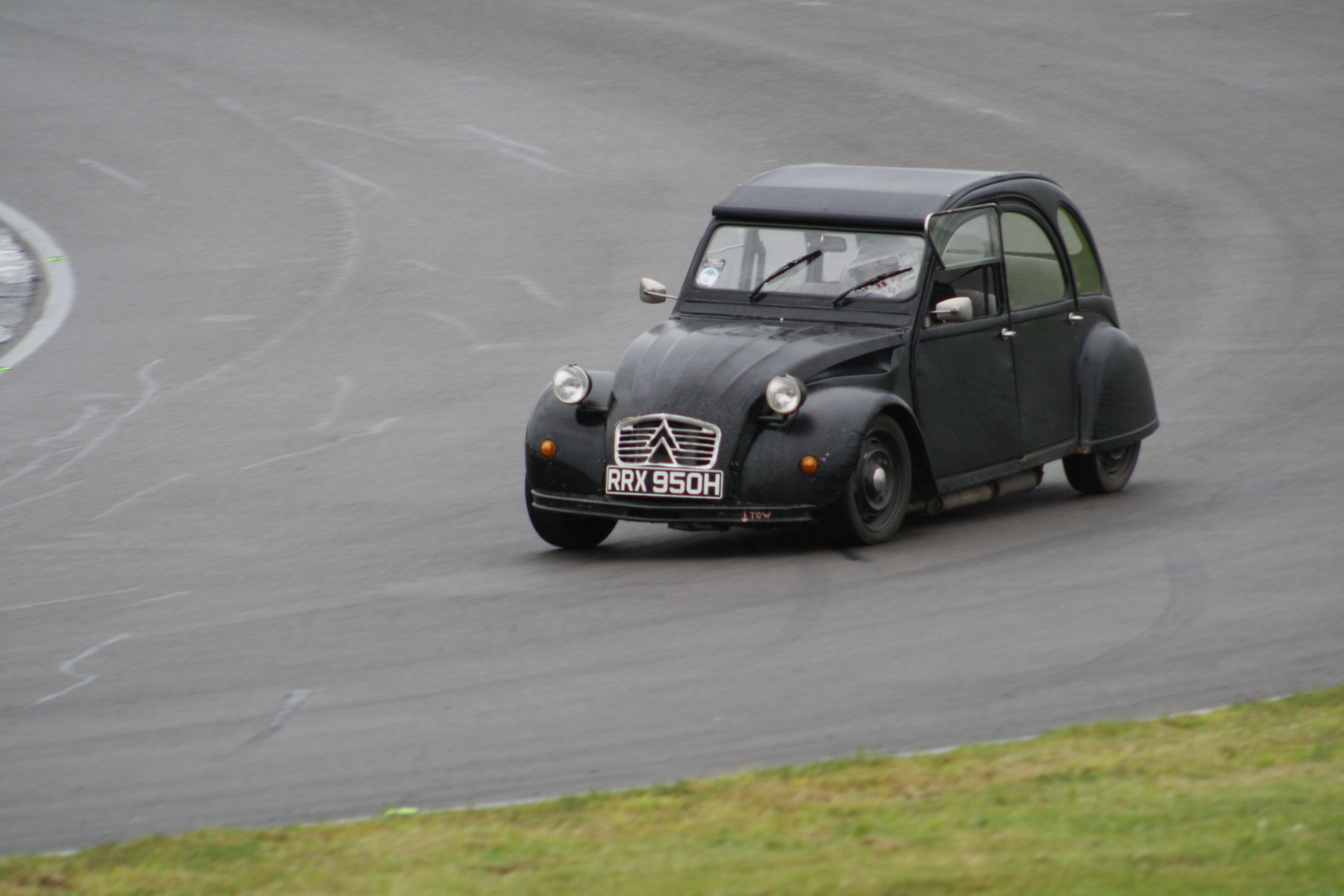
In the run up to the Classic 2CV Racing Club’s annual 24-hour race, Pete Sparrow had promised me another go in his black, BMW-powered 2CV. It’s the one built for the filming of RED2 but since used as a road-legal fun machine. I first drove it in May. Public roads just weren’t the place to explore its considerable potential.

Trying not to crash the 100bhp 2CV (thanks to Ed McDonough for the photo)

Trying not to crash the 100bhp 2CV (thanks to Ed McDonough for the photo)

As it happens, Anglesey in August wasn’t the ideal place either. It was absolutely pouring with rain, making it a tricky place to try and drive a 2CV with three times the normal power output. Worse, an organisational mix-up meant three of us would be trying to drive the car in just thirty minutes. That meant just one flying lap. It also meant there just wasn’t time to set up my video camera. I managed to install my phone, but that just recorded my face in extreme close up, with me swearing occasionally as I attempted to get the power down.

But what a rush! I barely managed to utter a word to camera as I drove around the sodden track, enjoying the huge rush of power as the 2CV sprinted towards the next bend. I kept a modern hatchback at bay as I chased down slower cars, passing a Toyota Yaris and my friend in her Citroen Dyane. It’s an astonishing testament to the 2CV that it can cope with such a daft amount of power. When the 2CV was launched, it had NINE bhp. Nine! Yet here was much of that basic engineering coping with 100. The steering is just fabulous, so you know exactly where you’re going to be heading. The pedals are perfect for a spot of heel-and-toe – though I found it hard to adjust to the quick-revving nature of the BMW engine versus a normal 2CV, which has a very heavy flywheel.

Pete Sparrow giving it some welly in his BMW 2CV.

Pete Sparrow giving it some welly in his BMW 2CV.

The racers don’t much care for bodyroll, but I absolutely love it. This car is a bit stiffer than standard, but still isn’t afraid to show of its underside when you’re really pushing on – not that I went too crazy, as I knew Pete was meant to be heading off on holiday in this car after the race.

The buzz I felt as I clambered out of the car was amazing. If nothing else, this was a very useful insight into the world of the racing driver. It explains the wide-eyed mania you see when they clamber out of the car after a stint. I’d also gone some way to understanding the challenges of getting around the superb Anglesey Circuit. Getting your line right through the corkscrew, as you descend through a tight left then right hander, is very tricky. How rewarding though, when you gradually feed in the power and feel the car push wider out to the kerb before giving it all you’ve got until the next bend. The ridiculous thing is though, I was here driving the most powerful 2CV that went around the track that weekend. Even the super-modified Belgian overall winner ‘only’ had 70bhp! I would love to try a racer to see how it compares. Less power, but more cornering potential. Unfortunately, with the race just an hour away, no-one seemed to want to lend me their car. Maybe next time!

I’ll conclude by saying if you get a chance to take part in a track session, whether your car has power or not, do so. The 2CV/Dyane road car drivers seemed to be having just as much fun as everyone else. You don’t need power to have fun, but by jingo it’s entertaining!

Thanks to Pete Sparrow of Sparrow Automotive for yet another chance to try this incredible car. 

Road Test: Peugeot 205 (very) turbo diesel

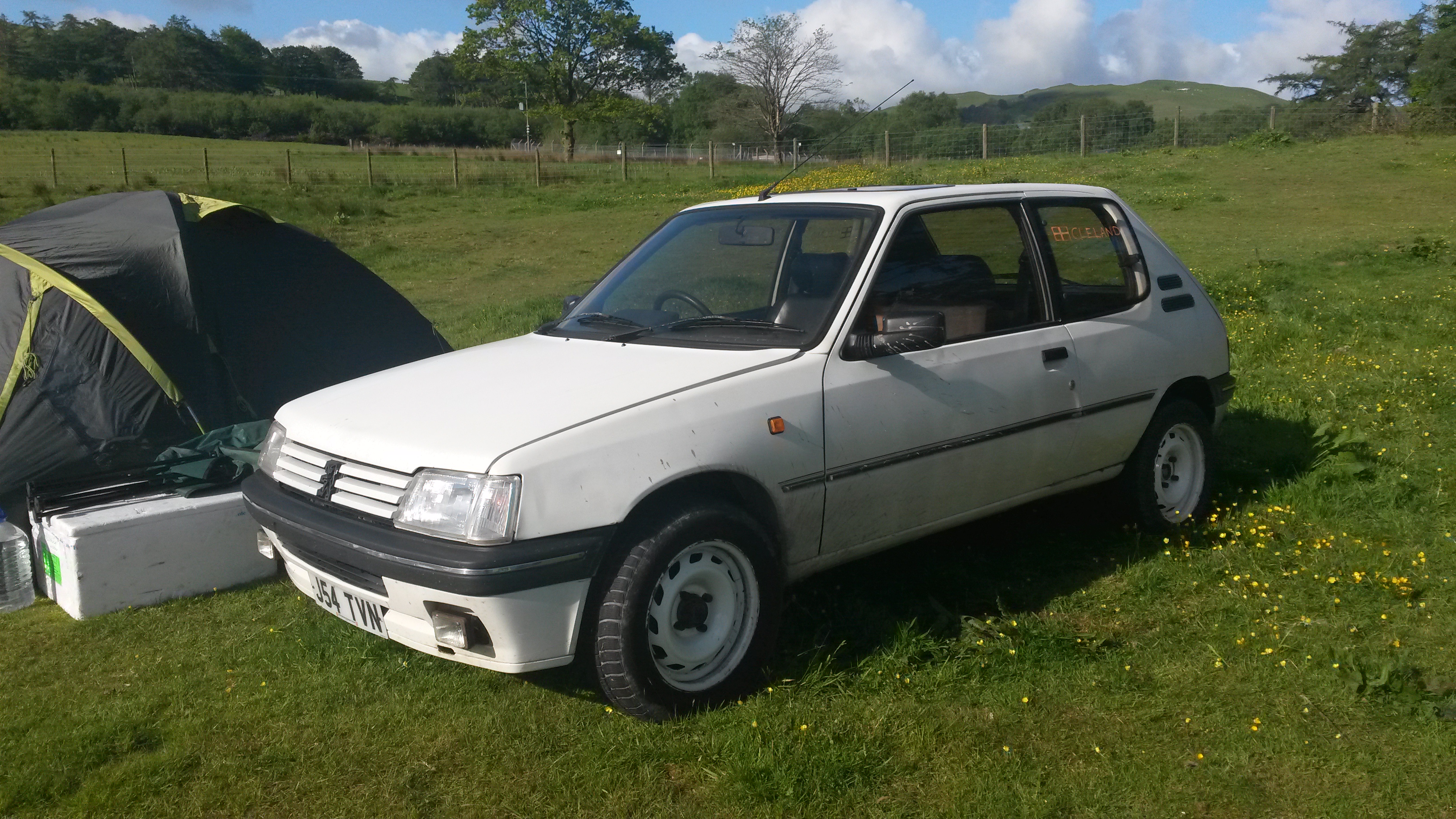
I could quite easily hold up the Peugeot 205 as one of the best cars of the 1980s. It replaced the dumpy, uninspiring 104 with something that remains super-stylish today. This is one of the most attractive hatchbacks of all time. Every line seems just about perfect. Quite remarkable for an in-house design, from a company that hardly had a track record in producing genuinely attractive cars. I mean no offence, but while the -04 range certainly had charm, they all lacked the game-changing wow-factor of the 205.

This 205 packs plenty of punch.

This 205 packs plenty of punch.

As well as that, it manages to be comfortable, it handles really rather well and even the tiny 954cc poverty models are good fun to drive. The huge hatchback and folding rear seat means they’re surprisingly practical too. There’s a strong, and very lengthy, engine line up. One of the best diesel engines ever made. Hilarious power in the 1.9 GTi. Pretty amusing power in the smaller XS and 1.6 GTi. There’s a pretty convertible. In France, you could even buy a stylish van version – not just the hatchback with plated over windows that we got here.

Quite rightly, it was a huge success. It made cars like the Austin Metro seem awfully old hat (much as I love them) in a stroke, just a few years after that car was launched. The STDT was one of the first DIESEL hot hatchbacks. Here was a car that could be entertainingly brisk, but would also deliver 45mpg or better. Oil burners really had come a long way.

The car tested here has had the larger 1905cc turbo diesel inserted from a 306 (I think). Furthermore, it has undergone quite a few mods (better intercooler positioning, cranked up fuelling) to ensure it really is very brisk indeed. This was the first 205 I’d driven in quite a long time – possibly since I owned a 1.0 XE back in about 2000. So, what was it like?

Firstly, all the usual 205 hallmarks are there. Enormous side doors (this being a 3-door) and a gearlever that was seemingly stolen from a coach. It’s massively long! But this car is all about the power delivery – and how! Progress is sluggish until you sneak beyond 2000rpm, at which point it’ll light up the tyres! This is not a smooth, torque-laden turbo diesel, it feels far more like the abrupt power delivery of a BMW 2002 or early Audi Quattro. It’s a case of lag, lag, lag, OH MY GOSH THAT’S QUICK! Before you hit 4000rpm, change gear and do it all over again.

I’ll be honest, this is not actually my idea of fun. I like the turbo diesel in my XM, which gently increases power from 1500rpm as the turbo whistles into life. It’s smooth, almost seamless and a world a way from this nothing-nothing-BANG approach.

It’s hugely entertaining for sure, especially with the smokescreen it seems to generate, but there is no chance I’d want to live with a car like this every day. I’d find it too frustrating. It’s exactly why I tired of my Peugeot 306 DTurbo and my Citroen BX turbo diesels. You find yourself constantly facing a battle to keep the engine in its incredibly short sweet spot.

One thing is for certain though. This car certainly proves that a little light tweaking can make a fun, economical little car an absolute riot. All while topping 40mpg on waste vegetable oil. Not my cup of tea then, but I can certainly see the appeal.

Video: My relationship with the 2CV

After yesterday’s Blog post, I did probably-not-enough thinking, and have agreed to purchase the Dyane. More on that in the coming weeks! But, I thought it might be nice to indulge myself with some thoughts on why I like 2CVs (and other A-Series Citroens such as the Dyane) quite so much.

I’m not sure my video has all of the answers, but I hope you enjoy it. It includes some truly excellent external footage from my friend Keith Hicks. We had great fun nailing those sequences together last summer. It really has reminded me just why it is that I need an A-Series Citroen in my life ASAP!

Road (and field) Test: Combi-Camp trailer tent

I feel that I should probably do a review of our Combi Camp trailer tent, because we’ve used it quite extensively this summer. How has it fared and how easy is it to use?

Pitched up with Combi-Camp friends at 2CV meet.

Combi Camps compared. Ours has a ‘wonderful patina.’

First, the history. Combi-Camps originate from Denmark, and first became available in 1964. The premise is simple enough. Make something light and very quick to erect, so you get something that’s better and more comfortable than a tent, but not as much hassle to tow as a caravan. There have been many models over the years, and you can still buy Combi-Camps new! They’re all a bit fancy these days, but the basic design of ours – which I think is a late 1970s/early 1980s one – continued with very few changes for quite some time.

Ours is a Combi-Camp 2000, so it clearly dates from a time when the year 2000 seemed a long time in the future! The curtains and mattress are more recent additions, albeit very colourful ones. As far as I can work out, it weighs about 300kg – though that might include the awning which we’ve never used. Frankly, there’s plenty of space for a couple for a weekend. For one person, it seems an almost unseemly amount of space.

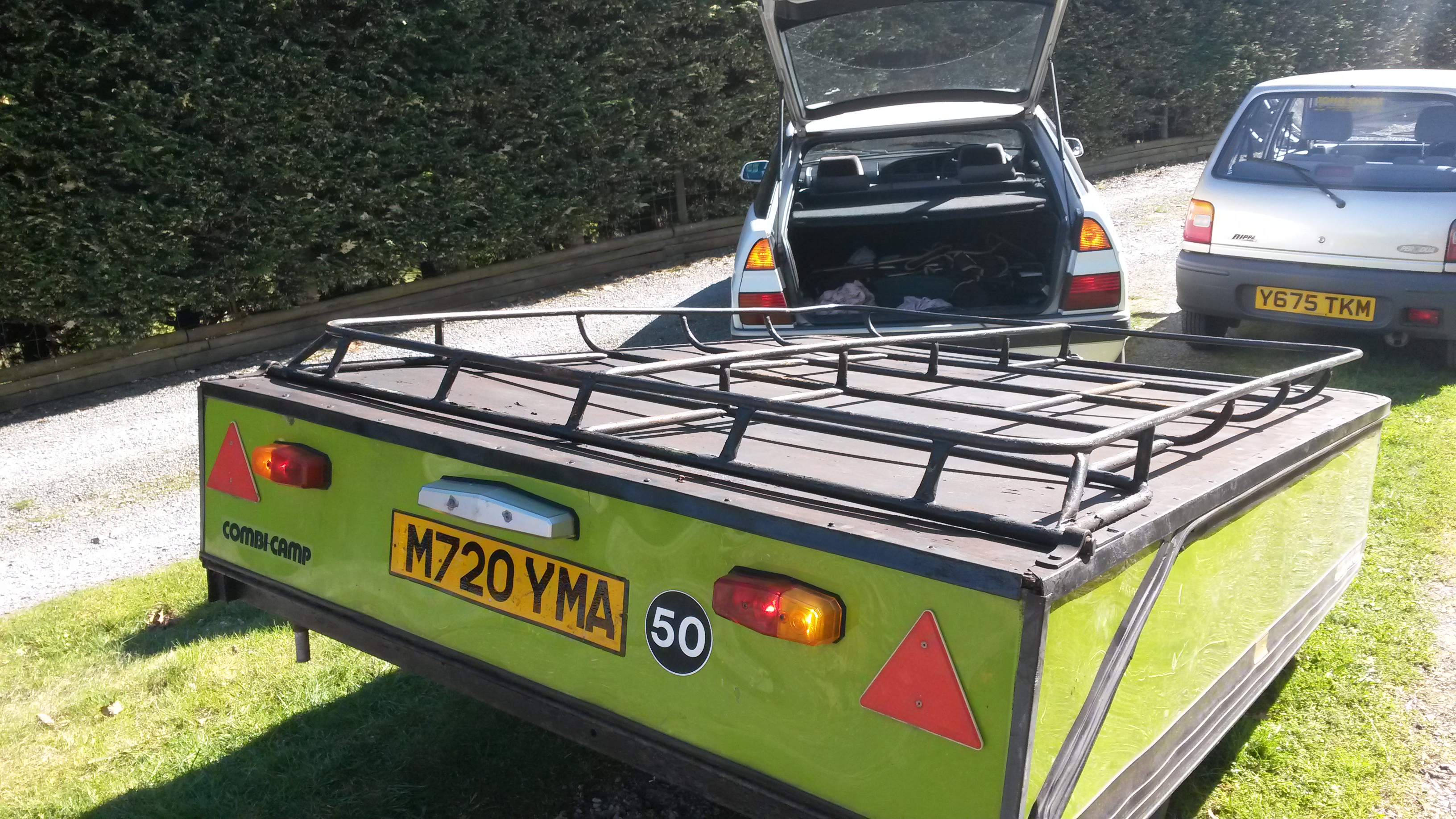
Folded up and ready for the next adventure! Lights are excellent.

Folded up and ready for the next adventure! Lights are excellent.

It tows beautifully. There are no brakes, because it is so light. My 110bhp Citroen XM barely feels the strain of pulling it along and being a similar width, I don’t have to worry about squeezing through gaps, nor bothering with extra mirrors. If the car will go through, so will the trailer tent. It seems to follow a very similar trajectory to the tow car too, so it isn’t very often that I even have to think about it. I sometimes get reminded I’m towing when I take level crossings too swiftly and the poor trailer tent bounces into view! The 2CV should be able to tow it too. I look forward to testing that at some point. Some 2CV friends of ours are currently heading to Poland with their 2CV/Combi-Camp set-up. Brilliant.

On arrival at site, it’s very easy to erect. Because the jockey wheel is missing on ours, I find it easier to ‘deploy’ still hitched up to the car – it helps that I can lower the suspension on the XM to get the trailer tent nice and level. You release two small legs at the rear of the trailer tent, then unclip the catch and simply fold the canvas out. Job done! You can even make your bed at home, then fold the trailer tent so you really are seconds away from kip on arrival. Folding isn’t really much more effort, you just have to keep stuffing the canvas in as the lid closes. The huge luggage rack acts as a countweight, so the lid doesn’t close too swiftly. Genius!

Camping perfection at last?

Camping perfection at last?

There is an inner, which we leave permanently in place. The bed is huge! Not far off kingsize width. The mattress on ours is perhaps a little thin, but it’s non-original. An airbed could be used. I find it comfortable enough on my own, but not so comfortable when sharing for some reason – perhaps because I can’t move around the bed so freely to find a new comfortable position. If we keep it, I may need to make changes.

But it’s so quick to erect and so much more comfortable than roll mats on the floor of a tent! There’s plenty of standing room and enough space for a table in the ‘standing’ area. There’s room for one seat too, and you can park yourself on the end of the bed. Some apparently can convert the bed into a sofa.

Age is the main issue. There are quite a few rips, one of which is proving very difficult to repair. However, I’ve camped in some horrific conditions in it, and it has generally fared very well. Overall, I’m very impressed and I think I may well seek a fresher example at some point. Certainly, in my many years of camping, having tried small tents, big tents, camper vans and even a little caravan, it is my favourite so far by quite some way.


Video Road Test: Mitsubishi Delica L400

It is still some surprise to me that my most-viewed Blog post of all time is a road test I did on a friend’s Mitsubishi Delica L400 – a Japanese import people carrier that uses Shogun off road tech to create a very multi-purpose vehicle.

So, I thought it was about time I did an actual video review. I borrowed his truck very briefly last night, and cobbled together a quick video. After all, I suspect a lot of people would like to know what it is like to drive one of these seemingly unstable beasts. You may well be surprised!

Road Test: Ford Cortina Mk3 estate

Citroen and Austin were busy innovating in the late 1960s, with their displacer-based hydraulic suspension systems, front-wheel drive and increasingly radical styling. Against this, Ford opted for utterly conventional. The Cortina Mk3 was a gentle evolution of the Mk2. It was wider, but still rear-wheel drive, still with overhead valves (2-litre excepting) and still with a simple live rear axle – albeit now with coil springs.

Cortina Mk3 estate

A beautiful load lugger for sure, if an unadventurous one.

But despite the dreary spec, Ford knew styling was important. With its clean snout and curvy rear wingline, the Cortina Mk3 is certainly a very attractive car, even in estate form. The extra width over the Mk2 meant it was very spacious inside, especially with the earlier dashboard, which curved away from the driver as it descended. It was a huge sales success – 1.1 million sold in just six years. During that time, the Pinto engine would replace the 1.6-litre Kent and trim levels would vary greatly. There was even a plush 2000E.

The car tested here is an early 2-litre L estate, dating from 1971 (but registered January 1972). That means it has more than enough power and torque for most. You certainly couldn’t call it sluggish. But what really impresses is just how pleasant this car is to drive. It feels planted and secure and the controls are all wonderfully light and accurate. That includes the gearbox, which is actually a five-speed Type 9 Sierra unit retro-fitted more recently. A cut-down gear lever gives a wonderfully precise change, and allows the Cortina to lope along at motorway speeds very comfortably.

Cortina mk3 rear

Oooh! Aftermarket rear wiper!

I was also surprised at how good the road manners were. I wasn’t going to start hanging the tail out in someone else’s pride and joy, but I could certainly corner briskly and feel perfectly safe. The engine has good torque characteristics, so you don’t have to rev it hard to build up speed. It’s just really nice.

And that’s the key to the Cortina’s success. Sadly, Ford proved that a car could be thoroughly, almost mind-numbingly safe in engineering terms, but pleasant for anyone to drive. The case for greater complication was already starting to look weak, even in the 1970s. After all, here is a car that even over 40 years later, is still wonderfully competent. I drove the car after it had driven to West Wales from Bury St Edmunds. It proves just how usable classic cars can be. It also proves that while a lot of cold, hard facts formed part of this car’s conception rather than engineering or design flair, the end result is a car you can’t fail to like.