Project 2CV: Patience…

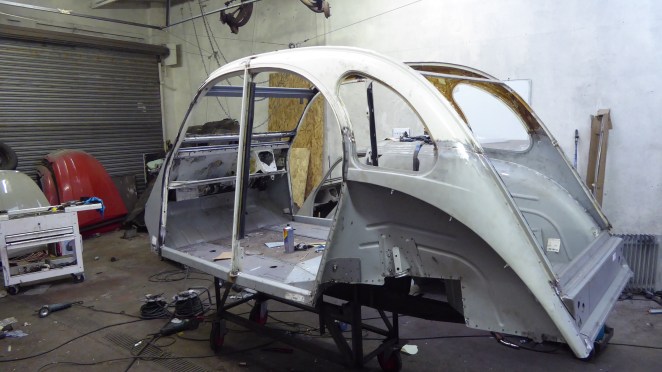
A couple of weeks ago, I saw Elly’s bodyshell, and it was good.

2cv refurbished body

It’s all metal again!

I’m staggered by the good work Alan has done. All that rotten metal is gone and around £1100-worth of panels have been welded in. Factoring in labour, even at a very friendly rate, total expenditure is already running at considerably more than £2000. The scary thing is, this still doesn’t leave me with a finished car! There’s still a lot to do.

In fact, progress will be slowing for a considerable while, as I want the bodyshell painted in cellulose, as per the original, rather than two pack. Had I opted for two pack, then the body could have been finished and painted this week. It isn’t though. It’ll take longer to get a ‘window’ for a cellulose session, and there are quite a few other things to sort out as well.

Primarily, that’s the doors and bonnet. The original bonnet has been deemed scrap, but Alan has sourced a better one. That’ll still need some fettling no doubt, but the doors definitely need some work. So, things are not yet really ready for paint at all. I’m aiming to paint the red bits myself to keep the costs down.

Thankfully, recent editorial work means I’ve been able to add considerably to the project fund myself. I’ve also had some parts donated – thanks John Stenhouse for donating a set of good wheels and tyres. That’s saved me a good £400. There’s still a long way to go though, even if the running gear generally seems good. Plus, my new tow car, the RAV4, has had a timing belt tensioner go down – thankfully it hasn’t taken the timing belt with it, but it has put a dent in my funds.

That’s about it for now. Alan is so busy, and I’m such a pain, that progress will be slow. He has a great many restoration projects to get sorted, some with much more urgent deadlines than mine. I’m certainly not going to have Elly on the road before the end of the summer, so I’m afraid you’ll all have to sit back and wait like I am. At the start of this year, I didn’t think the restoration was going to happen at all, so I’ve no complaints about waiting a bit longer. All I need to do is resist buying something else in the interim. Er…

Jalopnik gets it wrong

A browse of social media this morning led to me discovering this feature by Jalopnik, one of the better motoring websites out there. I almost spat out my morning brew when I read the lines “Owning a vintage car is a ridiculous proposition. It’s a bad idea, but it’s one that’s so bad that we all sort of applaud it.” What?! Accepting that the Americans use ‘vintage’ how we in the UK would use ‘classic,’ my main issue here is the suggestion that owning an old car is somehow a bad thing. The writer goes on to say how owning an old car means you’ll certainly be on first name terms with your mechanic – the suggestion being here that old cars are hopelessly unreliable and you’ll have to spend a fortune keeping them running.

2CV starting handle

With old cars, a bit of tinkering is all part of the fun. They can be reliable though!

He goes on to say how there’s an entire industry that has ‘sprung up’ just to look after these old cars, ignoring the fact that there is a far larger industry dedicated to keeping NEW cars going. Have modern cars suddenly become so reliable that the AA and RAC have gone out of business? No, they have not.

Let’s take my 2CV as an example. I’ve driven over 100,000 miles in it and sure, I’ve changed engines (the original lasted 170,000 miles) and have to get the grease gun out every now and then, but when did I last have to call out a breakdown service? I think it was 2003, but the truth is that it’s so long ago that I can’t truly remember. I did experience a breakdown in 2012 when the main cooling fan failed, but after getting a tow up a steep hill, I managed to limp home. It was the work of mere seconds to fit a replacement and all was well.

I don’t think you can argue against the fact that old cars require a little more love than newer ones, but to claim they always go wrong is a long way from the truth. In reality, I’m actually pretty poor at sticking to the regimented service programme for my 2CV, yet it never seems to fail to proceed, and very rarely lets me down at the side of the road – I can think of about four times, and three of those were related to iffy alternators (before I learnt my lesson and bought a brand new one). The third and final alternator issue saw me simply remove it and drive to my girlfriend’s house on battery power alone. Try doing that in your brand new Vauxhall Insignia.

Then there are the considerable plus points to older car ownership. These are cars that make passers-by smile. They often make the driver and passengers smile too. They offer a driving experience that is raw and exciting, even at slow speeds. You feel at one with an old car in a way you simply don’t with a modern one. Driving some old cars is a real challenge, and all the better for it.

Moduron Hafod Garage fitted the tyres

Elly only visits this garage when new tyres are required.

I simply live for older cars. My life truly revolves around them. My work is all about them. So is my free time. This is why I found the Jalopnik feature so frustrating. I do accept that there is a need to know your way around an old car. To get the best from them, you must understand their weaknesses. You must be on your guard and prepared to listen and feel for any mechanical issues. For me, this is all part of the fun. Journeys become a partnership between you and the car. On my 2CV, I once felt the clutch cable starting to break. I managed to limp to a car park where I was able to change the clutch cable (without tools!) and safely get home. You have to be prepared to occasionally get your hands dirty. This is all part of the fun! If you have your man sort it out for you every time there’s a slight issue, then it really isn’t the same.

But, my statistics speak for themselves. My cars are generally always at least 20 years old, yet I have called for breakdown services so infrequently in the past few years that I can’t even remember what I have to do if it happens. I think the last time was 2013, when a 300,000-mile Citroen BX I owned blew a major hydraulic pipe. It still drove perfectly well until I found somewhere safe to stop. A panic it was not, though this job wasn’t cheap either!

But, I could not afford to run a classic car if it was expensive. I simply don’t have the funds. I’m only able to restore my 2CV because of the generosity of friends, family and those of you who follow this blog, and that’s because bodywork is the one aspect of classic car ownership that I’m yet to crack. It seems my 2CV needs a major body rebuild every 100,000 miles. But mechanically? That car costs me very little indeed – easily less than £500 a year.

So, my real-world experiences simply do not tally with Raphael Orlove’s. There’s probably a simple reason for that though. Apparently, he owns old Volkswagens…

EV: Getting it wrong

This is a little additional post, following my experiences where I got a range calculation very wrong. It isn’t part of the main roadtrip, but a separate trip I undertook after a day of rest.

Firstly, I had to get to Cannock, which is 102 miles away. I’d been out the night before and as I don’t have a home charger, I’d plugged the car in when I got home at 10:45pm. When I went to leave at 9am the next morning, the car was still charging. This is the downside of a bigger battery – it takes longer to charge up! Most LEAF owners will have a fast charger at home, which should charge a LEAF up in just a few hours, depending on which charger is fitted to the car.

However, I had over 100 miles of range, so off I set. As the journey went on, I began to realise that while I could make it to my destination, I probably wouldn’t have much left ‘in the tank’ when I got there. I suspected my chums would want to have a quick ride in the car, so stopped at Telford for a quick ten-minute charge. That took the battery back up to 51%, putting in 7.2kwh of juice.

A joyful morning was spent watching awful cars fetching baffling amounts of money at a car auction before I headed off for the next leg. A friend had offered me a set of wheels and tyres for my 2CV Project, so I now headed south to Stow-On-The-Wold in the Cotswolds. Hilton Park services on the M6 was handily placed, so I headed there for a charge-up. Sadly, I utterly failed to remember how much juice I put in, but I felt it was comfortably enough to get to Stow, then to proceed to Strensham Services on the M5.

Cruising around The Cotswolds was truly joyous. I risked ruining the aerodynamics by opening the windows as I whispered along the lanes. With the tyres and wheels collected, all of which fitted in the generous boot, I headed for the M5, where I arrived with 13% battery remaining. I suspect the enormous 50mph section through the M5’s roadworks helped the range a great deal!

I’d checked the status of the chargers before I set off, but forgot that one of the Strensham chargers is offline. I spent several frustrating minutes trying to get it to work before giving up. Sadly, there was a Mitsubishi Outlander PHEV at the other charger, and the display indicated it hadn’t been there long. Some EV owners get angry about these hybrids, as they don’t HAVE to charge up – the joy of still having an actual engine. I’m not like that. Electricity helps improve the economy, so it could be argued they’re just as welcome at the chargers as EVs.

After about ten minutes, the owners came back. I suspect they would have liked to keep charging, but they were kind and let me take over. I had to fend off another PHEV that had just arrived, but they were kind and understanding too.

I now had a long wait, so spent some time reading the owners’ manuals and cursing the fact that motorway tea costs £2.50. Disgraceful. I refused to partake and stuck with water. After exactly 39 minutes, I was a bit fed up. The battery was at 85% and the range was showing as 111 miles. The distance to home? 99 miles. I’ll concede that after our first long trip of 98 miles, I may have got a bit over confident. After all, that trip was with a battery at 100%…

Things get scary

It didn’t take long for me to realise that I was in a spot of bother. I think it was after about 20 miles that I realised this was going to be a struggle. You see, the route from Worcester to Wales feels like it’s almost entirely uphill! I felt ok with 15 miles between range and distance to cover, but that gap soon began to close up. I started to deploy the first stage of panic stations. No air con and letting the speed drop by 10-15mph going up hills. I limited to the top speed to 53mph (a realistic 50). For some time, range and distance remained near-identical. I’d drop into negative figures when climbing, but would get miles back coming down the other side. Not enough though.

My back muscles began to tense, and an uncomfortable feeling developed in my stomach. Ah yes. My old friend range anxiety! I desperately tried to conserve momentum, using racing lines to try and keep my speed up through bends. My economy went up, so it was having some effect. Would it be enough though? Approaching Leominster, things were getting so worrying that I refused to overtake a tractor.

The anxiety was extra bad because I’d stupidly left the 13amp charge cable at home. That meant that it was impossible for me to just find a kindly person to pinch some electricity from. My only option was to push on for home. After Kington, there’s an awfully steep climb before reaching Pen-y-Bont. I allowed the speed to drop to 30mph, despite the 60mph limit. As we came down the other side, I allowed my speed to build, pressing the throttle enough to cancel the regen, but not so much that power was used to build speed up. Regen was employed for sharp turns, but my speed was still very low. I couldn’t build up enough momentum and was soon on the power again.

The range continued to sit at a lower figure than the miles remaining as I headed toward Rhayader. I’d turned the speed limiter off at this point. I’d control the pace and keep it slow as I climbed, but if I could get up to 60mph going downhill without using power, I would, employing the subsequent regen before the inevitable bends, but only slowing down just enough to get around the bend. The aim was to avoid heavy acceleration on the exit.

As we snaked along the A470, I was starting to think this was hopeless. I had 18 miles still to go, but only 14 miles of range. My speed dropped to 40mph and I nervously kept watch on the rear-view mirror. People who overtook must have ended up thinking that these electric cars are hopelessly slow!

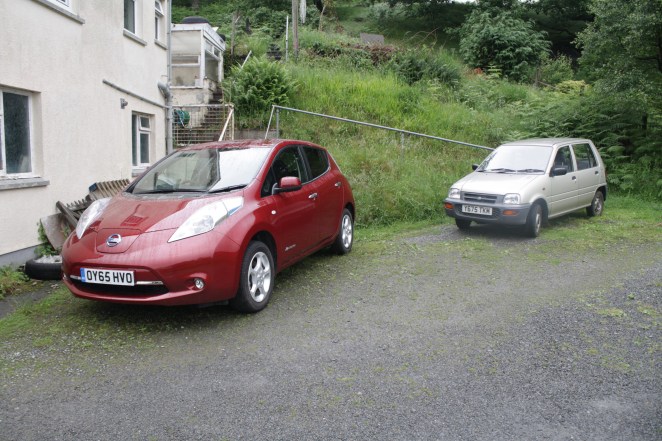
At Llangurig, I had 13 miles to go, but now just ten miles of range. I also had to climb over the Cambrian Mountains again. I called home and requested emergency help! Rachel dashed to the garage, grabbed the 13amp charging cable and hopped in her Perodua Nippa to come to the rescue. I pushed on. Would I actually get to find out what it feels like to run out of juice?

Even the LEAF was worried. Not that it could find any charging stations in mid-Wales!

Even the LEAF was worried. Not that it could find any charging stations in mid-Wales!

By now, I was doing 30mph as an absolute maximum, and even less when climbing. Thankfully, it was after 8pm at night, and traffic levels were very low. The range kept dropping. With 11 miles to go, the range dropped first to 8 miles, then went blank. It was refusing to tell me how far I could now go. I checked the battery level. That also was refusing to tell me how much was left. My back was no longer touching the seat because I was so tense!

However, owning a 2CV means I know a few tricks about conserving momentum. It’s about being as smooth as possible. I continued to use racing lines, and allowed speed to build when gravity could assist. I eased the car over the crest at Eisteddfa Gurig and allowed myself a smile. Now, I had a fighting chance. The road immediately began to drop steeply. Balancing the throttle, I allowed the car to get up to 60mph, before employing medium regen. I’ve no idea how much power I generated on this section of slopes, but we were still moving. Excellent.

Fuel light roulette, EV style.

Fuel light roulette, EV style.

I then reached the ‘splash road,’ or the B4343 as it is known on maps. This was another steep climb, but no traffic was approaching, and I could crawl up at 20mph. A flying Perodua came towards me – the rescue team! However, there were now just four miles to go, and once I crested the hill at Parcgwyn, I knew it was mostly downhill.

Arriving at Devil’s Bridge, I felt much calmer. If the battery level was dangerously low, the LEAF would have gone into ‘turtle’ mode, where it really cuts back on the power. I still had a small hill to climb, and the car did it easily.

But I’d done it! I managed to coax the car home. The relief was palpable. I’d managed to cover 11 miles with dire warnings of extremely low battery level, in hilly terrain.

Made it! Phew. Back home.

Made it! Phew. Back home.

In conclusion, this highlights the problem with living in rural Wales. There just aren’t any charging options. At all. Stay close to the motorway network and range anxiety just isn’t really an issue. Departing from it is still a bit of a leap of faith though, and it must be said, driving with range anxiety is no fun at all. This is exactly the opposite of joyful motoring, though it does also remind me how much fuel is used to keep speed up on hills, and to accelerate away from bends.

Just one rapid charger along the length of the A44 would have taken the stress away. A ten-minute charge would have been plenty. Then I could actually have enjoyed this great driving road, because the LEAF handles well, rides well and is actually very pleasant to drive. The infrastructure has improved hugely in the 2.5 years since I last tested a LEAF, and none of the long trips I have made this time were even remotely possible back then. This was my second 300-mile day in the LEAF, taking me to 720 miles covered in just three days of driving. It proves that electric vehicles are viable, but I have also proved that when it comes to Wales, issues do remain.
EV Roadtrip: 30kwh LEAF Pt2

As mentioned in the previous post, we found ourselves with 98 miles to travel to the rapid charger at Chester in the 30kwh LEAF due to the intermediate one having broken. I was very concerned, after a near-failure involving a Volkswagen e-UP! last year. In that, I only just managed to make it home from the rapid charger at Oswestry.

As it happens, I needn’t have worried. There was no drama. In the LEAF, we sailed past said rapid charger with 77 miles of range still showing! I had enough juice to turnaround and drive back home if I’d fancied it. We were off to Liverpool though, so I didn’t do that.

First rapid charge, after 98 miles of driving.

First rapid charge, after 98 miles of driving.

Now, I wasn’t doing anything special to boost economy in the LEAF, though perhaps I was deploying a few small tricks. For a start, I was in ECO mode. This makes the air conditioning less power draining, decreases the throttle response and reduces the total amount of power you can access. We needed the air conditioning throughout the journey, as the conditions were horrific! Lots of rain, so lots of headlamp and wiper use too. That was fine really, as I wanted to test the car in everyday conditions.

The other trick was gentle acceleration. I’d estimate that I was getting up to 60mph about as quickly as my 2CV manages it – a 0-60mph time of 30 seconds. Acceleration batters your range, whether in an EV or a combustion-engined car. It’s why you always get better economy on a long run – it generally involves more travelling at a consistent speed.

You know when you’re driving well, as you start acquiring ‘trees’ on the dashboard. I’m not sure how they actually work, but found it quite easy to amass a veritable forest.

A veritable forest. But what does it mean?

A veritable forest. But what does it mean?

I refused to actually lower my speed so, where traffic allowed, I would do 60mph if that was the legal limit, and I increased that to 70mph on the motorway once we reached it. This was the most enjoyable aspect of this. The e-NV200 roadtrip had seen us cruising along at a miserable 50-60mph on the motorway, often freezing cold as we desperately tried to eke out every bit of range. I was being spoilt in the LEAF. Range anxiety just wasn’t an issue.

Well, that’s not entirely true. At the start of our journey, which saw us climb over the Cambrian Mountains, the range did drop down to 88 miles, when we had 88 miles left to cover. Experience has taught me not to stress in such circumstances though. By the time we reached Newtown, 30 miles away, the range was back up to the 105 miles it had been predicting before we set off. This highlights that the range is only a guide really. It can’t hope to predict how you’ll drive, nor how hilly the terrain is.

I’ll do a proper review of the LEAF later, but I was certainly enjoying driving it. When I first drove one in November 2013, it was a frustrating experience. It felt like a great car for covering distance, but I wasn’t within range of any rapid chargers at all at that time. I was stranded in mid-Wales. As cars go, it couldn’t be more simple really. There’s a go pedal, and a stop pedal and a steering wheel.

The biggest downside to the Oswestry charger being down is that we now had to go out of our way to find power. A quick trek along the M56 was necessary to access the pair of chargers at Roadchef Chester. As we arrived, one charger seemed to be getting glued back together by a chap in a French-registered van, but a second charger was free and ready to use.

Rapid charger being 'glued' back together.

Rapid charger being ‘glued’ back together.

The charging process is as follows. Press the fuel flap release, which unlocks the small panel in the nose. Flick open the cover on the main charging point (there are two, the smaller one is used for smaller chargers ie home use). Grab the DC rapid charging ‘gun’ (the charger has three cables) otherwise known as ChaDeMo (Volkswagen and some other manufacturers use CCS, for which there is a different cable). Now, press DC charging on the machine present your Ecotricy charge card (the Nissan press car came with one, but you can order one yourself. There is currently (June 2016) no charge). Wait for it to initialise, then the charging will begin.

We’d been driving for over two hours by this point, at an average of over 40mph, so we were due a break ourselves. We brought along tea and cold toast, because motorway services are generally horrible and expensive (Gloucester and Tebay excepted). That is one downside of EVs. Most of the rapid chargers are at motorway services, which are almost universally grim places in which to spend time.

After 20 minutes, the battery was up to 72%. As well as having greater range, it seems the 30kwh LEAF also charges more quickly. Sadly, I didn’t note down what the battery percentage was when we arrived, but I’d estimate it to be below 20%. We still had 24 miles of range left, having driven 98 miles (the car was wrong, Google maps called it correctly!) to get to the charger. Given the claimed 124 miles of range, that was pretty good going!

You’ll note we didn’t charge up to 100%. There are several reasons for that. Firstly, we couldn’t be bothered to wait. We had enough to get to our next destination, why waste time? Secondly, the last 20% of the battery cannot be charged as quickly as the previous 80%. As the battery fills, it’s harder to squeeze the last bit in, so it could have taken a very long time to charge. Thirdly, it’s better for the battery not to repeatedly charge it beyond 80%. On the e-NV200 roadtrip, we had no choice. We often needed 100% (or close to it) to get from one charger to the next. Now, we had the luxury of not bothering.

I disconnected, with the car now predicting 88 miles of range. We headed to Liverpool and only got slightly annoyed at the sat nav. It isn’t actually very clear to read in city conditions, and was sometimes too slow to react to our actual road position. An one point, I had to drive through a seriously flooded section. It was nice not to have an engine air intake to worry about…

We overnighted in Liverpool, leaving the car in a general car park. We could have perhaps found somewhere with a charge point, but we’d be passing a rapid charger in the morning. That would do.

Overall though, is it impressive that I managed to cover 98 miles with out recharging? Well, against a combustion-engined car, no it isn’t. However, it does make the LEAF feel a lot more valid. 98 miles was enough for a couple of hours of driving, after which we were very keen to stop anyway. Does that mean everyone should get an EV? No. It just means the limitations are perhaps less limiting now. A bigger test would be driving back home via Bradford, and covering over 300 miles in a day. That’ll be the next installment. Stay tuned!


EV Roadtrip: 30kwh Nissan LEAF Pt1

I haven’t conducted a proper EV roadtrip for a while, so I thought it was about time I had another go. My previous roadtrip, in a Nissan e-NV200 Combi, wasn’t very enjoyable at all. Can the new 30kwh LEAF do a better job?

We need to cover 98 miles to the nearest charger...

We need to cover 98 miles to the nearest charger…

Firstly, let’s talk range. Even driving gently, I struggled to get more than 60 miles out of the e-NV200 between charges. That was against a claimed range of 106 miles. To be fair, I was conducting the test in November, so heater use was denting range, but it was still pretty poor.

The LEAF should stand a better chance. It has a claimed range of 124 miles, which is probably closer in reality to the 106 claimed for the e-NV200. Anecdotal evidence certainly suggests so. The other advantages are a larger battery back (30kwh to 24kwh), better aerodynamics and heat-pump heater technology – not that we should need it, being summer. Allegedly.

I’ll certainly be testing the range pretty thoroughly, and not out of choice. We’re off to Liverpool today, and the first rapid charger along the route is broken. It seems The Electric Highway is sadly still not entirely fit for purpose. Where this charger is located, there are no less than 16 pumps for internal combustion engines. If one of those breaks, it’s hardly the end of the world.

As it happens, I now have to try and get to a rapid charger near Chester, on the M56. That’s 98 miles away, so the challenge is definitely on!

First up, here’s a bit about the test vehicle. It’s Acenta spec, which is the lowest available with the 30kwh battery – you can have a Visia with the 24kwh battery and a few less toys. The on the road price, not including any plug-in grant, is a smidge under £30,000. The paperwork doesn’t confirm whether that price includes the Magnetic Red metallic paint – my favourite colour. The spec includes a reversing camera, heat pump heating and air con, lots of electric toys, auto headlamps and wipers, keyless entry and a 3.3kw on-board charger.

That latter point is worth bearing in mind. It means that it can’t charge particularly quickly at some smaller AC chargers, such as the ones you can have installed at home. There is an optional 6.6kw charger, but that seems to be about another £1500! Some people don’t consider that worth paying, and here’s why.

There are three basic charging options. 13amp plug, fast charger and rapid charger. The spec of the on-board charger only affects the fast charger option – typically a 16amp supply, or 32 if you’ve gone for the bigger charger. The sort of charge points you’ll find that use this are at home, in some car parks and even roadside in towns.

I probably won’t use that facility at all. I’ll either be charging at home via the 13 amp plug, or using rapid chargers, which supply over 100amps at several hundred volts. That should get the LEAF’s battery up to 80% charge in around half an hour – it’ll be interesting to see how the real-life experience tallies with expectation. 80% charge should be good for 80 miles and once I’m on The Electric Highway, that should be more than enough to get to the next station and/or destinations.

I’ll be live tweeting my experiences at http://www.twitter.com/dollywobbler and will, of course, be reporting back on here once the journey is complete. There will be video too. If you’ve got any questions about the LEAF, now is the time to ask!

Project RAV4: First video

Life is exceedingly busy at the moment, which is why my first June blog is ten days into the month! Where does all the time go? Suffice it to say, I’m still loving the RAV4, even if I’ve had to sort out a few foibles. More details on that soon but in the meantime, here’s a video of my new steed. For extra laughs, put the subtitles on. They’re automatic, courtesy of YouTube, and rubbish!

New(ish) Top Gear

I said I would reserve judgement on Top Gear with new presenters until I had seen the show. I have. Judgement made. And I’m not sure it’s good news.

Firstly, Chris Evans is just too annoying. Too shouty. It suited TFI Friday all those years ago, for a bit of a Friday night knees-up. When we were all young. Now, it’s just a bit much. He’s also not very good at coming up with actual words. I’ll admit I have often disliked Clarkson, sometimes to a very large degree. But, he is a wordsmith. His line “the boot is not big enough for a mouse’s pants” still makes me laugh today. For all that oafish man’s faults (and they are many), he really can write. So can May. To be fair, so could script editor Richard Porter, and he’s gone now too. (I’m not that convinced about Hammond).

But Evans just isn’t geeky enough either. The show desperately needs some James May input. Some actual facts, from someone who likes all cars. Even ones that are a bit rubbish. Half the time, Evans sounds like he’s just coming out with stuff he read in a magazine once. I get the feeling he doesn’t actually know what he’s on about.

LeBlanc is the surprise. He’s actually very watchable, despite the sometimes annoying smugness that typified his role in Friends. Compared to Evans, it’s Mr Hollywood who actually feels more rooted in reality. Which tells you a lot.

I’ll leave the ‘cinematic’ features and challenges for a while, but have to say that Sabine Schmitz was rather underused. She just seemed to swear a lot. I’m sure she could actually give some genuine insight into a car rather than just shouting as much as Evans.

The most enjoyable part of the ‘star in a rallycross car’ piece was the engine noise of the MINI. That sounded great. Gordon Ramsey boasting about his LaFerrari is not good television. Not is you dropping a subtle hint that you also own one (it was quick, but it was there). And oh, look at this! More ridiculing of ‘first cars.’ No Mr Evans. Owning a Fiat Strada is not laughable. I’ve no idea who the other guest was (I don’t get out much) but he actually seemed quite likeable, though he proved to be another whipping boy for first car jokes. The crowd voting for they favourites was excruciating too.

The rallycross element was a good one, especially as the off-road tyres seemed ill-suited to dry tarmac. It made it entertaining to watch. Credit where credit is due, I liked that. The ‘reasonably priced car’ format badly needed an overhaul. It had never recovered from Tom Cruise ‘setting’ the fastest lap. Fair play, I’d say job done. On the actual driving bit at least.

I wasn’t keen on any of the studio segments. Too much bloody whooping for a start, but also the chemistry between Evans and LeBlanc just isn’t there. It could develop with time – I remember how utterly dreary ‘new’ Top Gear was in the early days, before May came along and it still look a series or two to get good. Some of the dreadful rubbish Evans came out with was nothing short of painful though. “The best thing about these cars, is that they’re built for pleasure alone,” he bellows, making a fist at the camera. WHAT?! You can hear the confusion in the crowd, as if they’re going, “did he just actually do that?” I’ve cringed less during episodes of Alan Partridge (which I absolutely hate by the way). Not cool.

The ‘fast car goes around a track’ thing is dull these days too, especially with Evans’ clueless commentary. It would have been better if he’d just shut up and let that V10 do the talking.

But, the biggest problem is that rather than come up with new ideas, the team have just gone in for blatant Top Gear copyism. I’d already tired with Top Gear, because the ideas were stale and the challenges absolutely false. The new show brings nothing new to that party, and it’s a party I just don’t want to be at. No, I don’t want to watch Reliants get ridiculed and destroyed (especially as one of them was apparently rather nice before they got hold of it). No, I don’t want to watch really rather nice Jeeps and Land Rovers being thrashed up a hillside. It’s just disrespectful to nice, old vehicles. There are lots of genuinely shit cars out there! Use one of those instead.

This strikes me as a missed opportunity, and the biggest reason why is Roadkill. It’s where two very knowledgeable and funny Americans do silly things with cars. But it isn’t staged, it isn’t fake. It just feels like it catalogues their lives. They work on the cars themselves. They have very little (compared to Top Gear) budget. But, they have skills, they have chemistry and they have lots and lots of knowledge. And V8s engines. They have lots of those too.

So, in conclusion, new Top Gear just isn’t new enough for me I’m afraid. It failed to grab me just as the latter years of the Clarkson era also failed to grab me. That’s a real shame. I was fully prepared to give it a go. I refused to jump on the bandwagon of rubbishing a show that hadn’t even happened. Even now, I’m not going to rant that it’s a waste of TV licence payers money, because it’s tiresome. I was hoping for better though. If it improves, do let me know, because while I’m no desperate rush to watch another episode, I do still hold out hope that better times are coming. There do need to be some serious improvements though.

Project RAV4: Greenlaning!

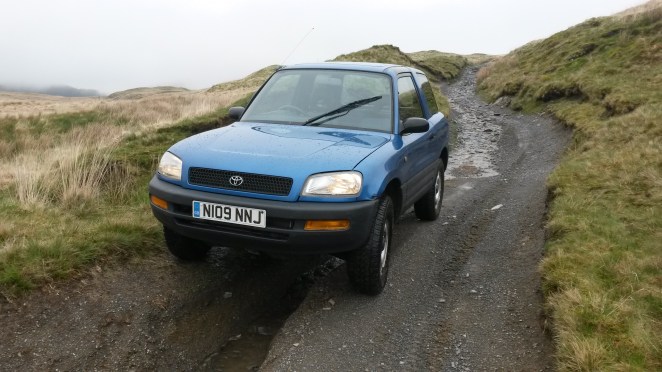
There’s not much point in owning a 4×4 unless you’re going to test its ability, so it should be no surprise that within days, I’d taken the RAV4 to explore some local lanes.

Originally, I was just planning to go for a drive. I’d discovered that you can remove the roof panels and store them on the inside of the rear door and fancied a roof-off blast. Wales didn’t disappoint.

RAV4

Roof panels removed. All the better to enjoy the scenery.

But this road, in the area known as Nant-y-Moch, leads to a few greenlanes. Well, it is a 4×4 after all. Perhaps a quick exploration was in order!

I opted for a lane I know quite well, though the problem is, these lanes change all of the time. Vehicles can change the terrain but to be honest, it’s water damage that can really destroy the lanes. You never know quite what you’re going to be driving into.

First off, let’s talk a bit about the RAV4’s off-road kit. It has permanent four-wheel drive, which is pretty unusual for a Japanese 4×4. Most have a part-time system, as do later RAVs. Happily, there is a lockable centre differential, like on 1980s Land Rovers. This prevents you losing all your power through one spinning wheel. If the wheel is spinning at one end with a locked diff, equal power will still be sent to the other axle. Not that axle is the right word to use here, because the RAV4 doesn’t have any. It has fixed differentials with halfshafts and independent springing at each corner. That does leave things like wishbones looking a bit vulnerable, though ground clearance really isn’t too bad.

There is no low-ratio gearbox though – the transverse engine layout really doesn’t allow it. That’s what really defines this as a soft-roader. A low-ratio gearbox gives much lower gears, which give greater control off-road. It means you can crawl along at less than walking pace – very handy if inching your way over tricky rocks. The RAV4 has a very low first gear compared to a normal car, which gives reasonable control of pace when climbing. I soon found it offered very little control at all when descending. With a proper low box, you can put it in low first, take your feet of the pedals and the vehicle will slowly crawl down a hill (grip permitting). All nice and safe. Not so the Toyota…

Greenlaning Toyota RAV4

Lack of low box compromises RAV4’s abilities.

Descents always look far less dramatic through the lens, but this was eye-opening stuff. I couldn’t just remove my feet from the pedals, because it just can’t crawl downhill. I had to start using the brakes – a big no-no really as this can (and indeed did) induce skids. The lack of ABS didn’t help, and nor did the road-bias tyres. That are quite worn. I was having to constantly adjust the brake pedal pressure to suit the grip, but certainly did not feel entirely in control. I also found I had to jump out and survey the land ahead more often than I would in a ‘proper’ 4×4. I’m not yet used to where the RAV will scrape and catch. Which it did, a few times, despite my efforts. Thankfully, it has solid bash plates underneath.

RAV4 off-road

Carefully does it! Accuracy required here to avoid slipping.

It does feel rather vulnerable, but in a way, that makes it more of a challenge, and therefore more fun. I see lots of 4x4s in these parts that have a ridiculous amount of kit – most of which is unnecessary. The diff lock works well though and it successfully completed a couple of tricky climbs with only minor scrabbling – that despite a perilous lack of grip. I’ll certainly be looking to take it greenlaning again once I’ve got some decent tyres sorted out.

The odd thing is returning to surfaced roads and being behind the wheel of something that feels nimble and keen in a way most 4x4s do not! The bias is definitely more towards road than off-road, but the RAV4’s off-road ability should not be ignored.

Oh and don’t worry. I have a new driver’s wiper arm on the way, so I can ditch the single-wiper look!

Goodbye XM. I’ll miss you.

The big news today is that the XM has left the fleet. It’ll be strange not having the huge barge around the place. It has been a superb buy and has served me very well indeed.

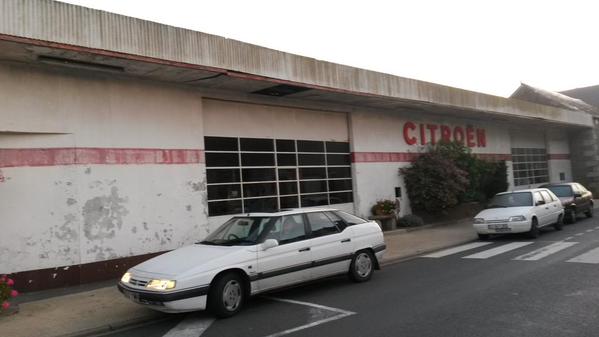
When I bought the XM in October 2014, I had no idea that it would remain a part of my fleet for quite so long. I liked it on the test drive, but I’ve liked lots of cars on test drives! In regular use though, I grew to adore its strong torque delivery, floaty ride (especially when I finally sorted the suspension out) and peaceful nature. I took it all over the country, and even to France last summer, where we visited Le Mans and had a gentle hoon around the road section of the fabled track.

Citroen XM in France.

Taking the XM to France was a real boon.

For eating up the miles, it really was pretty exemplary. But practical too. The boot is enormous, and folding the rear seats makes it even more so. Then there’s the towing ability. I didn’t really test it that much, but it certainly came in useful when asked.

I can’t deny that I’m a huge fan of the looks too. I’d often have the XM parked up outside my office window and could happy gaze at it when words were eluding me.

XM rear

Fantastic Bertone styling

Sure, it wasn’t perfect. I never did like the clutch, nor the gearchange. The ride around town is pretty poor given how good it is everywhere else too. It is also a sod to park, being enormous and having corners that are almost entirely invisible from the driver’s seat. Reversing it is like reversing a Lamborghini (probably).

But, this one will definitely be going down as an enormous success. The likes generally outweighed the dislikes and it’s taken an awfully long time for me to feel like seeking a replacement! Not an easy task, as I’ve discussed. In fact, I’ve deliberately gone for something entirely different. I’ll have a break from magnificent barges so I can savour the memories of this fantastic hatchback. Thanks XM. May you enjoy many more miles.