Road Test Video: Jaguar E-Type

To tie in with the 1st July 2015 issue of Classic Car Buyer, which features my full report on my experiences in a Jaguar E-Type Series 3 V12, I’ve made this short video which summarises some of my views. It also does the one thing that my words cannot do – it lets you listen to the car itself!

So, what is a last-of-the-line E-Type really like?

So, what is a last-of-the-line E-Type really like?

Be warned, it does also feature an out of control beard. Sorry.

My thanks to Hartlebury Castle and Great Escape Classic Car Hire.

Road Test: Volkswagen e-Golf Conclusions

Part 5. In which I actually make my mind up

My time with the e-Golf is almost over. In a week, I’ve covered over 700 miles putting this car properly through its paces. I have undertaken long trips, and it has also entirely replaced my own cars for normal car stuff – like going to the shops and general bimbling about. So, how has it been?

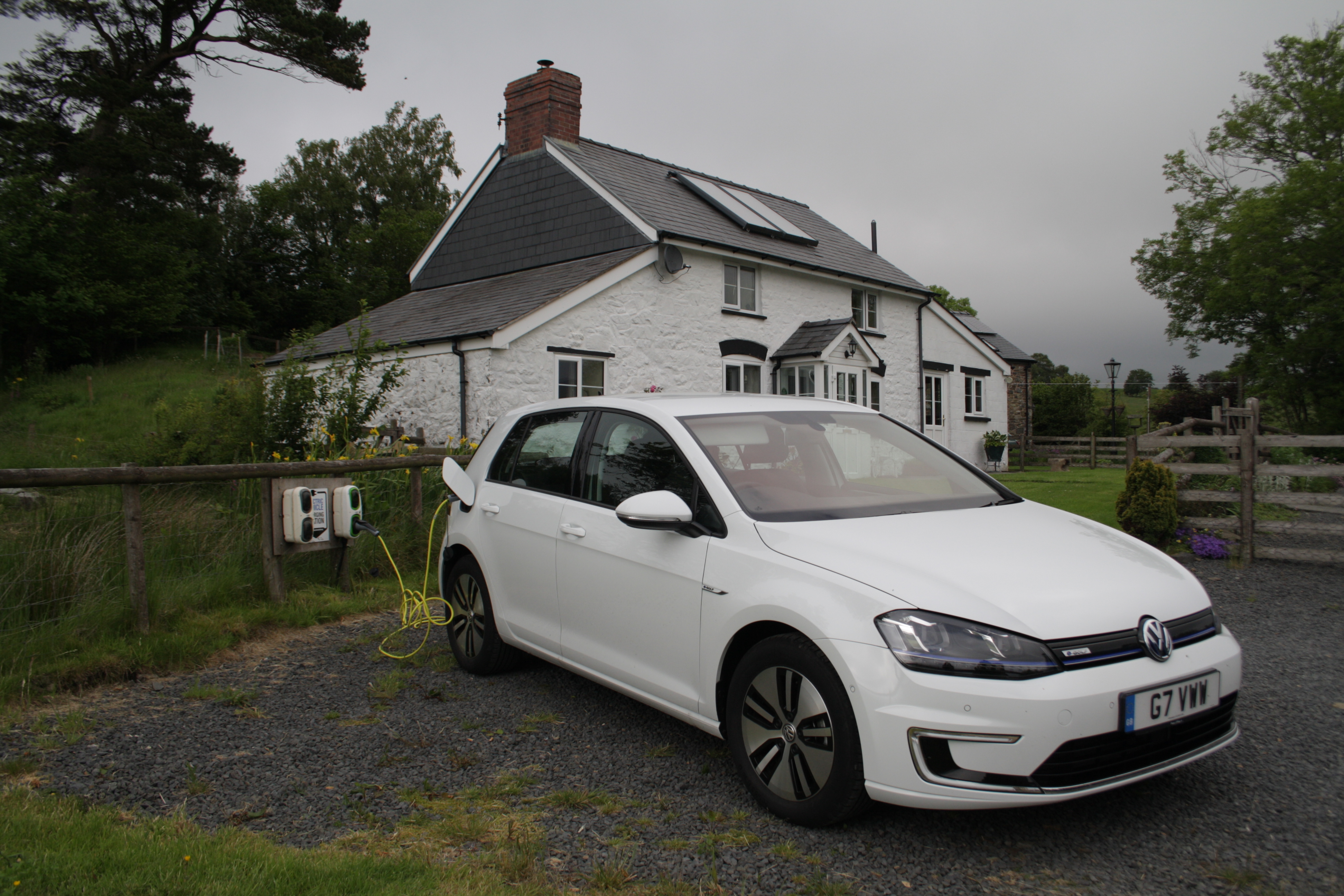
e-Golf

After 700 miles, have we reached a conclusion?

Firstly, you’ll find all the detail here, in my Introduction, Clever Tech, Downsides and Roadtrip reports. There I talk about the features and realities of the e-Golf, enabling me to keep this conclusion fairly short. For once.

It must be said – the e-Golf is a very capable machine. It should be. The Mk7 Golf is a very good basis. Mix in the super-smooth EV driving experience and you have a car that stands up very well. I don’t doubt for a moment that anyone buying an e-Golf would find it a very satisfactory experience.

But there are one or two caveats. Charging is perhaps the biggest issue. As I covered in downsides, the lack of a large on-board charger, and incompatibility with the most common form of rapid charger do put restrictions on use. Volkswagen have told me that they’re looking into an on-board charger upgrade in the future (no timescale specified) and the necessary CCS rapid chargers are becoming more widespread, so perhaps these issues will simply go away.

The other is price. Some will find it absolutely fine to pay a little more for what is seen by many as a prestige product. It certainly feels very well screwed together, but so do most cars these days. Seriously, a Nissan LEAF more than matches it for refinement and build quality. The e-Golf scores a few points over its British-built rival with the Adaptive Cruise Control though. I’m simply staggered at how well it works most of the time (not the smoothest in stop/start traffic) and how relaxing it makes the driving experience once you learn to trust it.

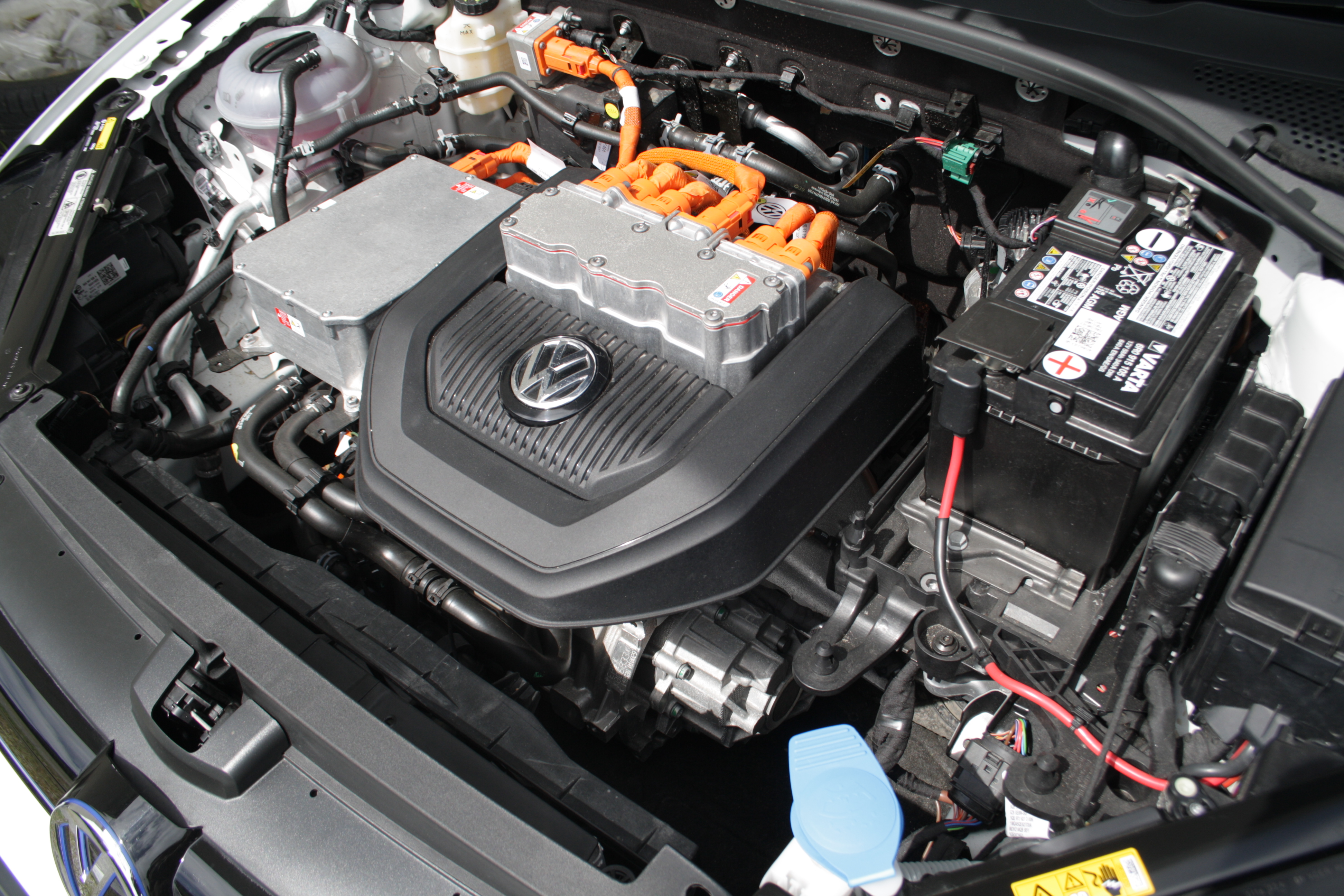
e-Golf engine

The e-Golf’s motor looks fairly engine-like!

I do have some concerns about rapid charging – the Volkswagen battery guarantee advises against doing it more than twice in succession (I did it three times yesterday, naughty me). That really rules the e-Golf out for those doing motorway miles or long distance trips on a regular basis. Which is annoying. That really does restrict the e-Golf to second car duty – ideal for those local trips (whether you live in the city or somewhere more rural).

The range is impressive – a genuine 100 miles seems possible, even in the hilly terrain of Wales. Of course, the caveat here is that I have not tested this vehicle in the winter (there’s an idea). My previous tests have deliberately been conducted in November, as that’s the hardest time of year for an EV. The less aerodynamic, heavier Nissan e-NV200 found 61 miles a real struggle when it was really cold against its claimed range of 106 miles (the e-Golf’s claimed range is 118 miles).

Overall then, this is a seriously impressive car albeit with a hefty price tag. Certainly, it only justifies its cheaper running costs (free road tax, cheap fuel) if you’re in the market for a new car anyway. Were I in the market for new, I’m not sure petrol and diesel would tempt me, so I’d be inclined towards EV. If I had the money, choosing between e-Golf and LEAF (I’m yet to test the Kia Soul and BMW i3) would certainly not be easy. I doubt I’d feel hard done by with either. They’re both great examples of just how far electric vehicles have come in recent years.

e-Golf: The biggest electric road trip yet

Road Test Part 4 – The 300-mile roadtrip. Part 3 (The not-so good) Here

Sorry, you’ll have a further wait for my conclusions on the Volkswagen e-Golf, as I first need to relate the details of my biggest ever electric car road trip.

I began the day aiming to crack 200 miles in the day, though I’d actually done this before with the Nissan e-NV200. After failing the other day, I aimed to get a rapid charge at Oswestry on the Electric Highway. From there, I would hopefully head north – probably to Chester, though that opened up the whole of the M6 and therefore, much of England.

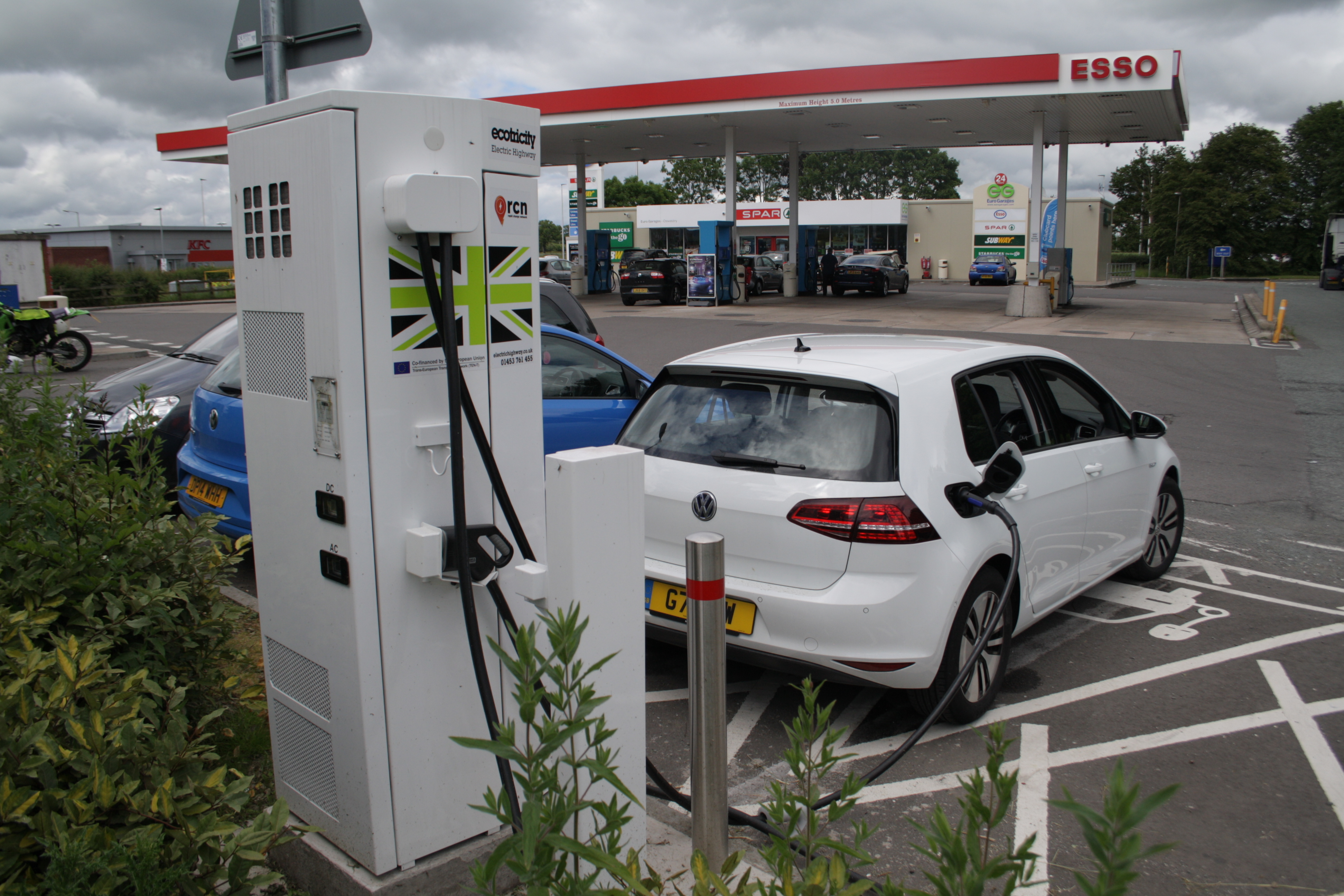
Success! e-Golf slurps DC current at 110Amps.

Success! e-Golf slurps DC current at 110Amps.

Now, things didn’t start all that well. The first two attempts to get electrons flowing resulted in a baffling error message. So, I did what any IT bod would do. I effectively rebooted it by removing the connector from the car and starting again. Third time lucky, and I could head off for a brew.

It was definitely time for a brew, as I’d been driving for almost two hours by this point, having covered 62 miles on typical Welsh A roads. By the time I got back to the car, it was already at 85% charge! It had been at 48% when I arrived just 15 minutes earlier. Charging slows as the battery fills, so although going to maximum is not advised (certainly on a regular basis – it’s healthier to stop at 80%), I left it going and supped my brew. And perhaps a cookie.

Soon enough, it was time to continue my journey. I headed up the A483 towards Chester. Now, Chester is a nice place, but the next rapid charger was a mere 35 miles away. That hardly felt like the stuff of adventure. Hold on. Isn’t there (bizzarely) a rapid charger on Holyhead? A quick consultation of Ecotricity’s map revealed that this was the case. Sat nav reckoned it was 92 miles away. The range estimate was 98 miles. Easy!

Of course, I may have neglected to remember that Snowdonia lies between the two, and that electric cars (and normal cars for that matter) use up a lot more energy when climbing hills. I got off to a good start though, and twenty miles in, it still reckoned it had over 80 miles of range. Brilliant. I passed through beautiful Llangollen (for the third time this year), delightful Betws-y-Coed and as I climbed the next steep hill, noted that I appeared to have 38 miles of range for the 34 remaining miles. Ah. I knocked the cruise control down from 50mph to 45. Perhaps if I climbed hills more slowly, all would be well.

Normally, travelling this slowly would pain me – even going uphill in the 2CV – but actually, it was really relaxing. Mainly because this was not a weekend and there was not much traffic. Incredibly, I still encountered folk going more slowly than me! I set the Adaptive Cruise Control and let the e-Golf follow their pace. Saving yet more miles. As we neared the A55, the range was again around 20 miles higher than my destination distance. I could do 60mph with relish.

I arrived at Holyhead with a full 16 miles of spare range. The charger (or rather chargers) took a little finding, being hidden at the far end of the short term car park at The Port of Holyhead. I was pleased with my stats so far though.

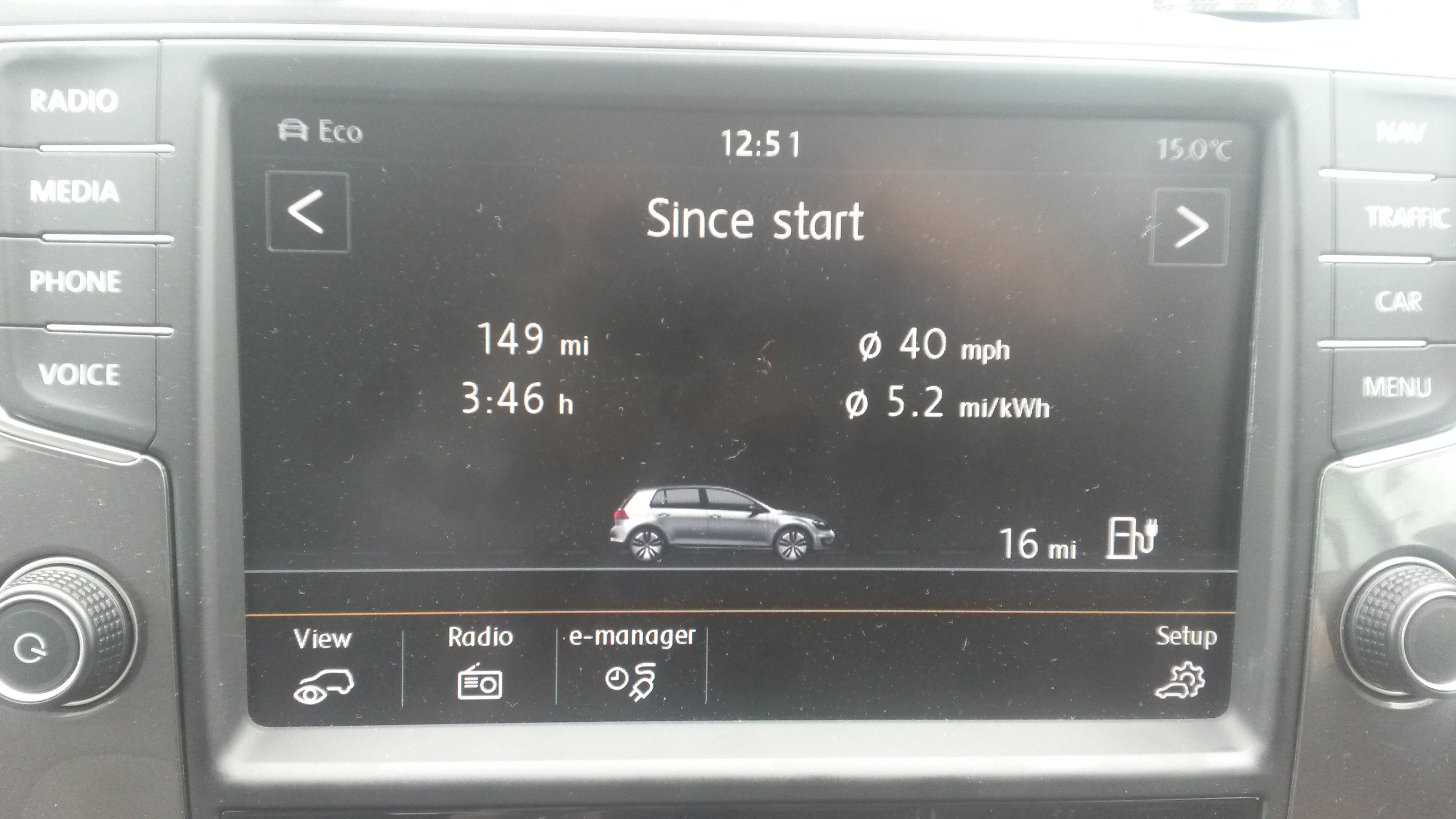
e-Golf figures

5.2 miles per kilowatt hour is pretty impressive for the speed and terrain!

Frankly, managing to AVERAGE 40mph across Snowdonia and mid-Wales is not bad in any car. But to do it while achieving a very creditable 5.2 miles per kilowatt hour impressed me no end. Clearly all the momentum-conservation tips I’ve learnt through 2CVing came in useful, as did actually allowing the car to slow on hills rather than using all of that beautiful torque to keep the speed up. It was also fun, as I didn’t slow down much for bends…

At Holyhead, the only issue was that I first parked at a charger that didn’t have the DC CCS plug I needed. The other one did, and started charging straight away – no issues.

Electric Highway Holyhead

Just to prove it. That’s a ferry in the background at Holyhead.

The only other issue is that the port is unremittingly grim! I’m glad I only had to enter the main building to use the toilet. I charged to about 90%, giving a range of 100 miles, and set off back to Oswestry.

There seemed a little more traffic on the way back, so I made more use of the cruise control. I found it accelerated more gently when placed in Eco mode, so I sat back to enjoy the views, listen to BBC Radio 6 Music on DAB (where terrain allowed) and focus merely on not steering the car off the road. I did get fed up with a dawdler in a BMW at one point and made a lavish, range-sapping overtake. That torque means you can zip past and expose yourself to danger for a very short period. Confident I’d make it back with miles to spare, I allowed myself the luxury of a 60mph cruise.

There was one brief period after a long climb where the range dropped below the predicted mileage, and the car started frantically asking me if I wanted to find a charging station. For a giggle, I told it to do this, and it told me it couldn’t find any. None of the Electric Highway chargers seem to be on its map. This is poor.

But I made it anyway, gave it another charge, drank more tea (I refuse to comment on cookie intake) and headed home. I had way more charge than I needed, so got a positive hoon on along the A44. It’s a nice car to drive briskly. As I pulled up at home, the e-Golf reported that it’d clocked up 300 miles since leaving home that morning. In total, I’ve driven this car 700 miles since Thursday. Not bad going for any car, but unthinkable with an electric car only a few years ago. Truly, times have changed.

Road Test: Talbot Alpine LE. Dreadful but fantastic.

A quick break from the world of electric Volkswagens as I correct a massive oversight – how could I forget that I’d finally had a decent drive in a Talbot Alpine?

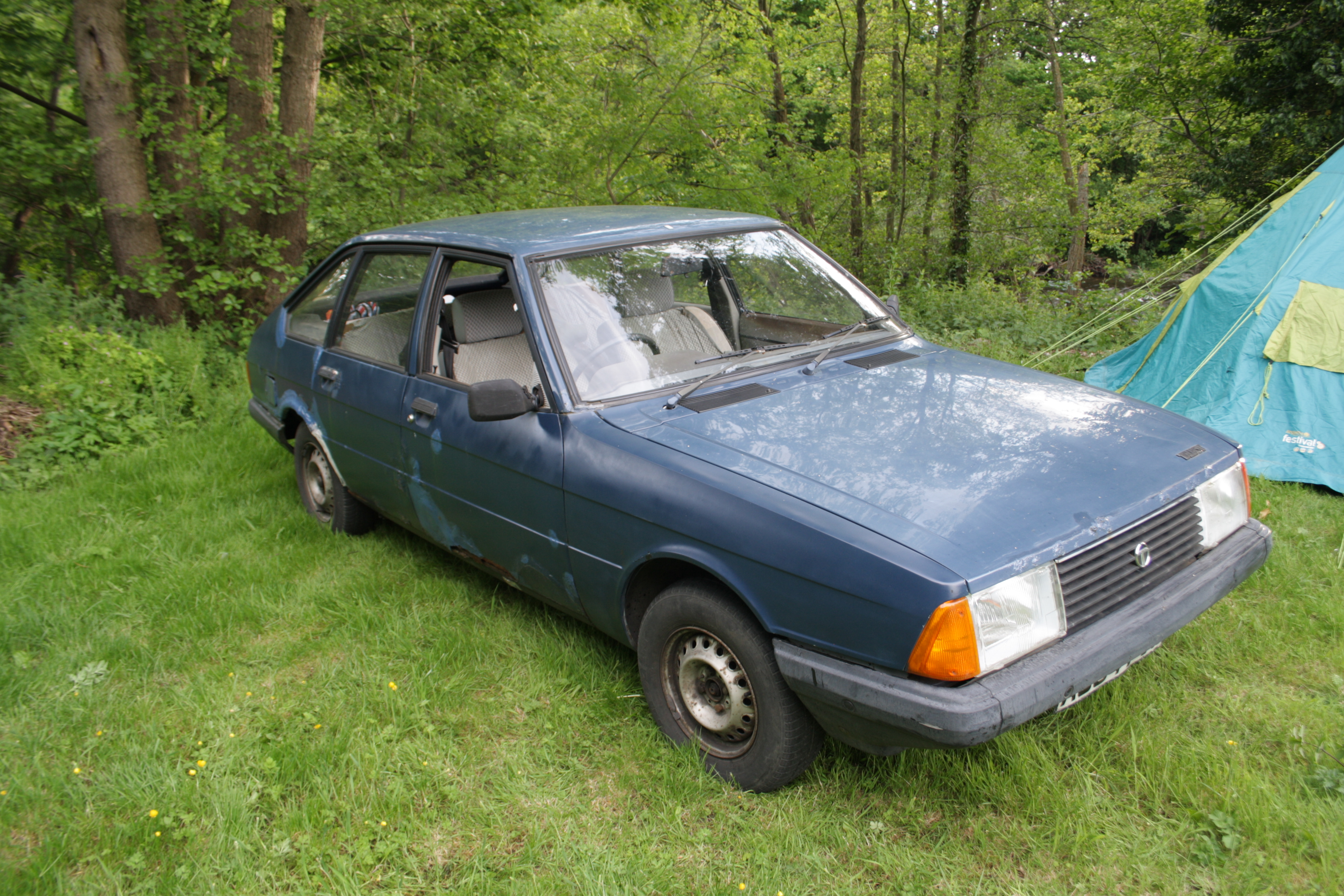
Talbot Alpine rusty

Sheer glamour, the other week. Surely it must be dreadful to drive?

I’ve long admired the Talbot née Simca/Chrysler Alpine. As Simca’s final flurry, it was a bold statement. It took the basic formula of the Renault 16 – hatchback, space, comfort – and brought it bang up to date, with sharp styling and quite a few less quirks. It was powered by the ‘Poissy’ four-cylinder, overhead valve engine that had first seen life in the 1961 Simca 1000. Ok, that bit was less bang up to date!

Sold as the Simca 1307 in France, and the Chrysler Alpine in the UK, the car took the European Car of the Year award in 1976 – the year after launch. That was also the year that UK production commenced, at the now-sadly demolished Ryton-on-Dunsmore plant near Coventry. Fewer than 200,000 were built there by the time production ended in 1986. Not a hugely successful run, though the Simca 1307/1308 sold much better – 200,000 were built by the end of 1976! This one model accounted for 7% of all French car sales that year.

The British were not so welcoming. The engines were seen as too noisy, and the market the Alpine was aimed at wanted a nice, conventional saloon. Like the Morrs Marina, Ford Cortina or Vauxhall Cavalier. Our loss really, as these are rather good cars. Chrysler Europe was sold to Peugeot in 1979, who dug the Talbot name out of the archives. The Talbot Alpine soon got a restyle, with a squarer nose.

This one looks dreadful. The body was absolutely hanging – at the time of writing, the entire rear quarter on the driver’s side has now been replaced and further work is ongoing.

Chrysler Talbot Alpine

Typical Talbot Alpine rot. This has all been cut out and replaced now.

Oddly, this base LE model has the 1592cc, 89bhp engine. It starts promptly and isn’t as noisy as you might expect. A lot of the ‘Simca rattle’ is down to poorly adjusted valve clearances. It certainly sounds much healthier than it looks! The seats are typically French – very soft, with coverings that have disintegrated in UV light. Pulling away, you soon realise that this is an exceedingly jolly car to drive. It feels leagues ahead of the Cortina/Cavalier/Marina trio. How stupid British conservatism can be. It is hard to place it as a car of the 1970s as it feels much more like a Cavalier Mk2 or Montego. The steering is particularly nice and while the car rolls a bit in bends thanks to that soft suspension, it corners really, really well. They do have a reputation for understeer if you push too hard, but that’s easily avoided by not pushing too hard.

The engine pulls staggeringly well. I tested the car up my favourite hill, and it just loped up it in fifth gear! You barely need to change gear at all, which is a shame as it shifts very nicely, with seemingly none of the baggy nonsense that a Peugeot gearchange usually entails – jump into a Peugeot 205 to see what I mean.

Shabby chic? Soft seats offer great comfort.

Shabby chic? Soft seats offer great comfort. Very 1980s in feel, even though design dates from 1970s.

Overall then, this car was one of the biggest surprises from a day of driving ‘dreadful’ motor cars. That honour is perhaps shared with the Lancia Y10, but while the tiny Italian tearaway was an absolute hoot, it’s the Talbot Alpine that I’d much rather own on a day-to-day basis. A shame then that they rot so readily! I’m glad this one is now getting the restoration it deserves.

Road Test: Volkswagen e-Golf. The not-so-good

Road Test Part 3. Part 2 (Clever Tech) here

No car is perfect. Not even the Citroen 2CV. So here are the less-good things my review on the Volkswagen e-Golf has found in my real-world road test.

Firstly, there’s price. At £27,395 on the road, this one is certainly not what you’d call cheap. I configured a top-spec Nissan LEAF Tekna with metallic paint, all-round parking sensors and a meaty 6.6kW on-board charger (quite expensive at £1150 extra) and the on the road price was £25,590. With the LEAF, you can down-spec (Visia trim starts at £16,490). With the e-Golf, there’s only one level of trim and quite a lengthy options list.

Electric Car Charger  EV

Free, non-smelling fuel – but charger confusion ruins dream.

You cannot specify a 6.6kW charger with the e-Golf, which is probably the next big hurdle. The optional bigger charger means a 32amp home supply can charge a LEAF in just four hours. The e-Golf will take eight – which isn’t that useful a saving over the 13 hours it takes to charge from a simple 13 amp plug. In short, it means it needs to charge overnight. Volkswagen are aware of the issue and there is talk of an upgrade to the spec at some point. Really though, they’re behind the game in this regard. Kia already packs a 6.6kW charger as standard on its Soul EV. Incidentally, the Soul EV’s RRP is £24,995 after grant, and it packs an impressive spec – including a 7-year, 100,000 mile warranty. Metallic paint is free.

The e-Golf has another downside to charging – albeit one which is steadily improving. To rapid charge with DC (say at motorway services) you need to find what’s known as a CCS charger – Combined Charging System. Sadly, most DC rapid chargers use a ChaDeMo plug. It doesn’t fit the e-Golf. There are two CCS chargers in Wales. One is on Anglesey, the other is in Llanelli and doesn’t work. I visited one in Oswestry the other day, but got confused by the complete lack of labelling on the charger, and pages and pages of info in the owner’s manual that I found it hard to make sense of. I just could not easily see the information I needed and hadn’t realise that a lower cover needs removing from the charge port to allow use of a CCS plug. I did get the AC socket to work, but that relies on the slow on-board charger, so it took two hours to get enough juice on board. And I then discovered that this was not enough after encountering a few hills! I was forced to stop at the excellent EV-friendly Blaenglanhanog self-catering cottage where the owners kindly let me juice up some more. That took another two hours. Sure, some of this was my fault – I should have taken longer to make sense of the handbook – but it goes to show how something easy may not see so to a novice. It should be noted that more CCS chargers are being rolled out. See ZapMap for more.

Fast charging wall box

The friendly folk at Blaenglanhanog allow me to use their fast charger.

To be honest, those charging issues are the main gripe with the e-Golf. Yes, the ride is a bit firm and jiggly at times, but that’s sadly common with many modern cars. Low-profile tyres certainly don’t help here. I’m also not all that keen on how wide the centre console is – what’s hiding under there? It’s like the transmission tunnel in an E-Type Jaguar and I find my leg rests, uncomfortably, on the hard plastic if my foot is on the ‘clutch’ rest.

That’s probably just a personal thing though, as is annoyance at the number of beeps and bongs. One final issue was revealed as I visited Blaenglanhanog though, which is along a gated track. The e-Golf chucks a massive hissy fit if you get out while it is still ‘running.’ In effect, you have to restart it every time you get back in. Which can be quite often on a gated road!

EDIT 25/06/15 I need to add a few more gripes now I’ve covered over 700 miles in this car. The first one is that the climate control resets every time you turn it on. It puts the temperature to 22 degrees, and puts it on Auto. I find this infuriating after a bit as I have to keep putting the settings back to where I want them (usually a lower temperature, or off entirely). You can access very little information about the car while it is charging too – the info screens won’t show anything unless the ignition is on, which we are told not to do while charging. It’s important to have stuff to play with while sitting there charging! Not huge things, just things.

Next time, I’ll reach my conclusions and later on, I’ll discuss EVs in wider detail – the good, the bad and the downright frustrating!

Road Test: Volkswagen e-Golf – Clever Tech

Road Test Part 2. Part 1 here.

The Volkswagen e-Golf is not a cheap car – the one I’m driving has a retail price of £27, 395, which includes the £5000 plug-in grant from the government. However, it does pack in quite a lot of tech, and has some features not found on other EVs. That said, it also lacks kit in some ways, as we’ll find out on my Downsides report.

Let’s stay positive for now though, with the two headline features for me. These are not exclusive to the e-Golf and can be specified on any Mk7 Golf. They are Parking Assist and Adaptive Cruise Control (ACC). The former is a nice show-off gimmick. The car will literally steer itself into a roadside parking space, while you operate the pedals. Quite snazzy, but it does have its limitations – ie space size. It won’t shuffle back and forth into a tiny space. [EDIT – I’ve since discovered that it will do this if you switch between D and R]

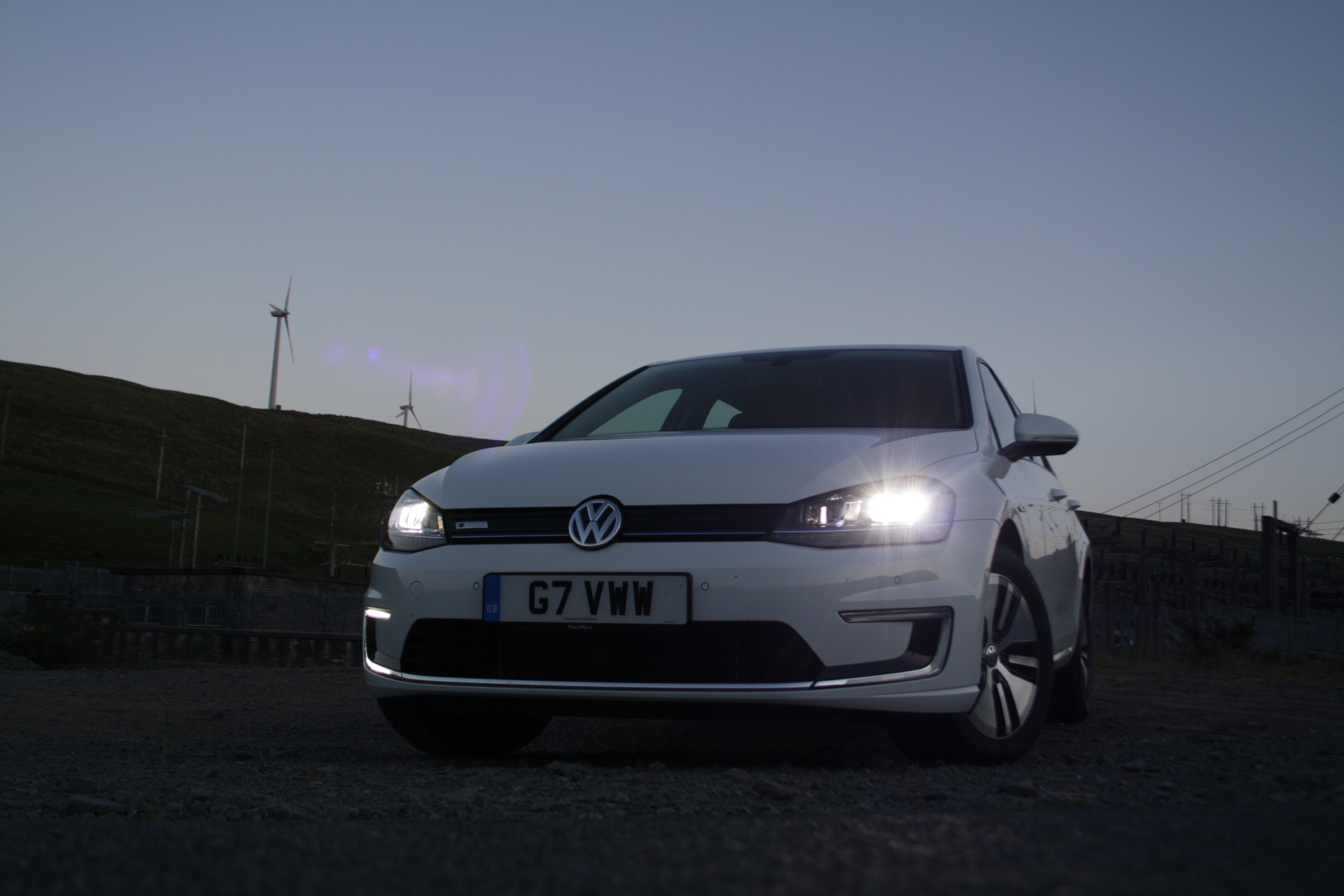
e-Golf headlamps

LED headlamps certainly help you keep an eye on the world.

The ACC is far more impressive in reality, and a lot more useful. You set your cruise control speed as normal, but a front-mounted radar will slow the car if you encounter slower traffic. Here in rural Wales, I found this system very useful on busy trunk routes. You find that all you have to do is steer. For miles and miles! Follow another car and the e-Golf will even slow down for bends (assuming the car in front does!). It’s hugely relaxing – once you’ve got used to trusting the car. It even spotted a motorcyclist turning left, and slowed the car right down behind them as they turned. Most impressive was how it brought the car to a halt at a set of temporary traffic lights as the car in front did likewise.

Oddly, I found this reduced control quite comforting. It was far more relaxing (and better for battery life) to sit back with the slower traffic rather than attempting lunatic overtaking manoeuvres. A petrolhead should not like this hint of automated driving to come. Thing is, on a really busy road, it’s hard for a petrolhead to have much fun anyway. The result is, I really like this feature. Trusting it is tricky at first, as you’re convinced that parked cars and oncoming traffic will confuse it. It didn’t get confused once during over 100 miles of driving with it turned on so far though.

Other smart tech unique to the e-Golf includes LED lighting front and rear. The headlights are formidable, yet consume much less power than Xenons or Halogens. There is also a multifunction display, which can tell you a lot about your driving – average economy, speed and so on. I didn’t find it as good as Nissan’s system, on which you can monitor power usage as you drive. Then you can see what difference climate control and headlamps make to power consumption. There are at least eleventy twelve ways of playing music on this car, with USB ports, SD card ports and even an Aux input. The radio is DAB and allowed me to listen to the cricket on Five Live pretty well, even in remote Wales.

There is an auto-hold function, should you be performing a lot of hill starts. This means that if you bring the car to a halt, you can remove your foot from the brake pedal and the car will remain where it is until you accelerate. Saves blinding people with the brake lights, and means you don’t have to use the stupid electronic handbrake. (not a specific e-Golf problem, I absolutely detest electronic handbrakes). You can turn auto-hold off, which means the car will creep as you release the brake, much like a conventional automatic.

Unnecessary badge picture.

Unnecessary badge picture.

I didn’t explore the Car Net, but this apparently allows you to access some functions from your smart phone. That’ll be things like climate control, lighting and charging status – useful because there’s no way of telling at a glance how charged the vehicle is. Nissan’s EV range has three lamps that indicate rough charge level.

Other scary tech includes Automatic Post Collision Braking System. If you smack something, the car will slam the anchors on to try and stop you smacking something else. I opted not to test this functionality, at the time of writing. Nor did I test the Driver Alert System, which tries to guess if you’re falling asleep. It monitors your driving to spot anything out of the ordinary – presumably like swerving unnecessarily or departing from lane.

Optional but fitted to this vehicle are the horrible, bland white paint (£260), the winter pack (£380) which consists of heated seats and washers, a wireless heated windscreen (£295 – a wired screen is standard) and the £315 fancy pants conductive mobile phone connection to use the car aerial. This apparently includes a phone holder built into the centre armrest, but I could find no such thing on this car. I even read the manual.

Next time, some of the less good points of this very impressive car.


Road Test: Volkswagen e-Golf first impressions

Volkswagen is pretty unique in offering conventional, hybrid or electric versions of its family-favourite Golf hatchback. Given my increasing love of electric vehicles, it was naturally the fully blown e-Golf I opted to test. In short, this is a Golf, but with a transversely-mounted 85kW/115PS electric motor driving the front wheels via a single-speed transmission and with a 24.2kWh, 318kg battery back mounted at the rear. It has a claimed range of 118 miles per charge. The weight of the e-Golf is 1585kg, which is 200kg more than an equivalent diesel.

e-Golf

A very clever, thoroughly conventional car.

In reality, it’s just like a Golf. You get in, twist the key in the ignition, select Drive on the automatic gear lever, press the handbrake release button (electronic – annoying) and off you go. It feels very conventional, if eerily silent as you come to a halt.

Once you’re on the move, it’s like the smoothest automatic you’ve ever driven. There’s grunt instantly if you require it, but the key to getting the best out of an electric vehicle (EV) is to drive as smoothly as possible. The seamless power supply certainly aids here, as does nicely weighted (if slightly lifeless) steering. A power counter replaces the rev counter, and the key is to keep it in the blue range. The gauge goes from zero to 10 but you really want to try and keep the needle below three. The needle also swings the other way, into a green zone, which is when regeneration occurs. This is where the motor turns into a generator, which gives an engine braking effect, slowing you down without having to brake.

You can accentuate this feature through no less than four modes. In D, you can knock the gearlever left to access D1, D2, and D3, which gradually increase the regen effect. Or, knock the lever down to put it in B mode (like on a Nissan Leaf) which gives a really strong regen effect. I see no reason not to use this really.

Selector

Gear selector is just like an automatic, but with a B mode for more regen.

In reality, you find yourself controlling your speed almost exclusively with the throttle pedal. Lift off completely and the car slows quite dramatically (it does illiuminate the brake lights). Lift a bit less and you can manage that regen effect to slow as much or as little as you like. It isn’t very often that you have to actually use the brake pedal. Even then, the first bit of travel merely increases regen further before the actual brakes come into use.

The ride is mainly composed, but a bit jiggly over some surfaces. 55-profile tyres probably don’t help here. Otherwise though, it’s all reassuringly conventional. Road noise is quite pronounced, probably because there’s a complete lack of any other noise. It’s very easy to drive smoothly, but if you do decide to burn up the amps, it can be very entertaining too. It has superb weight distribution, so it’s really well poised if you decide to really push on. The vast wave of torque means you can dart very swiftly from corner to corner.

LED car lights

LED lights front and rear reduce power consumption.

There’s plenty of room in the back, though tall adults may find a lack of under-thigh support. There’s loads of knee room though. The boot is a decent size, but not overly generous. The charge cables live in a bag beneath the boot floor. On a regular Golf, this is a much larger storage area.

Next time, I’ll talk about some of the clever features of the e-Golf, some of the downsides and later on, some of the major problems with electric vehicles in general. If you have any queries about the e-Golf, ask away!

EV Road Test: Volkswagen e-Golf intro

Ok, a break from the shambolic cavalcade of shabby old cars, as I conduct one of my Electric Vehicle Road Tests. The Volkswagen e-Golf has arrived. It has 104-miles of range showing and we’re about to head out to start the tests proper. Naturally, I haven’t read the manual, understand that the range is going to drop quite rapidly as soon as I encounter a hill (about quarter of a mile to the first one) and only have a vague idea of where suitable chargers are.

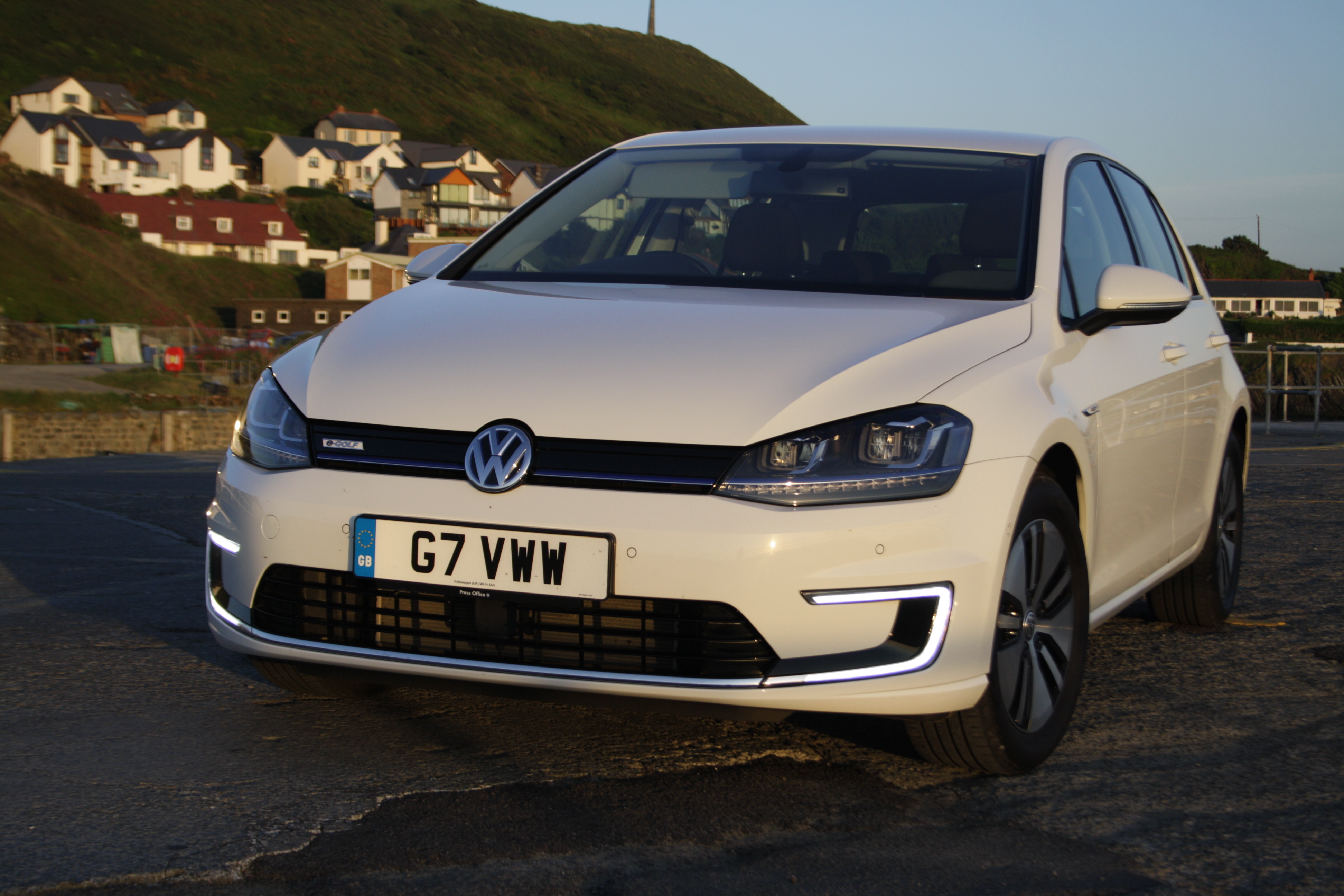
The e-Golf has landed. Let the test commence!

The e-Golf has landed. Let the test commence!

Let’s be honest. The terrain here in beautiful mid Wales is not ideal for electric cars. That said, the number of long descents allows for a good amount of regeneration – putting charge back into the batteries rather than using the brakes to slow the vehicle. So, it’ll lose a fair bit going up, but will get some back coming down.

Over the next week, I aim to get a realistic feel for the range of this vehicle well away from city limits. Stay tuned for more as it happens. I’ll be live-tweeting my experiences.

Road Test: Lancia Y10 1.3GTie entirely wins me over

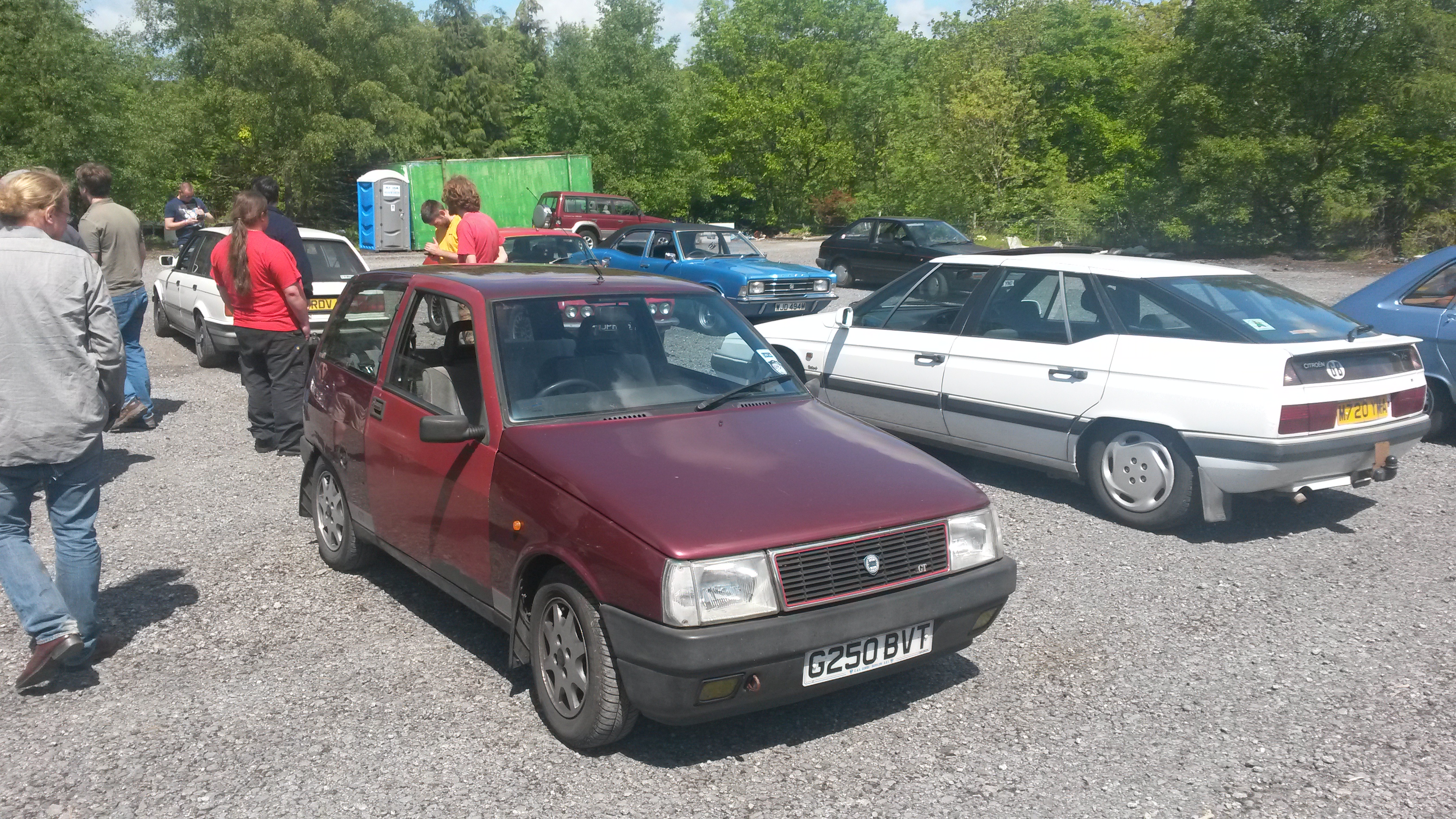
This is a car that attended Shitefest last year, after a monumental weld-fest. Unsurprisingly, it was rotten as a pair, and most of the underside had to be replaced. I didn’t get to drive it last year, so, despite the owner now temporarily living in Australia, I thought I’d better not miss out this time.

While the owner is away, he has loaned the car to various members of the Autoshite forum. It was one of these temporary carers who brought it to Shitefest.

Y10

Tiny Lancia is sheer joy to drive.

First, a bit about the Y10. In Italy, it was actually badged as an Autobianchi – the spin-off from Fiat that has a history of producing slightly-quirky designs, such as the Primula – the first modern-era hatchback with a transverse engine and end-on gearbox. MacPherson strut front suspension is allied to a dead ‘Omega’ beam axle at the rear. This formed the basis of the suspension improvements on the Mk2 Fiat Panda, when the simple leaf springs were replaced by coils.

This one is a GTie – which replaced the frenetic Turbo in 1989. It uses a 1.3-litre engine, not one generally used on Fiats at the time, but an overhead-cam version of the Fiat 124 engine, built in Brazil. It seems the Y10 uniquely used a fuel injected version of this engine. Power output is 78bhp.

I’d heard people say these cars were a good laugh, so I climbed aboard with many great expectations. The first thing that struck me is how wide this car felt for a small thing! It’s a bit Tardis-like. The engine isn’t overly quiet, but as I accelerated up my favourite test hill, I actually hooted out loud! Gosh, this car is hilarious! A kerb weight of 850kg means there’s not much weight to shift, but it really does feel a lot more powerful than the paper stats suggest.

The pedals are tiny though, so its best to avoid braking. That’s fine, as this car handles absolutely superbly. It makes Minis seem a bit reluctant with the way it dives into corners at seemingly suicidal speeds. I just had not expected a supermini to be such an absolute riot. I imagine it’s not bad on a long trip if you can resist endlessly wringing its neck.

You can keep your XR2s and MG Metros though. When it comes to diminutive fun, this is my new benchmark. It’s entirely worthy of the Lancia badge.

Road Test: BMW 335i Touring

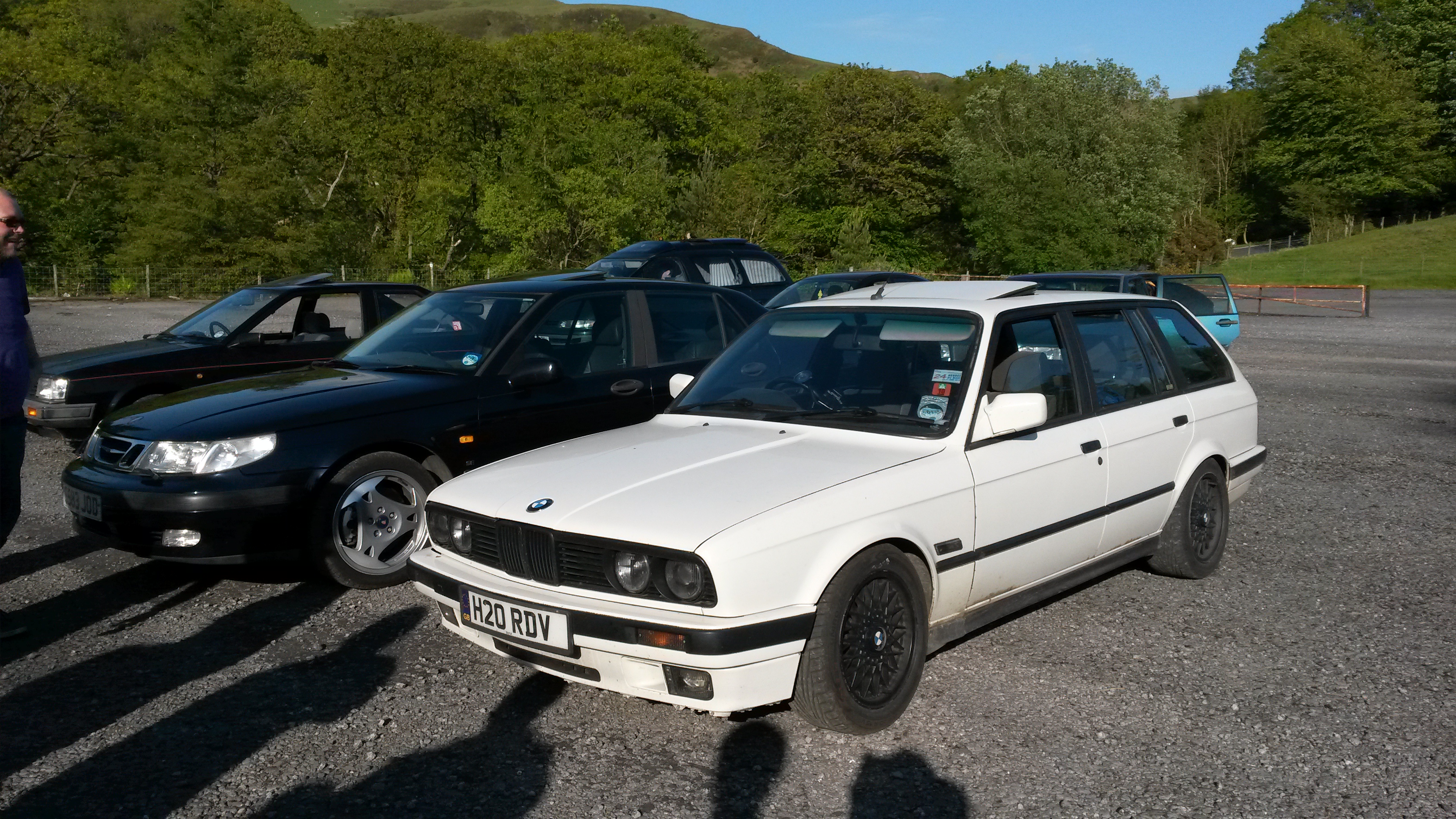
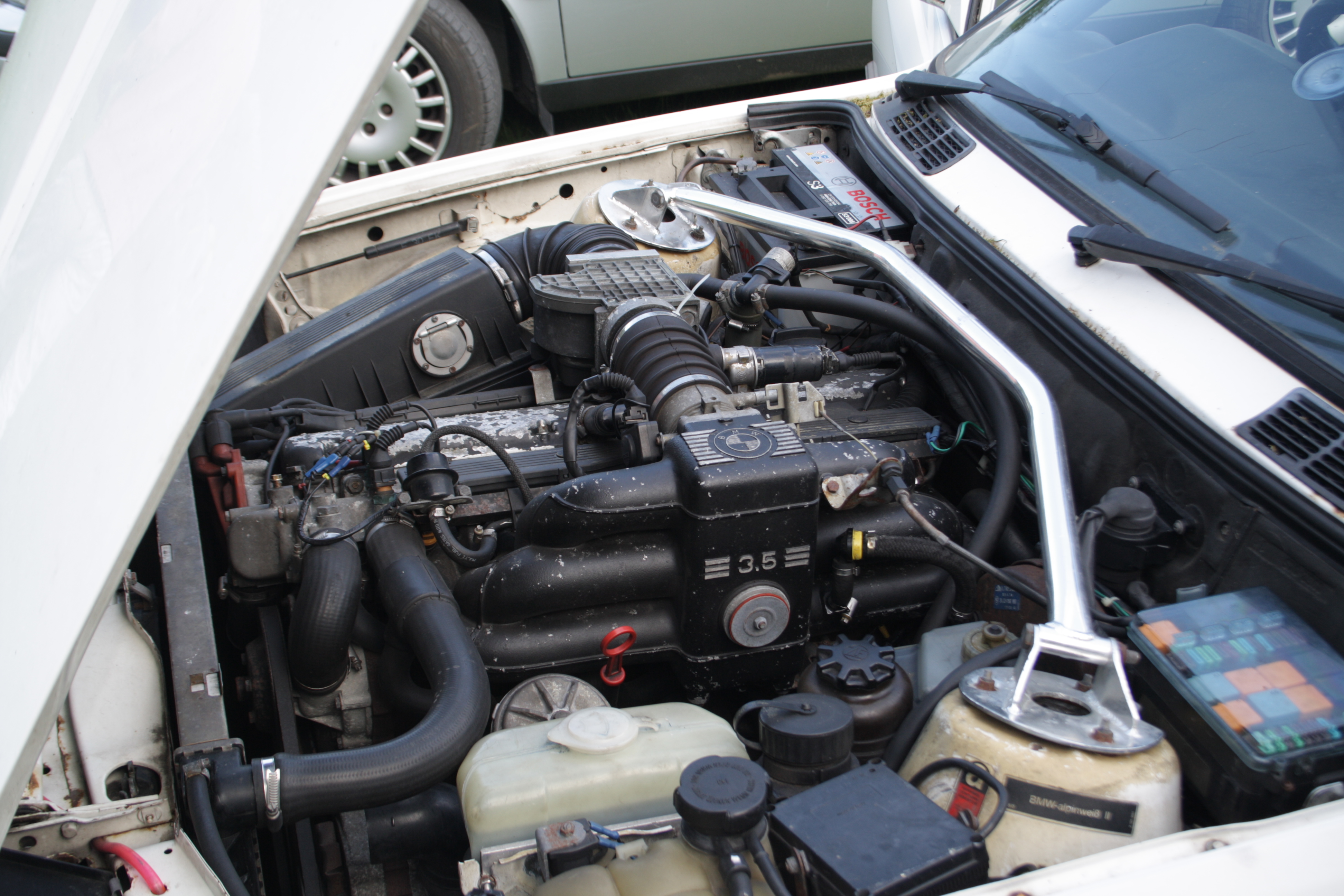
BMW E30 fans will already be querying the model name that doesn’t exist, so that tells you already that this is no normal motor vehicle. Open the bonnet and you won’t find much spare space – this engine is a full litre larger than any E30 from the factory.

I must admit, I had mixed emotions as I clambered aboard this silly-looking, chopped-suspension estate. This is exactly the sort of car I don’t much like. Slammed, noisy and with more power than any reasonable person needs.

Meaty Beemer fends off hovering males

Meaty Beemer fends off hovering males

I mean, just look at it. Barely any suspension travel and silly wheels. Clambering aboard revealed a tiny steering wheel thrust towards your chest, and seats that grabbed you in a bear hug.

A twist of the key fires the six-cylinder engine noisily into life. I pointed the nose up a nice, steep hill and floored it. Cue loads of misfiring and not much acceleration. See? Silly car. Then the chap who owns it switched off the (now empty) LPG tank and encouraged actual petrol into the engine. I tried again.

Jeepers! We must have overtaken several scalded cats and excrement ladled from a shovel as we flew up the hill. The car showed the sort of disdain for gravity that I usually reserve for Tory MPs. It had that typical, smooth BMW six-pot bellow. Yes, it was louder than you might normally expect, but still wondrously smooth. I didn’t dare take it near the redline at first, for fear I might simply run out of road.

Not much space in here. Meaty.

Not much space in here. Meaty.

Perhaps the most annoying aspect was the way this car darted into corners. No roll, no upset if any bumps were encountered, just a lithe feeling that made you want to try harder next time. I did eventually trouble the upper echelons of the rev-range and it was something I just wanted to do again. Instantly. To do so in third gear would have taken us way beyond any desirable road speed though, so I didn’t.

That kind of proved my point really. It is a stupid amount of power. Totally unnecessary and very hard to exploit on the road without getting into trouble. So, why was I grinning so much when I clambered out?

Car provided by Fu’Gutty Cars.