BX brake investigations

As well as buying yet another vehicle, I actually spent some time at the weekend trying to fix one I already own. After the BX returned from a visit to Sparrow Automotive, I had been advised that the nearside front brake looked like it had been binding, and that the offside front brake had low pads.
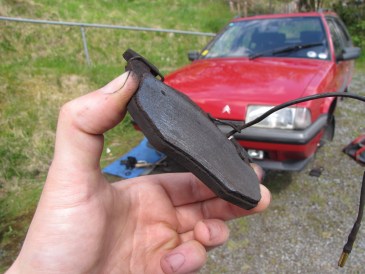
Low pads. These were replaced

Low pads. These were replaced

It didn’t take long to free the pads and have a look. The offside ones weer indeed very low. That’s not just important for braking ability – low pads don’t dissipate heat as well as fresh ones as there is less material to absorb the massive heat generated by braking. These were definitely bin fodder.

They were so low that I wondered if the caliper was sticking, but all seemed well enough. I wound the piston back and inserted the new pads. Job done on that side.

The nearside disc did indeed show some sign of getting hot, and had proved warmer to the touch than the offside after a drive. The first thing to do was disconnect the handbrake cable. This made no difference. Spinning the hub by hand, it still felt restricted. So, it was out with the pads and have a look at the caliper.
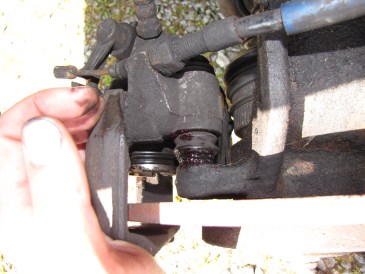
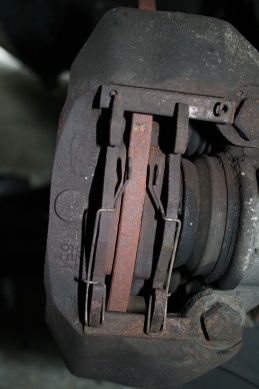
Slider rubbers not entirely healthy

Slider rubbers not entirely healthy

It’s tricky to see in the above picture, but right in the middle of the shot is a rubber boot. This covers one of two sliders, which allow the caliper to move back and forth. There’s a single piston which thanks to the sliding action, can push on both sides of the disc at the same time. One boot had a slight tear in it, but the sliders were doing their thing. I greased them up with heat-proof grease.

The piston itself was very difficult to wind back in. This is perhaps the most likely problem – applying the brakes pushes the piston out and corrosion is preventing the piston springing back in as the pedal pressure is removed. I cleaned the piston as best I could without removing it, then greased it and wound it back in. This was hard going but I got there in the end. With new pads fitted all-round, I started the engine and gave the brake pedal a good shove. This apparently helps reset the handbrake mechanism. Only then did I connect up the handbrake cables. The result was the best handbrake I’ve ever had in a BX!

I’ll keep a watching brief on that nearside caliper. Chances are it’s going to need replacing, but I may have squeezed a bit more life out of it yet.

This BX is improving. I felt very gloomy about it not long ago but the replacement spheres fitted last week have massively improved how the car feels. I still need to replace a rear arm bearing, which will improve things further, but the biggest challenge is to stop it smoking. It really does create a smokescreen when the turbo kicks in! There are many things it could be, and I’m no closer to finding out what it is. To be continued…
Mood swings

I got the BX back on Wednesday. Hoorah! £413 later and it had undergone a thorough re-piping courtesy of Sparrow Automotive. Problem was, the drive home was a bit meh to be honest. That after I’d stepped out of a battered Skoda Felica (thanks for the lift Rob!). Actually, I was quite taken by the Felicia to be honest.

It never helps when you’ve spent a lot of money on something invisible. Apart from a notable lack of green puddles when the car was running, it felt absolutely no different to drive than before. That can be frustrating, especially when the suspension is far from perfect. One rear sphere offers all the damping ability of a space hopper. Then there’s the smoke it produces when the turbo kicks in, the heavy clutch, heavy throttle pedal and typical clunky BX gearchange. By the time I’d driven the 70 miles home, the ‘meh’ had turned into a full-blown ‘ugh.’ Part of the problem is that I knew the only way to make things better was to spend yet more money. Definitely ‘ugh!’

However, I woke up today in a promising frame of mind. I was at my desk working by 8am, and was pretty much done by 10am. I refused to curse myself for finally starting a feature I’d had two months to write. I like pressure. It helps focus the mind. That left a good chunk of day. So, I set about improving the BX. There are a million and one things I could try and fix, but I decided to start small. The rear screenwash hasn’t worked at all since I bought the car and reading the Blog from the previous owner on the BX Club, it didn’t seem to have worked during his ownership either – stretching back to 2010.

BX is still knackered, but rear screenwash now works

BX is still knackered, but rear screenwash now works

The simple thing to do would be to order up a replacement. I decided to pull out the screenwash bottle and pull the pump apart. I did test the pump by wiring it directly to a battery. Nothing happened. Demolition time. I took no photos of this, so you’ll have to take my word for it. The motor part comes away from the impeller part, so I was able to give the operating rod a twist, then wire it up directly to the battery. It span! Then I reassembled and plugged it into the wiring loom. It didn’t run. Cleaning the contacts improved matters and I now have a working rear screenwash. Result!

Now that’s one tiny fix, but it’s a start. Fired up by this watery success, I headed online and ordered a full set of suspension spheres. That’s £100 gone. Then I ordered another £100 of anti-corrosion products for both the BX and 2CV. Yes, it was pay day today…

I did also investigate whether a clogged air filter might be contributing to the horrific smoke levels from the exhaust. It wasn’t, but I did discover a fair dose of engine oil in the airfilter suggesting a breather issue. It’s quite normal for engines to have a crankcase breather to deal with the pressure difference generated by moving pistons. Even the 2CV has one. These breathers can fail, though oil can also bypass the pistons due to ring wear and cause a similar issue. I’ll start with the breather though!

Again, I took no pictures because I’m rubbish. Imagine an air filter with some engine oil on it though, and you’ve got a pretty good idea.

I shall try and get my BX Mojo fired back up again. I need to rather desperately as we’re due to drive it around Scotland next month. I’ve got a fair bit of work to do before then including a front brake overhaul and a much-needed service…

The heroic snail returns

I very much enjoyed my week with a Citroen Ami, but while it was a lot of fun, the Ami was not my 2CV. Clambering back aboard my 1986 2CV6 Dolly made me realise just how special it is, and how much it means to me.

That’s good, because a bill for nearly £500 worth of work severely tested my loyalty! I usually spend that sort of amount to buy a car, rather than spend on it. It’s worth considering how much I’ve spent on the car in the past three years though. The total is pretty much sod all. Some paint, some oil filters, some spark plugs and oil. The most expensive expenditure in that time has been £100 for a new ignition barrel. I should have spent some more money on anti-corrosion products it seems, as the front bulkhead had corroded very badly indeed.

Once Pete Sparrow started digging, he uncovered this mess.

2CV corrosion bulkhead

2CV bulkhead rod. Yuck!

The toeboard, lower bulkhead and the leading edge of the front floors needed cutting back to good metal, and then new metal welding in. At least it was a fairly simple area to repair, though even simple repairs eat up the hours. Including all tinkering, the bill stated 10 hours of work, which is a day and a half.

It all looks better now.

Floors

New sections

Pete’s work didn’t stop there though. Elly has been sounding quite sickly for a while, clearly feeling the effects of my amateur spanner monkeying! A really good specialist will transform how your car feels. That’s exactly what Pete did.

First of all, he sorted out the steering. I’ve had a wobbly kingpin on this car for some years now, causing all manner of clonks and causing two MOT testers to frown in that manner that suggests I’ll be lucky if I get an advisory. I was lucky twice, but clearly pushing things a bit. The arm was worn though, so that was replaced with one taken from a car used in the action movie RED2. I’m not looking forward to seeing the film as when you see a 2CV flying through the air, that’ll be using the suspension arm now on my car! A new kingpin means the clonk has gone, which immediately makes the car feel nicer to drive.

The next step was to check the ignition timing. Unsurprisingly, it was out. Surprisingly, it was quite badly retarded – I thought it was if anything towards being too advanced! Proves what I know – very little when it comes to ignition timing. As well as correcting that error, Pete rejetted the carburettor and cleared out muck from the float chamber. The result is a car which is utterly transformed, feeling much more responsive and sitting at 65mph without resorting to the secondary choke. This should allow increased fuel economy.

It’s been an expensive MOT pass, but it has one more proved that while DIY tinkering is ok, specialists know a great many tricks when it comes to making your car run as it should. I feel like a rank amateur, which is probably because I am. While I can now work on most aspects of the 2CV myself, it’s a reminder that sometimes it is worth paying someone who really knows what they are doing!

So thrilled was I on the journey back home and I pretty much forgot about the Ami. I think that fact suggests I’ll be sinking a whole lot more money into Elly the 2CV in the coming year. End of the road? No. after 191,000 miles, I don’t think I can let that happen yet.

BX Heater – flap fear

Today, I have mostly been battling man flu and deadlines – all of which is very boring. However, I did manage to squeeze in a tiny amount of BX fettling.

The failure of the heater to supply any air was both frustrating and chilling on the drive home. My suspicion was that the flap on top of the heater unit – which should open when you turn the fan on – was not doing so. This job gave me The Fear, as most jobs involving BX heaters involve much cursing, even more dismantling  and a head-scratching session trying to work out how it all goes back together again. Was I right to be scared? Have a random picture before I continue.

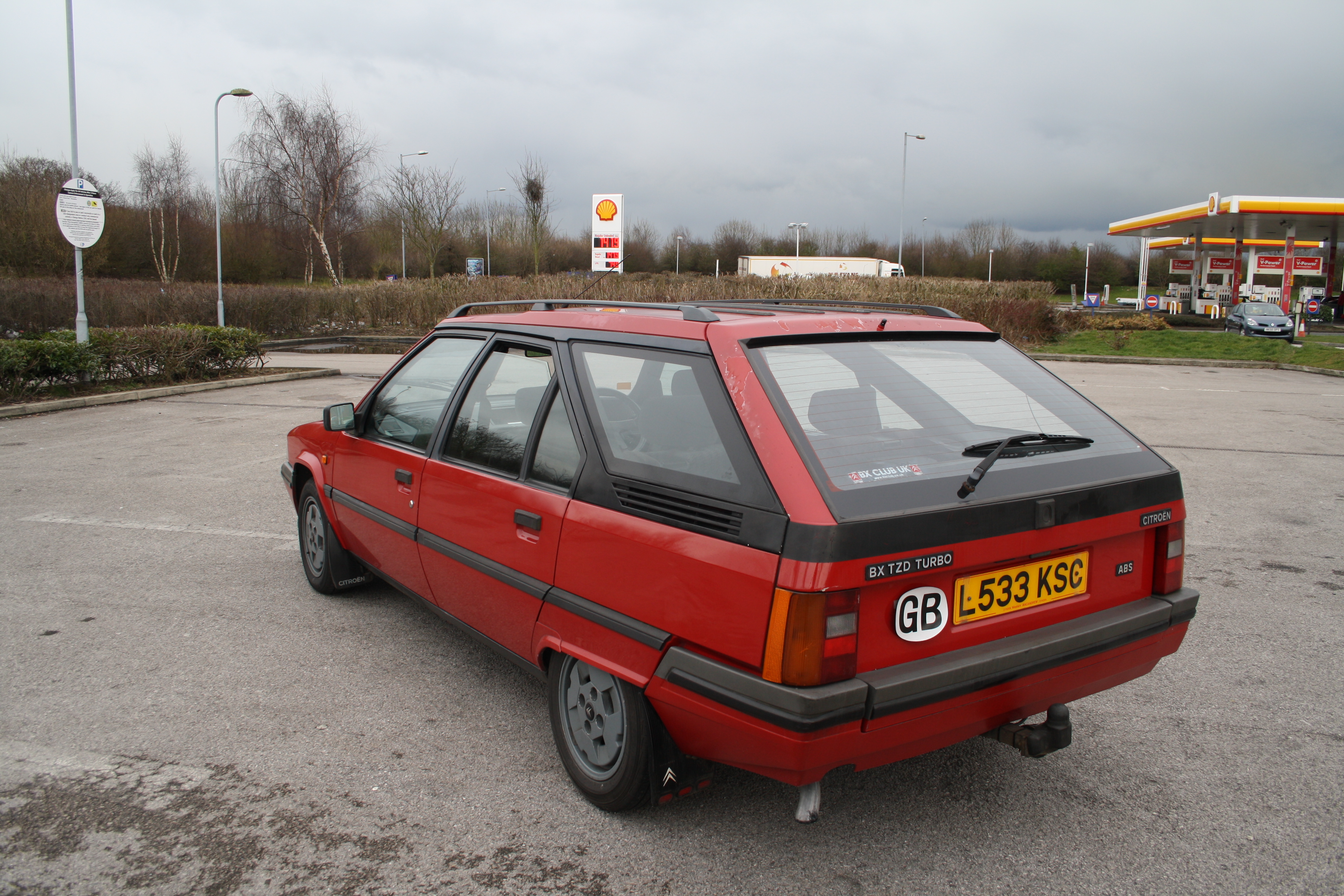
Citroen turbo diesel estate with steel wheels and trims

Random press shot of a TZD estate. I really like the wheeltrims.

Thankfully, checking the flap operation was simple. Just remove the scuttle panel (remove wiper arm and large plastic nut, then two fir-tree connectors) and an undertray to protect the wiper mechanism and you’re in. Three bolts and an easy-to-lose screw hold the blower motor in place. The wiring did not need to be disturbed. With the motor wiggled out of the way, it became possible to see that indeed, the flap on top of the heater unit was closed. Wiggling the control knob made no difference, so I pushed the flap open, refitted the blower unit and tested to see if this had worked. It did! A lovely waft of air from the vents.

Refitting wasn’t too much trauma but workload and illness meant the only other thing I’ve done is test that the towing electrics work. They do.  Apologies for not taking any pictures today. There really wasn’t time.

Mercedes – first jobs

After the drama of getting the car home, it was stuffed into my garage and I went inside to consume calories and to recover from the horror of the M6.

This morning I’ve had to finish off my news writing efforts for Classic Car Weekly, which has been frustrating as I was keen to have a play with my new motor. Eventually, while waiting for people to get back to me, a window of opportunity arose.

The car wasn’t too keen to fire up but did eventually, settling to a lovely even tickover. I thought I’d see if it’d behave on a test drive. It did until it got up to operating temperature. Then it was misfiring again. A duff distributor cap was the first point of call. I knew the previous owner had replaced the rotor arm in the past 40,000 miles, but there was no mention of a dizzy cap. Sure enough, once I finally got the thing off (access is terrible!) it looked like this.

Distributor cap W124 Mercedes

Icky dizzy, let’s get busy

I tried to clean it up, but it was like trying to improve the global environment by buying one canvas shopping bag. It didn’t achieve much. So, a new distributor cap and rotor arm have been ordered for a rather eye-watering £86 delivered. I can see me getting rather fed up with Merc ownership if it results in costs like that!

For now, it’ll have to await the arrival of a new cap. I turned my attention to other major issues. Like the headlamp wipers. The blades were knackered.

Mercedes W124 headlamp wiper blade

Knackered headlamp wiper blade. This was a priority job.

When I owned a Saab 9000 a while back, I made new wiper blades using cut-down scrap 2CV windscreen wiper blades. I reckoned I could do this again. I was right.

wiper blades

Wiper blades. This CCW was sent to us packaging a kettle. I don’t usually treat such glorious pages so badly!

Stripping the larger blades, I cut the rubber down to fit the headlamp blades. It took less than five minutes.

A small and rather unnecessary job, but it made me happy.

2CV – Tin (and rust) Snail update

My poor 2CV. Elly got rather neglected last year as I mucked about with a Peugeot 309, a Ford Maverick, a Nissan Bluebird and a pair of Citroen BXs. She only clocked up 3000 miles and spent a lot of the time sitting outside. I’m now paying for that neglect.

This afternoon though, once my deadlines had been met and enough tea had been consumed, I headed out to the garage. My aim was to finally get the exhaust fume-tight. The crossbox – which collects gases from each cylinder and which sits beneath the gearbox – broke on the 1st January. I fitted a new one, but the next link in the system – the swan neck – then failed on the 13th January. Two journeys conducted, both ended rather noisily. Yesterday, after doing battle with rusty clamps and mountings, I finally got the exhaust fitted again. It was blowing badly so I gave up.

This afternoon, I used a bunch of freshly purchased items to improve things. PTFE tape was applied to the swan neck as this sits inside the next part of the exhaust – the ‘torpedo’ silencer. Hopefully the PTFE tape will stop the two items becoming one, which is what normally happens. Then, I used some actual exhaust paste and some careful rejigging to cure the crossbox-to-swan neck leak. This worked! The torpedo sadly still has a leak. Some bodgery will take place before too long. It’s not bad.

Having reached this stage and with bits of bodywork removed, I decided it was an ideal time to set about a proper service. The oil was drained and refilled, and I fitted a new oil filter. I even took the rocker covers off, gave them a good clean out, retorqued the cylinder heads and checked the valve clearances. Then it was a case of checking the points, which means removing the fan. Not a problem to the seasoned 2CVer – a 14mm socket on a 3/8″ drive, a jiggle with a 1/2″ ratchet handle and the fan was off. At this stage I started realising just how scarily rusty the engine bay is…

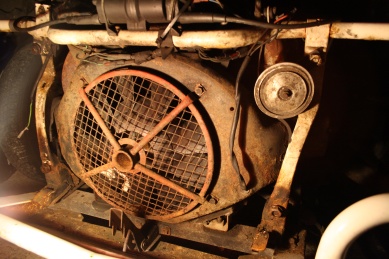
Moody night shot in the garage. Engine access is superb!

Moody night shot in the garage. Engine access is superb!

The fan shroud and cowling are in a dreadful state and the headlamp bar is getting very iffy.

Rust is becoming a real problem here.

Rust is becoming a real problem here.

Nonetheless, I continued, giving the points a clean up and re-setting the gap for the first time in five years. I love points-assisted ignition. It takes the strain off the points and it’s a credit to the simple, transistor-based system I use that the points have lasted so well.

Whenever the fan is off, it makes sense to check the oil cooler. All was well here.

New spark plugs were fitted, making sure not to over-tighten them. The ham-fisted find it very easy to strip a thread. Then I set about replacing a broken engine mounting. You can just see it below the cowling in the above photo. That explained why the engine seemed fairly mobile! It was rocking around more than it should. I also pulled out one of the brake pads – they’re down to about 3mm of material, so replacements won’t be too far away. They were fitted at the same time as the ignition upgrade back in 2008.

That leaves me with greasing still to do – kingpins, knife-edges and steering rack – and it’s about time I checked the rear drum brakes over as well. The air filter might get a clean if it’s really lucky.

I then took more pictures of rust. I really need to get on top of this. However, my main objective is to get Elly roadworthy again (I need to sort out a few wiring issues) before going to see top 2CV tinkerer Rick Pembro who can hopefully sort out a wobbly kingpin. Something I’ve been meaning to get sorted for about three years now…

Here’s some more rusty pics. Until next time…

Close up of the rust.

Close up of the rust.

I haven't been parking it in the sea, honest!

I haven’t been parking it in the sea, honest!


New project, new problems

Whenever you buy a car for less than £500, it’s pretty realistic to expect some issues. Even my bargainous Bluebird required anti-roll bar drop links and a service and it now seems to be demanding a new thermostat too.

Small fry compared to my new BX though! To be fair, the BX was cheaper (by an entire £25) and good turbo diesels usually change hands for far more money. So, it’s fair to say that I was expecting the odd niggle. However, since I bought the car, it’s generally been doing this.

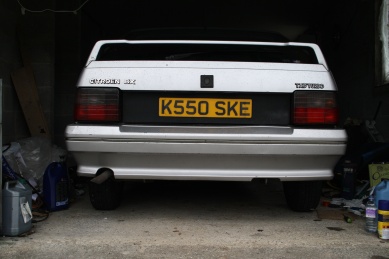
Citroen BX turbo diesel

My new car actually LOVES garages and hates driving at the moment, the reverse of a 1980s advertising phrase…

Sitting in my garage, awaiting parts and attention. The 2CV has been booted outside into the rain.

The drive home revealed a nasty clonk from the front end but when I went to investigate, I found other problems too. For a start, both hydraulic strut return pipes were broken. These allow the front suspension units to breathe, and allow fluid to return to the reservoir. Rather than do that, the fluid was instead spraying all over the front wheel. No wonder it was losing fluid!

This was the other problem.

Disc brakes seized slider

A brake that is broken

Can you see the problem? The pad on the left has suffered much more wear than the pad on the right. It was the same issue that dogged my Maverick earlier in the year – stuck sliders. With single-piston calipers, the whole assembly moves with the piston pushing against one pad, and effectively pulling against the other as it does so. It should give even braking but these calipers rely on sliders to allow the movement. If the boots that cover them get damaged, the sliders seize and the braking is lopsided, leading to unusual wear.

Dismantling the caliper revealed that sure enough, the boots were damaged. No problem. I whipped the reconditioned caliper off the other BX and fitted it to the new one. I ordered up various parts and replaced the return pipes and also a seized handbrake cable.

While doing this, I discovered a lot of play in one inner track rod, which might well explain the worrying clunk from the front end. There’s still a fair bit to do with this car, but at least it’s working again for now!

Reaching braking point

In the past 18 months, I’ve rebuilt the Mini’s front brakes, a Range Rover’s rear brakes, tried to fix a sticky caliper on a Saab 9000 and pretty much completely overhauled the Ford Maverick’s stoppers. I was hoping I could take a break from brakes, but live isn’t always fair.

The problem now is the BX. One front caliper is suffering from a sticky piston, while the other suffers from a sticky handbrake cable (handbrake is on the front wheels). The two are combining beautifully to create binding brakes. Just like we had on the Mini, Range Rover, Saab and Ford. What is it with bloomin’ brakes?!

BX brake disc

First look at the BX's brakes while recommissioning. They worked fine a few months ago! This one now suffers a sticky handbrake cable

My mood isn’t enhanced – though it probably should be – by the 2CV just sitting there looking smug. In almost 100,000 miles of motoring, and 12 years of ownership, the 2Cv has needed one set of front discs, a couple of sets of pads, a pair of new rear shoes and that’s about it. No binding issues at all, thanks apparently to the use of alloy pistons.

The problem with the others? Steel pistons. What a rubbish idea! Being steel, they inevitably corrode and then seize. The other issue is that the brakes on these cars all sit in the wheels, so get covered in road muck. The 2CV wears its front brakes on the sides of the gearbox, in the engine bay, and further away from wheel-hurled muck. Whoever was in charge of 2CV brakes deserves a medal. Especially as they’re so powerful as well!

I’ve now got the decision with the BX about whether to rebuild the front caliper or just buy a replacement (as I did on the Maverick). £40 for a complete caliper, but not sure how much a rebuild kit would be. Probably a fair bit as the piston is gunked up enough to need replacing. Hopefully pay day will allow me the luxury of the expensive option! In the meantime, yet another hero on the BX forum is sending me another handbrake cable, so I can sure that issue pretty easily.

I hope that this will bring an end to brake-fettling for some considerable time. I can dream can’t I?

Project Budget 4×4: Brakes sorted

Just a quick blog today to report that the Maverick’s braking system is now fully functioning – albeit waiting for the new discs and pads to bed in. It does stop in a straight line now, which is nice!

There was a large delay in the brake project caused by me damaging some muscles in my back after the last session of brake tinkering. Also, I’ve ended up having to replace both calipers. So, that’s two new calipers (£67×2), new discs and pads (£55) and some other odd bits and pieces. Total expenditure is now over £800, but not by much. I look forward to using it now!

Project Budget 4×4: Budget gets stretched

Brake work on the Maverick continues, but all is not well. After the horrors of finding one front brake pad worn down to the metal, the overhaul has revealed further issues.

Ford Maverick tinkering

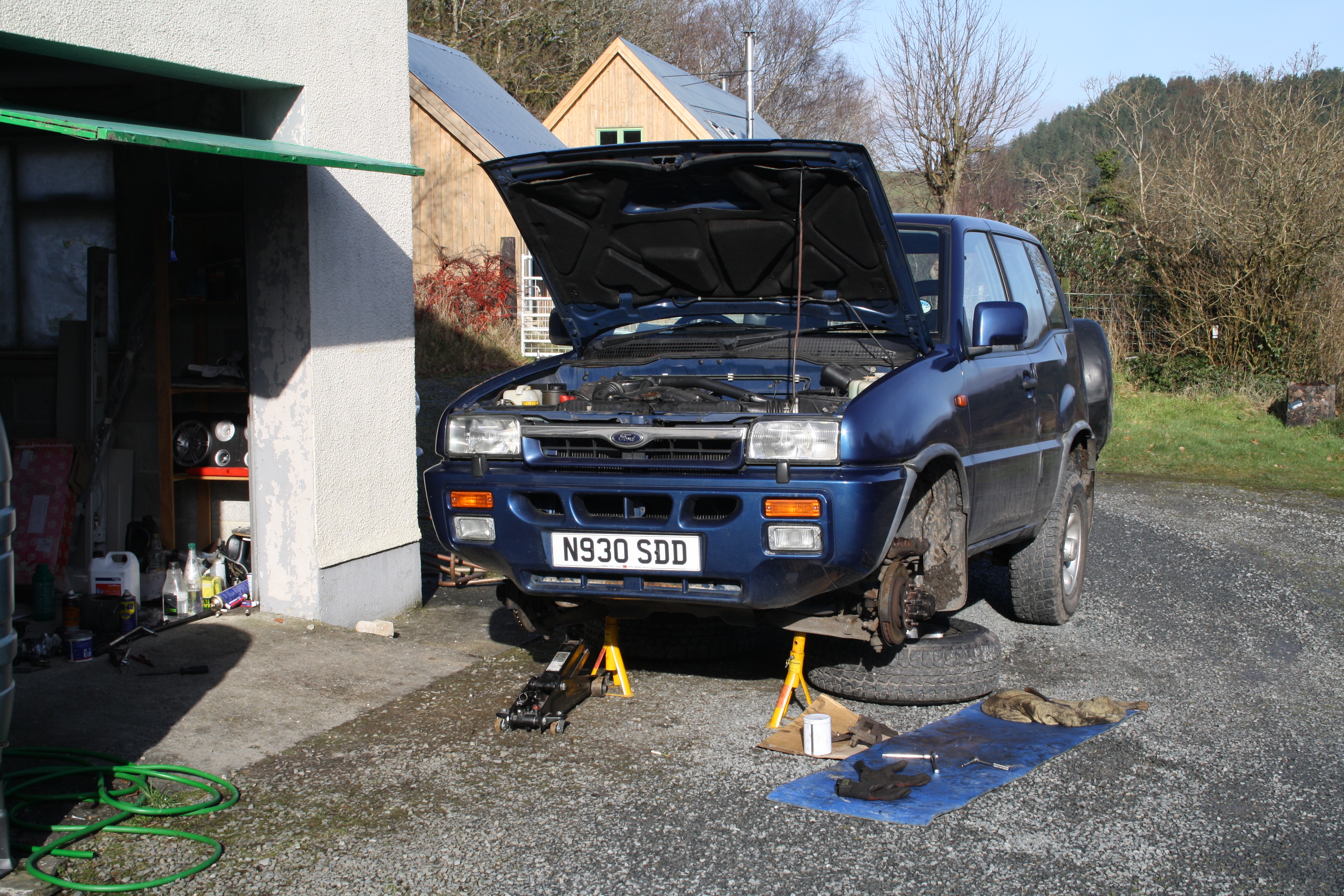
Yet more brake trauma. It should be great after all of this work! (axle stand more secure than it looks...)

The first step was to pull apart the offside brake – the one with the faulty caliper. During this work, it quickly became apparent that the slide pins that the caliper moves on were totally seized up. This is what caused extreme wear on one pad – the seized caliper pistons just exaggerated the problem. The advice on the Nissan 4×4 Owners Club forum was to remove the entire caliper assembly, so it can be worked on away from the vehicle. If I had a big vice, this would have worked nicely, but I only have a battered Black & Decker workmate, which wouldn’t really help.

The caliper itself is a unit that holds the pads. There are two caliper pots on one side which act directly on one brake pad. The pressure then pulls the whole caliper towards the inside of the car, which thereby acts upon the opposite brake pad. Presumably this is an economic measure as most 4x4s would have four caliper pots per front brake, rather than the two used here. I consider it a fairly flakey idea as it just allows something else to go wrong – the sliders in this case which prevented the caliper from moving correctly.

So, the caliper was quickly lifted out of the way. The next challenge was to remove the slider pins from the caliper carrier. Brute force was necessary, all the while bearing in mind that there’s a good chance of snapping the pins if you get carried away. The pins have a 17mm nut at the end, which initially made me think they had to be unscrewed. No. This is merely to allow you tighten up the 13mm headed bolts that hold the caliper to the carrier.

I used a lot of penetrating oil, and one pin responded well to a chisel and a hammer – eventually coming free. The top one was very, very stuck though. I tried waggling it back and forth with a spanner, then tried the chisel and hammer approach, all the while soaking it in penetrating oil. After a very lengthy battle, it finally came out. No wonder the caliper wasn’t working! On the passenger side, the pins moved beautifully under no more than light finger pressure.

Then I could remove the caliper carrier and then the hub and brake disc. This isn’t too tricky, though there are lots of bits to keep an eye on and remember where they live. The auto-locking hub has to come off (an ideal opportunity to lubricate), then a circlip and some washers, followed by the outer wheel bearing and finally the disc/hub.

Separating the disc and hub proved very tricky, on both sides. For a start, the 14mm headed bolts were a pain to undo. If I’d remembered the instructions I’d seen online, I would have undone these bolts while the brakes were still fitted. As it was, I had to use a bar to prevent the hub from turning. Then the hub and disc seemed almost welded together with rust and friction. It took another serious bout of hammer-and-chisel work to separate the two parts.

Then it was quite easy to fit the hubs to the new discs and re-assemble. A good opportunity to repack the bearings with grease.

Sadly, I ran into problems locating new sliding pins, so work drew to a halt. I thought I’d try reassembling the nearside caliper, but then realised that the pistons were seized here too! Annoyingly, I’d already ordered a new caliper for the offside, so missed an opportunity to combine postage. The calipers cost £67 each delivered. I did consider rebuilding the calipers, but I’ve done it before and it’s not much fun. The parts were proving almost as expensive as a remanufactured caliper anyway, so the bullet was bitten. That means that total expenditure is now past my original £800 desire. I am left hoping that future months will be much cheaper!

And that’s where the project remains for the moment. I’m awaiting parts and just to make life even more interesting, I strained my back badly while clearing up. I hope to recover in time to get the brakes completed this week…