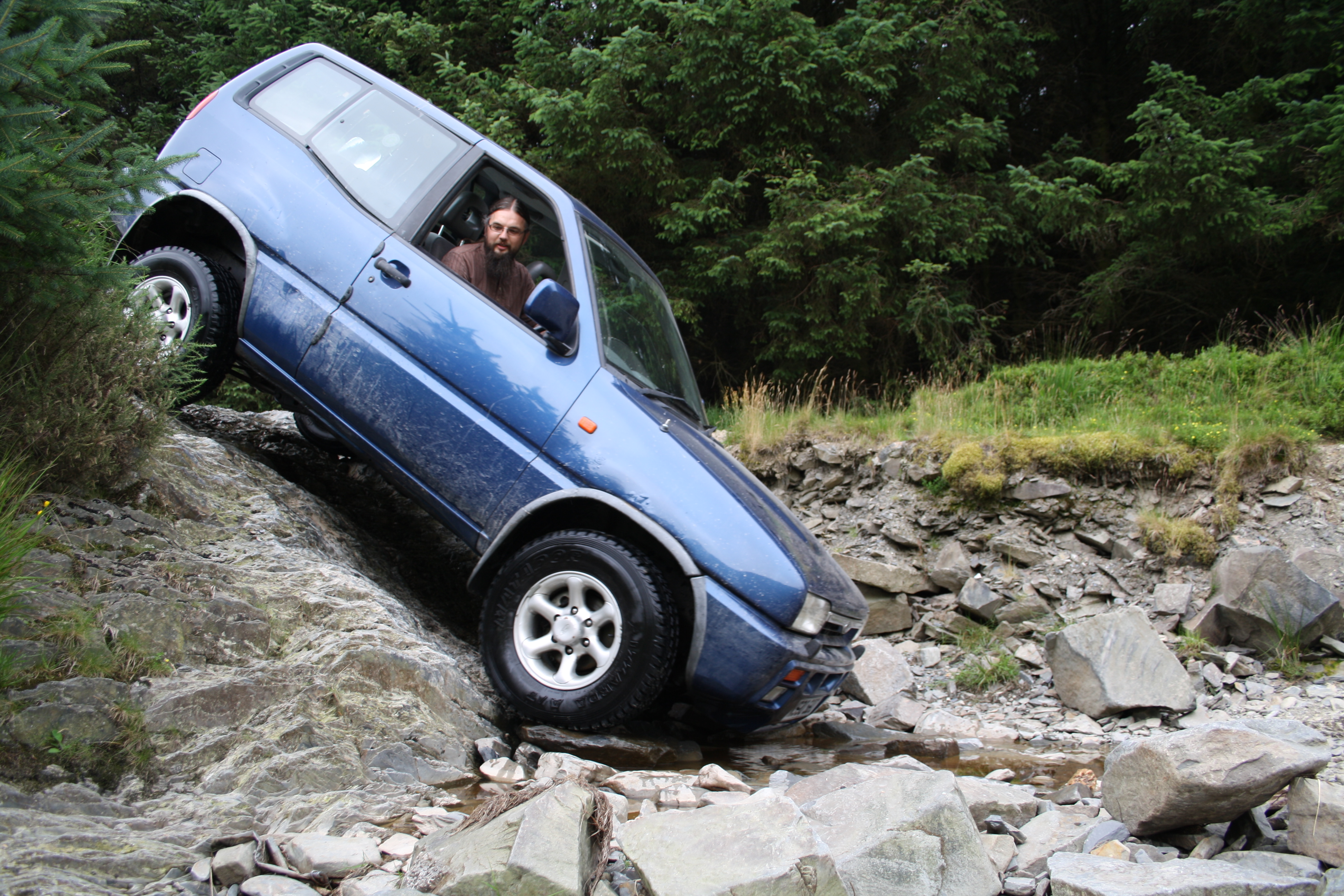
Blue, blue, Bluebird

Sorry for the recent lack of posts. It’s all been a bit manic recently. Fleet instability continues and I’m not at all sure that the Bluebird is going to be a long term contender. Which hardly makes it unique…

However, I clocked up a good 300 or so miles in it yesterday, which gave me plenty of time to get used to the blue seats, blue carpets, blue dashboard and even blue headlining. It really is very, very blue.

Nissan bluebird seat

It really is very, very blue this Bluebird.

It is very comfortable though, with lots of adjustment. There’s lumbar control and you can even use a knob on the side of the head restraint to move it forwards or backwards to suit. It’s certainly not a bad way to travel, though having been spoilt with Citroen ride comfort, it does jiggle somewhat. That can be annoying after a while.

With tall gearing though, it’s all rather peaceful. I was able to listen to the Invisible Touch album by Genesis (also dating from 1986, like the car) without undue disruption from wind or road noise. The only downside is the handling. I think I’m going to blame the tyres rather than the car itself, but it does not like going around bends in the wet. I don’t know why people fit cheap tyres. They’re often rubbish!

Another problem is the noise of the engine. It’s really unpleasant. Thankfully it has lots of torque, so going above 3000rpm is not really necessary. I turned up the Genesis.
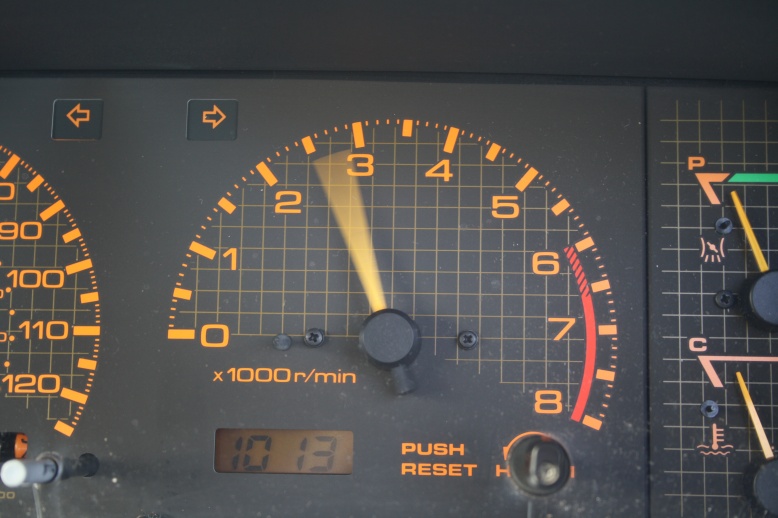
Bluebird rev counter

Any higher than this and it gets mightily unpleasant. It sounds horrible!

Of course the biggest problem is that the Bluebird is not really quirky enough for my tastes. Even with a dashboard that looks like that. Bright orange dials. What were they thinking? Yes, I do like the wiper and the chime for the headlights-on warning that appears to be a tiny pair of bells, but I also like cars that can corner.

Bluebird

Is it already time to move it on?

Last in is usually first out, though not always. I do need to try and stabilise the fleet once more though. I’ll have to see what I make of my latest purchase when I pick it up on Sunday…


The joy of the road trip

You can’t beat leaving your life behind and heading off on a high-mileage jolly. I’ve done it several times and while each trip had its own stressful moments, looking back, these were good times for sure.

The first big road trip that my wife and I undertook was to drive to Sweden. Via France. In an undergeared Citroen H van of a design first launched in 1947. This would be a classic grand scenic tour with a big difference! Rather than using an exotic sports car, we’d be travelling in a corrugated shed on wheels with a comfortable-ish cruising speed of 50mph, servoless drum brakes but the advantage of a bed and kitchen area. Tea would be in endless supply.

In the space of three weeks, we drove through France, Belgium, The Netherlands, Germany (where the windscreen exploded in our faces), Denmark, Sweden, Norway and then back home via Newcastle. We clocked up 3100 miles with no mechanical trauma other than the exhaust setting fire to the carpet on the floor.

Road tripping H van

H van takes a break in the Norwegian mountains

The next year, we undertook The Eight Ball Challenge. This was a 2cv-only event driving around Great Britain in a figure of eight. That allowed us to clock up 3500 miles in 15 days, in cars with 29bhp (one was an old one with only 12bhp, and it turned out to have lost several of those!). It was one of the best experiences I’ve ever had, meeting different people around the country and having a lot of fun with the folks who took part in the event. The 2CV had a few mechanical issues that needed occasional fettling, but got us there in the end.

Then the year after that, I headed off with a friend to take part in the BXagon Challenge. We drove 3500 miles around the perimeter of France (taking in Belgium, Luxembourg, Switzerland and Spain for good measure) in 14 days. Apart from a coolant pipe failing and a rear disc shroud falling off, the car coped perfectly.

In 2010, our big road trip was to take the 2CV to Switzerland, via Normandy (where my father-in-law lives). That was great but in a moment of madness (well, 17 hours of madness) we drove all the way from mid-France to home in Cambridgeshire in one hectic day. That was 660 miles of driving! We filled up with fuel in four different countries.

All of the above took us to places we’d never usually visit, often well away from major routes and civilisation. The scenery was often truly breath-taking and you begin to revel in the freedom of the road. Don’t get me wrong – these are expensive holidays, even when the BX we used on the BXagon only cost us £266 to buy. Even with a rather excellent 50mpg, we used over 315 litres of fuel, so that’s probably £350 on fuel alone, without considering ferries, catering, accommodation etc. We did avoid paying for tolls by keeping away from big roads – France allows you that and you see far more of the country.

Scottish adventure in a 2CV

A good road trip includes plenty of gorgeous scenery to make it feel like a grand tour!

Trips like this are perfect to re-ignite the joy of driving. Cities and commuter routes can leave you thinking that driving can no longer be a pleasure. That is not the case. Take a road-trip in your classic or tackle a grand classic tour and remind yourself that driving CAN be darned good fun. Even in an underpowered old Citroen.

BX: I don’t want to scrap it!

With the BX Mk1 moved on to pastures new, it’s allowed me some breathing space with the Mk2. Both BXs run out of tax this month so I was facing some difficult decisions. Taxing both of them was not an option.

Happily, I now only own one BX and come payday, I should actually be able to afford to tax the thing. I’d been getting very downbeat about it (my moods do swing rather!) because it’s quite rotten, has occasionally-intermitted power assisted steering and needs a cambelt and (before took long) a clutch. In fact, the To Do list was looking scary enough for me to consider this an End of Life vehicle.

Problem is, I keep driving it and when the steering is working, it’s a bloody good car. It can easily achieve 50mpg, is incredibly comfortable and has a simply massive load capacity for its size. It seems wrong to throw away a car that works so well. Yes, it’s covered over 189,000 miles, but that’s barely anything for a BX diesel!

Citroen BXs together

Ian’s stripey BX at a recent meeting. Perhaps it can be saved…

With this in mind, I’m going to get some quotes to sort the bodywork out (though one place has already refused!). The cambelt is a fiddly but easy enough job, that should cost less than £50 once all parts are taken into account (water pump and tensioner). The clutch can wait as it’s not actually slipping yet. The clutch and cambelt are worth doing because even if the car is ruled too rotten for salvation, the engine and gearbox could well come in useful for something else.

I’m hoping a refresh of the LHM will cure the steering issue. Again, not a difficult or expensive job – unless it proves not to be successful! I do have a spare pump (that I really should pay my friend Justin for…) which could be another culprit.

As good as my new Bluebird is, it can’t compete with the driving dynamics of the BX in my opinion. The BX always seemed to do well in comparison tests and rightly so. It has rather good handling, a superb ride, a competition-thrashing engine and good equipment levels. It may sound odd, but I reckon that the 1.9-litre XUD diesel engine is the best engine ever fitted to these cars. Sure, the GTi engines (especially the 160bhp 16v) are good fun, but they require a track really to fully extend them. With 71bhp, I can drive foot-to-the-floor in my BX pretty much all day. The performance isn’t that strong, but it’s not bad either, and the worst MPG figure I’ve managed is 48. That’s remarkable.

There’s also the point that I’m rather attached to this BX. I bought it in 2009 for a banger rally and should never have sold it. It came back to me unserviced and broken, but has responded well to a bit of TLC. 2CV aside, this BX could be the best car I’ve ever owned.

Cortina trance – break away!

I know I have tendencies towards the unloved, but the Ford Cortina is a car that genuinely baffles me. It was a major seller in its day, but for some reason, people still hold them in almost holy regard. I’ll admit, I like the styling of pretty much all the Cortinas, and a Mk5 (or Cortina 80 if you want to be precise) is a nice motor to tool around in, but are they really worth what people are starting to pay for them?

The Mk1 Cortina begat the Lotus Cortina, which won a few things. Having driven one, I can confirm that they’re an absolute hoot. In fact, it is one of very few cars that has actually made me whoop while behind the wheel – and this while on busy Dagenham roads. However, the reason it’s such a hoot is because Colin Chapman did rather a lot too them – a much better engine and major suspension revisions (this one lacked the A-frame but it still handles well). Lotus Cortinas are now worth a fortune, and no Mk1 will be cheap to buy. The halo effect doesn’t seem to have affected the Chrysler Sunbeam in the same way. Why is that?

Small car with a big difference

Don’t believe the hype! Is a Cortina really worth such a song and dance?

The Mk2 had a small amount of rally success but the Mk3, 4 and 5 didn’t get up to much at all, so sporting success can’t be the reason for the high regard. It’s not like they’re anything special to drive either. Competent for sure, but more so than a Hillman Hunter or Fiat 125? No.

In fact the Cortina is just pure white goods. Ford built them as cheaply as they could get away with and did away with anything even slightly fancy. Because this seemed to result in huge sales, other manufacturers followed suit. British Leyland hastily conceived the Marina to be a deliberately unfancy, miserable machine. Why? Because that’s what Ford was doing. Meanwhile, Citroen was desperately trying to make motoring fun with the 2CV, GS, SM and CX. They were discovering that sadly this approach didn’t make any money.

Yet the Ford has an enormous following. Is it because we’re proud of such a British classic? Oh please. From the Mk3 onwards, the influence was firmly Germanic and Ford is as British as George W Bush. Is it because they are better than anything else? Definitely not! Is it because ‘my Dad had one?’ well, that at least makes some sense. However, my advice would be to buy anything but a Cortina. Let them have their following. Why not have a near-unloved Vauxhall Cavalier instead? Rarer and very pleasant to drive. There’s a lot to be said for not following the herd.

New car: 1986 Nissan Bluebird 2.0SLX

So, I bade farewell to the Mk1 BX on Sunday and enjoyed having some actual money in my possession. It was a novel, unusual and pleasant sensation.

Nissan Bluebird

One extreme to the other for Ian, with the purchase of a Nissan Bluebird

It didn’t last long. About an hour in fact. You see, I’d delivered the BX to its new owner on the proviso that he gave me a lift to Bristol to pick up my new steed. The new steed is a 1986 Nissan Bluebird 2.0SLX in Sky Blue. It’s the polar opposite of the BX, yet shares a number plate containing the same letters in the same sequence! Both cars were registered in the same part of South London, and both were purchased by me in Bristol.

There are some major differences though. The BX had already clocked up 230,000 miles by the time I got my grubby paws on it, and it was in a dreadful state. The Bluebird has an incredible 36,000 miles on the clock and is in much, much better condition.

The BX was a rarity, being the only RHD Mk1 estate known to be in roadworthy condition. The Bluebird is also a rarity, being one of very few T12 Bluebirds on a C-plate. In fact, I’d be willing to say it’s possibly the earliest Bluebird on the road – even earlier than the one Nissan has in its own collection at Sunderland. That’s because British production didn’t get underway until late 1986. For the first few months, the cars were entirely constructed in Japan.

Despite the rarity and it’s great condition, it was struggling to find a buyer. It had been on the market since May with a very reasonable £450 asking price. It failed to garner any interest at all on Ebay, which all rather goes to show that the market for 1980s classics just isn’t really there yet.

Bluebird interior

Pretty blue inside and out!

Oh well. The world missed a great opportunity and I was able to bag a low mileage stunner for all of £400 with tax and test! (albeit not a vast amount of either).

I’ll admit, it’s not the most exciting of vehicles, but the more I drive it, the more I like it. Sure, it feels pretty dismal dynamically compared to a BX – the ride and body control when cornering are laughably inferior – but it feels pretty planted, safe and secure and is quiet and peaceful on the move. I was able to listen to the cricket on Long Wave in great comfort on my drive home from Bristol.

The engine is good too. Sure, it doesn’t sound very pleasant, but then few straight-four engines do. What I love is the torque. Maximum grunt comes at 3600rpm, but the torque curve is flat, and it pulls readily from 1500rpm in a way modern petrol engines just don’t. It sounds pretty breathless when you rev it, but there’s little performance to be gained by doing so, and it’s a lot more pleasant to keep the revs down and allow the car to gather speed more gently. It still doesn’t hang about, though it won’t accelerate in a way that would cause excitement.

That’s ok, because it doesn’t corner in a way that would cause excitement either. The steering is nicely weighted with reasonable feedback but it still feels a bit dead, and the car does not feel composed. It doesn’t encourage you to push on, but you can corner reasonably quickly without too much fuss. Nor is the ride brilliant, being bouncy over poor ground. It’s not bad, but it’s not excellent either.

Despite this, the more time I spend at the wheel, the happier I am. There’s the marvellous pantagraph rear wiper for a start, and the delicious twin-bell warning if you leave the lights on. So much nicer than a buzzer. The seats are fabulous too, and visibility is excellent. It’s no wonder that the Bluebird became a favourite with minicab drivers. It deserves a wider appeal though, and I hope that by owning this car and shouting about it, I can help raise the profile of the T12 Bluebird and its T72 replacement. These are fine cars and more people should realise that.

Project BX: Bye Bye

Yes, I’ve done it. A sale has been agreed on the Mk1 BX estate. It’s going to a really good home, but I’m still a little sad that project fatigue and a lack of cash have prevented me doing more with it. I shouldn’t complain really. I got the car recommissioned and back on the road and working well enough to pick up two show awards! Ok, they were both for worst car there, but still – I’ve never been a prize winner before!

Bye bye

Bye bye BX. She’s off to a new home, but what will replace it?

It’s always difficult to keep momentum up with big projects, but the new owner has showed great ability with an equally shambolic GS so I wish him well.

So, that’s two cars culled from the fleet, leaving three vehicles. A very sensible number. So, naturally, I have already bought something else. It’s a British-built classic with a stunning blue velour interior. I’m not revealing any more details until I collect it on Sunday…

Project Budget 4×4: MOT time

Just a quick one today. Got the Maverick back after its MOT work. The good folks at Tsalta Motorsport sorted out two rotten sill ends and fitted a new rear brake flexi for me so it’s legal for another year for an all-in cost of £189.

In all, I reckon I’ve spent somewhere in the region of £1100 on this car, including buying it. Considering one car I looked at back in January was a rotten Land Rover Discover with issues galore and an asking price of £1800, I think the Maverick stacks up pretty nicely! Especially as the underside is in rather lovely condition. Must smear some more anti-corrosion wax over it…

Now, how long before I can get it out on the lanes again?

Goodbye Mini

A fleet reduction has become a necessity. When you’re living on a reduced income, which we very much are (happily out of lifestyle choice rather than economic gloom), it has to be said that running five elderly vehicles is not easy! Even though I do much of the servicing and upkeep myself, there’s still road tax, insurance (group classic policies minimise this though) and MOTs to consider.

The Mini is the first casualty, and it sold on Ebay for a sensible amount – £1375. Against the purchase price of £741 in 2006, that’s pretty good! Especially if you ignore the £3500 restoration in the middle of that time…

Rachel took to the Mini from the start. She liked it so much that she even cleaned it! This event was so shocking that I captured the moment on camera. I’m not sure she’s cleaned it since mind…

washing the car

Betsy joins the fleet in 2006, and actually gets washed by my wife! A rare event

Betsy proved surprisingly reliable in daily use, especially given that Rachel was using her for the commute. At the time, that was either a 20 mile round-trip to Banbury from our then home in Northants, or a remarkable 70 miles to Oxford if Rachel had decided to drive all the way rather than catch the train. She did this for a year and I can’t remember any issues in that time.

Betsy behaved slightly less well when we moved to Cambs. The points gap – or rather its propensity to close up – became an issue and more than once, Betsy conked out and refused to play. Not that it ever took very long to get her going again. I even managed to limp her home after she suffered condenser failure! I’ve become quite good at driving cars that are running very badly…

Mini breakdown

Generally reliable, but not always!

I loved the Mini’s handling, but was less keen on the suspension and cramped driving position. I bravely took ‘Betsy’ the Mini to Kent once, for the Bromley Pageant when I was working on Classic Car Weekly. My aching legs made sure I never spent that much time in it again! We were living in Cambs at the time so it was a long trek.

Mini car show

Betsy makes an appearance at the Bromley Pageant

Even though I wasn’t that keen on her though, Betsy won me over with her cheeky charm. But with corrosion nipping in at various points, it was definitely time to say goodbye. She’s gone back to her original home in the Midlands, and the new owner seems very enthusiastic. Betsy is now called James Bund…

Mini on the road

Goodbye old friend! Betsy heads to her new home

Fleet reduction: Something has to give

When we moved to Wales in October 2010, we did so knowing that our income would reduce. It did by around a third as I work nowhere near full-time hours (out of choice) and my wife Rachel doesn’t work at all (also out of choice!). We enjoy more time spent together but have our own projects to work on to stop us developing cabin fever. I have lots of fettling time for my fleet, while Rachel makes the garden produce food and leads the many DIY projects our house needs.

I’ve loved having the time to work on my own cars. It’s the first time I’ve really felt like I have enough time to tackle many of the jobs I’ve done. I’ve become quite good at rebuilding brakes and have learnt new skills such as how to change a cambelt. However, our goal has been to become more self-sufficent and to drastically reduce expenditure. The fact that we currently own 5 vehicles between us rather goes against this new philosophy!

Take our Mini. It’s Rachel’s car and in the past two years, it’s done about 4500 miles. That’s about 187 miles a month. It’s not really enough, especially given that a Mini exposed to Welsh weather will simply corrode. We can’t afford another bodywork restoration for it. That’s why it is currently on Ebay. Rachel doesn’t really need her own car as she doesn’t often have to drive far. I don’t drive the Mini as I generally prefer pretty much anything else on the fleet. The money will come in useful for house projects and it’s one less car to tax, service and insure.

The other car on the ‘must go’ list is my BX Mk1. Incredibly, I’ve owned it for almost a year now, but the project to restore it has rather stalled. Again, it’s a cash thing. Restoring a car requires a lot of money and at the moment, I simply don’t have it. The writing market has got tougher during the year and I’ve spread myself rather too thinly in attempting to run so many vehicles! It’s not an easy car to sell, being exceedingly rare but also worthless and of interest only to a very small group of enthusiasts.

With a reduced fleet, I hope to be able to focus on getting the 2CV and BX Mk2 into a less rusty state. The BX Mk2 is a much better car than the Mk1 but does need some welding and possibly a clutch. The 2CV has many faults, pretty much all rust related but also needs a kingpin and possibly a suspension arm bearing. With the Mk1 gone, I’ll be able to reclaim my garage. I’m going to need it.

It’s always sad selling cars, especially when the Mini has been with us for so long. We bought it in 2006. The Mk1 is also a bit sad. It was my dream BX specification – diesel, estate, Mk1. Sadly the dream has been rather tainted by its condition and my discovery that actually I think I prefer the later BXs after all…

Project Budget 4×4: Strata Florida

Strata Florida is one of the legends of greenlanes, though I’ve never been entirely sure why this is. Sure, it’s good, but there are other lanes around that are just as challenging and just as scenic, if not more so.

However, it beats the M25 and the other evening, I finally got to explore it in my Budget 4×4 Ford Maverick.

It was an entirely Japanese outing actually, with a much-modified Maverick and a mildly tweaked Suzuki Grand Vitara joining me. We started at the Pontrhydfendigaid end, passing the legendary abbey ruins that give the lane its name. That name is either the Latin for Vale of Flowers, or an Anglicised version of the Ystrad Fflur which means Valley of Flowers. No surprise that the two are so close as Latin would have been the official language of the Abbey. Founded in 1164, it was a victim of Henry VIII’s Dissolution of 1540.

However, it’s not that close to the start of lane, which is further into forestry land. From the start, it’s a rocky lane and immediately, the cushioning all-round coil springs of my Range Rover – the last vehicle I drove down this lane – were sadly missed! The Maverick uses stiff torsion bars up front, with a fairly-flexible but still-firm coil sprung live axle at the rear. It’s really not comfortable over this sort of terrain.

Maverick

No soft-roader this one. Maverick laps it up

Not that the Maverick seemed to mind. It pottered along as I picked what I thought was the best line through the rocks, only bottoming out a few times. That underbody protection – standard fitment but not really designed for big knocks – is thankfully good at preventing damage.

It was very much a job of keeping the thumbs well clear of the steering wheel spokes. This is often a first lesson in off-roading and the reason is simple. If the steering kicks back – which is more likely over rocky tracks – you’ll snap a thumb in no time at all if it’s inside the rim of the wheel.

The famous bombhole was dispatched with little trouble, though I did re-arrange the rocks at the bottom to avoid clouting the bumper. Short overhangs were a major boon here and I avoided damage. The Range Rover wasn’t quite so lucky, bending the number plate and catching the tow bar here. Nothing major, but the Maverick was entirely unscathed. Then my pal in the modified Maverick though we’d better drive back up the bombhole. I’d not done this before but the Grand Vitara made it up with a touch of wheelspin (it lacks a limited slip rear diff) and the modified Maverick also made it – albeit with a second attempt necessary. Would I make it?

As it happens, yes I did, though I rather overdid the power. My usual way to deal with an obstacle is to make sure momentum is maintained. When you’re climbing a rock face that’s well over 30 degrees, I felt I needed a fair chunk of momentum. I was still in low first, so that’s still not very fast at all, but the ride up was a bit rough! My tools were flying around in the back, reminding me that I really need to find a way to secure them (they are in a bag, but the bag flew quite merrily!).

We bounced our way to the end and then also tackled Soar y Mynydd (so-ar uh mun-uth). This is a very pretty lane, with some very loose rock on a couple of steep climbs. I took these gently and let the limited slip diff do its thing – preventing either of the heavily-loaded rear wheels from spinning excessively. No problem.

Then it was a matter of driving home, where the Maverick reminds you that while it isn’t very compromised off the surfaced road, it’s also exceedingly well mannered upon it.