The cheap, crap car returns

It has been quite, no, very disappointing to realise how hideously undesirable the Nissan Bluebird is. What on earth is wrong with our society when a fully functioning, even quite pleasant car is worth less than a decent hi-fi system?

It isn’t just the Bluebird either.  A scan of Ebay reveals that stupendous bargains are all around. A pal has just won a 52,000 mile Ford Mondeo Mk1 V6 for £400. A creamy smooth V6 powered express that while admittedly is no Jaguar, isn’t that bad either. Ridiculous. Why did I buy the Bluebird when I could have bought that?!

The farcical Scrappage Scheme brought a temporary end to cheap motoring. Far too many people were seduced by the alleged £2000 discount on a brand new car and over the space of a few months, many worthy cars were scrapped. Nice one Labour! Peter Mandleson did very little to improve my view of him with that one.

Happily for lovers of cheap old autoshite though, the good times seem to be back. Now it seems pretty easy to spend less than £500 and still get a car with low miles, lots of service history and plenty of life left in it. The insatiable need to own the latest and fanciest drives second-hand values ever lower.

This is very worrying because all of these lovely, overlooked cars seem so affordable! For a couple of month’s finance on a new car, you could buy a new ‘old’ clunker every couple of months. I do like a bit of retail therapy, though thankfully I’m skint enough to be prevented from buying anything else just yet.

Because that’s the next bit. Just buying a cheap car isn’t enough for me. I still have to look after it as if it was worth many times more. I paid £375 for my BX but give me a few more months and I’ll probably have spent more than that on upkeep.

It might seem foolish, but the cheap times will surely not last. Already, BX values seem to be rising…

A Marina in drag. Does it deliver?

The Morris Marina may not seem the most ideal choice on which to base a sports car, but that’s exactly what the Yorkshire-based Naylor Brothers did in the 1980s.

They hit on the rather spiffing idea of combining the flowing-yet-traditional lines of the MG TF with more modern running gear and a few more creature comforts. The Marina and Ital’s new O-Series engine would provide rather more urge than the old XPEG MG engine, linked to the Morris gearbox and rear axle. Happily the Marina’s leaf springs were replaced by coils and the ancient trunnions of the Marina were replaced by MacPherson struts. The Naylor TF1700 was fully type approved, with backing from Austin-Rover. 100 were built between 1984 and 1986 before the venture failed. A further 61 were sold as Hutsons after the failed company was purchased by another enthusiast.

Hutson TF1700

The heart of a Marina lurks beneath the traditional bodywork

The car driven here is a Hutson and it was rather a revelation. There is a hint of kit car in some details, like the out-of-place front indicators and the chunky Chrysler door handles, but it is otherwise a very faithful copy of the TF. Like the original, there’s a steel chassis and the body is formed in ash, with steel panels wrapping around it. It therefore feels nice and solid.

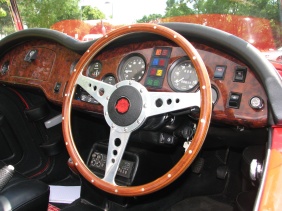
The interior is an interesting mix of tradition and modernity with controls nabbed from then-current Austin-Rovers. The walnut dashboard is a nice touch though and it doesn’t feel any more ‘wrong’ than a Morgan, which similarly mixes traditional wood with modern switchgear.

Hutson interior

Proper wood and modern switchgear combine

The biggest surprise comes when you drive off though. Who would have thought that a Marina engine could sound so rorty! Acceleration is strong enough too, feeling much quicker than the 12-second 0-60mph time. I may only have been blatting about the bumpy roads of Birmingham but this car felt taught, responsive and above all good fun. The Marina rear axle is better located, with a proper four-link set-up with Panhard rod. The coil springs all-round mean a much more comfortable ride than any original MG T-Type but this doesn’t seem to come at the cost of cornering ability.

There is a very passionate club for these cars, and it’s easy to see why. Who needs a Morgan if you want tradition and a few creature comforts? I was certainly impressed and in the best tradition of MG, the mechanicals of a thoroughly ordinary car have been transformed into something rather special.

Crap weather and an underused Snail

2012 will not necessarily be remembered too fondly by those in the classic world. Many shows were cancelled and a goodly number of classics spent the summer hiding away in water-tight garages rather than being driven.

I must concede that I turned my 2CV into a bit of a garage queen. That’s why poor Elly the 2CV has clocked up fewer than 2000 miles since January. Not that she entirely hid from the weather – 500 miles of that total involved splashing through flooded roads on the way to a rather soggy (but definitely not cancelled) 2CVGB event – Registers Day – in Cambridgeshire. There, the misery didn’t dampen spirits though I must concede that the tent we used will not be used again. It leaked quite badly and reminded us why we hadn’t used it for many years…

2CV starting handle

2012 got off to a bad start. Elly needed a little help.

I feel bad for not using the 2CV more often but it really has been a miserable year. Non-stop wet weather has made me reluctant to give my Tin Snail a soaking. I’m struggling enough to keep on top of the rot as it is! Another pair of sills are going to be necessary at this rate. They’re almost becoming a service item. Oh well. It’s a chance to catch up with some of the mechanical jobs isn’t it? Well, no. I haven’t done very well there either. She definitely needs a kingpin replacing before her next MOT in April but I fear the hole in the arm has worn excessively. I haven’t yet found a solution to that which works or is convenient. Plans to attack it at Registers Day were rather quashed by the weather. And my fear of big hammers…

I’ve been too busy playing with other cars too. Hopefully that will end as I’m looking to reduce the fleet somewhat from its current five cars (four of which are roadworthy) to a more manageable three, though I do want one of those to be a Land Rover Discovery…

I do need to rediscover my 2CV Mojo. I’ve only attended two 2CVGB Events this year, and I ran one of them! To think that in one year – 2005 I think – I clocked up 15,000 miles in Elly, travelling to camps in France (via Belgium) and the Scottish Borders. Three years after that, the 3500 miles we did driving around Great Britain in a fortnight for the Eight Ball Rally added to an impressive annual total. In 2010, we took her to Switzerland. This year? A soggy campsite in Cambridgeshire and that’s about it.

If I don’t pull my finger out, it’s going to take an awfully long time to clock up the next 100,000 miles.


Discovery desires

Fleet changes continue with the Nissan Bluebird currently up on Ebay, and the Ford Maverick likely to follow suit. A lack of interest and funding means I need to streamline the fleet a bit.

The Maverick is a tricky one. It’s very capable but I’m just not feeling any connection to it. Instead, little things are starting to annoy me. I’ve never been a fan of part-time four-wheel drive and not having a centre differential is just a pain. That means that the two axles cannot rotate at different speeds – something that is essential if you want to be able to go around bends. That’s fine off-road, where it effectively acts like a locked centre-diff on a Land Rover, improving traction, but I find it a real bind having to change between two and four-wheel drive depending on conditions.

It’s also not very good at towing, lacking low down grunt. The ride is far from pleasant. The lights-on warning buzzer makes me want to commit murder. The front suspension is too lacking in travel. It has a Ford badge.

So, I’ve decided it’s time to grab a slice of Discovery action while prices are still not entirely out of reach. Doubters will laugh and mock for how could I possibly consider saying goodbye to Japanese (ish) reliability and hello to hopeless Land Rover? Well, for sure, Solihull build quality is right up there with Chinese-built Christmas cracker gifts but the chaps and chapesses are good at knocking out vehicles that can handle the rough stuff. I’m willing to sacrifice the Maverick’s generally excellent road manners for a bit more off-road ability.

The difficult question is which Disco to go for. Naturally my budget will only stretch to a leggy first generation model, but there’s a pre- and post-facelift version, with the change over known as the 95MY (model year). I know this because for one joyous week, I enjoyed a school work experience at Land Rover’s Lode Lane, Solihull home back in 1993. I spent my time with the Validation team. They are the blokes (sorry, it was all blokes) who test prototypes to see whether they’re ready for production – or, in rather typical British fashion, see if enough bugs have been ironed out for production to commence…

Working on these still-secret models, with their black-plastic disguises, was absolutely incredible. Especially the few days I spent with the V8 teams. Crikey how their colleagues were jealous – especially those working on the feeble Mpi! (a 2-litre tax-dodge version with nowhere near enough torque). So, a 95MY Discovery would be the obvious choice then. A way to wallow in nostalgia and remember my small part in helping that version reach the production lines.

Well, no. You see, at the end of my week, as if it wasn’t already brilliant enough, I was whisked down to Eastnor Castle. In the land surrounding this impressive building, Land Rover frequently undertakes off-road testing. A group was being treated to a day out as a reward for helping to move the production line of the Range Rover Classic – to make way for the even-more-secret Range Rover P38.

Towards the end of the day, one of the Validation chaps asked me whether I’d like to drive a Land Rover. I was only 15 but somehow managed to squeak out a ‘yes!’ The steed chosen was a Discovery 200Tdi automatic prototype (J34 VKV – are you still out there?). It was white with a delicious beige interior. I didn’t just get to drive it. I got to drive it off-road! It was absolutely incredible and here’s a picture of a tiny me at the wheel.

Land Rover Discovery 200Tdi auto

A 15-year old me driving a Discovery!

You see, I think this rather trumps my time working on the 95MY prototypes. I’ve always preferred the looks of the original Discovery anyway, with that front end seemingly borrowed from the Mk2 Ford Transit van. It’s a real parts-bin special as naturally development funds were minimal. The headlamps are also seen on the Leyland-Daf 200 van – or later Sherpa as it’s also known. The rear lights are Maestro van. The door handles are Allegro/Marina and the column stalks very similar to those used in the Montego. The chassis and main body structure was Range Rover.

Despite this, designer Terence Conran managed to create a rather delightful interior, finished in beige or blue and the overall look was one of a new vehicle, not just a Range Rover with a lumpy roof. At launch, engines were the venerable then-19-year old V8 with twin carburettors or an all new direct injection diesel engine – the legendary Tdi.

And that leaves me with another dilemma. Which engine? Sure, the Tdi offers more economy, but the V8 sounds nicer and will deliver close to the MPG that my Maverick is delivering. V8s have more often enjoyed a softer life and do without turbochargers and cambelts – though the number of head gaskets to potentially fail is doubled.

I don’t think I can really afford to me choosy with my budget, so I’m just going to get whichever seems good at the time. Neither will be a bad engine and I don’t mind the sound of the Tdi. After all, it reminds me of my first ever drive and of a week spent in a factory in Solihull where that distinctive rattle was always hanging in the air.

So, sorry Maverick. Nostalgia wins. I may regret it, but if I don’t buy a Discovery soon, I’ll regret that even more I think.

The first car I drove – as a job

I never forget how lucky I am to get to write about cars. Sure, it’s not the blissful life of sheer joy that many people imagine – for every minute of wheel-time, there’s often weeks of sitting in front of a computer thinking of new and existing ways to describe rust – but I can’t deny that there are far, far worse things to do with one’s time.

Sure enough, my writing career began by sitting in front of a computer and bashing some words out. I wrote a feature about estate cars and was lucky enough for it to be published in Classic Car Weekly back when it was owned by Kelsey Publishing. Getting published was a massive buzz and would soon reap further work. Some of that work saw me sitting in the archives of the Coventry Transport Museum as I researched a feature on that great (but not as great as Birmingham) city and it’s marvellous history of producing vehicles. And sewing machines.

But then I got the call. Would I mind driving three vehicles as miniature road tests. Hmmm. Let me think about that for a moment. NOT IN THE LEAST!

I headed to a dealership and tried not to dance around in circles as I chose my three vehicles. It wouldn’t have seemed very professional to actually run around screaming “Oh My God! Oh My God!” so I didn’t. I’m made of stern stuff. There was an incredible selection of vehicles to sample, including an Austin-Healey 3000, an early MGB and a Jaguar Mk2. Ok, I may have been screaming silently in my own mind.

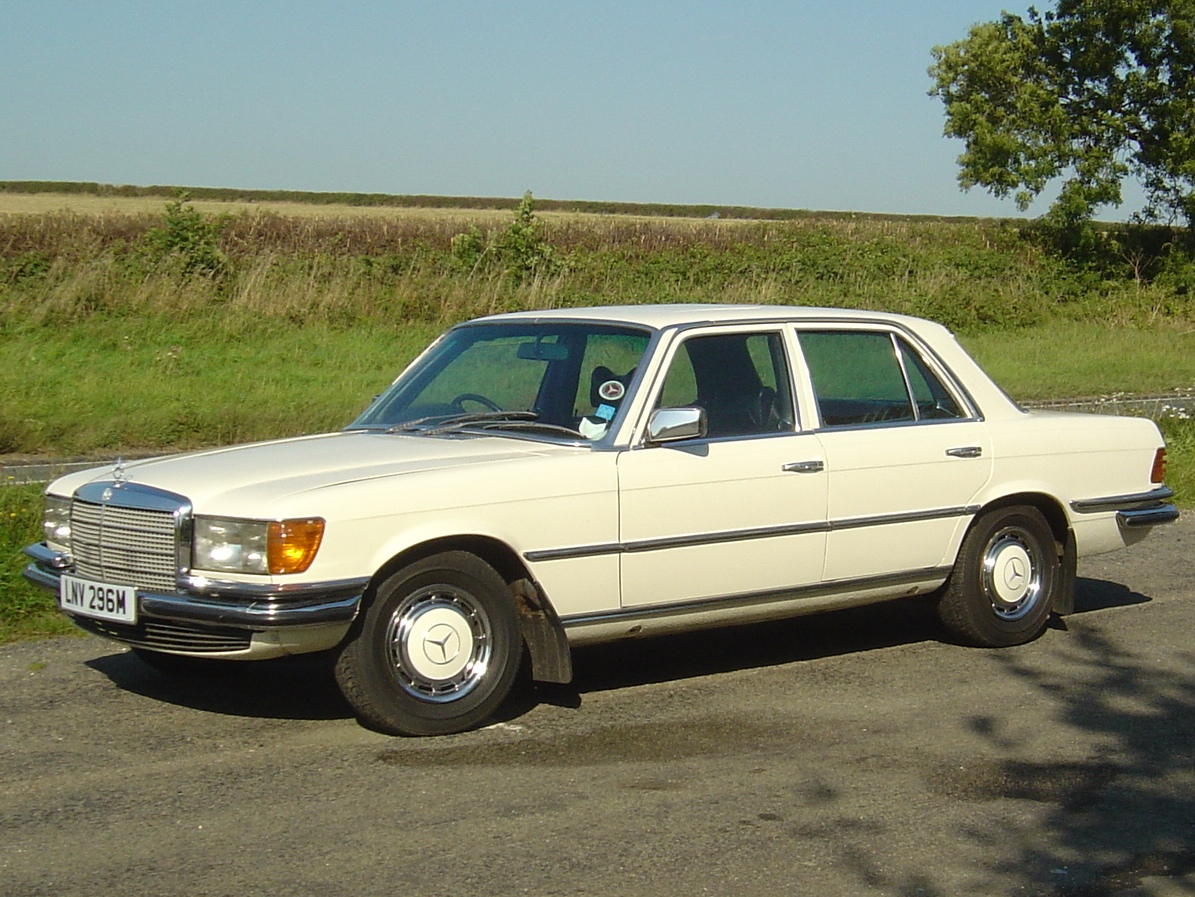
So, I naturally chose a Mercedes-Benz 350SE in light beige, or cream as most people prefer. Well, I’ve always liked to be different and this Germanic beauty had captivated me since I was a child. Probably because the wipers were enormous and a bit odd, with the same wiping pattern as my aunt’s old Morris Oxford. Just larger. This was a really early one – the W116 350SE was only introduced in 1973 and from memory, this example was from 1974. Clambering aboard was a bit of an anti-climax as the interior was rather bland and entirely black. What you see in an S-Class will inevitably be a feature of cars of the future. Tedious, all-black interior design started here.

Happily, things got merrier when the 3499cc V8 fired into life. It was all starting to feel a bit modern, but the fuel-injected, overhead camshaft motor had a touch of rortiness about it, especially when extended. In fact, the driving experience was an unusual mix of V8 soundtrack, slushmatic gearbox and a typical, enormous steering wheel which, through recirculating ball steering, offered the usual vague control of direction. I managed to control myself enough to get a reasonable photo of it, though the shadows are a bit off-putting. Sorry about that.

Mercedes Benz W116

I could have chosen a dream sports car. Not me!

I’m not sure I kept a copy of the resulting write-up – my filing system isn’t the best – but I hope I did. I hope my words were constructed with rather more care than the photo composition too. I had rather more time to carefully consider those at least.

I did then take the Austin-Healey out and despite almost having to use two hands to change gear, I did thoroughly enjoy it. I must boringly concede that the 3000 is bloody excellent fun, with an ear-splitting soundtrack and daft enough performance for me. I did lose my cool somewhat though as my hat blew off as I overtook someone and then I ran it out of fuel. Oops. It was all part of the learning experience but even now I struggle to get across how exhilarating the Austin-Healey experience was.

But the Mercedes was a good reminder that from the start, I was never out to drive just the famous and the brilliant. I’ve driven a Wartburg and it was hilariously entertaining, though the build quality didn’t quite compare with a Merc. Yet I was almost more excited when this year finally gave an opportunity to drive an Austin Montego – the first time I’d had a chance to drive one since I was 17, and a very-freshly qualified driver. How different the car felt when driven at two very stages of my life and experience.

But I’ll never forget that first drive, nor the buzz from writing that first feature. I was finally able to turn my back on job misery and combine both my love of English language and my insatiable appetite for cars. And that’s important. If you want to write about cars, it’s essential that you can get as much enjoyment for sending a cursor across a screen spitting letters out behind it as you do from twirling a wheel and pressing the go pedal. Writing is like a drug to me. A stationary cursor almost causes me physical pain (which is why I often ignore it and have a cup of tea instead).

And it all started with a beige Mercedes-Benz. I wonder where it is now.

Turbo Technique

The Citroen BX wasn’t the first turbo diesel that people could buy, even in its class (the Volkswagen Golf got there first) but it is in my view the best. Citroen had a long history of producing diesels – right back to the 1930s with British Ricardo Engineering involvement.

Ricardo helped design the pre-ignition chamber that is a feature of most indirect injection diesel engines. They’re called indirect because the injector actually fires in this small chamber rather than directly into the cylinder itself. Ricardo’s trick improved the swirl characteristics of the burn and improved both efficiency and refinement. That same technique was employed on the XUD, which was launched almost 50 years after the first Citroen diesel.

The XUD actually first saw use in the Peugeot 305 and Talbot Horizon – Peugeot by then owned Citroen and Talbot. The engine was soon featured in the popular 205 as well and gained popularity, especially in France. Diesel options were by no means common on family cars at this stage but the XUD wasn’t just a ground-breaker for being a diesel, it was also quite revvy, reasonably powerful and smooth in use. It was most unlike other diesel engines. Sure, it still clattered a great deal when starting from cold, but on the move, it was smooth and almost refined.

At this stage, you couldn’t buy one with a turbocharger, but that changed in 1987 when the Citroen BX gained a blown option, most commonly seen here as the DTR Turbo. Citroen already had a turbo diesel on the market in the form of the CX, but the BX was much more afforable.

The BX range was tweaked later to include the TZD Turbo, which was effectively a GTi with a turbo diesel engine. A sporty bodykit helped prove that diesels were no longer slow and cumbersome. They could be fun!

The BX could dash to 60mph in less than 12 seconds and top 110mph, but the mighty 134lb ft of torque at a mere 2100rpm meant in-gear acceleration was the real talking point. The 50-70mph dash – so critical for overtaking – took a mere 11.6 seconds in top gear. That’s quicker than a Mk1 Vauxhall Astra GTE. This was proper shoved-back-in-your-seat acceleration from a car then capable of topping 40mpg very easily.

Sounds brilliant, but how is it translating in every day use? Well, I’m not yet really sure. Going from the simple, flat-but-feeble torque curve of the normally aspirated diesel really is a massive change. In that, you just got up to fifth gear and stayed there pretty much all day. There was no point going to a lower ratio for more power as the engine simply didn’t have any. It was rather unusual because once wound up, you could travel remarkably briskly with the engine doing no more than 3000rpm. An odd experience!

BX Turbo diesel

Turbo Technique. Exhilarating but hard work

The turbo diesel isn’t like that. One reason is taller gearing, which makes motorway travel much more relaxing. The downside is that fifth gear is no good below about 45mph, so you have to downchange more often. You also have to downchange to try and keep the engine on boost. Below 2000rpm, it’s just like there’s no turbo at all. The urge suddenly kicks in at about 2000rpm with a strong surge up to the red line. The engine doesn’t sound pleasant when revved though, so that generally means trying to change gear when you get to 4000rpm. Keeping the engine in that power band does require a bit of planning and careful thought and if you fail to do this, boost is lost and performance is suddenly rather sluggish.

This isn’t a car for bombing down tight, twisty lanes then. It just becomes too much of a chore trying to keep the boost in play. I’m finding this car is at its strongest on faster, more open stretches of road, where you can keep the average above 45mph. Then you can stay in top and the turbo is always on boost – so acceleration is always strong and the engine feels eager and responsive when you need it to be.

Overall though, I think I do prefer it. I’m a big fan of the normally aspirated diesels, but there are always times when you wish you had just a little bit more go. Usually when overtaking or climbing steep hills. There’s a steep hill near here that the BX will climb briskly in top gear. No other car I’ve owned gets close to that. My V8 Land Rover would struggle in fourth!

BX TXD: More miles than I intended

I bought the BX TXD for £375 knowing that it would need some work. This was really driven home on the drive back from Nottingham to Wales. The rear suspension arms were creaking as the arm bearings were so shot while a variety of clonks from the front end caused concerns of their own.

That’s ok. I’ve got plenty of cars so was happy to use the new BX for no more than pottering about locally until such time as I could get the issues dealt with.

That all backfired when I ‘fixed’ a thermostat fault on the Bluebird which actually left it with a coolant leak it didn’t have before. Bother. I discovered this the day before we were due to leave when the coolant reservoir was completely empty. Ah.

Fleet review. 2CV – mostly working, but exceedingly noisy for the 600 mile trip. BX estate – now SORNd as it has become a parts donor. Maverick – 600 miles at 22mpg equals financial pain. Bluebird – now losing worrying amounts of coolant. New BX – rather worn suspension components but otherwise fine.

Turbo diesel BX

Mis-matched wheels but she’s good to go! 600 mile road-trip ahead.

So, new BX it was then and that’s how I found myself watching the odometer clocking up its 1000th mile since I’d collected it only two weeks previously. The drive to Sussex and back generated no drama at all and did deliver the benefit of an incredible 54mpg. The Bluebird fail had actually saved me about £35 in fuel. The only slight problem was having to fit different wheels. I’m replacing the alloys with steel wheels as I’m not an alloy fan. One of the alloys had thrown a weight, so generated a lot of wheel wobble. I wasn’t going to live with that on a long trip so I chucked on a couple of steel wheels complete with their recently acquired winter tyres.

For much of the drive to Sussex, we had the large sunroof fully opened (the trick is to open a rear window slightly to avoid buffeting). It was supremely comfortable, economical and swift. I’m fast getting used to that turbocharger, even if keeping it on boost can be a struggle at times. It was a real pleasure though. What a car.

It’s a worthy reminder that turbo diesels have come a long way but this was one of the first available to ordinary folk. The BX turbo diesel arrived in 1988 at a time when oil burners were generally regarded as horribly noisy, hideously slow and rather smelly and unpleasant. Volkswagen marketed the Mk2 Golf as a GTD, with a 1.6-litre turbo diesel engine, but it generated a rather feeble 75bhp. Citroen’s BX turbo diesel managed to get 90bhp from 1769cc by comparison. Performance was sparkling and generally on a par with the 1.6-litre petrol. The big difference was that maximum torque came in at 2100rpm, so there was plenty of urge without having to rev it.

Certainly, the BX turbo diesel remains a car capable of surprising people. Turbo diesels have a lot more power these days of course, but cars are also a lot heavier. The BX weighs in at a smidge over 1 ton but a brand new C5 is more like 1.6 tons – or the equivalent of a BX and a 2CV combined! The downsides are a lot of turbo lag, off-boost laziness and quite a bit of soot when you enjoy yourself…

I’ve always been a fan of the flat torque/power curves that are a feature of the non-blown BX diesels (71bhp from 1905cc is pretty impressive for a non-turbo diesel) so the peaky power of the turbo diesel does take some adjusting to. However, it’s so nice to be able to access that extra power for things like overtaking, getting up to motorway speeds and keeping a constant speed up regardless of gradient.

I was also impressed by the winter tyres, which seemed to have plenty of grip in the dry and much more than the worn tyres fitted previously when it got wet. I wonder if I’ll get to test them in snow…

Have I utterly fallen for this new car? Well, no. Not yet, but once I’ve made some suspension improvements, I can see it becoming a car I like a great deal.

The end is nigh. What to do with it!

The car situation is entirely out of hand once more and in a week’s time, two of my motors (the most recently acquired) need taxing. That’s a rather annoying £440 of Vehicle Excise Duty required, while someone can buy a brand new city car that is free of road tax. How is that fair?!

Of course, I’ve only recently taxed the BX estate (another £220) as well as buying two cars in a month, so I have absolutely no money. In fact, technically, my new car actually belongs to my wife until pay day…

BX 19TGD estate break

Time for the BX Break to be broken?

The problem with the BX estate is what to do with it. I’m loathe to start breaking it up as that’ll get quite messy and will generate a lot of parts that will need storing or selling. I’ll then have the problem of trying to get rid of a dead car – easy enough while scrap metal has plenty of value but still tricky on our driveway. However, nor do I want to keep it taxed as a refund on the disc would be quite handy at the moment!

To add an element of danger, there’s a really bad coolant leak, so the waterways are currently filled with pretty much neat water. That means trouble as soon as the temperature drops – and we’ve already had the first frost of the season.

So what do I do? No-one seems much interested in taking the ol’ girl on as a breaker themselves and just chucking the whole car away would be incredible foolish. There are some bits I definitely want (front struts, front hubs, possibly a door or two) but quite a lot I don’t.

Time is running out.

New project, new problems

Whenever you buy a car for less than £500, it’s pretty realistic to expect some issues. Even my bargainous Bluebird required anti-roll bar drop links and a service and it now seems to be demanding a new thermostat too.

Small fry compared to my new BX though! To be fair, the BX was cheaper (by an entire £25) and good turbo diesels usually change hands for far more money. So, it’s fair to say that I was expecting the odd niggle. However, since I bought the car, it’s generally been doing this.

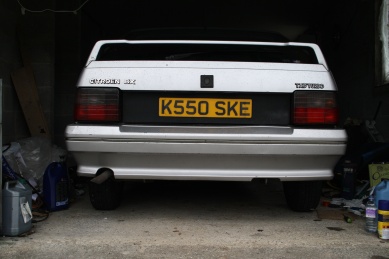
Citroen BX turbo diesel

My new car actually LOVES garages and hates driving at the moment, the reverse of a 1980s advertising phrase…

Sitting in my garage, awaiting parts and attention. The 2CV has been booted outside into the rain.

The drive home revealed a nasty clonk from the front end but when I went to investigate, I found other problems too. For a start, both hydraulic strut return pipes were broken. These allow the front suspension units to breathe, and allow fluid to return to the reservoir. Rather than do that, the fluid was instead spraying all over the front wheel. No wonder it was losing fluid!

This was the other problem.

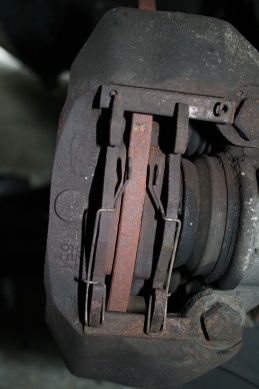
Disc brakes seized slider

A brake that is broken

Can you see the problem? The pad on the left has suffered much more wear than the pad on the right. It was the same issue that dogged my Maverick earlier in the year – stuck sliders. With single-piston calipers, the whole assembly moves with the piston pushing against one pad, and effectively pulling against the other as it does so. It should give even braking but these calipers rely on sliders to allow the movement. If the boots that cover them get damaged, the sliders seize and the braking is lopsided, leading to unusual wear.

Dismantling the caliper revealed that sure enough, the boots were damaged. No problem. I whipped the reconditioned caliper off the other BX and fitted it to the new one. I ordered up various parts and replaced the return pipes and also a seized handbrake cable.

While doing this, I discovered a lot of play in one inner track rod, which might well explain the worrying clunk from the front end. There’s still a fair bit to do with this car, but at least it’s working again for now!

Oh gawd. It’s ‘silly car purchase season’

I was doing so well. I’d somehow got from January to August with only one new vehicle purchase, and the return of an old friend. That’s quite remarkable for me, especially after the crazy year of 2011 when at various points I owned a V8 Land Rover, a Reliant Scimitar GTE, a Range Rover, a really rather ropey but rare BX, a Rover 75 and a Peugeot 309 – as well as the stripey BX first time around and the 2CV of course.

I was determined to be far less restless in 2012 and until August, I was doing really well. The Maverick was the right vehicle at the right time and I donned my rose-tinted glasses to expect my stripey BX to be as good second time around as it had been before. It wasn’t. And I already had another rusty BX. This gave me great stress, so I sold the ‘worst’ BX to someone who could tackle its many issues. Fair play to him – he has as well!

Problem was, the BX I was left with was still in desperate condition. The rear end was chronically rotten, the cambelt needed changing and then the clutch started to deteriorate. It really needs replacing. I tried to blind myself to the truth. I could still save it! And I still could. If I had lots and lots of money. I don’t though, so it looks like The Green Tiger is destined to become a parts stash to keep other BXs going.

Then a BX 17TXD Turbo came up for sale at entirely the wrong time. The drive back form the CXM Rally in Milton Keynes had been pretty awful. The BX felt sluggish and the clutch was horrific. Two nasty traffic jams didn’t help. My love for the car was fast diminishing. I tried to remove the tow bar so it could be welded up, but bits of it kept falling off – and that was just when I removed the electrics! Then I decided to investigate a noise coming from the rear brakes. I discovered rotten discs and pads which fell apart when I removed them. Getting this car back into fully working order was going to take a LOT of time and money. No dice.

So, when a turbo-diesel BX came up for sale on the BX Club website for not a lot of cash, I couldn’t really refuse could I?

The only problem was that it was in Nottingham. This hurdle was overcome when a neighbour said she was driving to Leicestershire that very weekend. So you see, it was totally beyond my control. It was definitely destiny. Allegedly.

I agreed to buy the car sight unseen as frankly, it was cheap enough to be snapped up by someone else if I wasn’t quick. Some people may baulk at the idea of buying a car 140 miles away without seeing it, and then driving home in it, but a true gentleman (or lady but these are rare) of Autoshite takes such things in his stride, reckoning that there’s a fairly good chance that however bad the car is, it is probably better than the car he/she is already driving around in.

Happily, I wasn’t wrong. A quick check-over revealed that it was considerably more solid than my BX estate and the only real issues were a clonk from the front end and a flicker from the STOP light indicating a low LHM level. You know, the vital fluid that powers the steering, brakes and suspension. Hardly a biggy.
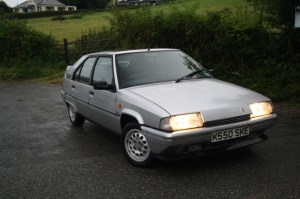
Citroen BX turbo diesel

The new purchase. It’s turbocharged! The wheels and front spoiler are to be banished…

I handed over cash, collected some paperwork and was on my way back home. I was briskly onto the M1 where I discovered a really nasty steering judder at 70mph. This was going to be a frustrating journey home. Then I discovered that if you accelerate up to 80mph, it gets really, really bad, slow down to 70mph and it seemed fine…or was it just less bad? Anyway, the threat of developing Vibration White Finger seemed diminished so I pushed on.

At Newtowns in Powy, after just over two hours of driving, I was considering the BX a good buy. Sure, it had a few issues – like that front end knock, creaking from the front AND rear suspension (sticky struts and worn arm bearings respectively) – but this was joyous to drive. I could actually keep up with traffic and quite often, leave it behind in a cloud of soot. A 0-60mph time of just under 12 seconds may be pretty tardy by modern standards, but I’m used it taking 20 seconds or more. I was flying!

Citroen BX with spoiler

Not sure about the rear spoiler either, but it is standard for this model.

The handling was ok, but I wasn’t really pushing it due to not knowing exactly what was clonking up front and a lack of confidence in the tyres. I reckoned by this time that there was something worn in the front suspension/steering being made worse by a wheel balancing issue. The Peugeot alloys fitted to it lack centre holes, which means most places can’t balance them properly. One weight looked like it had fallen off too. That wouldn’t help!

By now a bigger problem was the wiper blades. The one fitted to the front was horrific, not aided by non-working screenwash. At Newtown, I put the rear blade on the front – a right faff with the stupid rear spoiler in the way. That improved things but it still felt like I was driving along with someone else’s glasses on. It would have to do as petrol stations these days sell brightly coloured, hideously nasty food rather than bits you might want for a car.

However, my new purchase DID get me home, and in style. I was beginning to love the strong wall of torque that this engine develops from low engine speeds. I was worried I’d have to rag it silly to get a shift on, but that’s not the case at all. In fact, it’s only first gear that’s a pain. By the time the turbo has spooled up, it’s time to change gear!

I’ve given the car a more thorough check-over today and the important jobs are going to be to replace an inner track rod to get rid of that clonk, and possibly a balljoint. The rear suspension arm bearings desperately need replacement too. The creak is because they are so worn that the arms are at a slight angle and rubbing on the rear axle beam. Oh, and replace two utterly broken LHM return pipes. That might well be why it’s losing so much fluid, though there is also a declared leak on the pipework near the pressure regulator.

I’m looking forward to getting this one fettled and then battling to keep it nice. After purchasing two cars in a month, I’m now hoping that’ll be it for 2012, but there will still be plenty for me to Blog about I’m sure!