BX brake investigations

As well as buying yet another vehicle, I actually spent some time at the weekend trying to fix one I already own. After the BX returned from a visit to Sparrow Automotive, I had been advised that the nearside front brake looked like it had been binding, and that the offside front brake had low pads.

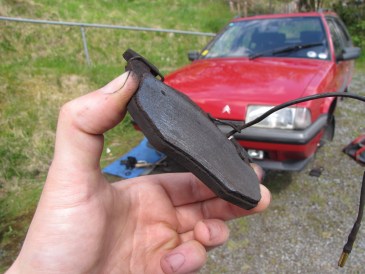
Low pads. These were replaced

Low pads. These were replaced

It didn’t take long to free the pads and have a look. The offside ones weer indeed very low. That’s not just important for braking ability – low pads don’t dissipate heat as well as fresh ones as there is less material to absorb the massive heat generated by braking. These were definitely bin fodder.

They were so low that I wondered if the caliper was sticking, but all seemed well enough. I wound the piston back and inserted the new pads. Job done on that side.

The nearside disc did indeed show some sign of getting hot, and had proved warmer to the touch than the offside after a drive. The first thing to do was disconnect the handbrake cable. This made no difference. Spinning the hub by hand, it still felt restricted. So, it was out with the pads and have a look at the caliper.

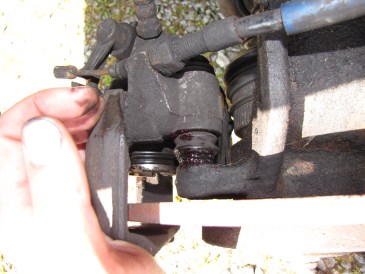
Slider rubbers not entirely healthy

Slider rubbers not entirely healthy

It’s tricky to see in the above picture, but right in the middle of the shot is a rubber boot. This covers one of two sliders, which allow the caliper to move back and forth. There’s a single piston which thanks to the sliding action, can push on both sides of the disc at the same time. One boot had a slight tear in it, but the sliders were doing their thing. I greased them up with heat-proof grease.

The piston itself was very difficult to wind back in. This is perhaps the most likely problem – applying the brakes pushes the piston out and corrosion is preventing the piston springing back in as the pedal pressure is removed. I cleaned the piston as best I could without removing it, then greased it and wound it back in. This was hard going but I got there in the end. With new pads fitted all-round, I started the engine and gave the brake pedal a good shove. This apparently helps reset the handbrake mechanism. Only then did I connect up the handbrake cables. The result was the best handbrake I’ve ever had in a BX!

I’ll keep a watching brief on that nearside caliper. Chances are it’s going to need replacing, but I may have squeezed a bit more life out of it yet.

This BX is improving. I felt very gloomy about it not long ago but the replacement spheres fitted last week have massively improved how the car feels. I still need to replace a rear arm bearing, which will improve things further, but the biggest challenge is to stop it smoking. It really does create a smokescreen when the turbo kicks in! There are many things it could be, and I’m no closer to finding out what it is. To be continued…

Discovery – a plan is hatched

And what a plan. A hire car, a train, probably a bus, some walking and a 170-mile drive back home in a £450 Land Rover Discovery that’s held together with gaffer tape. Oh yes, an adventure this will be!

Disco inferno

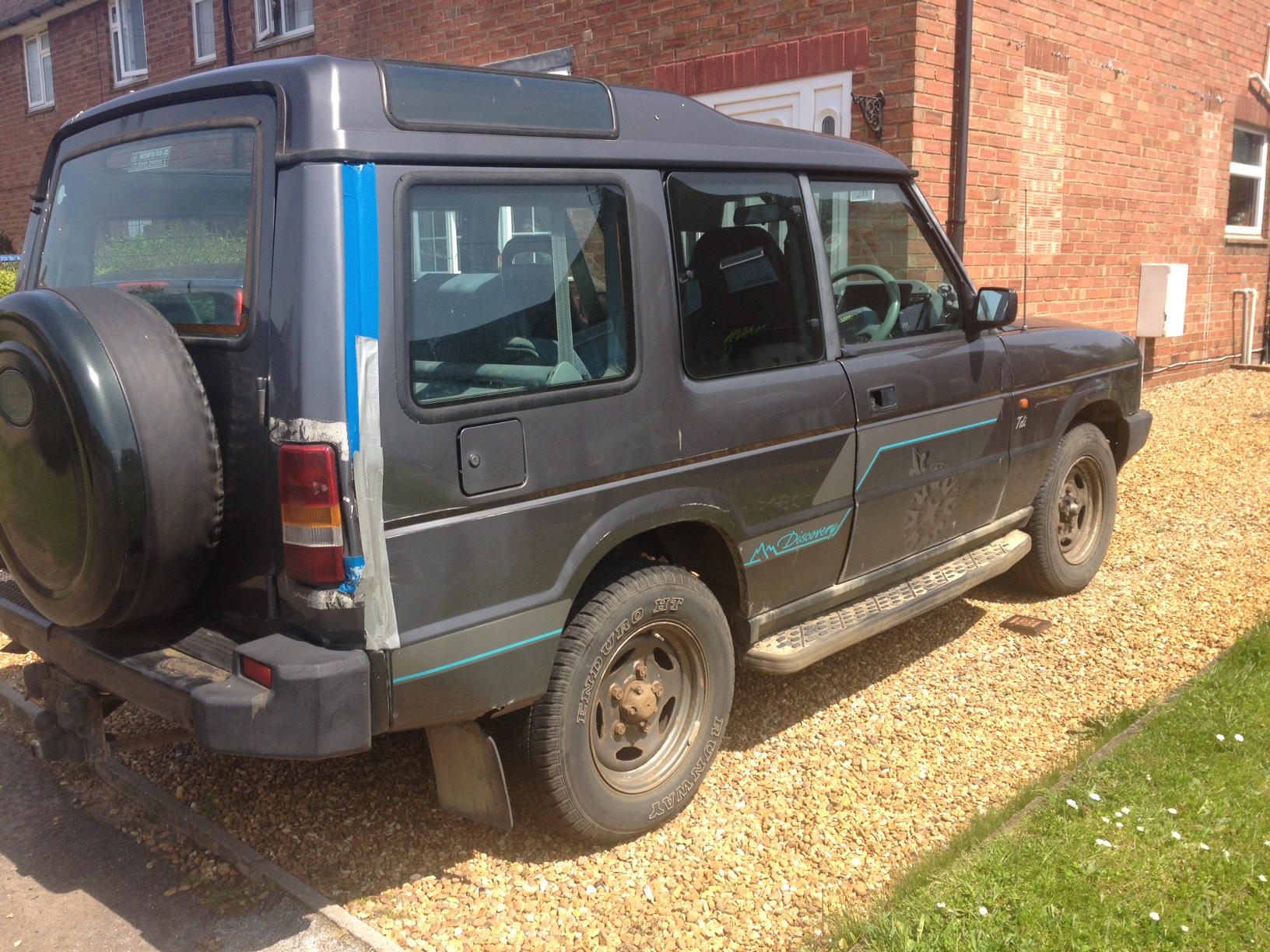
Would you drive home in this car?

The car was buried away in the Parts section of Ebay, with a one-line description that at least confirmed that it had a good amount of tax and test. Interestingly, the picture above was not a feature of the advert, though some rear damage was at least mentioned. Having spent many, many hours scouring the internet for a suitable vehicle, I somehow concluded that spending £450 on the above – plus some pounds to get it home – was a sensible course of action.

At this point, while the power of hindsight is still some way off, it still seems like a good idea. I’m pretty resigned to the fact that a Discovery is going to cost money, as things will need replacing. You can say that about almost any car for sale under a grand. But, I felt it was also very possible if I spent more than a grand too. After all, the ol’ Disco doesn’t have the best reputation for reliability. So, I thought it sensible to risk as little money as possible. Should it spectacularly go wrong on the journey home, I can probably sell its broken remnants on Ebay for pretty much what I’ve paid for it. I may even try to do that roadside if it happens!

To be fair, it is the only Discovery that matched my basic requirement list. It had to be a 200Tdi, ideally a three-door with the funky side graphics (see above) and preferably with the standard steel wheels – I’m not an alloy fan and I’ve always loved the standard steel wheels. This motor has everything I require and the shabby bodywork doesn’t depress me. I’m likely to indulge in some greenlaning and scratches and bumps can easily occur – I’d rather take something that is already scratched and bumped with no fear of damaging its resale prospects.

Of course, I have no idea how good this Discovery really is. I have asked a few questions and have received some reassurance but also accept the inevitability of some costs. There seems to be no record of when the timing belt was last replaced, so I’m going to hope it lasts the journey home and then set about replacing it. I’ll probably change the water pump at the same time, and therefore the coolant to try and keep the head gasket happy. That’ll be £60 or so I reckon. Then I’ll find what else it needs…

Spending on the engine makes a lot of sense, even with the value of the vehicle so low. If the Disco should rust away around me, the engine alone should be worth £300. The Meccano-esque nature of the vehicle means that they are good breakers – in fact it’s why you don’t often see cheap Discos for sale – they’re good money makers.

The epic journey commences tomorrow, when I collect my hire car – as yet unknown but the cheapest possible! I shall bravely set forth on Wednesday, hoping to arrive home before nightfall. I’d better do – I’m then working for several days on minibus duty!

Scratching the itch

I wrote back in October about how I very much desired a Land Rover Discovery. That itch just hasn’t gone away, which is hardly surprising. As that previous Blog tells you, I’ve had a strong emotional link to the vehicles since I was 15 as the very first car I drove was a Discovery.

As a 16-year old, I became convinced that I could own one as my first car. How’s that for ambitious? Sadly, I was skint, so had to make do with the Ford Fiesta Mk2 kindly financed by my parents. Given that I pretty much totally trashed it, it’s a good job I didn’t have a Discovery as my first car after all…

Reality caused me to spend many years driving 2CVs instead. They were cheap back in the mid-1990s and HUGE fun. That led to a new obsession that hasn’t ended even today. I love 2CVs and can’t really see me being without one. Land Rover desires were put on hold.

Then we moved to Wales. Not long after, I purchased a Land Rover 90 V8. This was a silly thing to do, but it was cheap! Running it was not though – 15mpg was as good as it got. I sold it, then spent the profit (almost £700) and a bit more on a Reliant Scimitar. This was also a silly thing to do, but it was another dream car to cross off the list. Then I bought a Range Rover. That was fun, though I spent a LOT of time trying to fix its many foibles before giving up. It was awesome off-road, pretty good on it but it wasn’t a Discovery. The split tailgate was annoying and the horrific interior just depressing. Luxury vehicle my arse! Fisher Price has a much better command of plastics.

I tried satisfying my off-road desires with a Ford Maverick instead. It was far better off-road than I expected – and confounded quite a few people. It was pretty awful on the road though. The ride was too firm and than translated on rocky tracks when green laning too. It was bloody uncomfortable compared to the Rangie.

A Discovery like this, with side graphics and steel wheels, would be perfect

All of this was a denial of the one I must surely seek out. A Discovery. Who cares that the underpinnings were already 19 years old when it was launched back in 1989. Those underpinnings have massive ability. Who cares about the claimed reliability woes either. Scouring the classifieds has taught me that a great many Discovery 1s have sailed past 150,000 miles, or even 200,000 miles. Sure, bits need replacing from time to time, but they are at least generally not eye-watering. Should I wish to go down that route, there are many accessories to boost off-road performance. I’m not sure I do want to do that – I get a bigger kick out of taking a bog standard vehicle to its limits.

I’m frantically searching for one now. Despite the fact that my school work experience was spent working on 95Model Year facelift Discos, it has to be a pre-facelift one for me. I love the ‘looks like a Mk2 Transit’ nose and the Terence Conran interior. Later models tried to be more fancy than they really were, and I don’t think it worked too well.

Now really is the time to act. Pre-facelift Discos are becoming rather rare. They must surely start attracting some collector interest at some point – I hope so. It was only the third new passenger car design in Land Rover’s then 41-year history and arguably became its most important model.

Naturally, I could really do with selling the Merc. If anyone wants a Mercedes-Benz 300E W124, it’s very much for sale with an asking price of £545. Offers will be considered!

Failing at bangernomics

I seem to have got it all wrong. The way my fleet works is that there’s my 2CV, then some cheap bangers that are knocking on the door of classic-dom. I have a high turnover of these vehicles and it isn’t just down to boredom. Really, the best way to avoid major expenditure is to buy a pretty good car, then sell it before anything major goes wrong.

This has enabled me to own some pretty dangerous bangers, such as a VM-engined Range Rover, a Citroen CX, a Rover 414 (with the K-Series engine) and several Citroen BXs. All are capable of going wrong in expensive ways, yet I’ve only caught the bullet once – with the latest BX.

BX on ramps suspension high

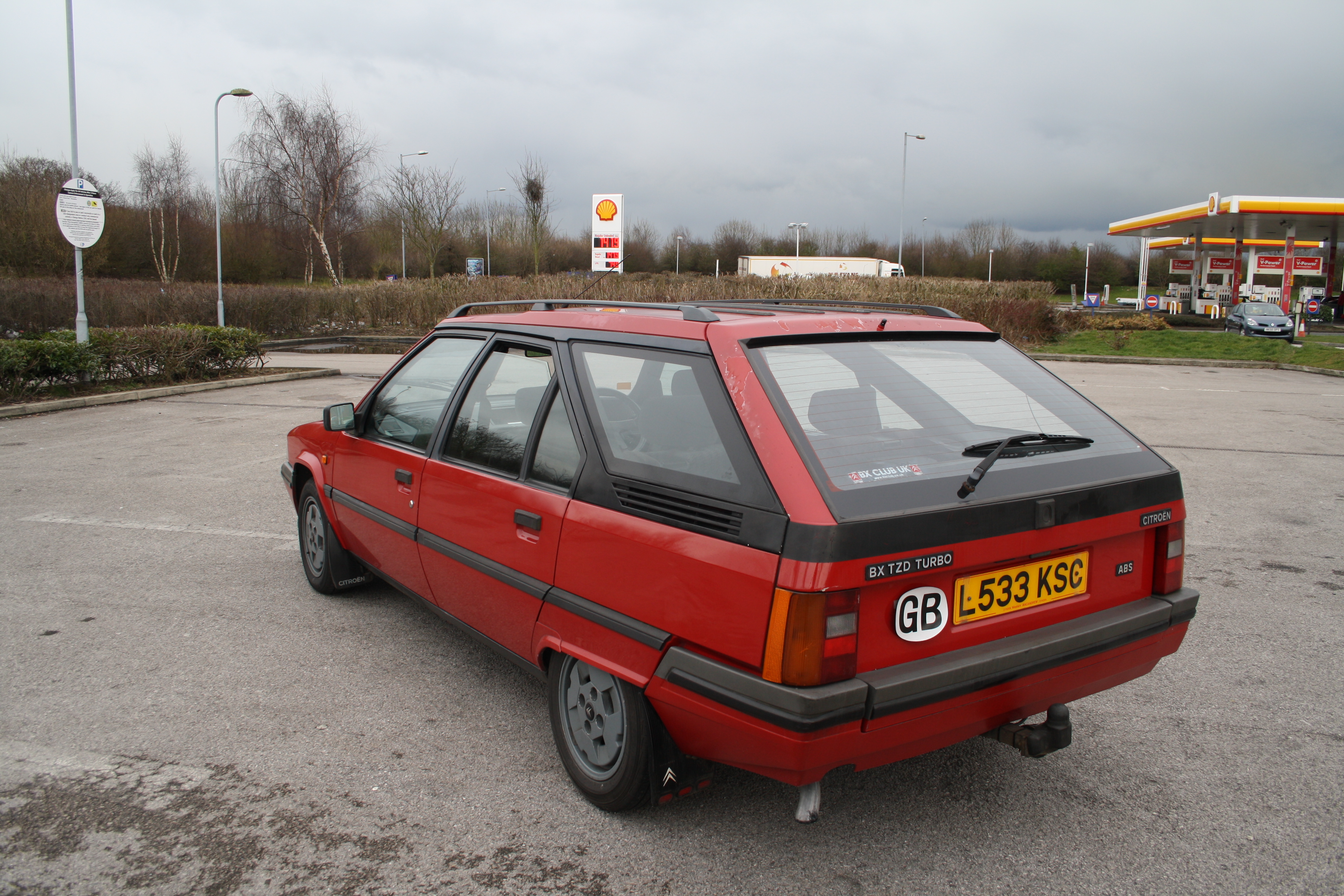
Bangernomics fail. This £500 car has absorbed about £500 of work and parts

The problem is, somewhere along the line I decided that the ultimate car for ‘every occasion’ use is a Citroen BX. I had a stripey estate, but that was too rotten and several bullets were threatening to strike. I sold it for £250 and the new owner is tackling the jobs as he can, while trying to revive a beige wedge Princess. The man has impressive ambition and good skills judging by progress so far!

I thought the perfect BX for me might be a Mk1 diesel estate. Sadly I could only find one, and it was far from brilliant. I got it back on the road, but bullets were almost falling from the sky with that one. I sold it to an enthusiast who knows how to weld. And repair broken engines…

Then I found a silver BX turbo diesel. It was a great car, but it did prove that the hatchback just wasn’t practical enough. I sold that when I should have kept it. It was a good banger. So much so that I did throw a decent chunk of cash at it repairing things like worn balljoints and knackered rear arm bearings.

So, I convinced myself that the perfect specification would be a turbo diesel estate. I found one pretty quickly. Surely this would be the perfect vehicle? Well, no. Not really. I think my problem is that the BX is moving out of ‘cheap banger’ and into ‘classic acceptance’ at quite a rate. People are starting to spend a LOT of money on their upkeep. That’s necessary or they just rust to bits or wear out. I’m trying to follow the crowd in treating the BX like more of a classic. But is that really compatible with both my income and what I actually need?

By taking the hit from (expensive) bullets, I’m going from bangernomics into the world of preservation. That’s fine, but combine preservation with daily use and things get expensive. I’m happy to take the hit with the 2CV because it’s a car I have a strong bond with. I can’t see me being without a 2CV any time soon and I’ve been investing in that one long enough to know the resale prospects don’t even come into it.

I’m not sure I want to do that with a BX. I’m trying to use what is fast becoming a classic vehicle as everyday transport and I’m not sure it’s going to work. I can try to keep the rust at bay, but it’s going to catch up with the car sooner or later. Sorting it out properly will costs hundreds if not thousands. Nor do I want to just simply run the BX into the ground. This is turning into quite a dilemma.

I think what I’d prefer to do is just keep on buying cheap old chod and then getting something else a few months later, though that has its own downsides – like the need to sell vehicles. I’m going to have to grin and bear it though. I simply MUST own a pre-facelift, Mk1 Land Rover Discovery. I’ve mentioned this craving before but it isn’t going to go away. I need to do it before there aren’t any left. I’m not saying I’ll keep it forever – that would be a silly thing to say – but this craving isn’t going to disappear until I buy one.

I will keep the BX for a bit, but I do need to try and rein in the expenditure or at least get some use out of it. I can’t get a Land Rover until other things go. Anyone want a Mercedes? The green 2CV is definitely going to have to go as well.

Mood swings

I got the BX back on Wednesday. Hoorah! £413 later and it had undergone a thorough re-piping courtesy of Sparrow Automotive. Problem was, the drive home was a bit meh to be honest. That after I’d stepped out of a battered Skoda Felica (thanks for the lift Rob!). Actually, I was quite taken by the Felicia to be honest.

It never helps when you’ve spent a lot of money on something invisible. Apart from a notable lack of green puddles when the car was running, it felt absolutely no different to drive than before. That can be frustrating, especially when the suspension is far from perfect. One rear sphere offers all the damping ability of a space hopper. Then there’s the smoke it produces when the turbo kicks in, the heavy clutch, heavy throttle pedal and typical clunky BX gearchange. By the time I’d driven the 70 miles home, the ‘meh’ had turned into a full-blown ‘ugh.’ Part of the problem is that I knew the only way to make things better was to spend yet more money. Definitely ‘ugh!’

However, I woke up today in a promising frame of mind. I was at my desk working by 8am, and was pretty much done by 10am. I refused to curse myself for finally starting a feature I’d had two months to write. I like pressure. It helps focus the mind. That left a good chunk of day. So, I set about improving the BX. There are a million and one things I could try and fix, but I decided to start small. The rear screenwash hasn’t worked at all since I bought the car and reading the Blog from the previous owner on the BX Club, it didn’t seem to have worked during his ownership either – stretching back to 2010.

BX is still knackered, but rear screenwash now works

BX is still knackered, but rear screenwash now works

The simple thing to do would be to order up a replacement. I decided to pull out the screenwash bottle and pull the pump apart. I did test the pump by wiring it directly to a battery. Nothing happened. Demolition time. I took no photos of this, so you’ll have to take my word for it. The motor part comes away from the impeller part, so I was able to give the operating rod a twist, then wire it up directly to the battery. It span! Then I reassembled and plugged it into the wiring loom. It didn’t run. Cleaning the contacts improved matters and I now have a working rear screenwash. Result!

Now that’s one tiny fix, but it’s a start. Fired up by this watery success, I headed online and ordered a full set of suspension spheres. That’s £100 gone. Then I ordered another £100 of anti-corrosion products for both the BX and 2CV. Yes, it was pay day today…

I did also investigate whether a clogged air filter might be contributing to the horrific smoke levels from the exhaust. It wasn’t, but I did discover a fair dose of engine oil in the airfilter suggesting a breather issue. It’s quite normal for engines to have a crankcase breather to deal with the pressure difference generated by moving pistons. Even the 2CV has one. These breathers can fail, though oil can also bypass the pistons due to ring wear and cause a similar issue. I’ll start with the breather though!

Again, I took no pictures because I’m rubbish. Imagine an air filter with some engine oil on it though, and you’ve got a pretty good idea.

I shall try and get my BX Mojo fired back up again. I need to rather desperately as we’re due to drive it around Scotland next month. I’ve got a fair bit of work to do before then including a front brake overhaul and a much-needed service…

Thoughts on 1980s classics

I had a very enjoyable time with the Autoshite crowd at the weekend. I apologise for the crudity of that group’s name, but it sums up what most people think about the cars we own! These tend to be from the 1980s or early 1990s and are generally worthless.

So, why do a bunch of 20-50 years olds (generally) go against the grain and develop a love for the unloved? This at a time when 1980s classics are very much in the news – the BBC and Daily Mail both carried stories today about how endangered 1980s classics are.

Endangered?

1980s Classics giving plenty of enjoyment

A lot of it is nostalgia. Attend many car shows and the people there are cherishing the cars they remember from when they were younger. That means that generally, cars from the 1950s and 1960s attract older owners, who remember courting in the cars amongst other things. The 1970s and 1980s instead seems to generate the ‘my dad had one of those’ vibe, that makes young people keen to own the cars that were around through their childhood. That’s Cortinas, Sierras, Mk2 Cavaliers, Astras and the influx of Japanese classics such as the Nissan Bluebird, Honda Accord and Mazda 323.

Certainly, that’s why I love 1980s classics. They aren’t the cars of my adolescence – that would be stuff built in the mid-1990s. These are the cars I grew up surrounded by and which my Dad did indeed own. Montegos, Bluebirds and Renault 9s. None of which are exactly common these days. I’ve only managed to own the Bluebird from that selection – I’m playing catch-up.

But all this talk of 1980s classics being endangered. Is it true? Well, yes. I think it is. During the 1960s and 1970s, foreign cars were pretty rare. That means it’s likely that the cars you grew up with were BMC, Ford, Vauxhall or Rootes. Many different badges were often applied to the same car, so while there was a bewildering range of cars available, they didn’t vary much.

By the 1980s, foreign imports were flying in and with the Japanese setting up factories in the UK to beat quotas, buyers were faced with an ever-wider variety of buying options. But it was also increasingly the era of the disposable car. Cars might have been lasting longer, but people were still keen to buy new. Cars went down towards the realms of bangerdom and were simply scrapped when something major or expensive went wrong. The preservation movement took a while to get established – as it did with 1950s and 1960s classics for some time – and only now are thoughts really turning to protecting our 1980s motoring heritage.

Oddly, this comes at a time when preservationists are turning to modern classics like never before. I’m astounded by the following that already exists for moderns such as the Citroen Xantia and Rover 75. These are cars launched in the past 20 years, with production ending only within the past 10. Hardly classic material yet I’ve seen plenty of them in cherished hands at shows. There can’t be much of a nostalgia kick with such young cars, so why the interest? I can only put it down to the fact that both of these cars are a bit different to the norm, in a world of increasing blandness. The Xantia was arguably the last nicely styled Citroen, and it still possesses a hydraulic suspension system derived from the DS of 1955. The Rover was designed from the off with plenty of retro appeal to be something to recall previous Rover successes.

Both are superb cars to use everyday as well, and for some people, a car to cherish isn’t just one to hide away in a garage and take to the occasional show.

Returning to 1980s classics though, I do fear that cars I was once very familiar with will soon be extinct. There just doesn’t seem to be a large enough fan base to cherish them all. Perhaps all the recent publicity will wake people up to cars of that era. After all, most of them are exceedingly capable and refreshingly pleasant to drive compared to modern cars. Large glass areas mean simply superb visibility, and even the most feeble supermini from that time is up to motorway speed running.

It makes me want to rush out and buy a Honda Civic Shuttle before they’re all gone. Or am I too late?

Honda 1980s classic

Honda Civic Shuttle. Wonder how many of these are left? Pinched from: http://www.flickr.com/photos/38389354@N07/with/5054091750/#photo_5054091750

Bus love comes to the fore…

I do. Which is odd as conversely, I hate public transport. The public bit primarily, though at the risk of sounding old, buses are all boring these days. Not like the good ol’ days!

That was driven home at the weekend when I visited the Llandudno Transport Festival. An imminent show report in Classic Car Weekly means I’m not going to talk about some aspects of the show, but as it isn’t Classic Bus Weekly, I shall indulge in a light spot of nostalgia and excitement based on shivering masses of metal and pantograph wipers.

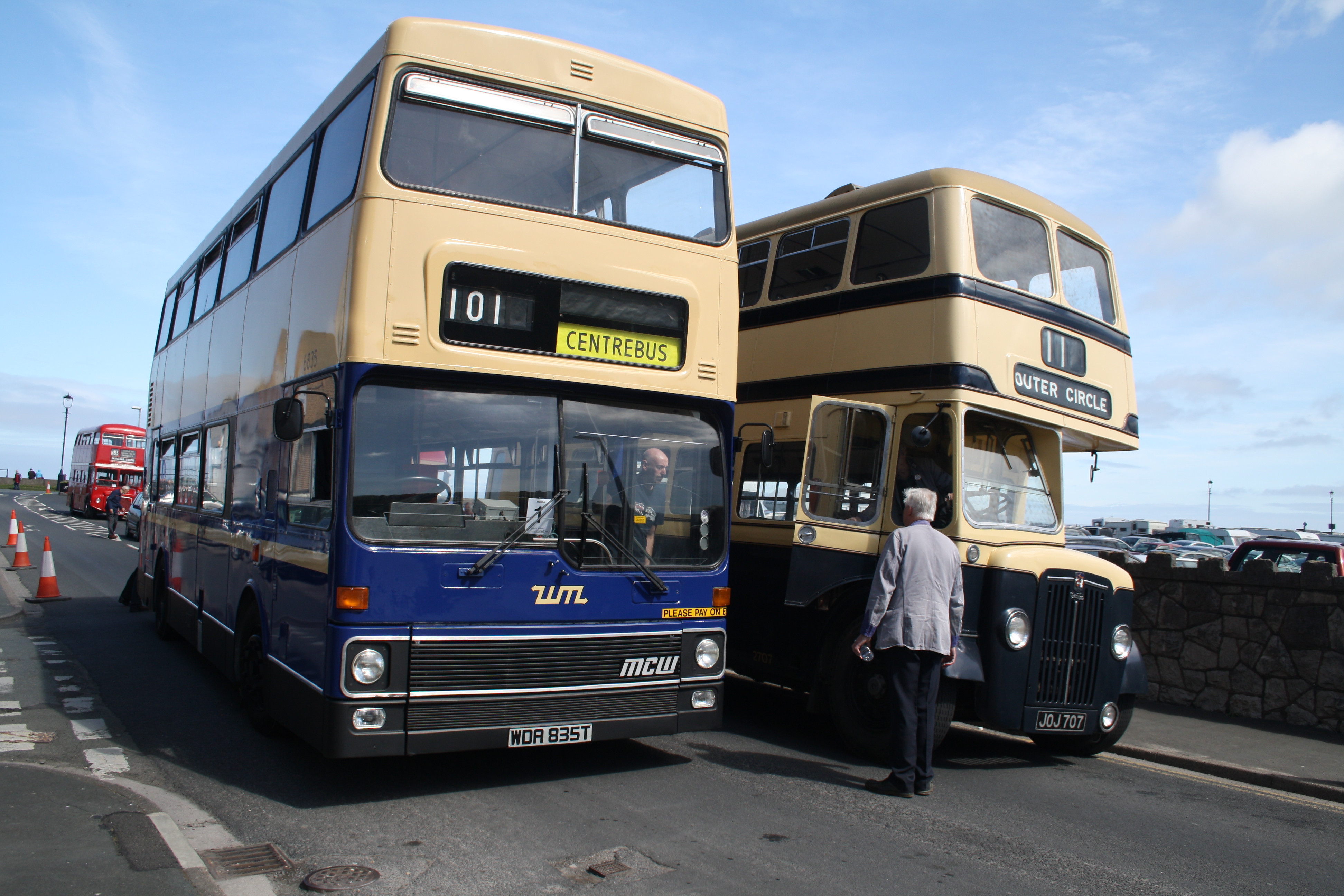
As I drove into the site, I almost rear-ended a Mercedes-Benz 380SLC as I caught a glance of a West Midlands Passenger Transport Executive (WMPTE or wumpty) MCW Metrobus. In short, a Birmingham-built bus that along with many hundreds of siblings, formed a key part of my childhood. WMPTE (later West Midlands Travel, then after a multi-million pound rethink Travel West Midlands) built up a huge fleet of Metrobuses, built by Metro Cammell Weymann in Washwood Heath, Birmingham. WMT had 1100 of them in the end and these were the buses that I first saw as a child (along with Daimler Fleetlines and the occasional Volvo Ailsa or Leyland National). It was the bus that took me to secondary school, the bus that brought me home after a night out in Birmingham and the bus that took me to college. The thundering Gardner 6LXB engine, high-pitched transmission scream and the shriek of the gearbox retarder when slowing down became ingrained on my mind. I probably caught my last Metrobus in the mid-1990s, but incredibly they remained in service until 2010. Some of them have since found work elsewhere, so new generations of school children get to experience the same engineering concerto. I bet they don’t even notice it.

Anyway, the point is that the following made me feel all of a quiver.

West Midlands Travel buses

The bus of my youth, and the bus of the previous generation’s youth

Yes, a WMPTE MCW Metrobus! The last thing I expected to see at a North Wales seaside resort was a pair of Birmingham-based (then and now as they belong to the Transport Museum at Wythall near Birmingham) buses – or buzzes as the locals call them.

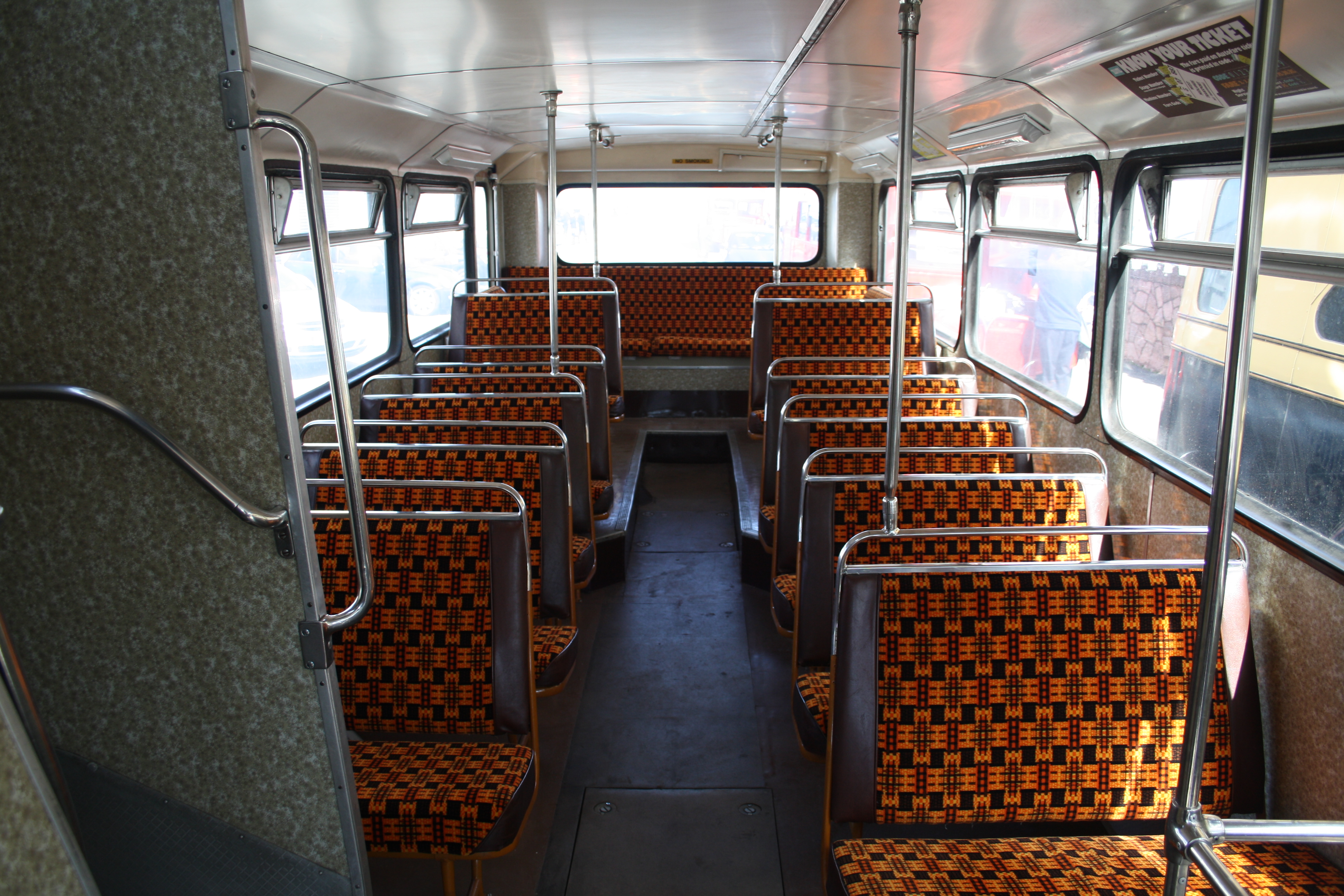
Best of all, this is a Mk1 Metrobus. In fact, it’s the last of five prototypes used by WMPTE to test for suitability. The Mk1 Metrobus has the unusual assymetrically-split windscreen. London Transport loved the Mk1 so much that MCW kept building them until 1985 just for them, even though the Mk2 had come along in 1982. This bus has been beautifully restored, complete with the vibrant orange seat material and floral interior trim.

West Midlands Travel orange bus seats

Vibrant, that’s for sure

Having had a nice chat with the drive of this bus while it worked its way to the front of the queue of heritage shuttle buses, I found myself first to find a seat. Naturally I headed to my favourite MCW Metrobus pew – the first raised seat on the nearside. You get to lord it over the ‘plebs’ in front of you, and you get quite a good view of what the driver is doing. Not that there’s much to do in an MCW Metrobus. The driver takes off the handbrake, which also puts the bus in gear. There is a button to press to go backwards and a steering wheel to make it change direction. That’s pretty much it.

Modern buses are far too clinical and quiet. A Metrobus vibrates so you feel the engine as much as hear it. It creates a vast range of noises which are all equally enchanting.

Anyway. I had a marvellous day riding around on the shuttle buses as well as compiling my report for a certain weekly classic car newspaper. Actually, after driving three hours north, spending nine hours gathering over 1000 photos and then driving three hours home, I was absolutely exhausted. It was  a worthwhile trip though, to a great event at a simply stunning location. If you’ve not been to Llandudno, you really must visit. Time it for the Llandudno Transport Festival and you can even enjoy a few free bus trips!


Car shows are boring

You perhaps wouldn’t expect that point of view from me, but it’s true. What’s interesting about row after row of cars all parked up?

Perhaps it’s because in this digital age, we can not only read about cars and look at pictures of them, but also watch videos of them in action. We can go to events where cars are driven – whether in anger or just for the pleasure of doing so. I find that much more interesting.

Morgan 3-wheeler

A Morgan, being not boring

I can liken this to meeting a film star. If you just see them in the street, or sitting down reading a magazine, it kind of highlights that they’re just another human really. You get that initial “OMG IT’S…” moment, then nothing much else happens. You might be brave enough to speak to them, ask for a photo, but when you get home, you’ll just realise that there are a zillion better photos of this person on the internet. Yes, you met them, were in the same place as them, but what’s special about that?

It’s like that with cars. Yes, it can be nice to see something special or unique at a show, but what can you do with the experience? Some cars are very, very pretty, so you can stare at them for a bit and go “hmmmm.” But that doesn’t last long. I’ve seen a Bugatti Veyron parked up, and if you stare at it long enough, it just becomes rather bland.

Watch one in action though and it all becomes rather more astonishing. The whoosh as it tries to put down some of its many horsepowers, the brain-baffling speed at which it moves and the grace of those lines as they slip through the air become something well worth remembering. I know this because every time I go to La Vie En Bleu at Prescott Hillclimb, I get the same giddy thrill. Walking around the paddock looking at them parked up does nothing for me.

Veyron Sport

One fast Volkswagen

It isn’t just the fancy stuff either. Looking at a Citroen 2CV is all well and good, but how much better is it to see one cornering on its doorhandles? Cars are about so much more than how they look. It pleases me that there are more and more road runs going on around the country. Then you get the full package. Not just the looks, but the bellow of an exhaust, the induction roar, the scream of a transmission. It’s like seeing that film star right in front of you doing what they do best. It’s the full package.

I’ve nothing against the ‘boring’ static shows to be honest, but they’re more suited to the people displaying than the people attending. It’s always nice to catch up with people in relaxing surroundings, but a group of people chattering next to a shiny car is not going to set pulses racing.

I’m off to an event this weekend which promises plenty of action – albeit at a rather more gentle pace than a Veyron can manage. That’s fine. As long as there is action, people will be captivated.

2CV in actual sunshine shocker

The best thing about being freelance is flexible working hours. Sure, working in the evening isn’t really my idea of fun, but it’s often the best time to get hold of car club officials – and I speak to a lot of them during the course of my work.

The bonus is that I’m not tied to my desk during the daytime. Which means that when it’s actually sunny, I can do this.

2CV Dolly

2CV enjoys some actual sunshine!

I will concede that after 500 serene miles in a Mercedes-Benz 300E, the 2CV takes a bit of readjustment! Once the shock of the noise had worn off though, I could concentrate on having a good ol’ hoon. Unassisted steering provides so much more feedback and 60mph feels actually quite fast! I love how different the two cars are to drive. After all, I wouldn’t want them to be identical. One is an antidote for too much of the other.

When it comes to the rest of the fleet, the other 2CV is still sitting in my garage. I’m still not entirely sure what to do with it. I’ve made tentative attempts to move it on, with some interest expressed by 2CVing friends I know. Is that a cop out though? Wouldn’t it be nice to actually get it sorted out? I’m not sure what the answer is.

The BX is in disgrace. It appears to have blown a high pressure pipe. I have no idea what’s involved in replacing them, but it’s quite an involved prospect that will require the rear subframe to be dropped. This doesn’t sound too jolly to me. As I can’t drive it anywhere, I’m going to have to knuckle down and get it sorted.

BX hydraulic leak rear suspension

BX makes a mess of the driveway

Which means that another working car would be a bonus. Shame I just sold the Mercedes then. Oh, hold on. I didn’t! The buyer seems to have got cold feet and for once, I don’t mind that yet another Ebay sale has failed. Yes, I’m a few pounds down on the experience, but it sold for naff all and I actually need another working vehicle! Having been so impressed with the Mercedes over the weekend, I really don’t mind at all. It shall remain on the fleet and I shall stop wracking my feeble brain trying to decide what to buy next. Perhaps ‘nothing’ really is the best option.

Mercedes – Last gasp, but what a gasp

This weekend, I was in the South East again. I appear to have a lot of friends and family in the area. It was Rachel’s cousin’s birthday and this being a public website and me being kind, I shall not reveal his age. The South East is a long way away and I’m afraid that immediately made me choose a vehicle other than the 2CV. Yes, my love for the Tin Snail has been thoroughly reignited, but hours of motorway driving are better conducted in something rather more suited to it. A cop out perhaps, but my hearing is already damaged! I don’t want to make it worse and I wanted something capable of maintaining an actual 70mph (not an indicated 70mph) for hours on end.

The BX estate was the obvious choice. Swift, comfortable, economical and fitted with an excellent stereo. It had a brand new balljoint and inner track rod end and so was in better shape than the last roadtrip. Or so I thought. Then I spotted an LHM leak. Oh bother. This was bad enough for me to abandon a journey after the STOP light came on. I tried to investigate and thought for a time that I’d repaired it. By the Thursday before we were due to depart, I’d decided the BX would be ok.

Fortunately for me, I decided to go and look at a Ford Puma that was advertised 12 miles away on Ebay. It looked like a jolly sort of a distraction, but it turned out to be a bit of a duffer. So, in an incredibly rare event, I declined to purchase said vehicle, even at just £450 with 12 months MOT. I’m amazed too. On getting back home in the BX though, I noticed that LHM was pouring out of the back of it. I wouldn’t be taking that to London then!

I was therefore left with no option but to take the 1990 Mercedes-Benz 300E. Yes, it would be thirsty, but it seemed to stand the best chance of getting there in peace and quiet. I was slightly concerned about a leaking radiator, especially as I actually have it on Ebay at the moment! I’d got to the point that I was getting very little pleasure out of it. The last tank of fuel delivered only 16mpg, which told its own story. I was only taking it out every now and then for a full-blooded hoon to get the fluids circulating (yes, 5000rpm is necessary for this, and fun). I was somewhat terrified about taking such a thirsty machine on a 500+ mile roadtrip, but having not bought a Ford Puma, I did at least have a little disposable cash. What the hell eh?

I filled a container with water ready to top up the coolant, noticed how rich it is still running and ran out of time. I loaded up and off we went. We left home at half past one in the afternoon. After two hours, we reached a motorway. I then drove at an indicated 80mph for two hours. The M4 was beautifully clear as London emptied – all the traffic was the other side. My wife slept (though she can sleep in a moving 2CV) while I enjoyed the sheer majesty of it all. Even at 80mph, there are just a few flutters of wind noise and very little engine noise. It’s absolutely serene. Best of all, people seem to glance in their mirror and move over as the three-pointed star hoves into view. I’m not at all used to this. Unlike when I’m in the 2CV, people don’t seem to feel the need to re-overtake me as soon as possible either! Having power in reserve means no slowing down for hills, and no struggles to overtake trucks.  It was incredibly relaxing.

Then we hit the M25 at half past five on a Friday afternoon. This was unsurprisingly sticky and we soon slowed to a crawl. Here, I was able to take my mind from the frightful effects on fuel economy of slow-speed running by enjoying the automatic gearbox. It really does make driving in heavy traffic almost joyous. Actually, I’m a huge fan of the Merc’s gearbox. It’s hard to imagine a better transmission. First gear is only for use in traffic light grand prix, so generally isn’t used unless you really boot it. So, for the majority of the time, it’s a three-speed unit. That’s great. It’s also very reluctant to kick-down. That’s also great. It’s got a thumping great six-cylinder engine with bags of torque – it’s nice to be able to use it. Modern automatics want to kick-down too readily by far, which makes progress frustratingly jerky.

As we spent the next two hours slowly crawling towards Beckenham in Kent, I became ever more grateful for clutch-free driving. We eventually arrived six hours after departing. We hadn’t managed a break in that time, other than when stationary on the M25. I don’t really applaud that sort of thing – taking a break every two hours really is much more sensible. I was impressed that I could get out of the Mercedes after that length of time without assistance though!

Here’s the Merc at rest in Croydon the next day. The capacious boot was useful for transporting party goodies (wine, food etc).

Mercedes-Benz W124 on driveway

Merc looks right at home in Croydon

It does rather look like it belongs doesn’t it? The house belongs to my wife’s aunt and will shortly be on the market. Mercedes-Benz not included sadly. You’ll have to buy your own.

Today, we went to see a friend in Surrey before heading home. I filled the car (again!) before we set-off for Wales. Another £65 which revealed that fuel consumption on the way there was 27mpg. Given that the car was hooning up and down Welsh hills (2hrs), cruising up the M4 at 80mph (2hrs) or crawling in nightmarish traffic (2hrs) that’s really not bad! Especially as it’s still running rich. I reckon that the motorway cruising must have been delivering over 30mpg. Astonishing for a 3-litre six-pot.

The homeward journey took 4.5hrs but as I’m not going to fill the tank again, I won’t know the MPG. Rather more sensibly, we did take a break after a couple of hours this time. What really impressed me is that the coolant didn’t need topping up at all. In fact, the car ran beautifully and now seems to be starting much more cleanly in the morning. It really is a marvellous machine.

So, why on earth am I selling a marvellous machine? Well, the problem is, it’s a great car for that sort of distance journey. I don’t actually undertake that many long distance journeys. Yes, I’ve done two this month (three if you include taking the 2CV to Birmingham) but that’s pretty unusual. It seems slightly ridiculous to have a car sitting around the rest of the time waiting three months to be used on an ideal journey. Truth is, the Merc is a bit hopeless in Wales – in much the same way that my Citroen CX estate was. It’s just too big and wobbly.

The hunt is now on for something that can be as impressive as the Merc on a motorway, but that isn’t big and wobbly. What will I find?