The Discovery’s Ebay fail

I’m not very good with numbers. Hopeless in fact. I’d got myself in a bit of a tizzy over my tax return and thought I owed a lot more than I did. In fact, the tax bill was much smaller than originally anticipated. Too late though as in a panic, I’d lobbed the Discovery on Ebay, where I discovered the downsides to selling just after Christmas. It made just £600. Yes, that was more than the utterly bargainous £450 I’d paid for it, but I’d spent a lot on it since then.

Driving it while the auction was live gave me a real sanity check. I really like it! With half a ton of sawdust briquettes in the back, it rides like a limousine – we thought we’d better collect the next load while we actually owned something capable of hauling it. However, I’m an honest man and when the auction finished for a feeble £600, I was fully prepared to honour the deal.

Things didn’t go to plan though. I usually ask people with less than ten feedback on Ebay to contact me with a phone number before bidding, in the hope it’d keep the timewasters at bay. So, I had a phone number for my ‘buyer’, who seemed reluctant to get in touch. I called the number – number not recognised. Great.

Looks like I can do more of this then!

Looks like I can do more of this then!

Days ticked by, so I opened a dispute on Ebay, which you can do after two days. The ‘buyer’ now had four days to pay for the item. He occasionally dropped me a message – his phone had been stolen but he still wanted it – but the four days lapsed. I claimed my money back from Ebay and the ‘buyer’ got an unpaid item mark against him. Despite providing my PayPal details, a deposit was not forthcoming. Tough! Proving that the ‘buyer’ was perhaps just not very Ebay savvy rather than a malicious timewaster, he actually phoned me six days after the auction finished wanting to make arrangements for collection! No, sorry. You had your chance, failed to respond to the dispute, time is up.

So, I still own the Land Rover, and have had yet another hopeless Ebay experience. That’s two cars that have failed to sell now, and when you check the sales listings, it’s amazing how many cars are “relisted due to timewaster.” I think I shall try elsewhere in future.

However, after a lot of faff, I can now look forward to continuing with the Discovery’s restoration. I’m hoping to tackle some RTV trials too, for something a bit different!

Rapid recovery – electrics and a shocking decision

Hoorah! Technology has been restored. Thanks to a very generous member of the Autoshite forum, my laptop has been fitted with a new hard drive. Having blithely ignored the warning to create back up DVDs for Windows, I’m now using Linux for the first time. All seems fairly well so far…

The restoration of technology has enabled me to get into a very strong debate. I’ve caused lots of upset today by putting my 2CV up for sale. She needs a LOT of work, and probably deserves a better owner than me. Well, that was my thinking! The howls of derision from (almost) all angles has left me questioning my sanity.

The howls got a bit much for me to be honest, so I headed out after a plea for assistance from my Skoda-loving friend, Rob. He was having one of ‘those’ experiences that us classic owners sometimes encounter. Namely, checking that all the lights work on a car before an MOT test, then discovering that many of them do not in fact work once the test begins. Every year, I wonder if the 2CV’s sidelights are going to work or not. Rob’s Rapid had decided that headlights and foglights were superfluous. The MOT tester did not.

Electrical woes prevent MOT

Electrical woes prevent MOT

Electrical issues are quite easy to solve if you have a multimeter though. On lovely old cars, there really are limits to what can actually be wrong. There must be power, and there must be an earth. That’s about it really. One sidelight was powerless, though trying to trace it back through the loom proved tricky. It seemed to recover on its own. That sort of thing never inspires confidence!

Iffy headlamps proved a bit easier to solve. The multimeter reckoned power was getting to the bulb holder, so the holder was probably at fault. Adjustment of the contacts improved things. Before too long, all front lamps were working. Next came the fog light. For some reason, this has a relay. The MOT-bodge solution, after checking the wiring was all ok, was to simply bypass the relay. Rob can now either replace the relay or live with more power going through the switch. One fog lamp can’t draw anywhere near the current of a pair of headlamps though – which is why relays are often fitted in the first place. I don’t fully understand why Skoda felt the fog light needed one.

All of this was a fine distraction from the hornet’s nest I’d stirred up by wishing to sell my 2CV. One interested party asked for better pictures of the rotten bits, and this forced me to take a closer look. Yes, there is work needed, but for the MOT, I reckon a bit of plating beneath the rear seat box will be sufficient. Probably not beyond the means of even my meagre budget. Much more work is needed than that longer term, but perhaps I should focus on each bit at a time. As with any classic car restoration project, if you try to take in all the work that’s required, you’d quickly lose the will to crack on with it! After all, I’ve been steadily improving the Discovery. Now that it has failed to sell, I need to plan the next stage. There’s always plenty to do with old cars!

I've really enjoyed this sort of thing

Discovery has failed to sell. Perhaps not a bad thing?

But while selling Elly the 2CV is entirely sensible at a practical level – it’s cheaper to buy a better one (or a Dyane) than to restore Elly – emotion is a very odd thing. Witness the outpouring of disbelief from my friends over the sale. Why has my decision to sell an inanimate object created such a fuss?

The truth is that old cars are not very much to do with practicality or reasonable thinking. Why do we want to drive old cars in the first place? Nostalgia mainly. It’s a return to an older way of life, a simpler way of life. Or it might just be the desire to experience the vehicle we remember when we grew up. Or our first car. Our parent’s car. The car we saw on our street that we wished our parents had owned. Emotion is hugely important to any classic purchase and our ability to ignore the brain and listen to the heart is why so many of us end up making bad purchase decisions. That’s all part of the fun really! If you take the emotion out of it, it just doesn’t seem as much fun.


Facebook gets it wrong

Facebook IS starting to charge people to promote their own posts. This isn’t one of those hoaxes, my wife is already being asked to pay to promote things she shares, whether it’s items relating to her Blog (for which she earns not a penny) or even just bog standard status updates. Part of a ‘test’ apparently, but surely a sign of things to come.

I find this utterly abhorrent. Facebook already makes billions of pounds because people like us use it. Companies will pay good money to advertise to the masses. Why do Facebook think this is not enough? Its corporate greed of the very worst kind. We, the customers of Facebook are actually the asset of Facebook. You’d think they’d treat us a little better.

Sadly, they must be using Ebay as a role model. If you become big and powerful and desirable, you can do what you like it seems. I keep making the mistake of going back to Ebay, even though the odds are stacked way against the small seller. An idiot ‘bought’ my Land Rover Discovery and wasted my time and thanks to the way Ebay works, I can’t even leave negative feedback against the non-buying buyer. They don’t care if I get a bit disgruntled. They know that people will keep coming back.

They won’t though. If Facebook rolls out charging to promote posts, I will leave, and I hope you will too. There was a world before Facebook, and I don’t recall it being a particularly grim place. Therefore, I’d ask you to bookmark my Blog so you can always be sure of seeing my latest posts.

Speaking of which, there are less posts than usual at the moment after the hard drive on my laptop died a death. I’m sorry about this. I’m hoping to have that machine up and running again soon. This desktop is a bit elderly and refuses to read the card in my camera, so things have gone quiet and I’m stuck with only ancient pictures. It won’t last!

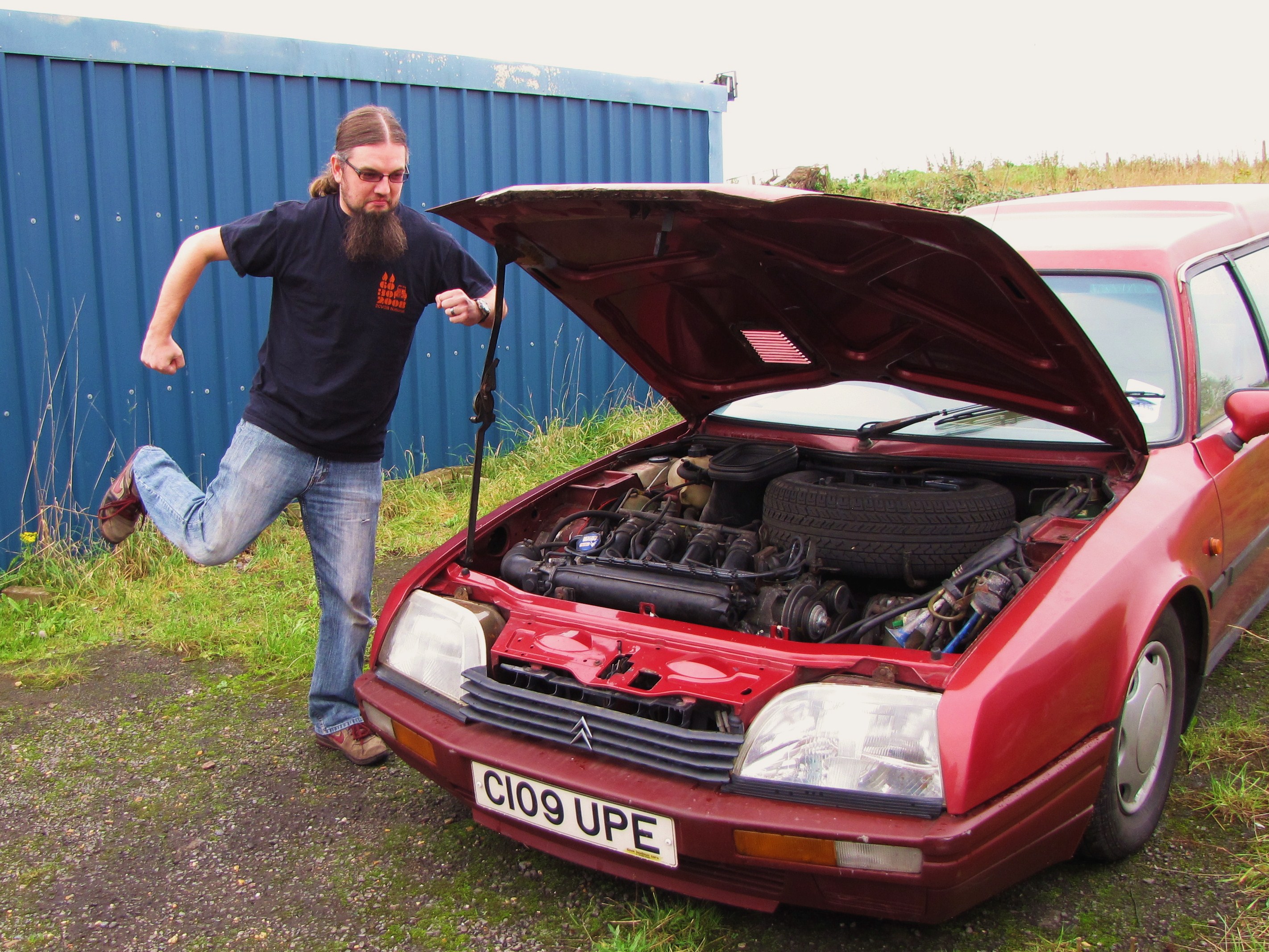
For now though, here’s an elderly shot of me looking thoughtful in the days before Facebook. I’m typing on that very keyboard right now.

Please stop laughing, this photo is almost ten years old

Please stop laughing, this photo is almost ten years old


Save money, upsize!

The days of super-cheap cars appear to be with us once more. People are looking at economy figures more closely than ever, but I’m not sure they’re actually saving money by downsizing.

Take this car for instance.

Ian's new Saab

Big needn’t mean expensive

It’s a 1991 Saab 9000 that I bought a few years ago. It was a lovely machine: swift, comfortable, powerful and able to deliver 35mpg on a run. I paid £595 for it and couldn’t believe my luck. It had 124,000 miles on the clock, full main dealer service history and I was only the second owner. Aside from rather sloppy initial turn-in when driving hard, I really couldn’t fault it. In one weekend, I took it from home in Aberystwyth to Suffolk and then to Croydon near London before returning home. It ate miles up with no bother at all, while delivering economy you might not expect from such an enormous beast.

Let’s say for instance that rather than taking the little Sirion to Scotland, we’d taken the Saab. Calculations reveal that yes, the larger car would have cost more, but only £60 more over the course of the 1577 miles we covered. Now, £60 is a useful amount of money, but it doesn’t seem a lot to pay for extra comfort the Saab offered. The difference between 35mpg and 45mpg is therefore not as vast as you might think.

People don’t see that though. They see an economy figure and assume that it makes a massive difference. They get so blinded that they pay much more for a newer, more economical car, when it probably made much more economical sense to keep what they had. Unless you’re swapping a Land Rover V8 for a Smart car, you’ll notice less of a difference than you may expect unless you’re clocking up vast amounts of miles.

With the Land Rover heading to new shores, I’ll be looking to bag myself another barge once the tax bill is out of the way. It’s been painful to watch an MOTd Vauxhall Carlton 2-litre sell on Ebay for less than £200. £200! For a road legal car – and a nice one at that. Here’s hoping that the bargain barges are still around when I actually have funds.


2CV-laning, who needs a Land Rover?

I drove away from my home today planning to have a gentle drive in the 2CV. She had been sheltering away from the weather in my garage since before Christmas. It all went a bit wrong though when I found myself driving towards a local greenlane. Perhaps a quick explore would be fun! Fun is certainly one word to use…

Happily, Elly seems remarkably unbothered by yet more harsh treatment. I guess after over 100,000 miles of my ownership, she’s rather used to it…

Sirion: 3000-mile review

The Sirion has only been on the fleet since October, but it has already clocked up 3000 miles in my ownership. I was starting to feel that I hadn’t done that much driving in 2013, but the 2CV has clocked up almost 2000 miles since September too. Clearly I am driving more than I think.

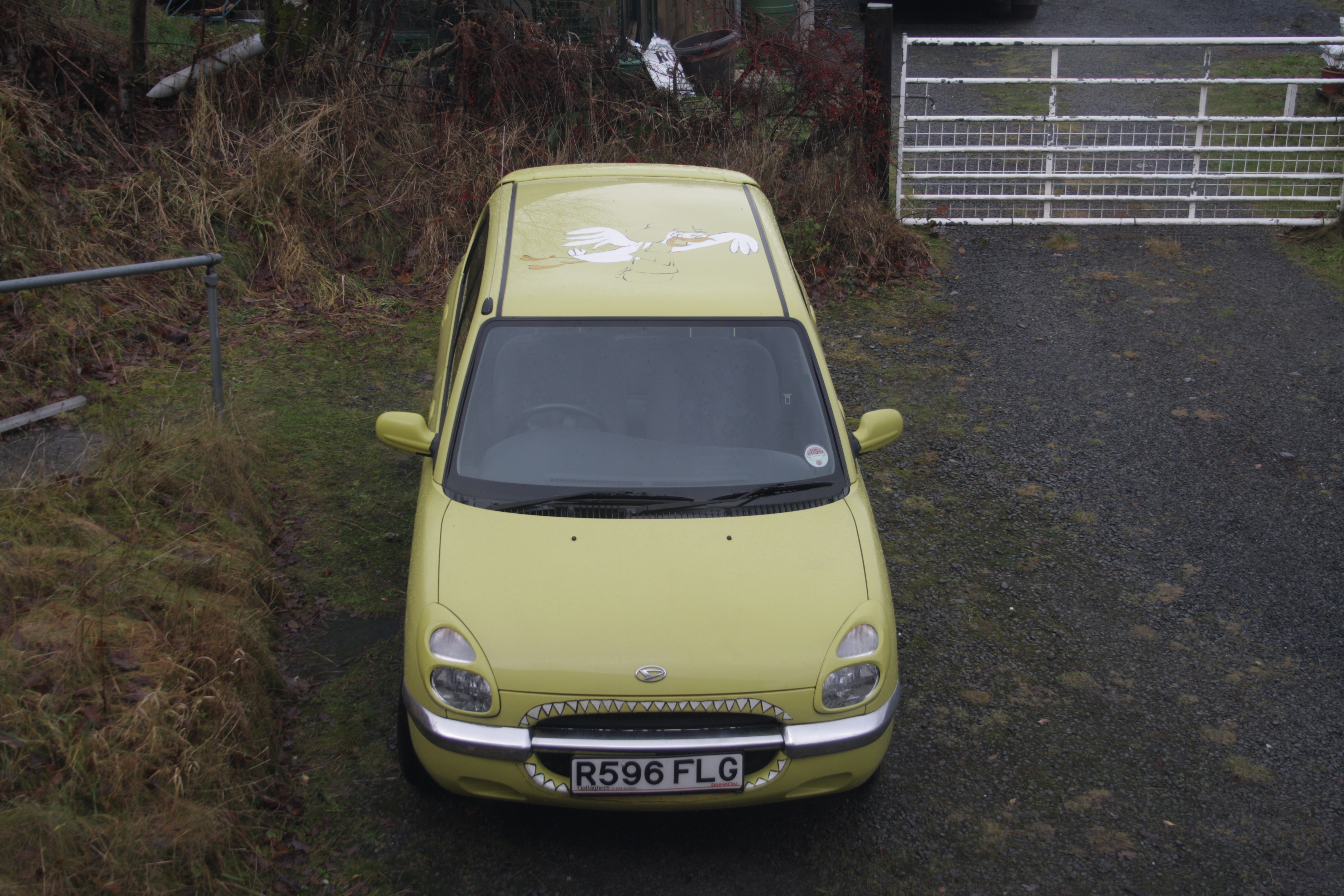
At rest after a busy year

At rest after a busy year

Since purchase, the Sirion has become the default vehicle. It’s the one I jump in for most journeys on account of the fact that it actually keeps inclement weather outside, it gets up to temperature REALLY quickly, and I still like driving it. For sheer effortlessness, it’s hard to beat. I’ve driven it to Birmingham, Sussex and Kent – as well as the very top of Scotland of course. Before I bought it, the Sirion had been used for a banger rally down to Nice in Southern France. After a life of bimbling around Cheshire, it seems to be heading for retirement having plenty of fun.

And yes, it sadly is heading for retirement before long. It may only have 73,000 miles on the clock, but the body is sadly not as healthy as the mechanicals. A week of high mileage on heavily salted roads has left the rear wheelarches looking iffy again, and corrosion has already had a good munch on other areas. It’s quite depressing really, as it feels like a car with a lot more to give.

There are a few downsides. The ride is not very good at all. It really does crash about over poor surfaces. The rear wiper switch position continues to irritate and the lack of a flick-wipe for the front wipers is also a pain. Really though, these are very minor grumbles. Usually, after 3000 miles in a car, I’ve thoroughly had enough! So, the Sirion will remain on the fleet and we’ll see just how bad things are when the MOT comes around in the summer. Unless something else tempts me in the meantime…

Why I adore the Jowett Javelin

As Great Britain recovered from the ravages of the Second World War, its car manufacturers faces a huge battle to restart production. Some new models arrived – notably the Armstrong Siddeley Lancaster and Hurricane as early as 1945 – but generally most companies hastily relaunched their pre-war ranges. Progress was slow to arrive, so Jowett rather stunned the world with the Javelin of 1947. For a start, it looked very much of its time, not something styled in the previous decade. The sweeping lines hid torsion bar suspension all-round, rack and pinion steering and Jowett’s own flat-four engine in 1486cc form.

One of my very favourite cars

One of my very favourite cars, the Jowett Javelin

Gerald Palmer designed the car – he would go on to pen the delicious MG Magnette Z, a favourite sporting saloon of many, including myself. He was allowed to be rather unconventional for the time, with engineering seemingly inspired far more by the likes of Citroen than other British manufacturers. Sadly, crankshaft problems blighted the engines, gearbox woes were next in line and then Ford bought Jowett’s body supplier. It all went a bit wrong and the 23,307 sold just wasn’t enough. Jowett ceased production in 1953 and one of Britain’s most exciting manufacturers was dead and buried.

That’s all history though. What is a Javelin like to drive today? Naturally, it’s really rather good, or I wouldn’t like it. History is fine, but I won’t rate a car if I don’t like driving it. I demand a car that handles and stops. The Javelin does, with its distinctive flat-four engine noise giving a wonderful off-beat thrum familiar to anyone who’s spent time with Volkswagen Beetles or Subaru Imprezas. It remains refined though and delivers strong performance for its age and size – 80mph is comfortably within reach.

Large steering wheel and a great column gearchange

Large steering wheel and a great column gearchange

The huge steering wheel gives wonderful feel, and the column-mounted gearchange is an engineering delight. It makes you wonder why column change never became more popular. Reach a bend and you needn’t be too cautious as it’ll sail around pretty quickly if you ask it too. Full hydraulic brakes – far from universal in the late 1940s in Britain – ensure speed can be reduced without worry.

Time has enabled enthusiasts to overcome many of the car’s foibles. For my money, the Javelin remains one of the best classic saloons money can buy. I just wish I had enough money to buy one!


Buying blind

The rise of a certain internet auction site has led to an entirely new way of buying cars. Buying blind. This means buying a car you haven’t actually seen in the metal. Previously, this was really not considered the best way of doing things. It isn’t just on Ebay that things have changed though – car dealers have told me that they now sell a lot more cars ‘blind’ than they ever did before.

It requires a huge amount of trust and a certain amount of daftness, but I do it all the time. I have no problem with it, as I rarely spend very much buying a car. Take the Discovery as an example. I found it hidden in the parts section of Ebay with very little description and one poor photo, which utterly failed to capture the described accident damage. Incredibly, I let it go with £500 and no bids. That required impressive levels of self-control. I then contacted the seller and found out a bit more about it. It’s important to do this bit in writing – ie email – because I now had a good description of the vehicle and some more photos. We haggled a bit and I agreed to pay £450 for it. I think I used PayPal to secure it with a deposit, then used various methods to get to Northamptonshire.

The way I saw it, a £450 Discovery just couldn’t lose me money. If it broke down on the way home, I could get recovered home and then break it for parts to get my money back – or even sell it as a going concern. As it happens, it was really a fair bit better than it had any right to be, though it has obviously needed work since. You expect that with any sub-£500 car.

It’s all about asking the right questions and deciding whether you trust the seller. Establish a relationship and judge for yourself. The seller needs assessing just as much as the car itself. Do your research and find out key problem areas for the car you’re looking at and ask what these bits are like. Be suspicious if the car is described as perfect, as it almost certainly won’t be!

I don’t always get it right. The Sirion is a great little car, but is more rotten than I’d hoped. I’m not really complaining at £370 though, and I’ve not had to spend much on it since buying it. Indeed, expenditure is very low for the 3000 miles it has now covered. I bought it because it sounded good mechanically, with a service history including important things like a timing belt change.

My nearest disaster was a Citroen CX Safari. I foolishly agreed to swap the CX for my Renault 21 Monaco and a bundle of cash. This was silly on many counts. The really tidy Renault was soon a rather sheddy Citroen. I filled it up as it was running on fumes and it started leaking petrol all over the place. Then, on the M6 in a traffic jam, I discovered that the cooling fan didn’t work at all, and the heater fan was hopeless. It hit 109 degrees Celsius at one stage. It also misfired a fair bit.

CX1

The relationship with the CX was occasionally frustrating


I did avoid complete disaster with that car though. A new air intake hose cured the misfire and it went on to perform very well bar the odd complete refusal to start. I used it to help a friend move house, and loaded it up for our own house move in 2010. That huge load area was a massive boon. Once in Wales, it proved incredibly good in snow and survived its coolant freezing in -15 degree weather. I sold it for £565 to someone who bought it blind. I replaced it with a Land Rover 90 V8 which I bought blind for £1600. That was pretty good too and I sold it for £2300. I was well chuffed as it was actually pretty disappointing to own. Certainly nowhere near as good as a 16-year old me imagined.

Land Rover 90 V8 County Station Wagon

This 90 V8 was a definite success

So, don’t be afraid to buy blind, but do take precautions. If it sounds too good to be true, it probably is. Bravery can be rewarded by a genuine bargain though. It’s all part of the fun!

The expedition to The North

Towards the end of 2013, Rachel announced that she wanted to see the Northern Lights. This seemed a rather splendid idea but the lack of funds made such a trip unlikely. Fortunately, Rachel works part-time and also holds a small contingency fund to which I am not allowed access. Apparently rusty old cars are not a contingency. Make no mistake, this trip was sheer luxury and our first proper holiday since moving to Wales in October 2010. Funding was still tight though, so the most economical car would have to be used for the trip. That meant the Sirion which, as it happened, I’d prepared for such an adventure by equipping it with a bargain set of winter tyres in early December.

On Friday 27 December, we loaded the poor Daihatsu with essentials, including a snow shovel and liquid snow chains. If you’re heading north in winter, you have to expect the possibility of some winter weather. The car was quite heavily laden, and this would eat into the fuel economy. It was averaging 45-47mpg on the way up. That drive up proved rather challenging thanks to the run of winter storms. Strong winds and heavy rain meant the motorway section especially was a struggle, especially on exposed sections. Here, the over-assisted steering proved a massive problem. It’s very direct, so trying to counter the effects of a gusty side-wind was very difficult. It was far too easy to over-correct, making maintaining a straight course near-impossible. Eventually, we decided we’d had enough and stopped at a hotel near Dunblane. My shoulders and upper arms were aching a lot.

The next day was calmer, and we drove another 200 odd miles without further incident. The Sirion really does bowl along very nicely on a long-distance trip, even if it does find hills hard work. As our route took us over the Cairngorms, the tiny 989cc engine was worked very hard to keep our momentum up. We reached the village of Helmsdale – created as part of the Highland Clearances and timed also to make the most of the Herring boom in the 19th century. From here, it was another ten miles down a single-track road to reach our very-remote cottage, where mobile reception and internet were conspicuous only by their complete absence.

Scottish paradise

Scottish paradise

Being cut-off from technology was a real bonus. My life invariably involves being connected to the internet for work and pleasure. The enforced break was a very good thing and allowed me to properly unwind. We went for walks, went for drives and enjoyed the best that north Scotland has to offer. Thoughts soon turned to the main reason for our visit – the Northern Lights. This phenomena is occasionally visible from the UK, but you want to be as far north as possible. This is not, as you might expect, John O’Groats. That’s a good thing as it’s a bleak and fairly unimpressive place. Instead, we headed to Thurso, then east along the coast to Dunnet Head. This headland is the northernmost point of the UK mainland – the only way to get further north in the UK is to fly or catch a ferry to Shetland. Our drive north from our cottage was livened up by only having quarter of a tank of fuel. In Scotland, 2nd January is also a Bank Holiday. Would we be able find a petrol station that was open? Just finding a petrol station was tricky enough, and we didn’t pass one until we’d driven 30 light-footed miles. It was closed. I opted to keep following the main road in the opposite direction from Thurso to Dunnet Head. This was a bold move but a successful one. We found the only open petrol station in Thurso! Phew. We then retraced our steps and headed out of town to Dunnet Head.

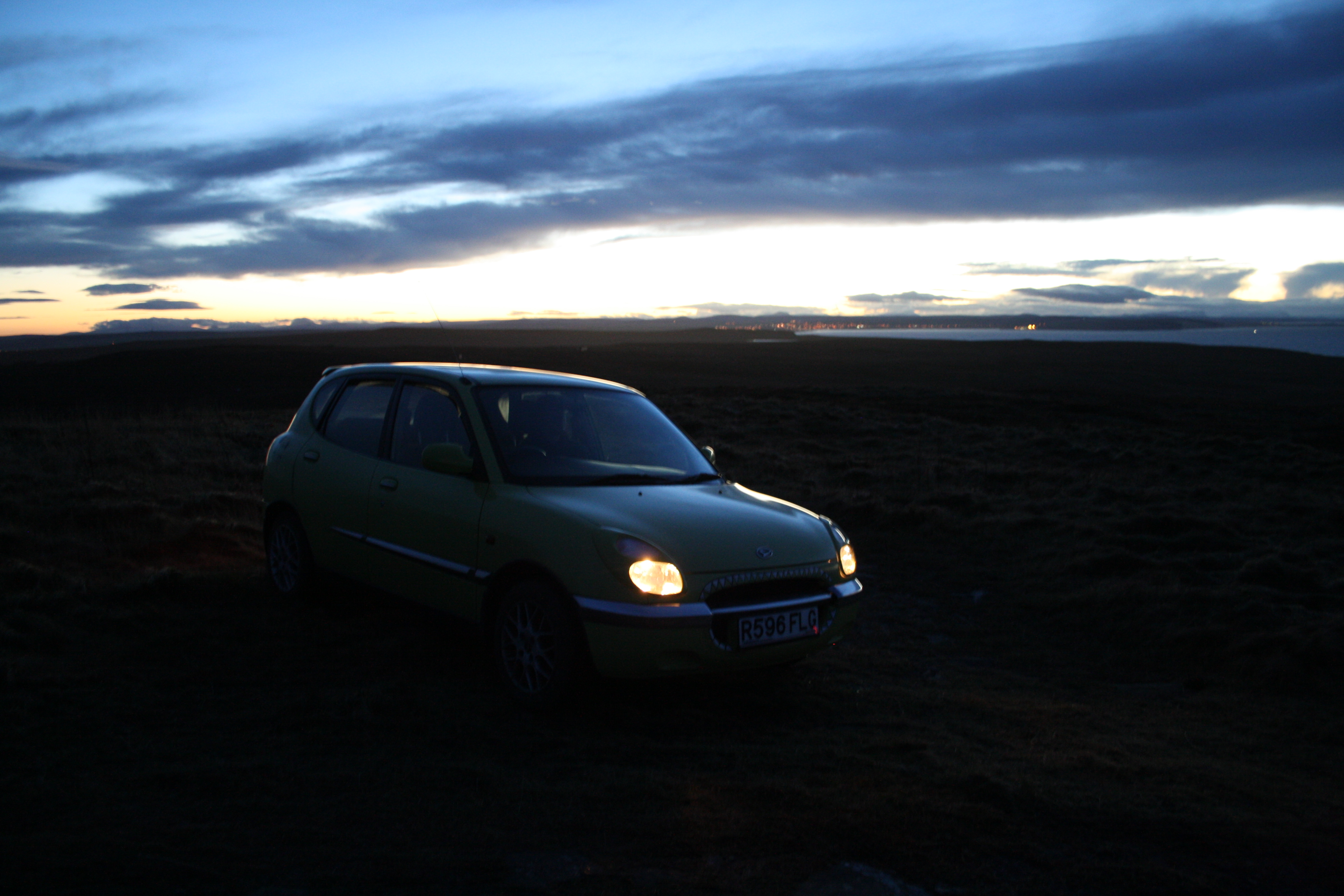
Sirion basks in the sunset at Dunnet Head

Sirion basks in the sunset at Dunnet Head

What now followed was a very lengthy wait. We arrived well before 5pm and enjoyed a spectacular sunset. There was a hint of aurora activity at around half past seven, but it didn’t amount to much. We sat back and listened to a remarkably odd programme on BBC Radio 2 in which Harry Shearer (Spinal Tap and The Simpsons) played some very obscure stuff from his record collection. At 10pm, more than five hours after we arrived, Jo Whiley took over radio duty and made the mistake of playing some Paul McCartney. The radio was turned off. We continued to wait. At half past ten, we got treated to a gentle but definite show of Northern Lights. Actual aurora! The show didn’t last long, so we continued to wait. Another hour crept by and then things got better. I took this shot at 2345hrs.

The Northern Lights! Amazing

The Northern Lights! Amazing

Not a very good photo as it happens, as I was cowering inside the Sirion due to gusts of wind. That and the cold rendered my tripod useless, so I was balancing my camera on the dashboard and trying to guess at the focus. It was still soft, as the gusts were still moving the car around! Still, it was mission accomplished. We had incredibly managed to see what we came to see.

We then had a rest day before driving home. I managed to do absolutely nothing at all on the Friday, which was good as Saturday would prove quite a challenge! We were treated to a telly in the cottage, so we’d been keeping up with the stormy developments around the UK, watching with dismay as Aberystwyth’s promenade was literally ripped apart by the storms. The forecast was grim, but Saturday – our travel-home day – was a rare window in otherwise grim news. The Sunday was meant to be particularly dreadful. That said, there were warnings of snow in central and southern Scotland, and north England too. Our route home.

We got up at the unholy hour of 7am and quickly packed and prepared. We managed to leave just after 8am – a record for us – and headed south as quickly as the little Daihatsu could carry us. The Cairngorms became a concern, but we needn’t have worried.
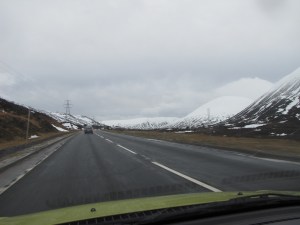
Very pretty, but thankfully the roads were clear

Very pretty, but thankfully the roads were clear

There were no problems and no more snow appeared to have fallen than had been around on our drive up the previous weekend. We stopped for a break north of Perth, then headed on south. We zoomed past Dunblane and on to Glasgow, where gritters were very much out in force and overhead signs warned of cold weather. We had another pause for lunch just north of the border, then pushed on – keen to get miles covered while it was still light, and while the weather was good.

We stopped at the truly excellent Tebay Services for another break – thoroughly recommended and a wonderful demonstration of how pleasant motorway services could be. We even bought some meat at the farm shop. I was still feeling fresh, even after 300 miles, so on we went, enjoying spectacular views as we headed south on the M6.

Astonishing views, from a motorway!

Astonishing views, from a motorway!

As darkness fell, the weather was still kind and our going was good. Almost ten hours after we started, we stopped at the Little Chef near Oswestry. For reasons I can’t really explain, I mourn the demise of Little Chef, so visiting this one felt like I was supporting an underdog – surely a very British pursuit. We were treated to the sight of a very tidy Ford Escort XR3i in the car park. Surely as sign from the gods that we were doing the right thing.
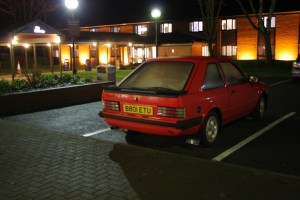
Nothing like taking an Escort to a hotel for the night

Nothing like taking an Escort to a hotel for the night

Duly reinforced, our journey home continued. All was not well however. After performing magnificently for more than 1500 miles, the Sirion began to display a worrying tendency to misfire during and after left-hand bends. This was very odd. It felt like fuel starvation and I began to suspect one of two things. Either the fuel filter was clogged, cutting fuel off when centrifugal force was added into the mix, or the leaky fuel filler pipe had been allowing water into the tank. I still don’t know which of these is the culprit and the weather will prevent me investigating today.

Then it started hailing. Finally, a test for the winter tyres! I cautiously pushed on and twelve hours and 560 miles after we set off, we were home!

I’m truly astonished by the little Daihatsu, which averaged well over 40mpg during the trip, despite being driven hard and being heavily laden. The economy did drop off a bit on the journey home, possibly because I was pushing it quite hard, but also possible due to whatever fuel fault there is. Regardless, it easily got us to the north of Scotland and back again, with the only downsides being that steering, rather harsh suspension and seats that lack enough comfort. Still, can’t be that bad if I can survive 12-hours at the wheel and still walk! The Sirion may not be the obvious choice of road trip machine, but it proved that size certainly is not everything. It fully reinforced my love of tiny cars.


2014 fleet predictions

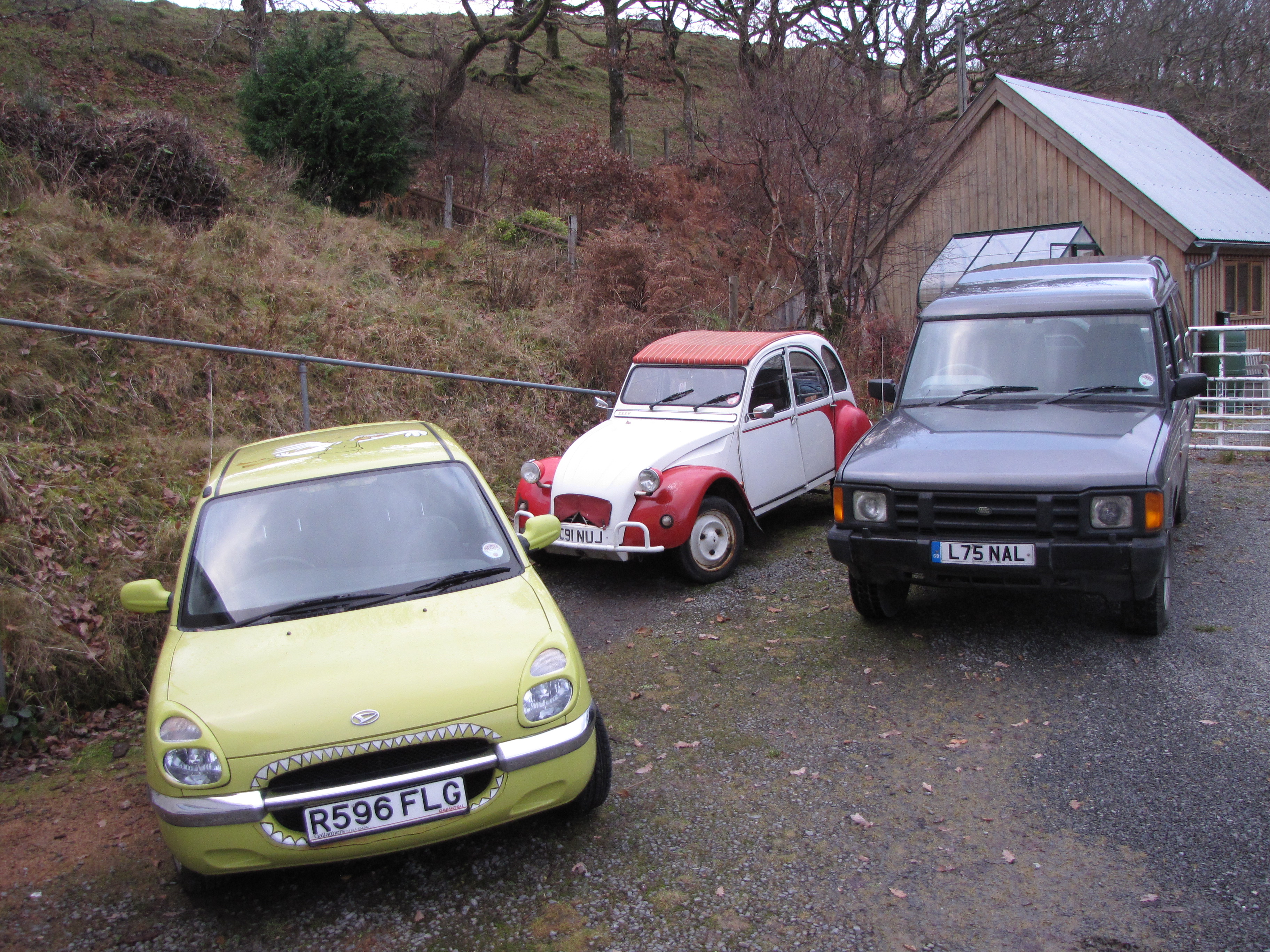
On the face of it, the ClassicHub fleet has settled down quite nicely. The Sirion is a superb little car for most driving, the Disco is the heavy-hauler and off-road toy and I can’t cope without a 2CV on the fleet, so the 2CV fills that slot. All is not well though.

The fleet. Not as good as it looks...

The fleet. Not as good as it looks…

Let’s start with the 2CV. She’s badly rotten and I’ve still no idea what I’m going to do about it. The bodyshell is in a right state, with some previous restoration and accident repair work hindering future restoration. It may be time to give up on this bodyshell. The running gear is still surprisingly good though. Some tricky decisions need to be made before the MOT runs out in April.

Then there’s the Sirion. Good as it is, it sadly proves that modern cars still rot. It will take either a miracle or a good deal of welding to see it gain another MOT, which is a bit disappointing for a car with only 71,000 miles on the clock. It ticks more boxes than many cars I’ve owned though, demonstrating huge capability but also being very easy to drive, nice and small and wonderfully efficient. It’s a hard car to replace. I love 1990s vehicles, as they have enough cleverness to make them work very well, but not so much that you need a computer to work on them.

Lastly, there’s the Discovery. This is the hardest vehicle to justify, which is why it might well find itself for sale in the New Year. As a vehicle, I like it very much, despite its many and obvious faults – the chief of which is a horrific inability to keep the weather out. Yes, it is useful for hauling stuff about, but my trailer is only rated at half a ton, which is within the capabilities of many smaller vehicles – if not quite as small as the other two on the fleet. Really, it’s just a big toy for playing about in. There are other downsides too. 4x4s seem to attract text talkers like no other vehicle. The Maverick was just as bad. I’m sorry, but I like my English as it should be written. I don’t always get it right, but I do my best to use all of the letters that should be used. I like to write how I speak. I rarely come across text talk amongst 2CVers, BXers or the Autoshite forum of which I’m a member – which celebrates the wonder of unloved cars. In fact, text talk is often rightly vilified amongst the members of the aforementioned enthusiasts. I’m not sure why this is, but I very much agree.

The simple truth is that I don’t NEED a 4×4, and January is probably a good time to sell. It’ll be a sad sale, but it’s becoming a rather inevitable one.

Before any of this though, there’s the small matter of taking the Sirion on a 1200-mile roadtrip to Scotland. Will I come back loving it more than ever or will it find itself joining the Disco in the classifieds?