2CV – rot hunting

I didn’t mean to go rot hunting, but that’s what I ended up doing. You see, I’d decided that the sill and C post needed painting after the recent weldathon. That meant taking the rear wing off again. With that off, I thought I’d better hose off the muck and see what was what. Rot was rot as it happened.
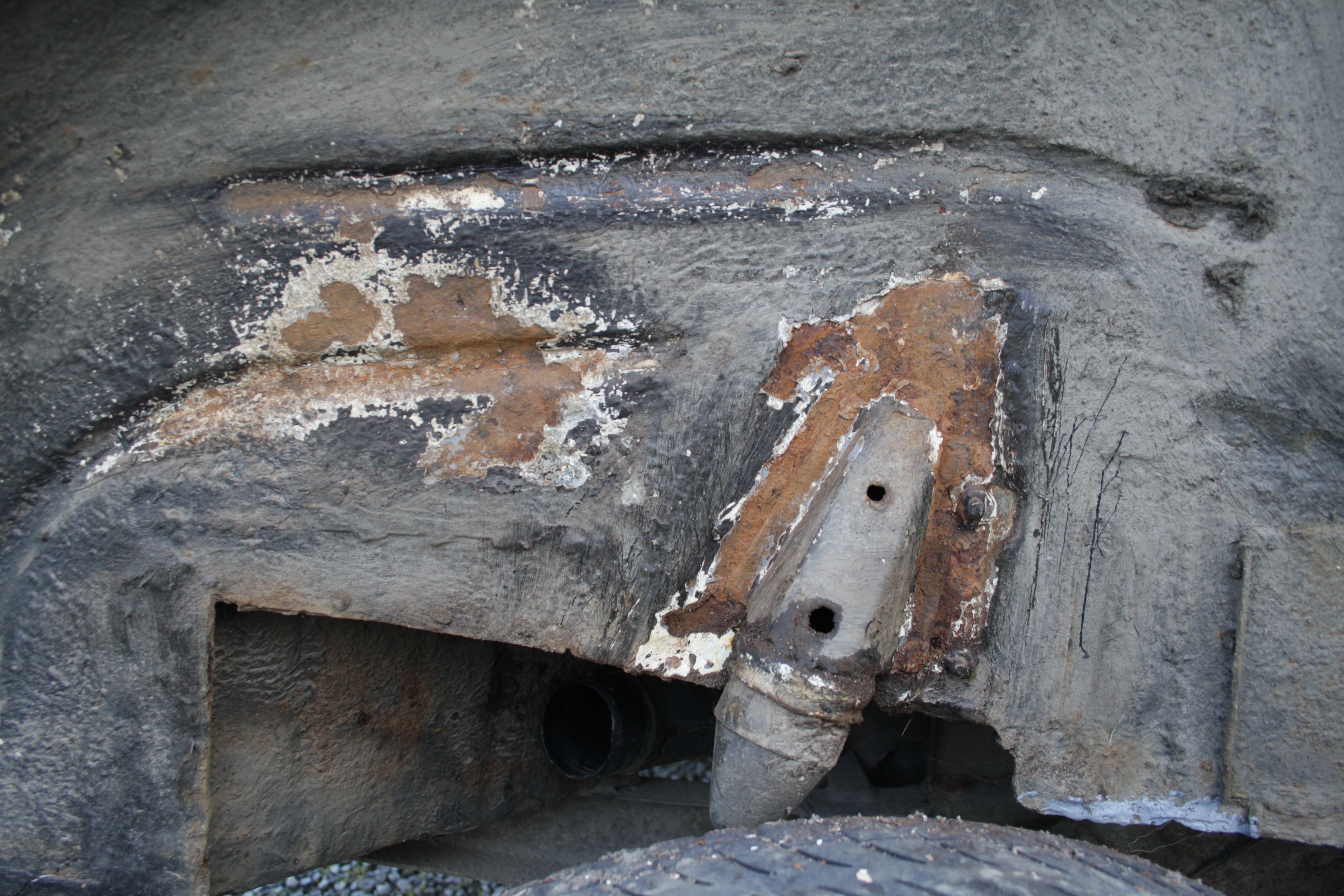
2CV corrosion

Eek! More rot found

The pressure from the hose was sufficient to have the underseal flaking off, and rot was very much lurking behind it. I attacked it further with a wire brush and a flat-bladed screwdriver to reveal the above. Apart from one tiny hole, it was all still solid. It was clearly time for action.

The first step was to grab my tub of Vactan. This rust converter is little-know but very effective. I gave the rusty areas a couple of coats with a period of waiting in between. It forms a black, protective layer once cured. It self-primes as well, but I decided to use zinc-rich primer in addition – a couple of coats of this were applied too.

Next I could actually get on with painting the bits I’d originally wanted to paint!

2CV restoration

Actual masking, so rear sweeps, C post and sill could be painted

I didn’t bother painting the inner wing as I hadn’t removed all of the underseal. Where it was still in good condition, it was still protecting the metal well – a couple of scrapes with the screwdriver revealed as much. I then unleashed some Bilt Hamber products – Dynax S50 for the box sections and cavities, and Dynax UB for the inner wing, underside of the sills and the floors – front to back.

The rear wing has been carefully refitted, but then plans got ruined by cloud and rain. I don’t want to refit the rear door until the paint has had a good chance to harden, so it’s frustrating that the sun has disappeared now!

Of course, I need to repeat this job on the other side, and I am slightly concerned. I fear the rot above the wing is worse that side. There’s some sealant stuff that seems to have been used in that area, as two panels are welded together. Sadly, this sealant seems to have done a great job of trapping moisture, which allows the seam to rot. But, doing nothing isn’t an answer, so I’m going to have to get brave, pull the other wing off and see what lurks beneath…

Not today though!

Driving a Car Of The Year – Citroen XM

One peaceful, February morning, I got a phone call from Practical Classics magazine. Could I find a Citroen XM for a photo shoot the following Monday? This didn’t leave much time, but Citroen folk rarely let me down. A plea for a suitable car quickly resulted in several offers, but a tasty 2.1 turbo diesel in Mandarin red sounded ideal.

So, I hopped into my 2CV and dashed over to Leicestershire, where I swapped my simple Tin Snail for a really rather nice XM. It was the first time I’d been in one for many years, and as I still had to get it to Rockingham Raceway, I had plenty of time to enjoy the experience.

Keith Moody enjoys the XM - courtesy of Richard Gunn

Keith Moody of Practical Classics enjoys the XM – courtesy of Richard Gunn

And what an experience it was. At the time, I was on a hiatus from hydropneumatic motoring. The XM swiftly reminded me what I was missing. The floating ride was backed up by keen handling, as the suspension automatically stiffens when cornering hard – it’s a much more complex beastie than the BX in that regard. The engine is a peach too – the 2.1-litre, 12-valve development of the XUD. I found the turbocharger cut in much more smoothly than the earlier XUD, and much earlier in the rev range. It made it much more relaxing. The XM was criticised for lacking power in this form, but being used to rather more feeble transport, I had no complaints at all. It was nicely brisk.

The photo shoot was fun, and pitched the XM against other Car Of The Year winners, ranging from the Porsche 928 to the sheer glory of the Renault 9. To find out more, head to the shops and grab a copy of Practical Classics. You can also read about CXs and BXs elsewhere in the issue.

The downside of this job is that it can leave you weak and unable to resist motoring purchases. Within days of driving the XM, I’d swapped the Land Rover Discovery for a Citroen BX. Once the hydropneumatic bug bites, it’s hard to resist! Thanks to Will of the XM forum for the loan of the car. It’s lovely!

See no evil. Oh, I peeked!

It’s easily done. Many of us have been there. You’re a bit sick of the wallpaper in this room. There’s a bit that isn’t quite attached to the wall. Well, you need to redecorate anyway, so why not give it a tug? Now you’ve started, you might as well keep going. Before you know it, the floor and all of your furniture (as you weren’t actually planning to start right this moment) are covered in bits of wallpaper. Then you notice the state of the plaster. Oh bother. It’s knackered.

I’ve just done the automotive equivalent of that. I’d sprayed some lovely, Alpine white paint over the 2CVs sill – something we didn’t have time for after the welding. A coat of zinc primer had to suffice for the MOT. I knew the rear wing had to come off again to do the job properly. I pulled it off today but rather than just apply the paint as I’d planned, I decided to hose all the dirt from the now-exposed inner rear wing. This was a stupid idea, because simple hose pressure began removing underseal. And paint. I grabbed a wire brush and a screwdriver to remove all of the loose stuff. This is what I was left with.

2CV inner rear wing

Oh bother. Yet more rot discovered…

Yes, I am aware that this tyre needs replacing as well. But it’s the rot that’s the biggest problem. There are a couple of small holes. I’m contemplating what bodgery can be employed here, with a view to complete inner wing replacement at a later date. I haven’t really got time to do anything tonight, so my plans for taking the 2CV away for the weekend are on hold.

That meant I had to do something about the BX’s blowing exhaust as I can’t face another crashy journey in the Sirion. The previous owner of the BX was having such a nightmare trying to get the system to seal that he welded up one of the connection points. Sadly, this joint wasn’t entirely gas tight.

Aluminium tape exhaust fix

A truly magnificent bodge

This was an official bodge, in that the paste I used was labelled as exhaust repair paste, and the aluminium tape was labelled as exhaust repair tape. What’s more, it worked too! We drove all the way to Kent and back with a perfectly leak-free exhaust. The problem was the pointless clamp. It has nothing to clamp anymore, so I removed the clamp today and found a new leak directly beneath it. More paste and some aluminium tape I had sitting in the garage for bodywork ‘repairs’ were called into use. It’s now leak free again until I can get a proper, welded repair in place.

While underneath, naturally I found quite a lot of surface rust. I really do need a rot-proof car!

Historic Racing. Old is best!

I watched the Formula 1 a couple of weeks ago. My timing was spot on. It was an absolutely thrilling battle, with Lewis Hamilton and Nico Rosberg having a titanic tussle for the lead. But as thrilling as their fight was, the spectacle of Formula 1 still doesn’t grab me. It hasn’t really done so for years. The problem is the noise. No, not that the cars are too quiet – these latest ones have a nice V6 growl and pleasant turbo whine – but that the noise just isn’t that nice.

This is where historic racing comes in.

Historic race cars

Old is better than new when it comes to racing

You get a lot more variety with historic racing for a start. Here, a TVR does battle with an Austin-Healey and a Triumph TR4 at the Goodwood Revival. Not that you need to stump up the frankly scary prices for admission at the frankly incredible Revival. Historic Racing takes place all over the UK and indeed the world. The Silverstone Classic lacks the atmosphere of the Revival, but features much of the same metal. There’s the Donington Historic coming up soon too – first weekend of May. There’s stuff going on all over the place, creating the sort of noises that racing cars should make. Hearing exotic V12s pumping out sweet music, joined in chorus by straight-sixes and tuned V8s makes for a true motoring spectacle. It creates the sort of soundtrack that modern F1 completely lacks.

It creates moments like this too. An extremely well-driven Ford GT40 at a soggy Goodwood. Remarkable car control.

You won’t see cars squirming around in Formula 1 like that. It really is astonishing stuff.

Prefer a V12? I bet you didn’t even know that a Jaguar XJ-S could make this sort of noise. The road car is rather more refined.

Those are the sorts of noises that set my blood curdling. There is an increasing interest in historic racing, and rightly so! Modern racers may be quicker, but like modern cars, they seem overly sanitised and some of the fun has gone out of it. It’s not just track racing either. Here’s perhaps one of my favourite motorsport videos. The late, great Colin McRae giving it some serious beans in a Metro 6R4, and losing it completely at one stage!

This sort of thing generates a level of excitement that modern racing just can’t match. Whether it’s 2CVs or Ferrari GTOs, historic racing has a massive range of interesting tin in action. I bloomin’ love it!


The best car of the 1930s isn’t a Citroen

You might have thought that a Citroen-lover wouldn’t have a difficult decision when picking the best car of the 1930s. The legendary Traction Avant has plenty to recommend it. From an engineering point, it was pretty remarkable. Monocoque construction, overhead valves, front-wheel drive, super-accurate rack-and-pinion steering and powerful hydraulic brakes. It is a 1930s car that doesn’t feel 1930s to drive.

Lancia Aprilia Goodwood Revival

A masterpiece of engineeriing, sexist comments avoided

It isn’t my favourite though. Not by some margin. Instead the title is taken by the Lancia Aprilia, launched two years after the Traction Avant in 1936. Again, there is a monocoque structure, all-independent springing and hydraulic brakes, but further quirk-factor comes from the unusual, Beetle-esque styling, the narrow-angle V4, overhead cam engine and remarkable interior space for what is a small car. Interestingly, Lancia opted to keep the drive at the rear, and throughout its production life – until 1949 – you could not have a gearbox with any synchromesh in it. That was a powerful statement. It said “this is a car for people who appreciate engineering and who can master a bit of double-declutching.”

I got to drive one a few years ago, within a year of a spell behind the wheel of a Slough-built Traction Avant. I was staggered by the difference. As advanced as the Traction feels for its age, the Aprilia felt leagues ahead. The controls were lighter and it felt more responsive. Going up the gearbox, the lack of synchromesh simply isn’t an issue. The sprightly Lancia felt wonderful through the bends. It was like driving an expensive pocket watch. It just oozed craftmanship. Lancia had been building monocoque cars for far longer than Citroen, and they were better at it. An Aprilia weighed in comfortably under a ton – under 900kg even. A Traction was more like 1200kg. Yes, a bigger car, but not delivering the interior space benefits the wheelbase would suggest.

Distinctive Aprilia shape

The wacky Aprilia even boasted pillarless design. The rear doors were of the suicide-type, and there was no B post. Very few production cars have managed this trick, though the Nissan Prairie did. Almost half a century later. That’s how ahead of the game it was. It made most British cars seem hopeless outdated.

Sadly, the incredible nature of these cars has not been missed by collectors. Because of that, ownership of one of these beauties is likely to require a £25,000 admission fee. The Citroen remains quite affordable by comparison.

Lancia Aprilia no b pillar

Aprilia doors. Astonishing engineering

Still, it’s the Lancia I’d rather have. If you want joyous motoring, it’s all the better to get it from a vehicle that is quite so elderly.

Sun worship, snail style

Ah, sunshine is a marvellous thing. The 2CV still needs lots of work, including painting the recently welded bits, which are still finished in stunning zinc primer. It doesn’t stop me enjoying it though!

Shabby sun seeker

Shabby sun seeker

I was ‘forced’ to drive around in the sunshine today, circulating posters for local music gigs my wife and I host at a local drinking establishment. I’m thoroughly convinced that there is no finer way to travel around sun-soaked Welsh hills than in a 2CV. More power is almost entirely pointless. Well, ok, perhaps a little more going up hills would be nice.

Pleasingly, my foot seems better this week, so thoughts of getting an automatic have been removed from my mind – aided by the state of my bank balance. The 2CV does still make my foot sore, but as an X-ray has revealed no structural issues, something muscular is likely to be at fault. Hopefully I can fix that unaided.

I am glad that I persisted with the 2CV though. Major expenditure is bound to be needed within the next year, but how can I get rid of the only car that I’ve owned for longer than 18 months? With over 60 vehicles passing through my hands, it says something about this 2CV. How on earth did a little French peasant wagon, in silly Dolly guise, get under my skin quite so much?

I don’t have the answer to that, but perhaps some questions don’t actually need an answer.


First shows of 2014 – Pride of Longbridge/Restoration Show

I had a great weekend, visiting Pride of Longbridge and the Practical Classics Restoration Show in Birmingham. It was the start of the car show season for me, with two events of an entirely different nature.

Pride of Longbridge was first up. Nine years after the collapse of MG Rover, the passion was clearly still alive. I had to queue to get in, as you can see in the rear of this MG ZS.

Queueing in Longbridge, spot the Sirion

After fighting off a queue-jumping twat in a Vauxhall Vectra, I opted to park outside the event. The show didn’t disappoint, with a larger space available this time. It meant a huge area to walk around, but it was worth it to find the treats. Endless rows of modern Rovers and MGs hid wonders in their midst. Such as this early Marina. Delicious indeed, even if the cars were not one of the best vehicles of their time.

Morris Marina Pride of Longbridge

Beautiful Morris Marina. No, I mean it. I like it a lot.

There were certainly cars for all tastes. Herbert Austin I’m sure never dreamt of a car bearing his name someday looking like this.

Austin Lowrider custom

Much-modified Austin A40 Cambridge

Many, many more pics can be found on my Facebook page, here.

After that excitement, I slept soundly and then headed the next day to the NEC. Here, I attended the Practical Classics Restoration Show – a brand new event and one that seemed a massive success. I suspect we’ll see this event again, perhaps with more space and more club involvement.

The Rover P6 Club [EDIT – and Rover Sport Register] had a strong stand, including this Rover P7 prototype. I was astonished to see it – the first time it has been seen in public for decades.

Rover P7

Wow! The sole remaining Rover P7 prototype. Restoration needed…

This six-cylinder development of the P6 never saw production. It was purely for development. Somehow, this one escaped from Solihull, escaping the scrapman’s claws. Restoration was started some time ago, but didn’t get very far. It’s an astonishing car and you can read much more about it at the excellent AR Online website.

Overall, the show was a refreshing break from the traditional ‘shiny shiney’ sort of show. Yes, there were restored cars there, but there were also eye-catching scenes like this.

Morris Minor barn find restoration project

A selection of barn finds, all with a tale to tell

It’s hard to know what it is about an as-is project, but it somehow has more character than a shiny car. Of course, the real challenge is to restore a car without losing the character. I’d love to face that challenge with this Sumbeam Rapier.

Sunbeam Rapier fastback

How do you restore a car like this?

This show left me with a real buzz. I look forward to its return in the future! In the meantime, clubs should always consider showing cars that are less than perfect at shows. People love it!

Again, more pics here.

Dodgy foot forces fleet rethink

I’ve got a problem with my foot. I suspect I’ve damaged a bone in it, though thanks to constant penny-pinching, I’m still waiting for the details of the X-ray I had over a week ago. The NHS really does seem to be in trouble.

DAF 55 Variomatic

Two-pedal options are being considered

It’s my left foot, so clutch control is proving problematic. I found the 2CV very painful and awkward to drive yesterday, and that has a lovely, light clutch action! At the moment, the least traumatic car of mine to drive is the Sirion. How typical that the one time I really need an automatic, I don’t actually own one.

Naturally, this scenario has sent me scuttling off to the classifieds but there’s a rather sizeable problem. I can’t actually afford to buy another car. That’s ok. This situation is hardly a new one to me. I’ll just sell one of the cars I already own. The problem is, I like all of them! The BX is massively useful – which is annoying as a friend is selling a very tidy BX automatic. It isn’t an estate though, and it’s amazing just how much more practical the estate is than the hatchback. There’s the other small matter than a 1.9-litre BX auto is not going to be quite as thrifty to run as a diesel.

The Sirion then? Well, no. I’ve already explained how much I like it. It pleases me greatly to own such a silly-looking, fun-to-drive little beastie. As for the 2CV, well, the last time I threatened to sell it, a lynch mob was swiftly formed, which forced me to reconsider. Annoyingly, the mob was right.

But, the action of a clutch pedal is really causing problems at the moment. I’m not sure what to do.

Dai another day

Buying the BX has led to one surprising side-effect. I love the little Daihatsu even more!

Sirion

Astonishing little car

My enthusiasm for the Sirion had been diluted a little by several long journeys – despite only owning it since October, I’d already managed to drive it to Kent and the very top of Scotland before its three-months of service on my fleet. It isn’t ideal for long journeys as I just can’t quite get the seat in the right position, and the suspension has all the compliance of a brick.

The BX is the total opposite of this car. It is low-revving, torquey, comfortable and smooth. The BX is pleasant to drive quickly, the Sirion absolutely begs you to thrash it. I’ve been using the Sirion more for local, quick blats of late – and loving it all the more because of this. Hurtling around on smooth, Welsh mountain roads is a sheer joy. The bark from the replacement exhaust is just hilarious and the over-light steering can be ignored.

The Sirion has also proved very reliable during its time on the fleet. I’ve had to do some minor work on the brakes, give it a service and replace an exhaust. Oh, and scrub a lot of graphics off. That took a while! I love the way it drives, love the quirky looks and absolutely adore its bright yellow hue. I even like the alloy wheels, even if they are a nightmare to keep clean.

Some expenditure is going to be needed though. Under the plastic trims, the sills are in a dreadful state. It did seem to survive being lifted on a four-post lift fairly recently though, so I’m hoping it won’t be too much of a nightmare to replace them. We’ll have to wait and see.

Because Hoon!

I’ve set this image free into the internet today, as a celebration of just how much fun the 2CV is to drive.

2CV Because Hoon

Well, it sums up the car nicely!

People who’ve never so much as sat in a 2CV can be very quick to pour scorn upon this French peasant’s wagon, but those of us who understand know that it’s hard to have more fun on four wheels without the aid of an energetic partner. Even after 18 years of 2CV ownership, it amazes me just how much fun you can have chucking a 2CV down a twisty road.

The above photo was taken during a rally experience at the Heritage Motor Centre. We demonstrated just how much fun a 2CV could be on an Autotest course, and then chased a Ford Cortina Mk1 down the country lanes as we had a go at reading a Tulip-style route book.

Elly the 2CV is currently two days away from an MOT test. Yes, she needs lots of restoration in the next year, but I’m hoping she’s solid in all the areas an MOT man cares about. My fingers are crossed. Wish me luck! Have any of your classics got an MOT looming?