Sirion: Decision time

I knew it would fail, but a failure is still a bit disappointing even when predicted! Quite rightly, the tester took one look at the sills and warmed up his refusal pen. He didn’t bother chalking the problem areas. They’re obvious enough – it’s the bits that aren’t the same colour as his chalk!

This is the Welsh for FAIL!

I put it in for a test knowing it would fail. I’ve already spoken to someone about repairing the sills, but what’s the point in having a load of welding done if there are other major failure points? There was one other significant failure – emissions. It needs a new catalytic converter and lambda sensor. I knew there was a reason I don’t own modern cars!

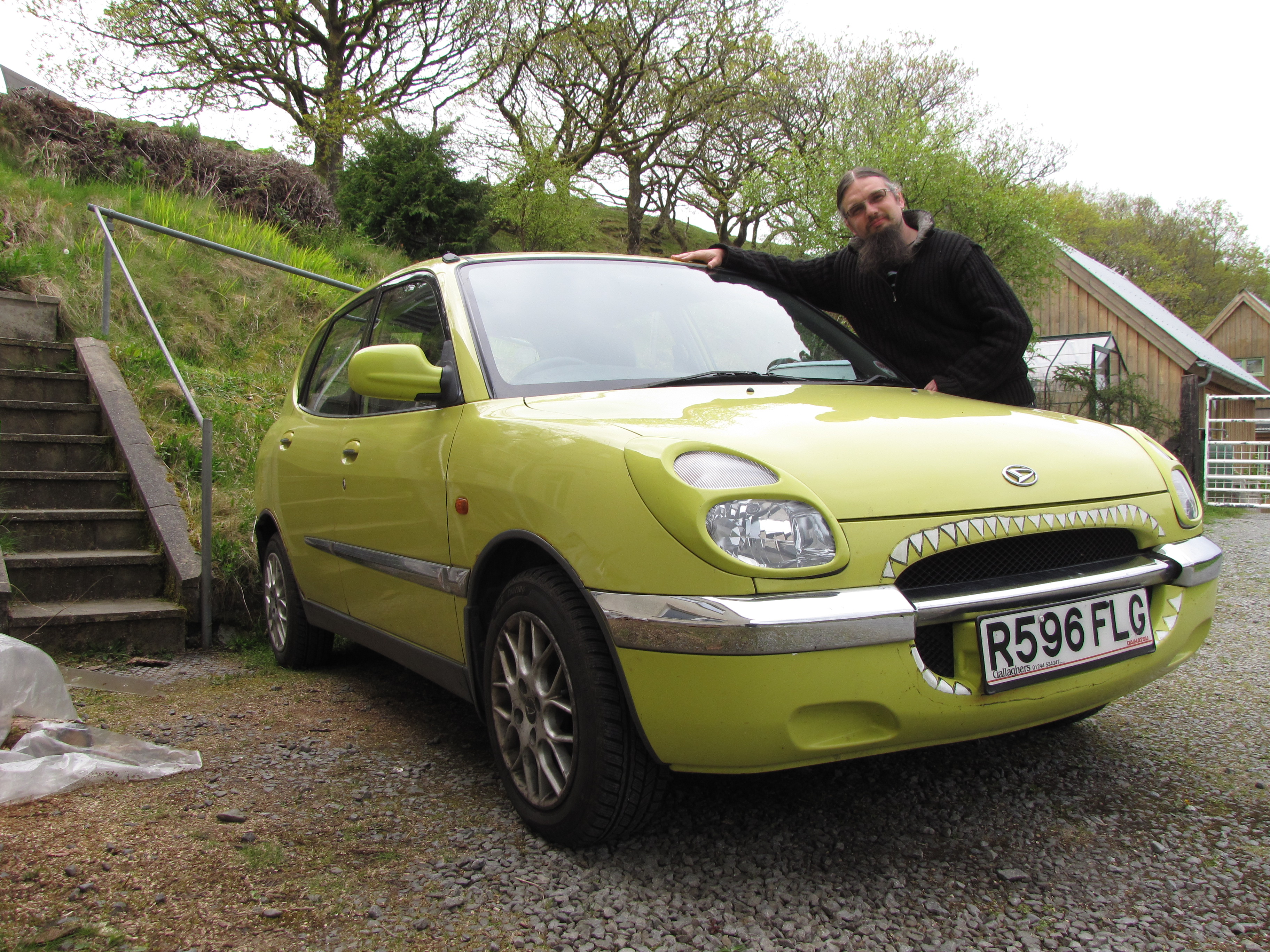
I’m waiting to price up the parts, but I’m sure they won’t be cheap, even if they are actually available. I can get pretty much any part I need for my 2CV, but the Sirion lacks that same comprehensive support. It could well be the end of the line for the cheery Sirion. It has a few weeks of MOT left so I need to decide on a course of action.

1) Discover money I didn’t know I had and get the Sirion fixed. My estimated expenditure is £300, but that’s a very rough guess! Fixing rot ALWAYS unearths yet more rot.

2) Flog it as a going concern. Might get £100 for it if I’m lucky! Scrap value isn’t very high. It is still road legal though.

3) Park it up, use it as a spares car, buy another Sirion. Not very appealing to be honest.

What I find most sad is that this car has done less than 76,000 miles. That’s barely run in! Seems ridiculous that a car with such mileage should be fit for the shredder. If only Daihatsu had done a better job of preventing them from rotting. It’s a great little car! But sadly one on life support.

More power, more danger?

I know fast cars don’t kill. I know speed doesn’t kill. It’s the crashing into things that does it. I also know that I can drive my 29bhp Citroen 2CV with more than enough speed to be considered dangerous. And it would be if it went wrong. But the same is true of ANY car.

Certainly, overtaking has many limits attached to it. Even my sprightly 54bhp Sirion makes overtaking feel dangerous enough at times. This is a very good thing! If you’ve got sod all power, you have to be REALLY certain before committing to an overtake. I got it wrong a few weeks back and a car coming the other way had to slow down. Here’s the thing though – I wasn’t travelling that quickly and the mutual speed of everyone involved meant the worst case scenario was a bit of bumped metal and a firm telling off.

If you're going to crash, do it on a race course!

If you’re going to crash, do it on a race course!

Contrast this with the time I owned a 160bhp Citroen BX 16 Valve. This car was absolute lunacy, and the giddy way in which it raced down the road beyond 4000rpm made overtaking super desirable! It was an engine that begged to be thrashed, and responded fabulously well when you did. Surely it was safer to overtake in the BX than the 2CV? After all, the collosal acceleration (30-70mph in just 7.5 seconds) meant you spent less time on the wrong side of the road. The problem was, it wasn’t safer! With astonishing power, the temptation was there to go for risky overtakes that I wouldn’t even consider in the 2CV. And I did. I recall plenty of hairy moments where the addictive power got the better of my common sense. Another problem is that when overtaking, easing off the throttle seems a silly thing to do, so I’d keep my foot in and find myself doing highly illegal speeds in no time. Cornering at the same speeds as my 2CV was dull too, so I’d corner more quickly, which meant a bigger accident was always a possibility. My solution was to sell the BX ASAP and replace it with a much more civilised Rover 414.

But I see this crazed overtaking going on all the time. Modern turbo diesels can be really punchy when it comes to delivering overtaking thrust and I’ve had my fair share of near misses because someone got a bit over ambitious. Fast  roads can be bloody dangerous. This was highlighted only a few days ago. I live very near the A44 which runs from Aberystwyth to Llangurig in mid-Wales. It’s one of the most dangerous roads in Wales. Endless tight bends, restricted visibility and a 60mph (for cars) speed limit which often gets ignored and rarely gets policed. It’s a road that saw 41 collisions between January and August 2012. I drove along there once and found a car on its roof in the middle of the road, and the sides of this route are littered with Police tape and ominous gaps in fences and barriers…

It isn’t an inherently dangerous road in itself. I have plenty of fun driving along it and have never had a problem – all within the speed limit as that’s how I drive. Other people don’t though. They get carried away and go for insanely risky overtakes, or a little too much speed in the bends. The problem is, it isn’t their own life their risking – there’s a very good chance that you will take others with you.

It’s too soon to speculate about what caused the recent horrific crash on the A44. Four members of the same family died and a child was rushed to hospital. It’s horribly tragic. Of course, the tragedy stretches further than that. A truck and a van were directly involved. Even if they carry no responsibility for the crash, the poor drivers must be horribly mentally scarred by what happened, as must the witnesses who were first on the scene. And all the emergency services of course. I don’t care what training you get. It must be difficult to get home after a day at work like that. It’s not speculation to say that human error lead to the smash though. 95% of collisions are due to human error. The chances are, this one was too.

Think about it though. If I’m doing 60mph in the 2CV and a car comes flying past me, it must be travelling at 80mph or more. In a modern car, that feels like you’re barely moving. Until it goes wrong. And it does, because people are simply driving too quickly. Perhaps Sir Alec Issigonis was right. He didn’t like cars to be comfortable and desensitising. He liked drivers to feel like they were actually driving. He’d be horrified at the way people drive today, barely paying attention and, even worse, often checking their phones while driving! I once saw a girl almost crash into a van on a motorway. When we overtook, she was checking her phone. At 60mph. Perhaps she was texting ‘NRLY DIED LOL!’
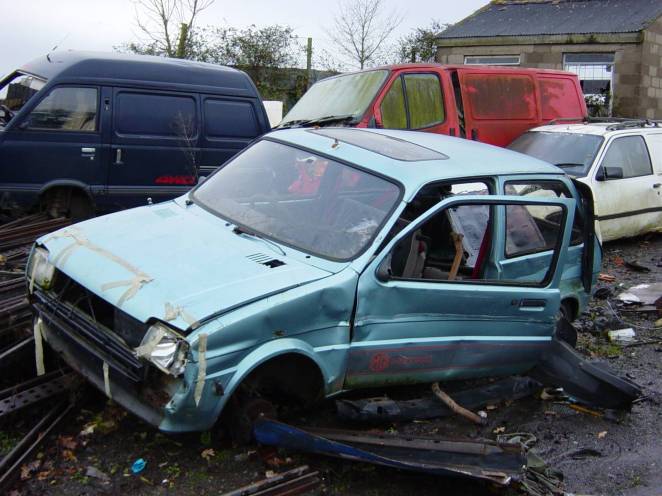
Crashing is not pretty

Crashing is not pretty

Naturally, there is great anger and upset about this accident. “More should be done,” people cry. “Everyone knows its a dangerous road,” say others. Do they? Really? Perhaps what’s actually needed is signs pointing out that this road claims lives. Or maybe we all need to do more to promote road safety. Being safe on the roads isn’t about driving slowly – I’ve seen plenty of dangerous incidents at low speeds and the vast majority of injuries are sustained on roads with a speed limit of 40mph or below. No, what we need is education. We need to remind people that 60mph is really bloody quick! We need to teach people HOW to overtake, and what the dangers are. I think I’m pretty rare for the fact that I once overtook a car on a driving lesson! (another learner driver, travelling at 40mph in a 60mph limit). I bet very few people try an overtake with tuition.

The biggest danger by far comes from the assumption that all the other vehicles will do what you expect. I’ve seen several incidents where someone has gone to overtake a long line of cars, then almost hit the car at the front, which it turns out was turning right (this is why you should ALWAYS check your mirror before executing a right turn, something I drill into people when minibus training). But just ask yourself. Is it worth the risk? Going at that speed, an accident is going to be messy. Airbags won’t save you if the impact is simply enormous.

The simplest lesson is just be aware. Focus on what’s going on, ignore your phone and perhaps turn the music down (I very rarely listen to any while driving, and never in poor weather or when getting a hoon on). Modern cars can go very briskly with no effort at all, but that doesn’t mean you can sit back and ignore the world around you. Your life, and the lives of others really do depend on you paying attention. Please do so, and stay safe.

Sirion: Another ‘temporary’ bodge

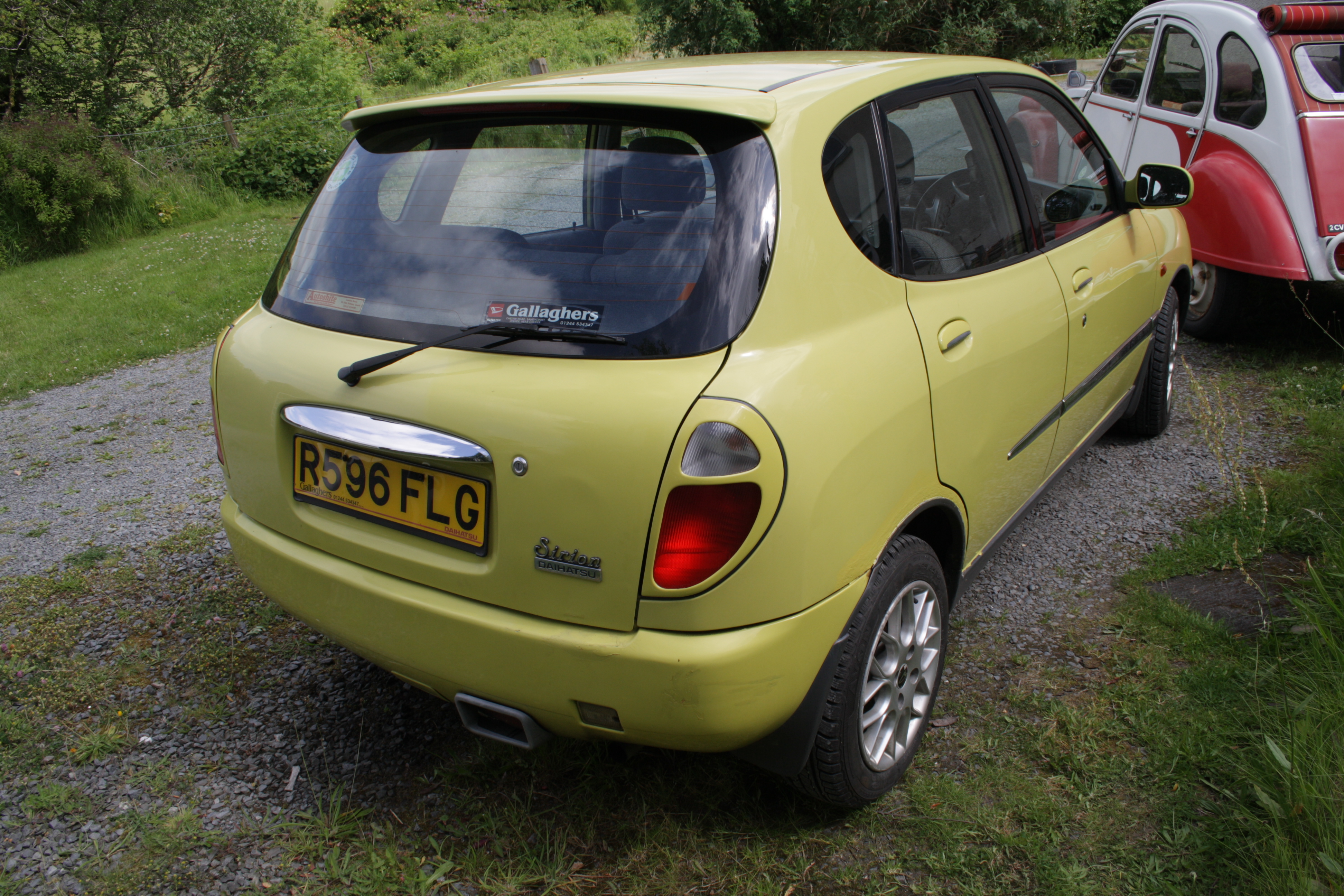
When I bought the Sirion last October, I was aware that it had rather rusty rear arches. I set about bodging them up to get it through the winter.

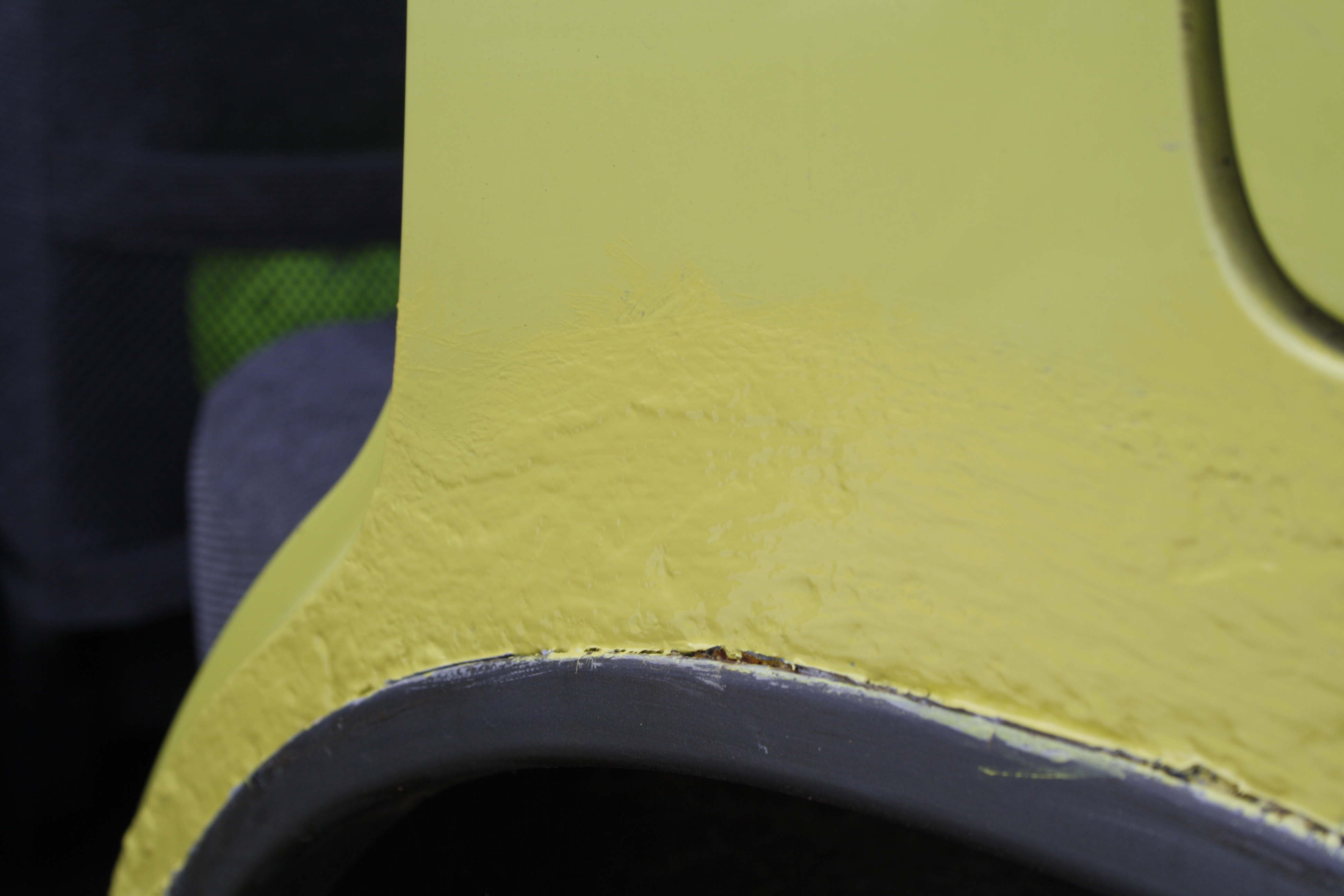
You may have noticed that it’s not winter anymore. The temporary bodge has worked fairly well for about six months now, but rust was starting to creep through again. With an MOT looming, I decided to unleash another round of bodge. Doing a proper, tidy repair just isn’t going to happen at the moment. I don’t have the budget to get the back arches properly stripped down. A load of mastic or something similar was slapped about the place, so the chances of a smooth finish were entirely nil. I opted just to rub back, scrape the worst of the rust off, apply a little filler here and there and then on with more coats of zinc primer and top-up paint.

The end result is dreadful!

Horrible

Horrible

It’s about as smooth as my face. When I was 13. Also, the colour match just isn’t as the tin of paint I had seems to have separated out a bit. Still, it beats looking at corrosion. Out of sight, out of mind! It’s MOT time next week, for which the wheelarches shouldn’t be a failure point anyway, I just thought they should look a bit better. Other work may well be needed, but I’ve opted to put the car in for test almost a month before the old test expires, to give enough time to carry out any repairs. If no repairs are needed, I will be thrilled. There’ll be no chicken counting before this one though.

Because I can’t count, the Sirion has actually been on the fleet for a full eight months now. It’s heading into unfamiliar territory for the vast majority of the 60-odd cars I’ve owned. Less than ten have made it beyond six months, so it’s already doing well. I wonder if I’ll still be using it next winter? It remains on a set of winter tyres. I’ll be keeping an eye on them to see if the wear rate becomes horrendous over the summer.

Aw, it's so cute!

Aw, it’s so cute!

I have been wondering if the Sirion is deserving of the classic tag though. Classic doesn’t necessarily mean old, but it should mean ‘interesting.’ For some cars, the fact that they are old is pretty much their only trick. I personally think that the Sirion’s cheeky looks make it worthy, especially as the driving experience also impresses. Even I feel it’s a touch too young though. Mine is one of the first imported in August 1998. Is that too recent?

The number plate rant

Dear Classic Car peoples. You’re getting number plates all wrong. Please stop! Signed, me.

You see, the problem is, the law allows vehicles built before 1973 to display black number plates with white/silver lettering. That’s because that’s how it used to be in the olden days. Fair enough. Only, there was no point at all during 1973 at which all number plates suddenly changed from black to white/yellow. In fact, the changeover commenced as early as 1968. Sadly, fashion seems to dictate that anything pre-1973 should have ‘old’ plates, so people remove the lovely, original plates for a nice, shiny set of black ones. Often in the horrible new font that subsequent law changes have forced upon us. YUCK!

Lovely, proper number plate

Lovely, proper number plate

Look at the above. It’s a lovely ‘correct for 1973’ number plate. It would be wrong on many levels (including legal ones) for this to be black. I honestly see no reason for anyone to consider fitting a black plate to such a car, let alone stuff from the 1980s. There’s something delightful about these old, raised digit number plates and I’d like to request that more people retain them.

The problem here is restoration. These plates do age with time, and when you’ve forked out over £10,000 to make your MG less rotten, you don’t want a scabby number plate spoiling the looks. For me though, it doesn’t spoil the looks! It’s perhaps the only aspect of a restored car that can leave you with a flavour of the original.


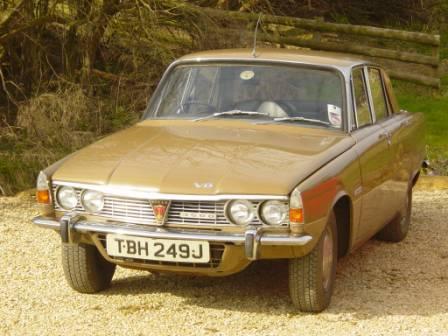
Rover P6B

My old Rover P6. Black plates would look utterly wrong!

I have seen restored cars with elderly, scabby plates affixed, and I really like it. There should be less emphasis on perfection, especially when that drive for perfection leaves all cars looking exactly the same! I get sick of seeing yet another red MGB with wire wheels, chrome grille, black number plates in the wrong font and a luggage rack on the boot. They came in lots of colours originally, and I personally have a soft spot for the 1969-on MGBs, which had a black grille and Rostyle wheels as standard. Yes, I know they look a bit silly, as the bonnet still has a raised section to match the earlier grille, but it sums up the early 1970s for me, which includes a sometimes awkward mix of old against new. Rostyle wheels were modern for the time, and less chrome was seen as a good thing. I quite this era of B.

My Perfect B?

My Perfect B? Well, apart from the number plates…

But even my ‘perfect’ MGB in the picture above is wearing the ‘wrong’ number plates with some interesting character spacing. It would look even better with a white plate, with delicious raised digits. However, it has the right grille and wheels for my liking, and isn’t sodding red. I shall try not to complain too much.

I guess what I’m trying to say is, as with so much in life, fashion is best avoided. Don’t be scared to paint your car in a colour people might not expect, especially if it’s an original shade. MGBs look great in Aconite (purple) and even the Tobacco Leaf of a Rover P6 is looking nicer with every year that passes. When I owned my Tobacco Leaf Rover, it was a deeply unfashionable shade. I bucked the fashion and absolutely loved the car. If not it’s propensity to empty my pockets every time maintenance was needed…

I know red is an attractive colour, but at times, it gets just as boring as it did during its last heyday – the 1980s, when every single saloon seemed to be that shade. Leave red to the Ferraris. Go hunt a classic in a colour that hasn’t been fashionable since 1975. Beige perhaps. But above all else, take your time to fit the correct number plates! Rant ends.

===

Well, rant almost ends. Before anyone cares to comment on the ‘incorrect’ plates on my 2CV, I would like to point out that her original plates had become sufficiently damaged to fail an MOT. I bought new ones, but had to get the ‘correct’ new font. This frustrated me very much, so I rebelled and had them made up in 3D font. With ‘You Can in a Tin Can’ written at the bottom. Also technically not allowed. I’m hoping to get some ‘correct for year’ plates made up at some point, but officialdom frowns upon this behaviour, so I shall say no more about it…

2CV: Too much hoon

I seem to have a real problem. I just can’t drive the 2CV slowly!

I covered a good 100 miles in the 2CV yesterday, attending the excellent Welshpool Air Show. I overtook a few cars on the way there, including a lovely Morris Minor Convertible. All overtakes remained legal, as the 2CV is scarcely powerful enough to break the National Speed Limit.

2CV Because Hoon

Yesterday looked a lot like this

On the way home, I found myself ‘stuck’ behind the worst kind of driver. The one who is unpredictable, slowing harshly and far too much for bends, then accelerating up to the speed limit on the straights so there’s no chance for a feeble 2CV to overtake. I started to get wound up. Even though we were averaging 50mph, I wanted to go faster! Moderns blasted past, able to rely on sheer grunt to get ahead – not an option for a 2CV battling a headwind. Overtaking needs plenty of planning and a good run up!

After many miles, I finally managed to get by, only to find myself stuck behind a car that was even slower. This hardly seemed fair. I spotted a gap and went for it. As I drew alongside the car, I could see that the gap was not big enough. I’d failed to consider the impact of gravity as we drove up a slight incline – me on the wrong side of the road. I decided to commit, with the 2CV in third gear and the valvegear threatening to go flying through the front wings. The car coming the other way was thankfully not moving overly quickly, but did have to ease off. I waved an apology and was away.

Looking back, I’m struggling to justify my actions. I wasn’t in a rush and the views are epic, so I could have just sat back, relaxed and enjoyed them. There’s a problem though. I hate driving the 2CV slowly! I think I see it as a responsibility to prove that the 2CV is not really that slow. Several times though, I found myself cornering with a little too much speed as I aimed to tread the fine line between conserving as much momentum as safely possible (because speeding up again takes so long) and not driving like a twat. I rather feel I overstepped the mark several times. Apologies if I alarmed you…

An artist's impression of yesterday

An artist’s impression of yesterday (taken years ago, not in Wales)

I think I desperately need a longer drive in the 2CV. When I undertake a long trip, I do ease off, because the stress of keeping the 2CV at maximum hoon is absolutely exhausting. Not that my cruise pace is that slow – I’ll still do my damnedest to attain the limit, but I’m in less of a hurry to overtake and more prepared to sit back at a cruise if traffic levels dictate it.

The real issue here is more simple though. The 2CV is too much fun to drive – something most so-called petrolheads have never really acknowledged, because Top Gear told them 2CVs were crap and anything with less than a zillion horsepower is embarrassingly feeble. Yesterday reminded me that on Welsh A and B roads, you’ll struggle to have more fun in anything other than a 2CV. More power might help with the overtakes, but you won’t be able to drive ‘foot-to-the-floor’ like I did.

So, I’m going to blame the 2CV for me driving in such a poor manner. It really wasn’t my fault.

Sirion loses its electricity & bump starting

Few things are more frustrating than a car that won’t start. These days, it’s easy to take it for granted that you turn the key/press a button and it fires up and away you go. A far cry from the struggles of my Dad’s Austin Montego on a damp winter’s morning, when you could play ‘count the number of cylinders actually firing.’ It often seemed to be less than the Sirion’s three-pot engine…

The 2CV demonstrates healthy charging, last year

The 2CV demonstrates healthy charging, last year

What was really silly with the Sirion is that I’d pulled into a lay-by to fiddle with a camera. I turned the engine off but forgot about the headlamps – it was a murky, wet day so I’d turned them on. As I didn’t get out of the car, the headlamp warning didn’t activate. After what I’m sure was only five or six minutes, I went to restart the engine and got that awful slow-starter noise. Bother. It wouldn’t turn the engine quickly enough for it to start, and then it quickly wouldn’t turn the engine at all.

I didn’t have my mobile phone with me, so I was faced with either a long walk home in the rain, or bump starting it. Bump starting a car with a catalytic converter is seen as a bit of a no-no as it can in theory poison the cat. I didn’t really care. I just wanted to get home. Why don’t modern cars have starting handles? The ground was flat and the lay-by was not very long – and also had a car parked in it for extra danger. After four attempts, I had utterly failed to get enough momentum up. After bashing my shin as I attempted to quickly leap aboard, I was annoyed. Perhaps that enabled me to push the car a bit more quickly. As the car rolled, I selected second gear, turned the ignition on and briefly dipped the throttle pedal. Fully releasing it I had learn just stopped the car! It was enough. Only just, but the little engine purred into life! Phew.

Silly Sirion

Operator error, not car error

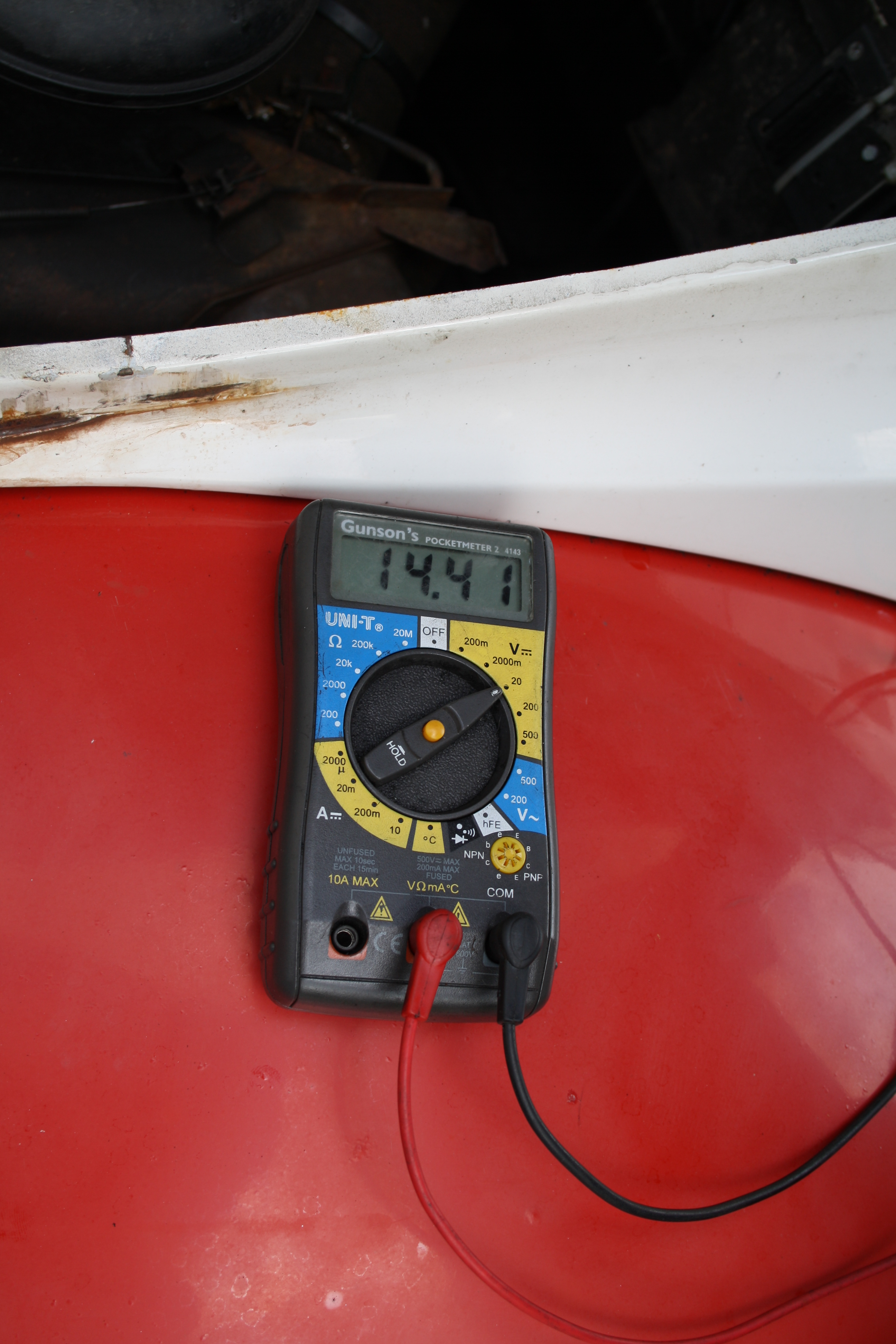
I drove home and pondered the reasons for the electrical fail. A few minutes of headlamps should not a battery flatten. Was it actually charging? The fact that I got home suggested it was, and a multimeter across the battery terminals confirmed this – 14.2 volts. A healthy number of volts in a 12 volt system. Certainly, the car was happy to start on its own without further bumpery.

So, the likely candidate is the battery. It’s a tiny battery on the Sirion, so its capacity is not astonishing. In the days of constant churning before an engine caught, this might have been an issue, but Japanese cars seem to start very nicely indeed. I suspect this one might be the original though, so it may be reaching the end of its life. That happens. The big test will be next winter, when the weather turns cold again. I’m not planning to replace the battery until I have to though, but will certainly avoid leaving the lights on in future!

The bump start technique

Bump starting a car is a useful trick if the battery goes flat, but first, some warnings. Bump starting requires the car to be moving without the engine working. That means that the brakes will gradually stop working as the servo pressure reduces. Also, the steering will be much heavier where it is usually assisted. Plan accordingly, remember where the handbrake is. Also try to plan what happens if the engine still doesn’t catch. Have an escape plan that doesn’t leave you blocking a road!

1) Turn ignition on. This also ensures that the steering lock is free. Gearbox in neutral, handbrake off, use gravity, push or recruit pushers.

2) Once the car is moving, and a slow jog is probably enough pace, select second gear and GENTLY ease up the clutch. You don’t have to jolt it. Once the engine catches, dip the clutch and bring the car to a halt. Simple!

Further warnings. There have been rumours of diesels shattering their clutches during bump starting, which emphasises the need to be gentle with the clutch release. I’ve done it enough times with diesel BXs to regard it as not an issue. I’m not sure some modern cars can even be bump started. A good reason to avoid them. Naturally, bump starting on the road is fraught with danger! Especially if the battery is so flat that you can’t deploy hazard lights. You have been warned!

Other electricity tips

Other options are jump starting, with safe jump leads or a jump pack, or using a starting handle if you’re lucky enough to have one! With jump leads, remember that the negative cable should go from the good battery negative terminal, to a good earth point on the car with the flat battery. That’s safer than connecting directly to the battery as sparks may ignite the gases a battery naturally produces. They really do go bang! With a starting handle, keep your thumb in. Don’t wrap your hand around the handle as it might kick back and break your thumb. Ouch!

Sunshine and powers

It has absolutely poured down today, even by Welsh standards. Which left me wondering if I’d dreamt Saturday. It was a day of work, but enjoyable work – photographing old cars in beautiful scenery, within easy reach of home and all in glorious sunshine. If only more work days were like this!

My 'photography platform'

My ‘photography platform’

Elly the 2CV was the natural choice of work hack. The rear bumper makes a fine place to stand to get a bit more height for a nice photo and if that’s not enough, I can always clamber over the seats with the roofback. Which I did.

I then headed out to get some shots of the cars out on a road run. This required staying ahead of the pack and trying to head them off. You might think that 29bhp would be a hindrance here, but it really isn’t. The 2CV is not half as slow as you might expect. Certainly by the standards of a modern hatchback, the on-paper performance is lacking but compared to other elderly motor cars, a late 2CV is really quite sprightly.

That’s a bit unfair I guess. After all, the youngest car in the group was from 1949, a time when the 2CV had just 9bhp. Yes, nine. By comparison, the later M28-engined 2CVs are absolute flying machines. They are the Cosworth, the GTi, the pure power machines of the 2CV world. Perhaps. At this point, and to avoid a lynching, I should point out that Amis and Dyanes had up to 35bhp from their 602cc engines. They’re not 2CVs though. Not really.

Economical motoring means trying to do more work yourself. Even in winter.

There’s a tiny engine in there somewhere

It further highlights what an oddball the late 2CVs are. I own a car designed during the 1930s and early 1940s, but it was not built until 1986. It has hazard warning lights, a fog light and a fuel gauge. It’s a bit posh really. I often don’t feel that I own a ‘proper’ classic, forgetting that really, I do. Motor cars don’t get a lot more simple, and it even has some shiny bits – though not as many as it should have (I ‘deleted’ the chrome sill strips and hubcaps).

Anyway, the point is, I just don’t think I could cope with an early 2CV, or a classic car that couldn’t get a bit of a shift on when required. That might seem an odd thing to say when the vast majority of drivers would find a modern 2CV clambering up a hill hideously slow, but that’s about where my limit is. I try to use momentum as much as possible and avoid slowing down too much by cornering like a lunatic. This is fun and the 2CV’s handling allows you to comfortably do it. Backing up the traffic as you crawl perilously slowly up a hill I find less enjoyable.

Each to their own though. I was very pleased to see that people in cars more feeble than mine had travelled from far flung corners of the UK at the weekend. I look forward to telling you more about their visit once my official report has been published.

The teeny, tiny fleet

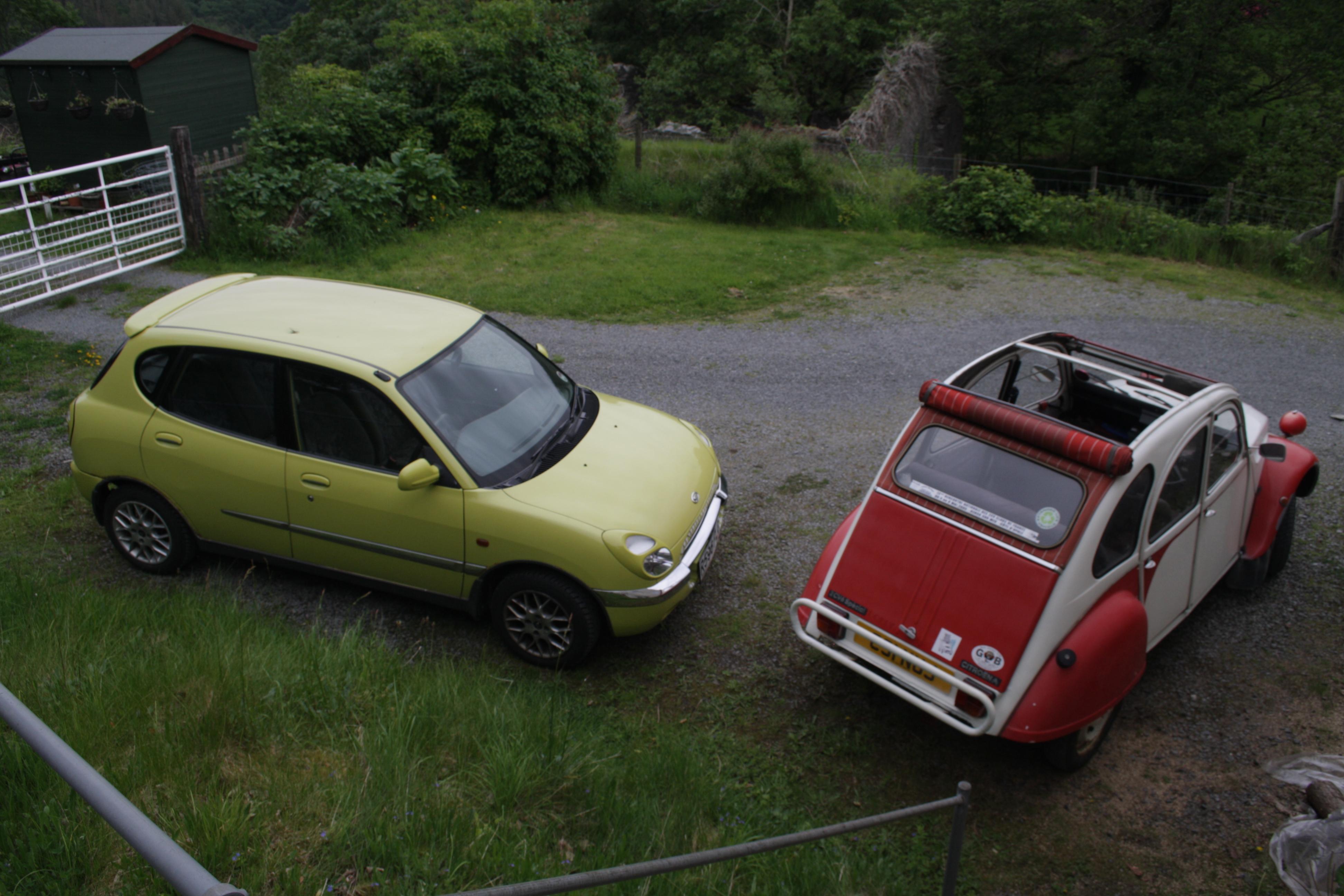
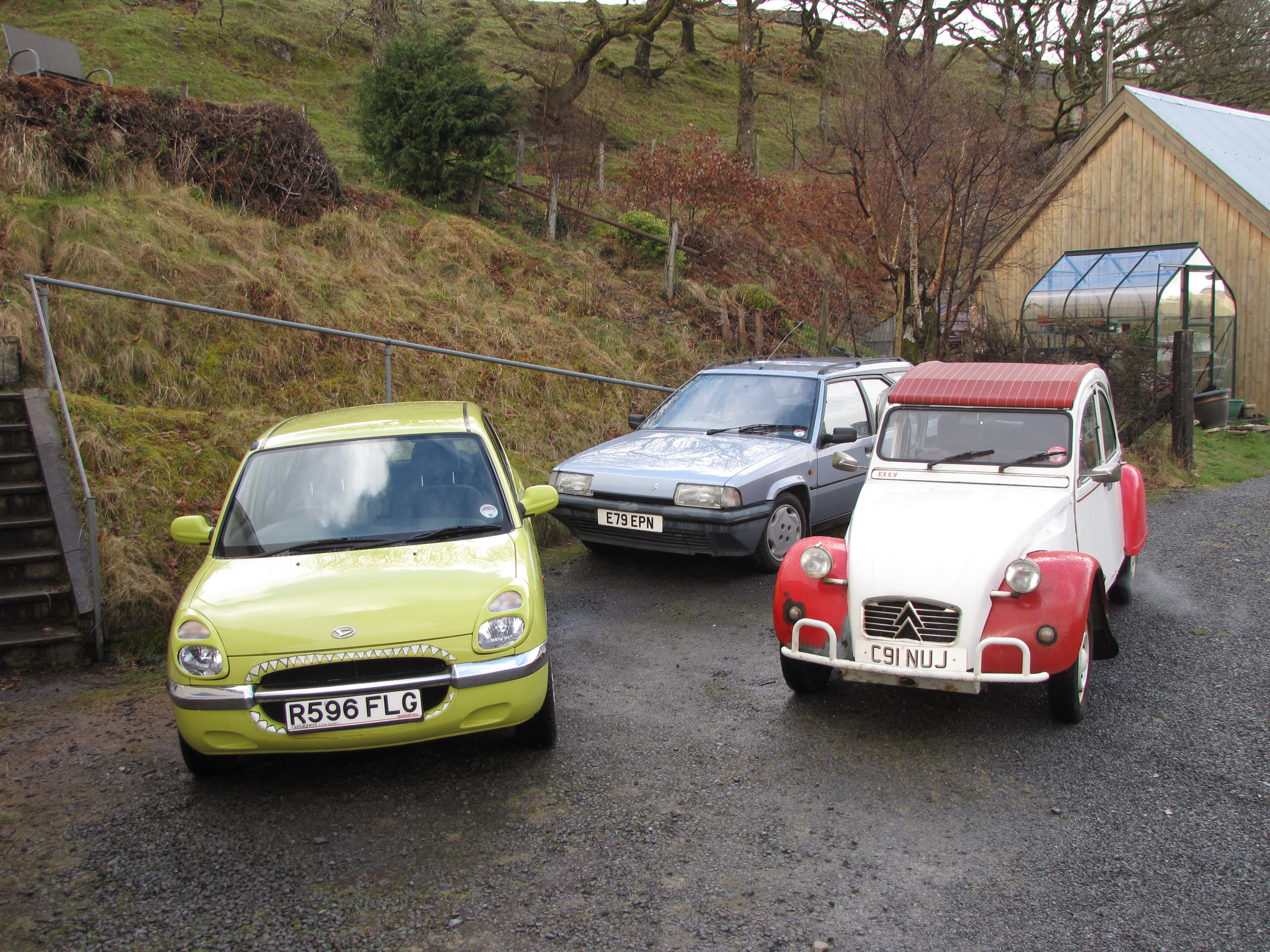
So, I have sold the most powerful vehicle in the fleet – a throbbing 71bhp and have left myself with a tiny fleet – 1591cc and just 83bhp between the pair of them.

Little cars

Tiny fleet, happy fleet?

It was the right decision. These two feeble machines provide an enormous amount of entertainment and both are in the cheaper road tax group. I get a huge amount of pleasure from thrashing them around the wonderful Welsh roads and they still better 45mpg. Lovely. The BX was fun and economical too, but it was time to move on. It was the right vehicle when I bought it, but I’m hoping it’ll be easier to focus on the various maladies of just two cars.

In these power-crazed times though, I like ignoring ‘sage’ media advice from Top Gear and the like, that suggest we need more and more powaaaaargh. No, we don’t. Powerful cars are very exciting. For a few seconds. Then you’re left either frustrated that you can’t explore the full potential of the car at legal speeds, or in trouble because you have explored the full potential of the car at illegal speeds. The most powerful car I’ve driven on the road had over 400bhp and felt like you could out-accelerate time. Yet I came back from the test drive realising I couldn’t hit the red line in any gear but first without breaking the National Speed Limit. It’s like being given the keys to the chocolate factory and being told you can eat no more than one chocolate bar. Insanely frustrating.

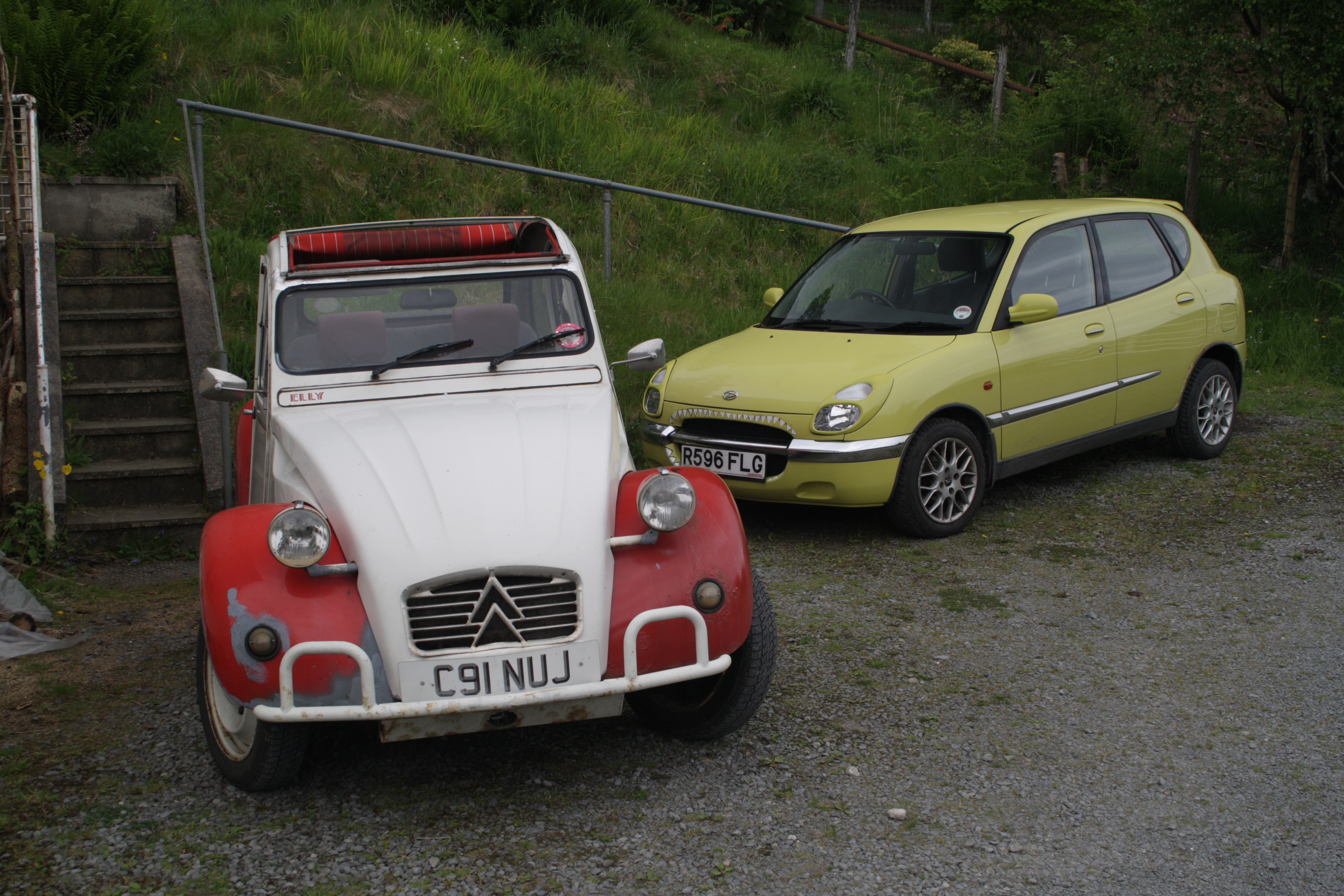
My oddball pair

My oddball pair

It’s a rather different story with my feeble twosome. The 2CV is pretty much flat out at the motorway speed limit and I can rag the Sirion through the gears and have lots of fun while not falling foul of the 60mph limit on local roads. I can chuck them into corners at what feels like very entertaining speeds, but what looks to outsiders as barely moving. There’s another key difference too – size. The BX was quite a big car, by my standards at least. You can’t have fun on Welsh roads in a big car, as you’re constantly concerned about what might be coming the other way. A narrow car is very handy on the other hand, as you can usually squeeze past whatever is coming the other way. If you can’t, light cars stop more quickly…

The only downside really is overtaking, which requires bravery, technique and a lot of anticipation. The main issue is that you get ‘mugged’ by more powerful, modern stuff which can accelerate swiftly while my pair need a bit of a run up. You can’t just put your foot down more if something suddenly appears coming the other way as you’re already flat out! One alternative is to sit back and just enjoy the view. It’s quite a nice view in these parts.

In the future, I do want another waft-barge, as I anticipate there’ll be a fair bit of distance driving to cover this year. I’m in no rush though. For now, I shall enjoy unpowerful motoring. The next priorities are further 2CV smartening and a bout of welding for the Daihatsu. Let’s see whether I can resist buying anything until those are done.

Shedlook – polishing is not for me

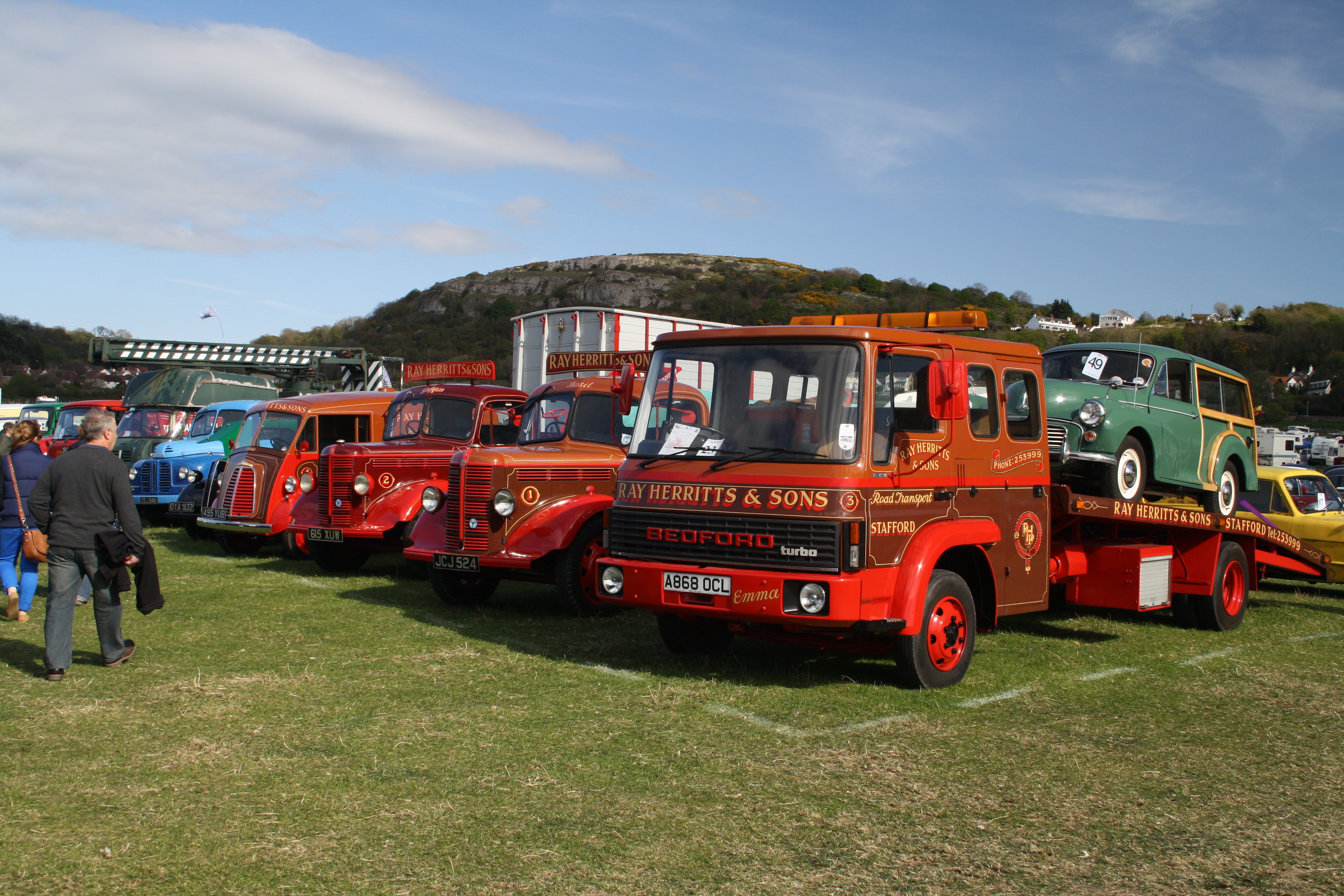
Car shows are awash with super-shiny classics. Fair enough. A lot of people take a lot of pride in their vehicles. The problem is, these cars rarely looked so nice when they were current. This is especially true of commercial vehicles. When prepared for show, they’re often far cleaner and more immaculate than the day they left the factory. Yet it often turns out that a shabby vehicle can get far more attention than an immaculate one.

The Bedfords of my youth were never this shiny

The Bedfords of my youth were never this shiny

Not that I’m a big fan of ‘rat look’ either. Deliberately letting your car go rusty is about as sensible as storing all of your actual cash money in a washing machine. It always looks fake too. A genuine distressed look is hard to replicate.

I find myself somewhere between the two. My 2CV is in an appalling state cosmetically. I dream of her being in immaculate condition again, like she was, briefly in 2006 at the end of a two-stage restoration. I don’t know why I dream of that, because trying to maintain that level of condition with a daily driver was impossible. So, I think I’m just going to accept that my 2CV is going to be tatty. It’s not a look that particularly suits the two-tone Dolly, but she’s not going to be factory fresh after 196,000 miles, and that’s that. If folk get sniffy about her shabby condition, then that’s their problem.

Another reason for not being tempted by the restoration route is that cars often look over-restored. I know my 2CV was. Two-pack paint was used, so she looked ridiculously shiny. The original cellulose finish would age with time and leave the car looking as old as it was. I love cars like that. Cars don’t have to be all glittery! The problem is, trying to maintain the sheddy look.

So fresh from resto that she's lacking side stripes

So fresh from resto that she’s lacking side stripes – 90,000 miles ago

The above is Elly immediately after her major restoration. So recent was it that the side stripes have not yet been fitted. Indeed, we were still fitting parts the day before this shot was taken, on the other side of the country! She looks good, it must be said. You can even see the inside of the wheels because they’re so clean!

Here’s what she looks like now.

rusty 2cv

Cosmetically challenged – a good thing, right?

Pretty shambolic, especially when you get up close. I’ve not bothered painting that wing because I plan to replace it entirely at some point. But, I’m ultimately happier with Elly in a messy state. I don’t have to worry too much about destroying her immaculate paint finish – it no longer exists. It means I’ll use her for pretty much any activity, including off-roading.

After all, variety is the spice of life. I’d be utterly devastated if I turned up to a 2CV meet, and was greeted by a line-up of immaculate cars, looking like they’d just left the factory. 2CVers have always gone in for customisation, and loving cars in all conditions. There’s no reason why this can’t apply to the wider world. Rat look shouldn’t really be encouraged as something to aim for, but increasingly, I’m thinking the same about full restoration. Why try and hide the life a car has enjoyed?

May 2014 Fleet Review

I’ve had a quiet couple of days on the car front. Frankly, it’s hard to know where to go next after the delights of a Kia Pride. Sadly, it seems that my thinking has focussed on saying goodbye to the BX. I really like the concept of the BX. It offers a wonderful mix of super-comfort, super-practicality and ridiculous economy. But I’m finding that the same niggles are frustrating me, and reminding me why I quit BXs last year.

The single windscreen wiper annoys me, as does the lack of a ‘flick’ wipe – an essential feature when you live in Wales, where there are at least one hundred and eleventy different grades of rain. The crap interior quality is a source of annoyance too. I’ve utterly failed to track down some of the trim rattles and every BX seems to have rattles in different places.

Fleet

One of these is for the chop…

That’s a poor list of excuses really though isn’t it? It seems more the case that I’m just bored, having owned many BXs between 1999 and now. In truth, financial matters are forcing my hand somewhat too. Our low-income, hippy lifestyle doesn’t really allow for huge expenditure on cars. I’m trying to run three of the things on a shoestring budget. All of the cars have their faults, and I can’t afford to sort any of them out at the moment. What can’t be avoided is road tax though, and as I’m still punished for enjoying middle-age tin, there’s no way of escaping it. The Sirion’s tax is up for renewal and sadly direct debit is not yet an option. It’ll be interesting to see how that works when it comes in later this year.

I shouldn’t complain. The Sirion has proved an excellent choice of machine. It has cost very little since I bought it for £370 last October. I’ve changed the engine oil twice and the front caliper sliders once. There will be bodywork to attend to before the MOT expires in July though – the sills don’t really seem to be there.

And here’s a strange observation. I love a comfortable ride. It’s why I own Citroens. The Sirion is pretty dreadful. Yet I’m finding that given a choice, I’ll choose the Sirion over the BX. That’s not a good sign. So, a fleet adjustment is in order and the BX is the one for the chop. Yes, it’s the most practical vehicle I own, but it also has by far the least engaging engine. The Sirion and 2CV prove that economy can still be fun and while the BX still has marvellous handling, it always feels a bit of a plodder – lacking the fizz of the Sirion’s screaming triple, or the 2CV’s vocal flat twin.

Naturally, I’m already contemplating what comes next, though this is somewhat at odds with my desire to keep the Sirion on the road and the need to pay a looming tax bill in July. I fear I may have to go down the road of owning only two vehicles for a while, which is somewhat at odds with my desire to stop the 2CV rusting away. She’s been spending a lot more time hiding in the garage of late, only coming out when the weather is fine. I must admit, 2CVing feels more fun when water isn’t dribbing down the dashboard and into your shoes. I’m also hoping that it’ll slow the body rot somewhat.

For now though, I shall attempt to move the BX on to a new owner and will do some window shopping as I try to decide what, when I can afford it, will be the best BX replacement. A warbling, five-pot Volvo 850 turbo diesel is appealing.