Tiny Road Test: Skoda Rapid 135RiC

I’ve always liked the rear-engined Skodas, but the one I bought back in 1998 turned out to be a bit of a dog. It put me off them for a while. Driving one for a friend’s wedding earlier this year was the first time I’d been in one for a goodly while. When said friend offered me the chance to spend a few days with his Rapid RiC, well I could hardly refuse could I?

The RiC was the last of the line. In fact, this car is the very last car off the line – H35 URB was first owned by Lord Strathcarron, who was a keen Skoda fan. It has a certificate stating it is the last rear-engined coupe built. As saloon production ended before the Rapid (with the Favorit taking over), that seems to make it the last rear-engined Skoda built. That’s quite remarkable.

Skudtastic

A very significant Skoda – the last rear-engined one built

I’ll start with a downside. I don’t actually like the Rapid’s shape. It looks all awkward from this front angle – the roofline just isn’t quite right. It does look better from the rear view, but I maintain that an Estelle is actually a better looking, better proportioned vehicle. However, you can’t see the outside when you’re inside, so I quickly hopped aboard. Here, the most striking thing is the wheelarch intrusion. It forces the pedals over almost as much as in a Citroen AX. Amusingly, the throttle pedal is an ‘organ pedal’ type. Adjusting to how the pedals behave takes a while – the middle one seems to do nothing at all for the first few inches of travel.

The gearchange is amusing too. There’s no point looking at it to tell which gear you’re in as it cants well over to the left even when in fifth. The lever has a massive travel too. It reminded me of driving a Volvo B10M coach. I can see why folk fit quick-change gear levers. Get moving though, and it’s all rather jolly. These later Skodas were very much better than earlier incarnations, with posh semi-trailing arm suspension calming down any sidewards tendencies. I found I could really hustle the thing along quickly. The steering is unassisted – it doesn’t need it with the engine at the back – and feels very good, if a little vague around the dead-ahead. The engine is fairly lusty too, despite having less than 60bhp. It’s enough power, but it does mean you need to try and carry speed in the bends, as it isn’t overly quick to regain lost momentum.

I’m used to a Citroen 2CV, so this technique of basically not slowing down is second nature. I’m not used to doing it in a car with a rather iffy reputation for handling on the limit though. I needn’t have worried. It corners very securely indeed. In fact, you barely notice that the engine is slung out back at all.

Interior still has Communist vibes. With the decadence of Western stereo

Interior still has Communist vibes. With the decadence of a Western stereo

I did like it a lot overall. You can still feel those Communist vibes, but mixed with greater excitement from the post-communist Czechoslovakia that existed when this car was built. I mean, it has fuel injection! That really wasn’t very common in budget circles in 1990 – the year that Citroen finally stopped making 2CVs. Allied with electronic ignition, it makes it turn-key reliable hot or cold. So this is a reliable car too. It can do the boring stuff, but it’s still very different to drive. Very competent, but very characterful. Volkswagen may have secured Skoda’s future, but German ownership is yet to produce anything quite so interesting.
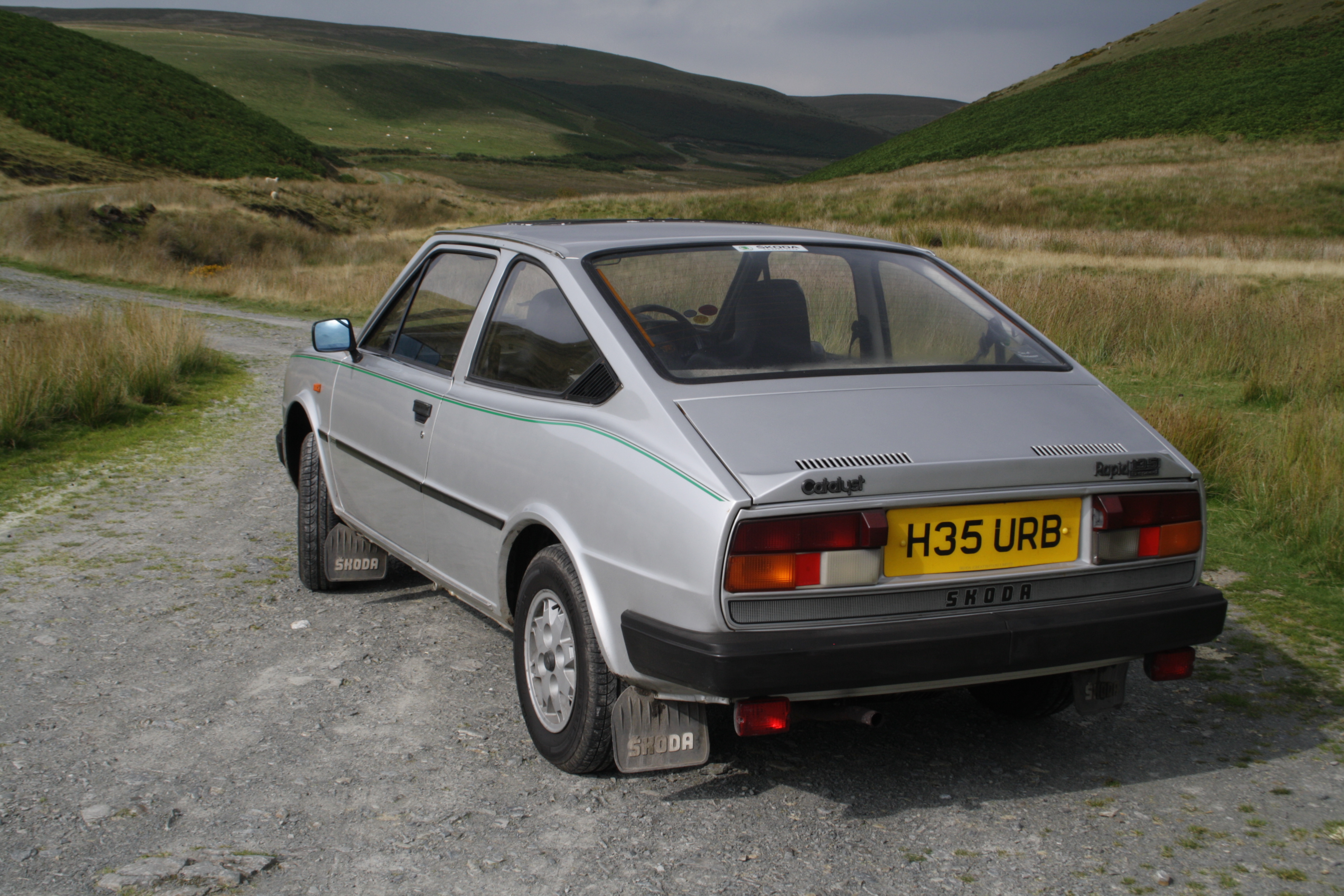
Definitely its best angle. Sleek.

Definitely its best angle. Sleek.

Tiny Road Test: Austin A40 Somerset

There’s something entirely lovable about old ‘county’ Austins. The bulbous lines are quite fantastic – like scaled-down Bentleys to my eyes. Again though, they have been rather a blind-spot for me. I’ve driven quite a few Sevens right up to the Ruby, and I have also driven an Austin Ten – which was hard work and not very pleasant. The ‘county’ Austins have passed me by though, and I’ve only driven later Westminsters and Cambridges.

Lovely! I drove it sans trailer tent

Lovely! I drove it sans trailer tent

Here was my opportunity though – a 1953 A40 Somerset that had been driven to Wales all the way from Southend-on-Sea. I first had to be reminded where the gears were. It’s the same pattern as my old Westminster, but that was a few years ago now. I was impressed. This column-change felt absolutely marvellous. A quick twist of the ignition/headlamp switch – yes, for some reason they are combined – and the engine fired into life. This was actually a 1489cc Wolseley B-Series rather than the 1200cc original. That’s a jump from 42bhp to about 55, enough to get the 0-60mph time down from a laughable (even to a 2CV owner) 36 seconds to something more like 25 at a guess.

Certainly, as I accelerated, enjoying the delicious first gear whine, it felt brisk enough. Not quick by any means, but not too shabby either. It seemed to handle far better than I expected too, with the huge wheel seemingly free of play given the steering box. It felt more positive about the idea of going around a bend than the Westminster did too and while it hardly encouraged you to really chuck it in, it didn’t cause the bottom to clench unwillingly either.

It all left me feeling like a bit of a fraud really. If a 23-year old  can use such a vehicle as daily transport, why haven’t I got anything older than 1986?

Video: Road test – Vauxhall ‘Victor’ FE 2300S

The Vauxhall ‘Victor’ FE 2300S is a pretty rare car, so I’m quite fortunate to have driven two of them. This is a car never marketed as a Victor and never badged as a Victor, despite clearly being a Victor, which is something I’ve only learnt recently. Anyway – without further ado, I shall thank Ed Morley for the opportunity and leave you to ‘enjoy’ my latest video offering.

About ClassicHub videos

I have no budget, no script and very little time. This video road test of a Vauxhall Victor FE 2300S was shot over the course of just half an hour, and edited on a free trial version of CyberLink PowerDirector 12. Which seems pretty good. I might actually purchase a copy. You don’t get anything fancy with ClassicHub – just a car and my thoughts on it! I usually review dreadful cars. Often my own. See more at https://www.youtube.com/channel/UCfxlBQnvNXX6o-2KbCMszWQ

Tiny Road Test: Ford Anglia

An opportunity presented itself last night to drive a Ford Anglia 105E for the first time. Well, actually, this one was in 1198cc 123E form, but I wasn’t going to be choosy. I’ve driven a LOT of cars over the years, but somehow the angular Anglia has eluded me.

I only got to drive a few miles as the car was soon to depart on a drive across the UK. Hence, the photos are minimal. This one in fact.

Delicious dinky-Detroit Anglebox

Clambering aboard, the driving position immediately felt quite odd. The seat seemed rather low compared to the high scuttle. Still, plenty of room for me and my legs. The gearlever is an odd thing. It’s very thin and spindly, and needs lifting up to enable reverse selection. It’s quite accurate, but does feel rather long and notchy. Not unpleasant, just unusual.

The pedals were surprisingly heavy, and I found the clutch and throttle both did very little at first and needed releasing/pressing a long way to get any action. Easy enough to adjust to. Performance is sprightly rather than quick but the engine is willing and there’s plenty of power – which exposes the rather short gearing. Motorway journeys must be a touch frantic.

The biggest surprise came from the steering though. The Anglia retains a steering box, but it’s light and delightful! It was far closer to a Morris Minor in feel, despite being an older technology (and in a car launched 11-years after the Moggy). I’ve always wondered why Anglias were so popular for saloon racing. I was beginning to see why. You can corner quite briskly without fear – not that I was pushing too much – and it left me eager for a longer stint at the wheel.

I’m glad I’ve finally removed this omission from my motoring CV. I had a feeling I’d like it, because that was certainly true of the Ford Prefect 107E – the older sidevalve Anglia body but with the later overhead-valve engine. To be honest, I actually prefer the more-subtle styling of the Prefect, though the Anglia provides plenty of ego-massaging opportunities. It generates a LOT of attention!

So, if you want to drive a car that makes people go ‘wow’ as you drive past, don’t bother with a sports car. Buy a Ford Anglia.

H8ers be H8ing, but the MGB is actually good!

The MGB is an absolute icon. The quintessential British sports car. The car that MG sold over half a million of (513, 276 of all types). A car so good that no other two-seater sports car sold as many units until the Mazda MX-5 – which surpassed it in 1999/2000.

The first MGB I drove, an early three-synchro model. Lovely!

The first MGB I drove, an early three-synchro model. Lovely!

It’s also a car that makes fans of other classic cars groan. It’s the one that always gets the prime front cover spot – usually in red – to the cost of pretty much any other classic. It’s seen as a default choice. A sports car for those who aren’t brave enough to go hunting for something different. A beige jacket of a car, not a ‘proper’ sports car. Whatever that means. They point at the feeble performance (105mph top speed, 0-60mph in 13 seconds), the fact that so many parts (engine, suspension basics, switchgear) are borrowed from boring family cars. “How could anything sporting have leaf springs and trunnions?” “How could something so ancient still be on sale in 1980?”

I don’t really get any of that. Sure, an MGB is not the fastest thing ever, nor the keenest when it comes to cornering at speed. But if ancient technology was so bloody awful, why do any of us like classic cars at all? Why do Morgan still sell cars with similar suspension and construction to those built 100 years ago? (albeit with an extra wheel since 1936. Steady on with the upgrades!).

An undeniably pretty car

An undeniably pretty car

A lot of the B’s appeal for me comes from the looks. Don Hayter (or is that H8er?) is largely responsible for that and while the B always lacked the seductive curves of the MGA, the neater snout and those delicate rear lines mean the MGB could never be called ugly. Dare I say it, I can even live with the later rubber bumpers even if I do dislike the corresponding rise in ride height – both driven by US Federal requirements.

If the roadster is attractive, the GT is almost more so. Pininfarina helped shape it and while it can’t quite stand up to the eerily beautiful Jaguar E-Type FHC, the GT can at least hold its pretty head high. It works really rather well, even if the rear seat is an absolute joke.  Don’t get me wrong – I won’t dash across a field to look at an MGB, but I’ll appreciate the styling as one drives past. And the bark from the exhaust. They really did manage to make them sound mean and powerful, even if they aren’t.

In terms of driving experience, the MGB feels about as modern as you’d expect. Not at all. The rack-and-pinion steering offers plenty of feel, even with the enormous steering wheel fitted to early Bs, but the ride quality is pretty dismal and if you really chuck it around, the limitations of that leaf-sprung live axle at the back are quickly met. You can still drive very quickly in one without coming unstuck though and have a jolly old time as you do, without necessarily risking your driving licence or frowns of disapproval from other motorists.

Amazingly, you can get them in other colours too

Amazingly, you can get them in other colours too

In fact, I’d argue that you can have more fun in an MGB on the open road than you can in an MX-5. Dynamically, Japan is ahead. It really should be having had the benefit of so long to do so. The MX-5 didn’t appear until the B had been dead for nine years and appears to have actually had a development budget. But, to really enjoy an MX-5, you need to go much, much quicker. In the B, I reckon you can have more fun at legal speeds and there’s a fair chance it’ll be less disastrous if you do over-step the mark.

No, I’ll stick with the rustic charm of the MGB please. Power really isn’t everything after all. If it was, I probably wouldn’t drive a Citroen 2CV. For sure, the MGB really isn’t anything special. It doesn’t particularly excel at anything. The thing is though, it doesn’t matter! The only thing that matters is whether driving one is enjoyable. Having driven many over the years, I can honestly say that I’ve enjoyed every one. It is one of those cars that is greater than the sum of its parts. I’m not sure how Abingdon managed it, but I can hand-on-heart tell you that while other cars may be ‘better,’ the B is a car that I hold in pretty high esteem.


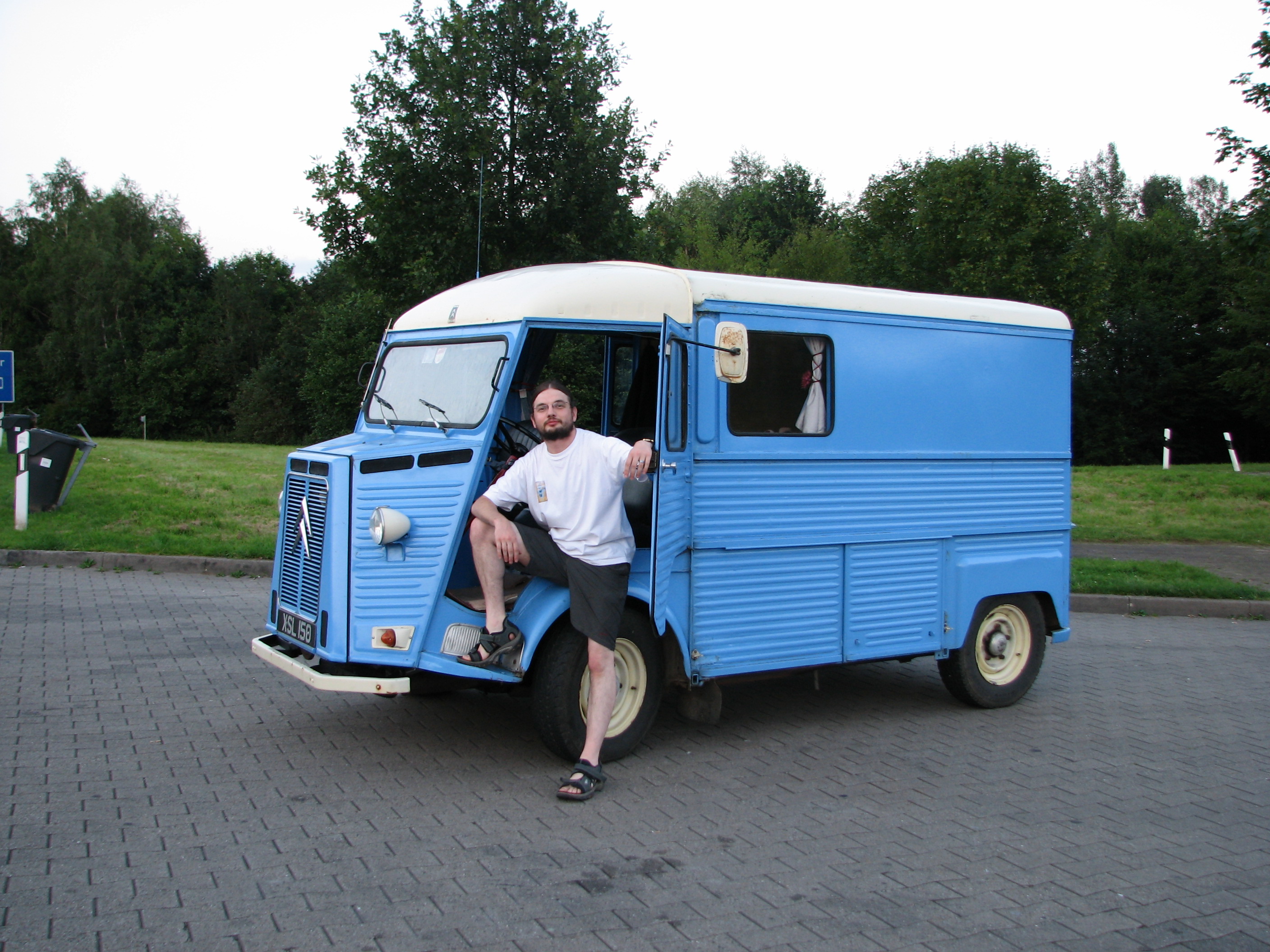
What is a Citroen H van like to drive?

Citroen H vans seem to be the new big thing. Sadly, a great many are being turned into ‘quirky’ catering vans. A lot of these just get shipped around and never actually get driven. People claim they’re too slow, heavy and generally just horrible. What’s the actual truth? Given that I drove one over 3000 miles to Sweden and back, I’m fairly well qualified to answer that question, so here goes!

First up, the history bit that The Law Of Writing Stuff dictates I must begin with. The H van was a quite remarkable van launched in 1947 by Citroen. It utilised front-wheel drive and monocoque construction with Torsion Bar suspension, just like a Traction Avant. In short, that means it has no chassis. It really is a box with some wheels and a drivetrain stuck on the front. A subframe holds the engine, front suspension and steering, with four large bolts holding it in place. This was revolutionary for the time. The main benefit is a seriously low floor in the back. It’s an easy step up, which is why the H van has been very popular for years as a camper. People up to about 5’8” can stand up in one with no need for a roof extension too.

Is an H van hard to drive?

Is an H van hard to drive?

The engine sits in front of a three-speed gearbox – engineering largely borrowed from the Traction Avant. The panels are lightweight and ribbed for greater strength – and a rather marvellous aesthetic. Early ones had a split windscreen and all had ‘suicide’ front doors, with the hinges on the rear. Well, ok. All but later ones for the Dutch market who deemed the original design a bit dangerous. They may have a point. I have heard tales of people falling out on the move…

Low floor is great. Yes, that is a piano in the back

Low floor is great. Yes, that is a piano in the back

Two wheelbases were available, and various overhangs. Coachbuilders also built their own specials. Three were built in right-hand drive form to test the UK market but they were a bit too unusual. Engines were a 1628cc or 1911cc petrol (with aluminium cylinder head from 1963 and 58bhp at most) or a rather feeble and noisy diesel. Amazingly, production did not end until 1981!

Driving an H Van

Clambering aboard is interesting, especially with suicide doors. There’s a handle near the windscreen to aid your entry. You sit right on top of the front wheel, rather like a Volkswagen Type 2. That means you sit quite high up, with a commanding view of the road. A button starts the engine once the ignition has been switched on and it’s quite noisy! That’s because it sits between your feet and those of your passenger, with just a thin, steel cover over it which is easily removed for maintenance. An H van is loud! Smothering the cover in sound-deadening is definitely a good idea.

Commanding driving position, here on a big bridge in Denmark

Commanding driving position, here on a big bridge in Denmark

Now you must get to grips with the gearchange. The lever is very heavy but precise. The shift pattern is back to front though. First is away from you and back, second towards and forwards, with third back from there. Reverse is opposite first so you need to get it right! The gearing is short, so you don’t need to slip the clutch much, but will quickly find yourself needing to change into second. You’ll soon be in third, which is good from about 25mph upwards. This means you don’t often have to change down. Don’t bother changing gear if approaching a clear roundabout, just keep going!

That’s probably a good idea, as the brakes take a good shove. A lot of people complain that H van brakes are rubbish. No, they’re not. They DO require a good shove, but an H van is capable of stopping briskly if you need to – as long as the brakes are well set-adjusted. Indeed, with no load, it’s very easy to lock the rear wheels.

You don’t really need to slow down though. Despite being a design that’s been around for longer than a Morris Minor, the H van handles like a big Mini! The steering is heavy, but wonderful. It’s so direct and you quite easily find that your crockery is on danger if you’ve got a camper.

The biggest problem is that gearing though. 50mph is hard work, as the engine is revving very high. 60mph is just about possible, but Motorhead is quieter. Even if you stick your head next to an amp. It’s hardly relaxing and the day we drove 288 miles in Germany is one of the toughest things my wife and I have ever done! I must confess that those who ship their catering vans to events may do so to protect their hearing.

Front-wheel drive secret to H van success

Front-wheel drive secret to H van success

But, you need to accept that an H is an old vehicle. Yes, it will be challenging at times, but they have a truly marvellous charm about them. They were never designed for gallivanting all around Europe. It’s frankly amazing that they do so in their stride, albeit a rather noisy stride. Mechanically, we had no troubles at all on our trip other than a slightly noisy driveshaft. When we flattened the battery at a campsite, I just started it on the handle.

So there you have it. Unsurprisingly, what was revolutionary in 1947 is perhaps hard work today. The fact that it remained in production so long just demonstrates how long it took the world to catch up though. Even in 1981, most vans were still rear-wheel drive with leaf springs. It’s only in the past 20 or so years that the H van formula of front-wheel drive has really caught on. How ahead of the game is that?

Video: Rover 416 – initial thoughts

This one took a bit of making. Sadly, my laptop is increasingly unhappy with the world of video editing, so this one isn’t as clean-cut as I’d like.

That’s a shame as I feel the car deserves better! I’ve been busy today getting the catalyst heat shield repaired and yesterday I managed to quieten the rattle you’ll occasionally here from the rear of the car. A spot of wheel balancing completes the minor jobs that have really improved how the car feels.

Regardless, here’s my real world video review of my 1992 Rover 400.

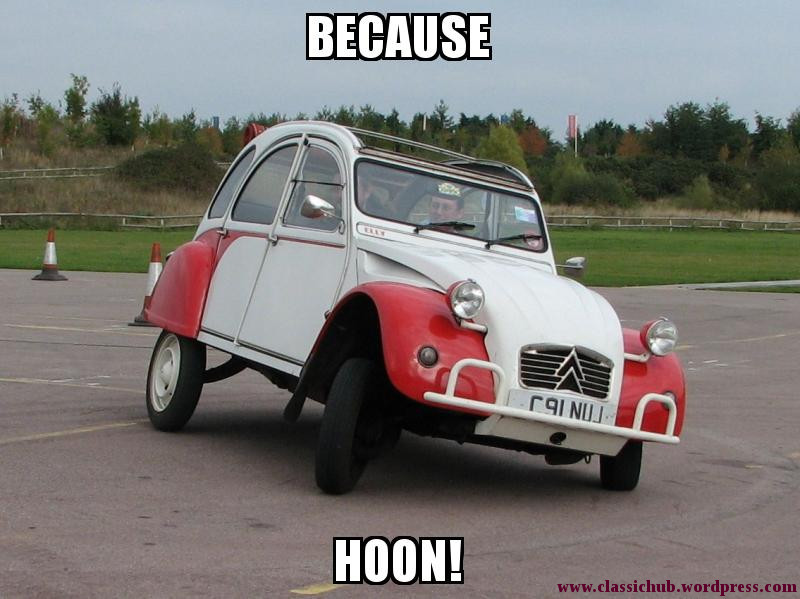
2CV: Too much hoon

I seem to have a real problem. I just can’t drive the 2CV slowly!

I covered a good 100 miles in the 2CV yesterday, attending the excellent Welshpool Air Show. I overtook a few cars on the way there, including a lovely Morris Minor Convertible. All overtakes remained legal, as the 2CV is scarcely powerful enough to break the National Speed Limit.

2CV Because Hoon

Yesterday looked a lot like this

On the way home, I found myself ‘stuck’ behind the worst kind of driver. The one who is unpredictable, slowing harshly and far too much for bends, then accelerating up to the speed limit on the straights so there’s no chance for a feeble 2CV to overtake. I started to get wound up. Even though we were averaging 50mph, I wanted to go faster! Moderns blasted past, able to rely on sheer grunt to get ahead – not an option for a 2CV battling a headwind. Overtaking needs plenty of planning and a good run up!

After many miles, I finally managed to get by, only to find myself stuck behind a car that was even slower. This hardly seemed fair. I spotted a gap and went for it. As I drew alongside the car, I could see that the gap was not big enough. I’d failed to consider the impact of gravity as we drove up a slight incline – me on the wrong side of the road. I decided to commit, with the 2CV in third gear and the valvegear threatening to go flying through the front wings. The car coming the other way was thankfully not moving overly quickly, but did have to ease off. I waved an apology and was away.

Looking back, I’m struggling to justify my actions. I wasn’t in a rush and the views are epic, so I could have just sat back, relaxed and enjoyed them. There’s a problem though. I hate driving the 2CV slowly! I think I see it as a responsibility to prove that the 2CV is not really that slow. Several times though, I found myself cornering with a little too much speed as I aimed to tread the fine line between conserving as much momentum as safely possible (because speeding up again takes so long) and not driving like a twat. I rather feel I overstepped the mark several times. Apologies if I alarmed you…

An artist's impression of yesterday

An artist’s impression of yesterday (taken years ago, not in Wales)

I think I desperately need a longer drive in the 2CV. When I undertake a long trip, I do ease off, because the stress of keeping the 2CV at maximum hoon is absolutely exhausting. Not that my cruise pace is that slow – I’ll still do my damnedest to attain the limit, but I’m in less of a hurry to overtake and more prepared to sit back at a cruise if traffic levels dictate it.

The real issue here is more simple though. The 2CV is too much fun to drive – something most so-called petrolheads have never really acknowledged, because Top Gear told them 2CVs were crap and anything with less than a zillion horsepower is embarrassingly feeble. Yesterday reminded me that on Welsh A and B roads, you’ll struggle to have more fun in anything other than a 2CV. More power might help with the overtakes, but you won’t be able to drive ‘foot-to-the-floor’ like I did.

So, I’m going to blame the 2CV for me driving in such a poor manner. It really wasn’t my fault.

Craptacular Road Test: Kia Pride

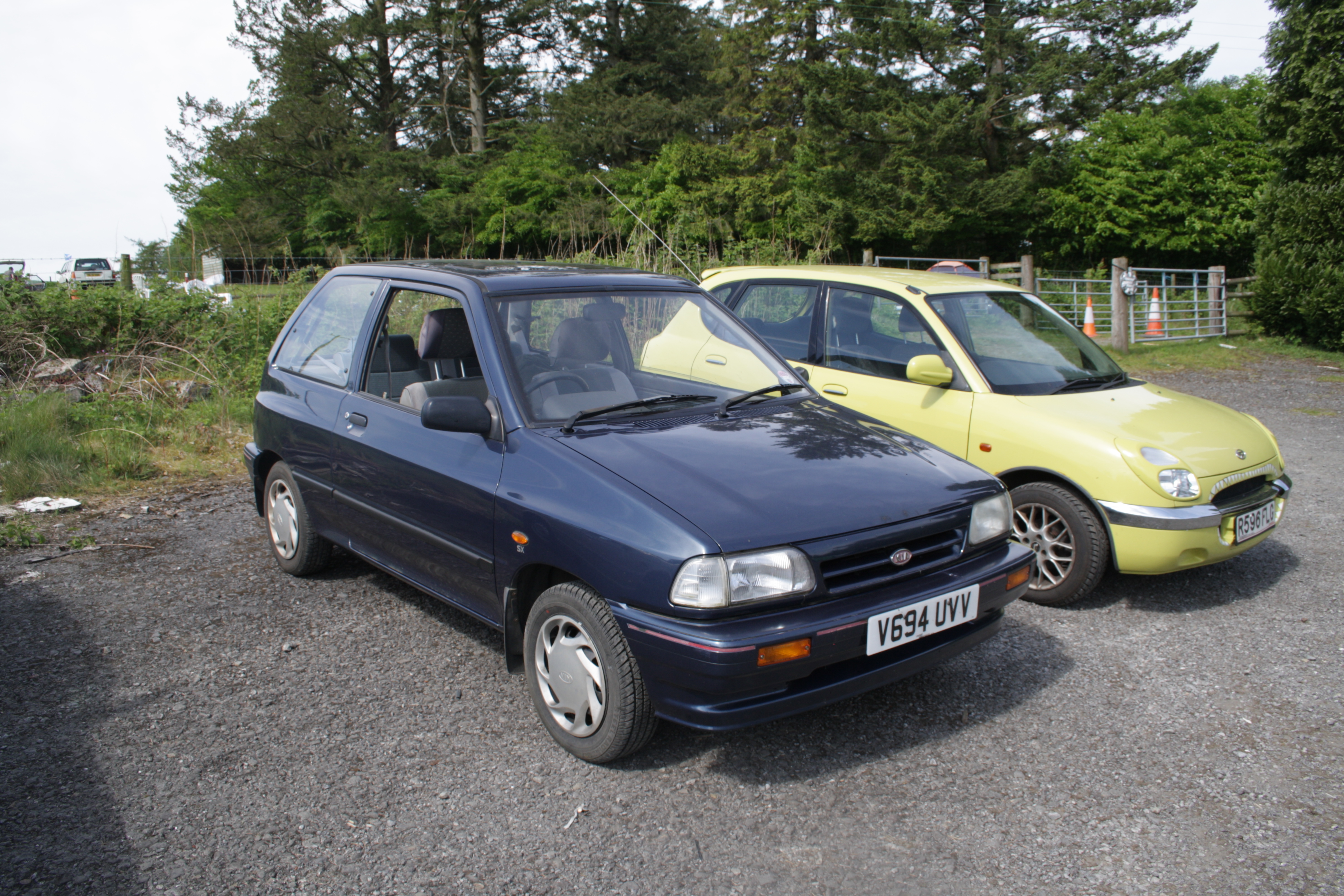
As alluded to a few blog posts ago, what killed off typical cheap motors such as the Lada Samara was a new wave of ‘cars we’d seen before’ built somewhere cheap. These included the Spanish Seat Marbella (an older Fiat Panda), the Proton (Malaysian Mitsubishi Lancer), the Sao Penza (South African-built Mazda 323) and, from 1991, the Kia Pride – a Mazda 121 with a South Korean accent.

Kia had been producing cars since the 1950s, but a tie-up with Ford from 1986 proved useful. Ford already boasted a strong relationship with Mazda, and this led to the Pride. The story starts with the Ford Festiva, launched in 1986 and designed and built by Mazda. The Mazda 121 followed in 1988, but was not sold in Japan. In 1991, production moved to South Korea and the Kia Pride was born – still sold as a Ford Festiva in markets such as Canada, Australia and the United States. Apparently, 1800 Kia Prides were sold in the UK in 1991, but Kia has now become a popular brand here, with its current range far from being cheap, old versions of cast-off designs. That’s because Hyundai bought the bankrupt Kia in 1998 and the Ford interest was ended. The Pride made a brief reappearance in the UK and the tested car is one of those last models.

Prides were sold with jazzy white wall tyres, but it’s rare to see one so equipped today. Such is the state of the one I got to drive. To be honest, I wasn’t going to bother. Even me, the great lover of crap cars, considered the Pride to be as exciting as a ballpoint pen. Useful yes. Exciting, no. Besides, I already own a Daihatsu Sirion. Compared to that, most small cars seem utterly boring.

One of these little cars is brilliant

One of these little cars is brilliant

The owner cajoled me into having a go though. It seemed only polite to accept. After all, to be truly informed about your own favourites, you need to try the opposition. Clambering into the Pride at least allowed me to escape from the brain-numbingly dull looks. The door is huge, and it felt like I was opening the entire side of the car. That helps with the feeling of space inside, as does the width. It’s only 2 inches narrower than a Citroen BX. A huge glass area leaves it feeling rather bright inside, as does acres of light grey plastic.

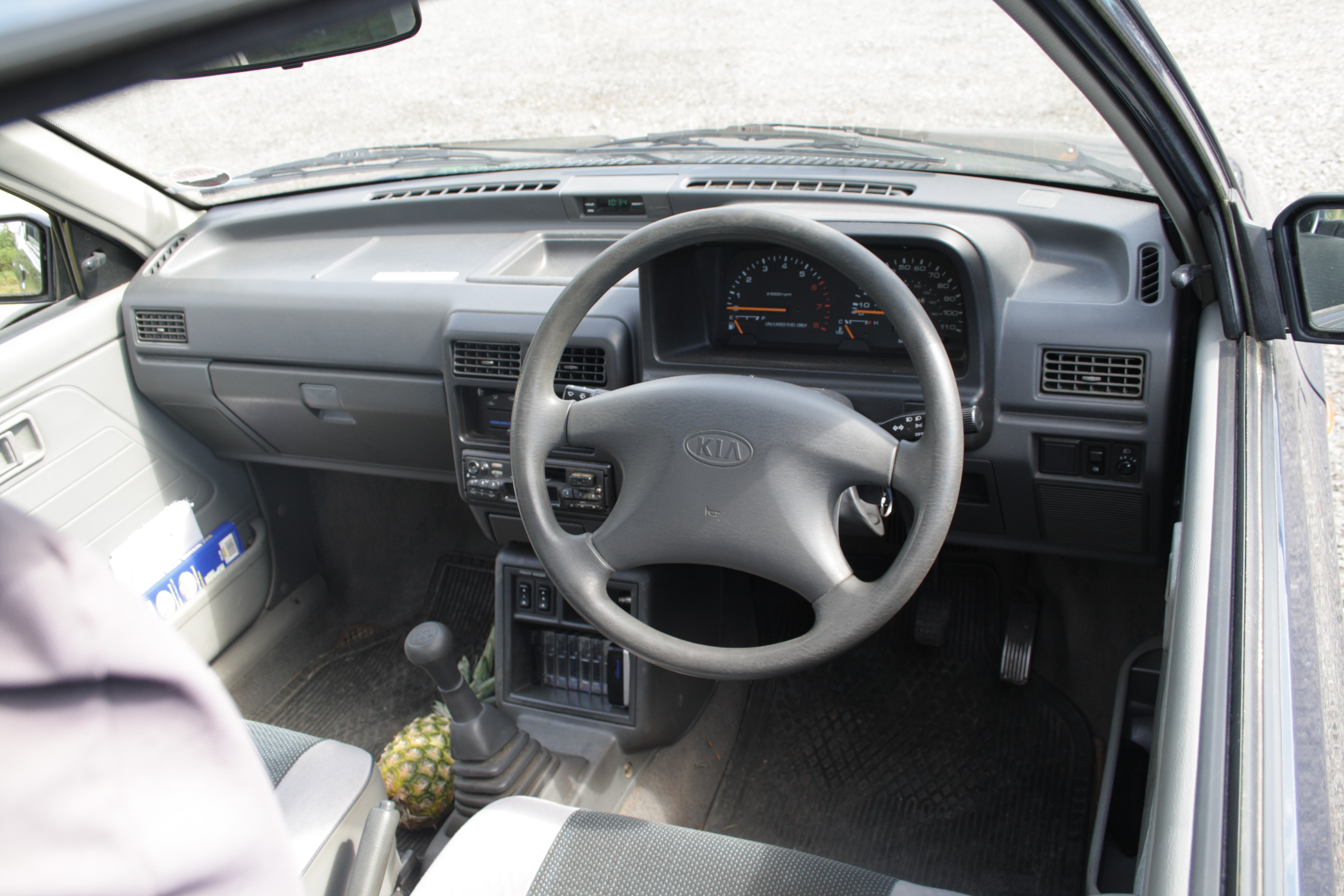
Pride inside

Not exactly inspiring. Pineapple adds interest

It’s not very inspiring, though I must concede that the inside of the Sirion is not exactly interesting either. The Japanese seem good at dull and functional, though at least switchgear wasn’t too scattered about. Only the electric window switches (yeah, posh eh?) confuse, by being mounted near the passenger’s right knee on the centre console.

The engine fires up as swiftly and sweetly as you’d expect. All a bit ordinary, but it does work with no bother. So far, so underwhelming. The gearchange felt a bit rubbery, but I felt confident enough to head up my favoured test hill. It went really well! The 64bhp engine has a nice spread of torque, so (unlike my feeble Sirion) it picks up speed briskly without need for ear-bleeding revs. That’s good, as the engine hardly sounds nice. It’s not unpleasant, but I can’t really describe it as pleasant either. It’s just another mundane four-pot. They tend to sound like this.

Reaching bends, things didn’t fall apart either. There was less roll than I expected, the unassisted steering was really rather good and precise, and it seemed happy to grip the road well. Bumps didn’t unsettle it unduly either. I began to suspect that motoring scribes who had little good to say about the Pride were either unrealistic in their expectations, or hadn’t actually driven one at all and just guessed that its budget price meant it was hopeless.

I also found it comfortable and the gearing seemed tall enough that motorway driving wouldn’t be too much of a chore, though this is pure guesswork as our road test took place about two hours away from any motorway. The five-speed gearbox has a good spread of ratios though.

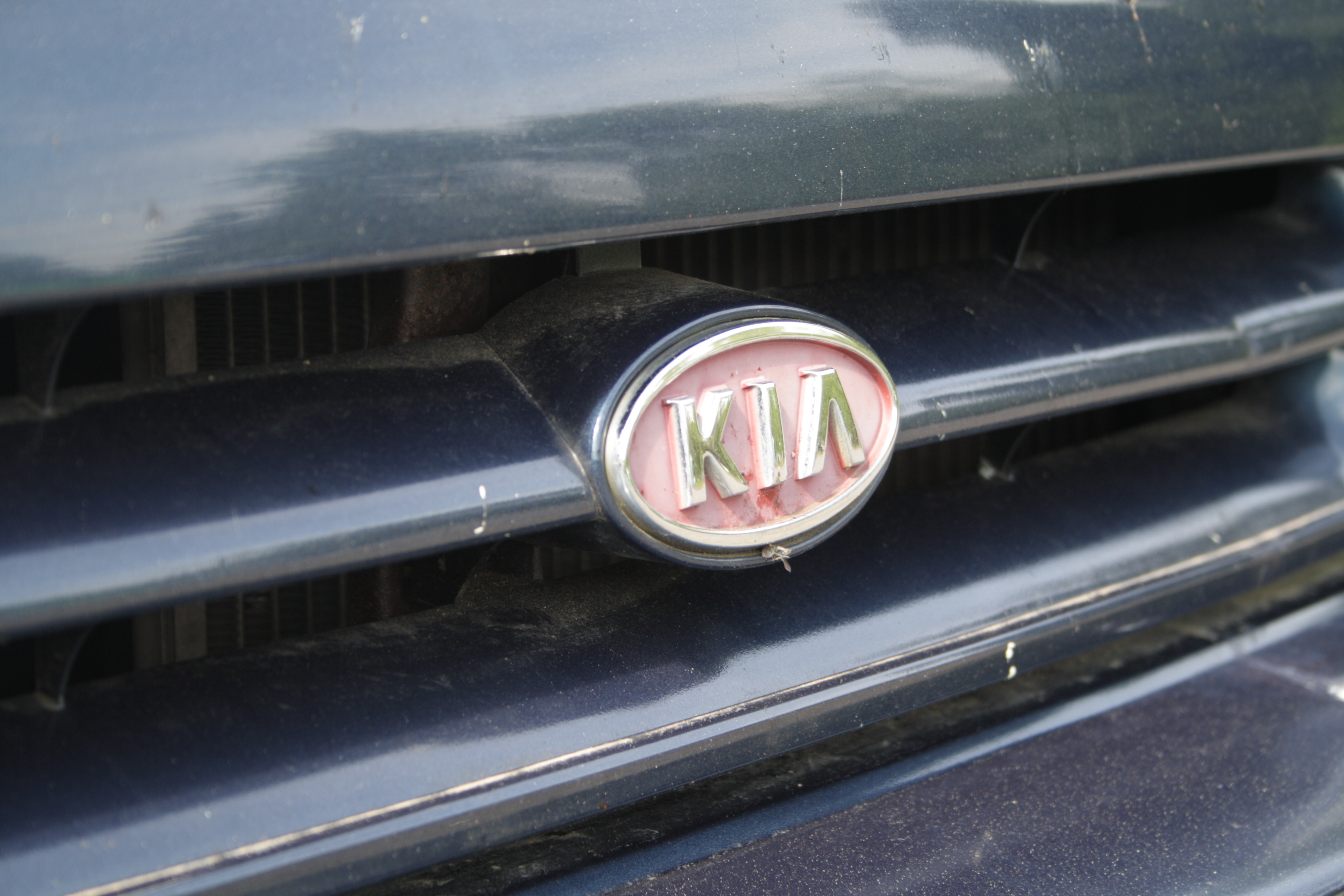
Kia is Korean for 'surprise.' Er, maybe.

Kia is Korean for ‘surprise.’ Er, maybe.

There you  have it then. Unsurprisingly, I found this unremarkable car quite pleasant. Isn’t it funny how actually, most 1980s/1990s cars can be described as pleasant? This one was purchased only a few weeks ago for the grand sum of £300 with an MOT until next year. That’s astonishing value really for a car that feels very competent and further proves that you really needn’t pay the earth for a good, working motor car. In many ways, it was much better than my Sirion. More spacious, more comfortable, quicker, more relaxing but, importantly, not as much fun. So, I’m happy to recommend the Kia Pride – but would always prefer something a bit more oddball myself.

Craptacular Road Test: Vauxhall Cavalier Mk3

Incredibly, it was 26 years ago that the third generation of Vauxhall Cavalier was launched. I remember it well. Permit me another Motor Show moment as I remember the 1988 gathering of new cars. Gone were the rigid, boxy lines of the Mk2 Cavalier. Instead, Vauxhall/Opel built on the public acceptance of the swoopy Sierra – that acceptance was a long time coming. The Cavalier was timed perfectly. I remember sitting in the Cavalier in 1988, feeling very impressed by the split/folding rear seat that was a feature even on the saloon. This ten-year old critic was impressed.

I loved the styling too, but it wasn’t until 1990 that I got my Cavalier experience – a relative got a bright red 1.6L as a company car. He probably doesn’t know this, but I tested the safety feature built into the electric windows one day. The theory was that if it encountered a hand on the way up, it’d stop before crushing the hand. Thankfully, it does! Because I tested it with my hand.

Not that the good point stopped at stupid-child-friendly windows. The Cavalier was one of few cars where you could carry out a clutch change without dropping the gearbox. A far cry from the palaver that faced the Sierra owner. It was entirely designed with fleet markets in mind. Yet I liked the growl that Vauxhall engines managed to deliver, even in 1.6 form.

I had to wait even longer than my LT moment to actually drive a Cavalier Mk3. The example I was faced with had typically crusty rear arches and was very evidently not in the first flush of youth.

Cavalier/Vectra Mk3

Desirable, isn’t it?

Incidentally. Here’s an anorak fact for you. The windscreen wipers were changed in 1991 for the simple reason that the original design didn’t easily allow you to change a wiper blade! The bonnet got in the way. Concealed wipers are all well and good for aerodynamics, but the revamped wipers were a lot easier to change. They haven’t parked properly in the above picture.

Clambering aboard the Cavalier was a true step back in time. I spent many, many hours pretending to drive my relative’s Mk3, so I was very familiar with the layout – if not all the extra toys and velour that the CD spec gets you. To be honest, it’s not a particularly thrilling place to sit. Lots of grey and black plastic and little inspiration.

Plasticky. Apols for the wonky wheel. The steering lock engaged

Plasticky. Apols for the wonky wheel. The steering lock engaged

This was the first time I’d moved the stubby gear lever and been able to drive off, so it was quite a moment. The mechanical action felt very familiar. The nose was aimed at a hill and away we went. The 2-litre engine is nice and punchy, with excellent torque characteristics. It sounds deep and gruff. Like Barry White doing a lion impression. It’s surprisingly appealing for a four-pot engine. As we powered around a series of bends, I was struck by how pleasant the Cavalier is to pilot. Hardly sports-car exciting, but grippy, composed and with enough power to sprint between corners. No wonder Ford felt they had to push the boat out with the Mondeo. General Motors had got a massive jump on the Blue Oval.

The seats were comfortable too, though I’d need a longer test to really ensure comfort. Vauxhall have a bit of a reputation for poor seating – a passenger experience in the back of a Zafira still carries painful memories.

Facelift model with extra trim between lights

One practical hatchback. Curves were astonishing in 1988

Overall though, the Cavalier more than lived up to expectations. It’s still very tempting to hunt down one of the excellent Isuzu-diesel powered versions, but even the petrols offer good pace and economy. It’s easy now to forget the impact of the curvy Cavalier back in 1988 but while corrosion has killed many, the Cav still makes a great cheap buy today and still drives very nicely. Not hugely exciting, but marvellously competent.