Why I adore the Jowett Javelin

As Great Britain recovered from the ravages of the Second World War, its car manufacturers faces a huge battle to restart production. Some new models arrived – notably the Armstrong Siddeley Lancaster and Hurricane as early as 1945 – but generally most companies hastily relaunched their pre-war ranges. Progress was slow to arrive, so Jowett rather stunned the world with the Javelin of 1947. For a start, it looked very much of its time, not something styled in the previous decade. The sweeping lines hid torsion bar suspension all-round, rack and pinion steering and Jowett’s own flat-four engine in 1486cc form.

One of my very favourite cars

One of my very favourite cars, the Jowett Javelin

Gerald Palmer designed the car – he would go on to pen the delicious MG Magnette Z, a favourite sporting saloon of many, including myself. He was allowed to be rather unconventional for the time, with engineering seemingly inspired far more by the likes of Citroen than other British manufacturers. Sadly, crankshaft problems blighted the engines, gearbox woes were next in line and then Ford bought Jowett’s body supplier. It all went a bit wrong and the 23,307 sold just wasn’t enough. Jowett ceased production in 1953 and one of Britain’s most exciting manufacturers was dead and buried.

That’s all history though. What is a Javelin like to drive today? Naturally, it’s really rather good, or I wouldn’t like it. History is fine, but I won’t rate a car if I don’t like driving it. I demand a car that handles and stops. The Javelin does, with its distinctive flat-four engine noise giving a wonderful off-beat thrum familiar to anyone who’s spent time with Volkswagen Beetles or Subaru Imprezas. It remains refined though and delivers strong performance for its age and size – 80mph is comfortably within reach.

Large steering wheel and a great column gearchange

Large steering wheel and a great column gearchange

The huge steering wheel gives wonderful feel, and the column-mounted gearchange is an engineering delight. It makes you wonder why column change never became more popular. Reach a bend and you needn’t be too cautious as it’ll sail around pretty quickly if you ask it too. Full hydraulic brakes – far from universal in the late 1940s in Britain – ensure speed can be reduced without worry.

Time has enabled enthusiasts to overcome many of the car’s foibles. For my money, the Javelin remains one of the best classic saloons money can buy. I just wish I had enough money to buy one!


The expedition to The North

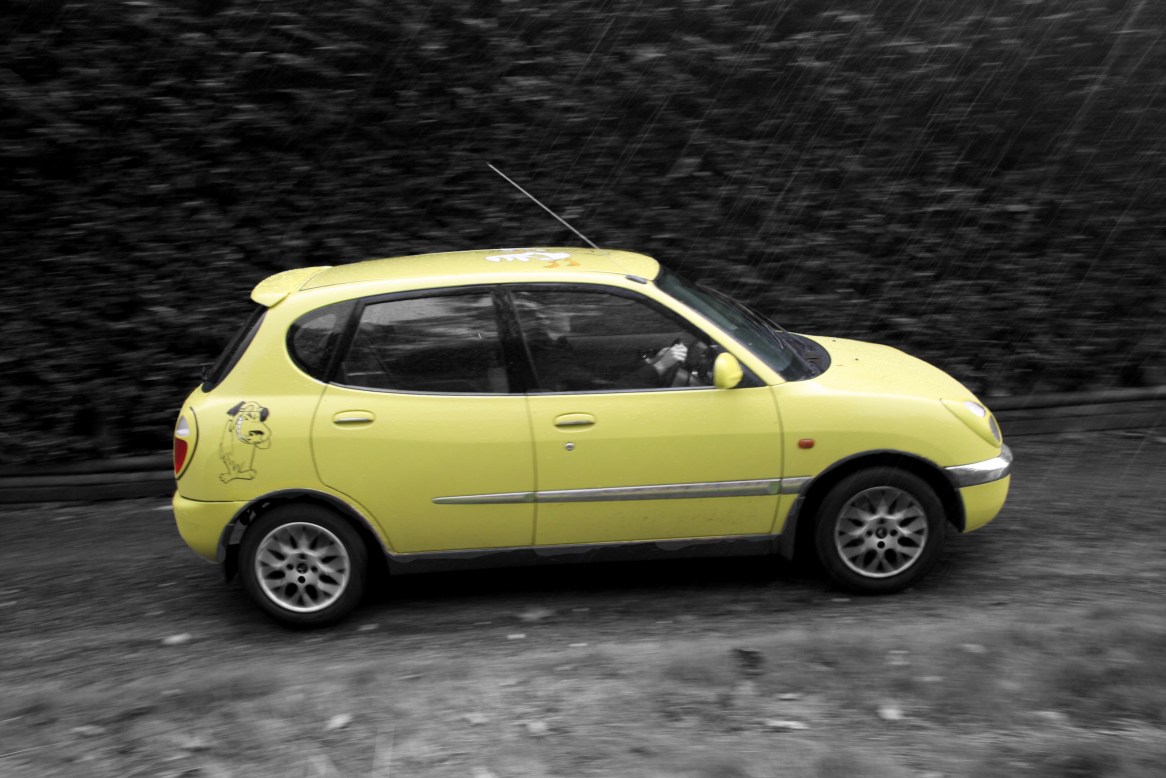
Towards the end of 2013, Rachel announced that she wanted to see the Northern Lights. This seemed a rather splendid idea but the lack of funds made such a trip unlikely. Fortunately, Rachel works part-time and also holds a small contingency fund to which I am not allowed access. Apparently rusty old cars are not a contingency. Make no mistake, this trip was sheer luxury and our first proper holiday since moving to Wales in October 2010. Funding was still tight though, so the most economical car would have to be used for the trip. That meant the Sirion which, as it happened, I’d prepared for such an adventure by equipping it with a bargain set of winter tyres in early December.

On Friday 27 December, we loaded the poor Daihatsu with essentials, including a snow shovel and liquid snow chains. If you’re heading north in winter, you have to expect the possibility of some winter weather. The car was quite heavily laden, and this would eat into the fuel economy. It was averaging 45-47mpg on the way up. That drive up proved rather challenging thanks to the run of winter storms. Strong winds and heavy rain meant the motorway section especially was a struggle, especially on exposed sections. Here, the over-assisted steering proved a massive problem. It’s very direct, so trying to counter the effects of a gusty side-wind was very difficult. It was far too easy to over-correct, making maintaining a straight course near-impossible. Eventually, we decided we’d had enough and stopped at a hotel near Dunblane. My shoulders and upper arms were aching a lot.

The next day was calmer, and we drove another 200 odd miles without further incident. The Sirion really does bowl along very nicely on a long-distance trip, even if it does find hills hard work. As our route took us over the Cairngorms, the tiny 989cc engine was worked very hard to keep our momentum up. We reached the village of Helmsdale – created as part of the Highland Clearances and timed also to make the most of the Herring boom in the 19th century. From here, it was another ten miles down a single-track road to reach our very-remote cottage, where mobile reception and internet were conspicuous only by their complete absence.

Scottish paradise

Scottish paradise

Being cut-off from technology was a real bonus. My life invariably involves being connected to the internet for work and pleasure. The enforced break was a very good thing and allowed me to properly unwind. We went for walks, went for drives and enjoyed the best that north Scotland has to offer. Thoughts soon turned to the main reason for our visit – the Northern Lights. This phenomena is occasionally visible from the UK, but you want to be as far north as possible. This is not, as you might expect, John O’Groats. That’s a good thing as it’s a bleak and fairly unimpressive place. Instead, we headed to Thurso, then east along the coast to Dunnet Head. This headland is the northernmost point of the UK mainland – the only way to get further north in the UK is to fly or catch a ferry to Shetland. Our drive north from our cottage was livened up by only having quarter of a tank of fuel. In Scotland, 2nd January is also a Bank Holiday. Would we be able find a petrol station that was open? Just finding a petrol station was tricky enough, and we didn’t pass one until we’d driven 30 light-footed miles. It was closed. I opted to keep following the main road in the opposite direction from Thurso to Dunnet Head. This was a bold move but a successful one. We found the only open petrol station in Thurso! Phew. We then retraced our steps and headed out of town to Dunnet Head.

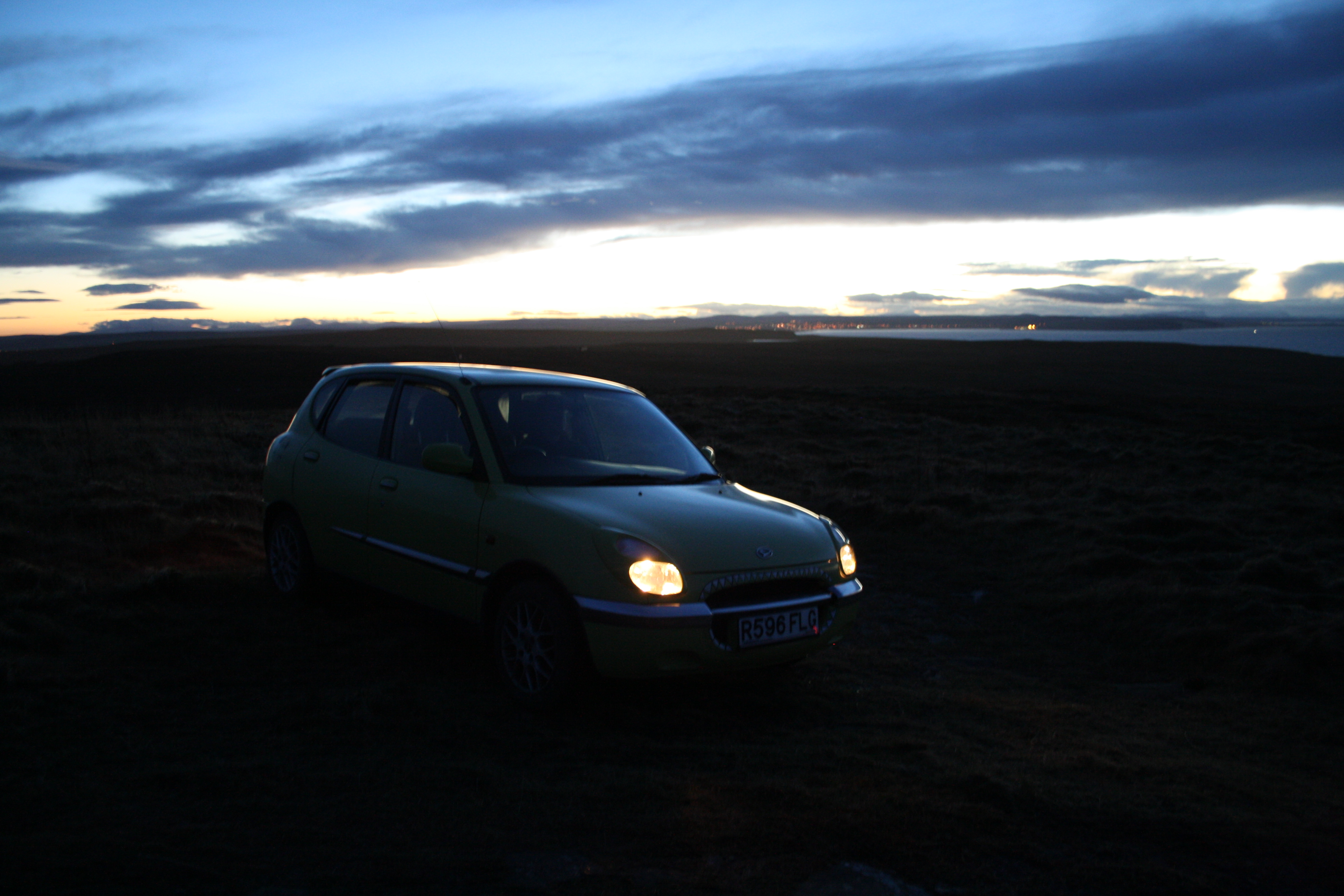
Sirion basks in the sunset at Dunnet Head

Sirion basks in the sunset at Dunnet Head

What now followed was a very lengthy wait. We arrived well before 5pm and enjoyed a spectacular sunset. There was a hint of aurora activity at around half past seven, but it didn’t amount to much. We sat back and listened to a remarkably odd programme on BBC Radio 2 in which Harry Shearer (Spinal Tap and The Simpsons) played some very obscure stuff from his record collection. At 10pm, more than five hours after we arrived, Jo Whiley took over radio duty and made the mistake of playing some Paul McCartney. The radio was turned off. We continued to wait. At half past ten, we got treated to a gentle but definite show of Northern Lights. Actual aurora! The show didn’t last long, so we continued to wait. Another hour crept by and then things got better. I took this shot at 2345hrs.

The Northern Lights! Amazing

The Northern Lights! Amazing

Not a very good photo as it happens, as I was cowering inside the Sirion due to gusts of wind. That and the cold rendered my tripod useless, so I was balancing my camera on the dashboard and trying to guess at the focus. It was still soft, as the gusts were still moving the car around! Still, it was mission accomplished. We had incredibly managed to see what we came to see.

We then had a rest day before driving home. I managed to do absolutely nothing at all on the Friday, which was good as Saturday would prove quite a challenge! We were treated to a telly in the cottage, so we’d been keeping up with the stormy developments around the UK, watching with dismay as Aberystwyth’s promenade was literally ripped apart by the storms. The forecast was grim, but Saturday – our travel-home day – was a rare window in otherwise grim news. The Sunday was meant to be particularly dreadful. That said, there were warnings of snow in central and southern Scotland, and north England too. Our route home.

We got up at the unholy hour of 7am and quickly packed and prepared. We managed to leave just after 8am – a record for us – and headed south as quickly as the little Daihatsu could carry us. The Cairngorms became a concern, but we needn’t have worried.
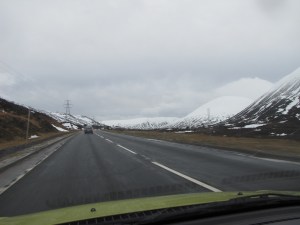
Very pretty, but thankfully the roads were clear

Very pretty, but thankfully the roads were clear

There were no problems and no more snow appeared to have fallen than had been around on our drive up the previous weekend. We stopped for a break north of Perth, then headed on south. We zoomed past Dunblane and on to Glasgow, where gritters were very much out in force and overhead signs warned of cold weather. We had another pause for lunch just north of the border, then pushed on – keen to get miles covered while it was still light, and while the weather was good.

We stopped at the truly excellent Tebay Services for another break – thoroughly recommended and a wonderful demonstration of how pleasant motorway services could be. We even bought some meat at the farm shop. I was still feeling fresh, even after 300 miles, so on we went, enjoying spectacular views as we headed south on the M6.

Astonishing views, from a motorway!

Astonishing views, from a motorway!

As darkness fell, the weather was still kind and our going was good. Almost ten hours after we started, we stopped at the Little Chef near Oswestry. For reasons I can’t really explain, I mourn the demise of Little Chef, so visiting this one felt like I was supporting an underdog – surely a very British pursuit. We were treated to the sight of a very tidy Ford Escort XR3i in the car park. Surely as sign from the gods that we were doing the right thing.
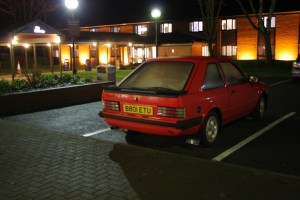
Nothing like taking an Escort to a hotel for the night

Nothing like taking an Escort to a hotel for the night

Duly reinforced, our journey home continued. All was not well however. After performing magnificently for more than 1500 miles, the Sirion began to display a worrying tendency to misfire during and after left-hand bends. This was very odd. It felt like fuel starvation and I began to suspect one of two things. Either the fuel filter was clogged, cutting fuel off when centrifugal force was added into the mix, or the leaky fuel filler pipe had been allowing water into the tank. I still don’t know which of these is the culprit and the weather will prevent me investigating today.

Then it started hailing. Finally, a test for the winter tyres! I cautiously pushed on and twelve hours and 560 miles after we set off, we were home!

I’m truly astonished by the little Daihatsu, which averaged well over 40mpg during the trip, despite being driven hard and being heavily laden. The economy did drop off a bit on the journey home, possibly because I was pushing it quite hard, but also possible due to whatever fuel fault there is. Regardless, it easily got us to the north of Scotland and back again, with the only downsides being that steering, rather harsh suspension and seats that lack enough comfort. Still, can’t be that bad if I can survive 12-hours at the wheel and still walk! The Sirion may not be the obvious choice of road trip machine, but it proved that size certainly is not everything. It fully reinforced my love of tiny cars.


Nissan Leaf: The Full Review

A short review of the Nissan Leaf has been written by me already, and published at NextGreenCar.com. What now follows is a more in-depth review of my week with a brand new electric car. Bear with me. It’s quite lengthy.

Not a classic, yet...

Not a classic, yet…

Electric cars are certainly not new. They’ve been around for almost as long as internal combustion-powered ones. The BBC is about to screen a show looking at one from the 1960s – the Enfield 8000. Like most electric cars, the Enfield suffered from a short range, much slowness and great heavyness. Heating is minimal, though the cars did include a heated windscreen, so you could at least see where you were going. Few were sold and sporadic attempts at electric power since have not come to much.

So, when Nissan decided to mass produce an electric car, launched in late 2010, it was a bold step indeed. I was curious and decided that now production was UK-based for the European market, it was about time I tried one. Who said us Brits don’t make anything these days?

The car was delivered early one winter’s day. If I was going to test an electric car, I wanted to do so in the most challenging conditions. There’s no point owning a car that’s only good in summer. Hopping aboard, it felt like pretty much any other modern car. There were lots of buttons, precious little visibility but the usual steering wheel and some pedals that we’ve come to expect from a car.

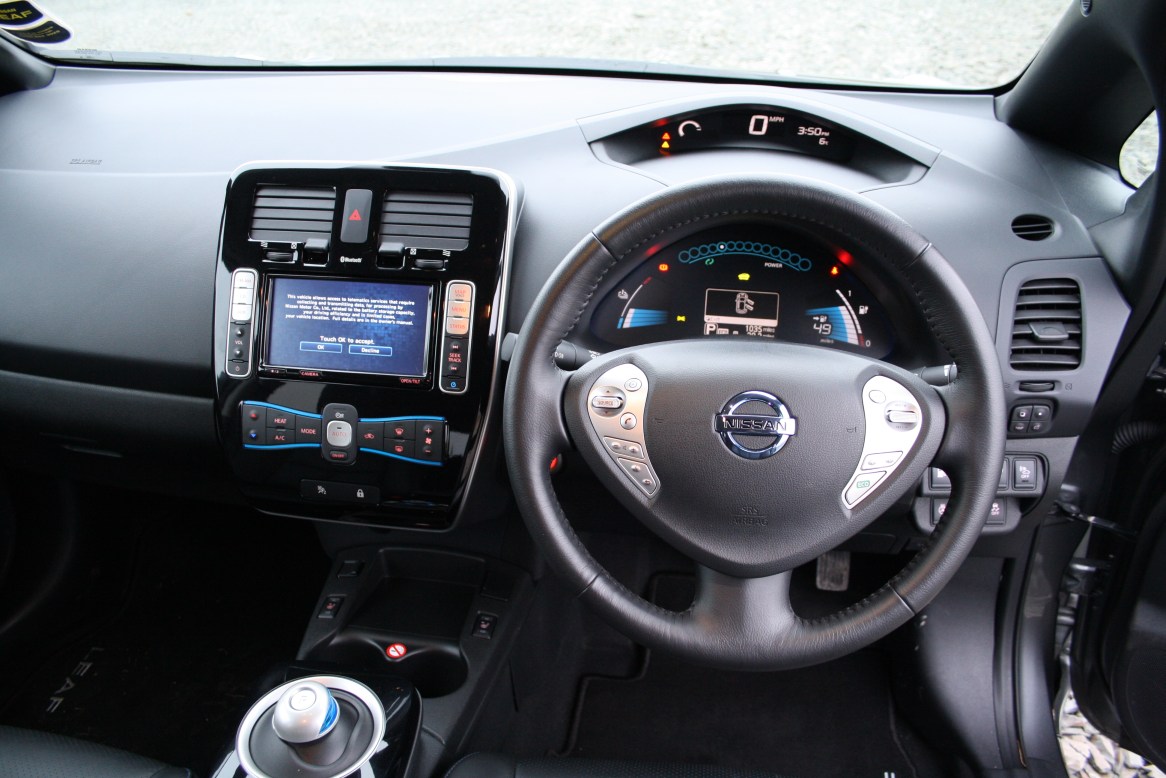
Buttons, many buttons

Buttons, many buttons

I put my foot on the brake as instructed and pressed the On button. An ‘intelligent’ key means you can clamber aboard and start up without removing the key from your pocket. Rather than growl into life, it played a little beepy tune that I feel could cause insanity after a few months of ownership. It was like turning on a smartphone. Then it was a case of selecting D with the nifty gearlever, releasing the foot-operated (and thankfully not electronic) parking brake and beginning the oddest driving experience of my life – this coming from someone who has driven a Scootacar.

A quiet, high-pitched whir is all you get by way of sound as the car creeps away. Throttle response is instant but easily moderated. The brakes are super-sharp, the electric power steering surprisingly pleasant. Coming to a halt is particularly odd as it all just goes very quiet indeed.

Over the next week, I drove over 250 miles in the Leaf, using it as daily transport. The range was typically 50-70 miles before charging was needed, though I never left it perilously low on ‘fuel.’ The ambient temperature was very low, so the climate control saw a lot of use, as did the heated seats and steering wheel. I also live in a very hilly part of Wales, so the battery pack really had its work cut out.

Being a top-spec Tekna model (with an eye-watering £32,000 list price) the Leaf had a B-mode as well as D for going forward. B gives more ‘engine’ braking, generating more power as you ease off the throttle. This gives the sort of lift-off retardation that you just don’t get with a conventional automatic, boosting confidence on twisty roads as well as generating power to keep the main battery topped up. I left it in B mode for almost all of the time. I also kept it in Eco mode a lot too. This gives you a ‘lazier’ throttle pedal to help stop you burning volts and restricts power to the heater. I would occasionally drop it out of Eco mode which to me felt like giving it a burst of nitrous oxide! Great for overtaking.

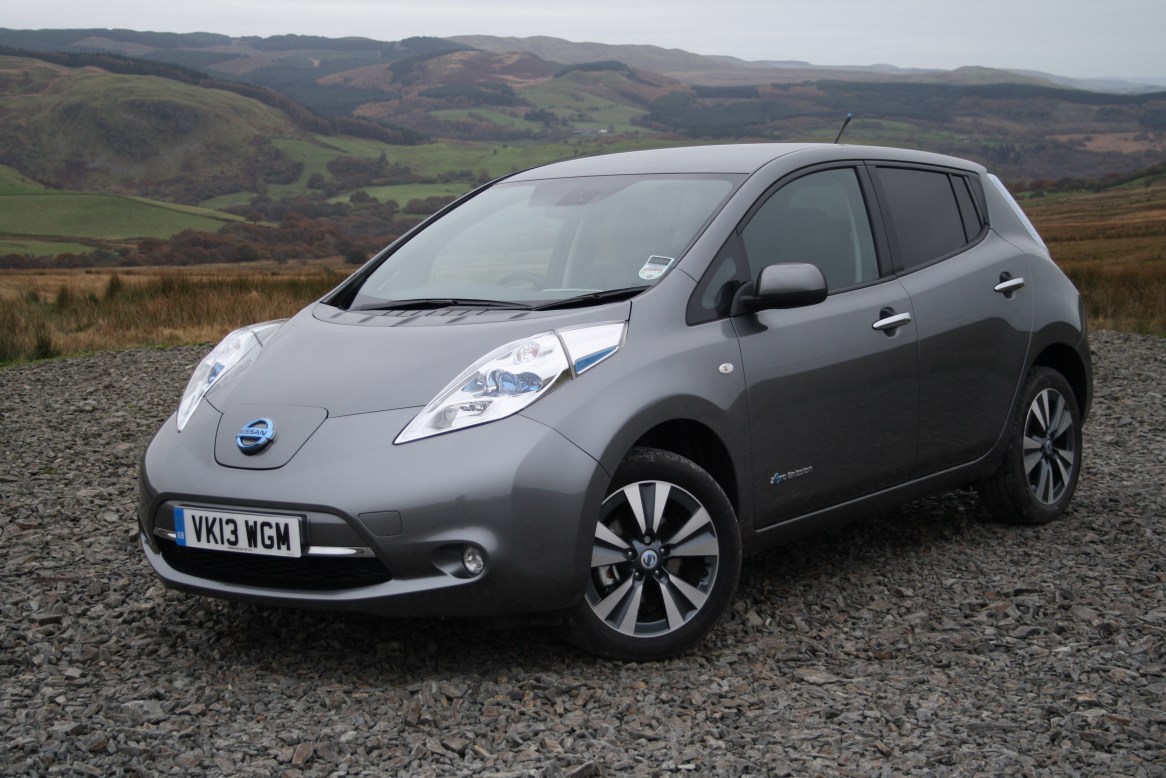
Nissan Leaf

Actually bloomin’ good

I was absolutely amazed at how quickly I got used to it. The car had clearly been very well thought out and the comfortable ride was something I really didn’t expect from a Japanese car. Well, a modern car to be honest. Most are hopeless. But I found myself soon loving the seamless power delivery, the ease of driving around town and how relaxing and pleasant it was on the open road. Sure, it’s not engaging in the way a 2CV is, but it was quick, efficient and so simple.

Sure, it wasn’t all good. The automatic wipers were hopeless and the clever reversing camera – with four cameras all-around the car to give a view akin to Grand Theft Auto – was only good until the lenses got dirty. Minor switchgear was carelessly placed too. There’s that range too. When I needed to get to Birmingham and back, I was forced to use a petrol-powered car. It was the only realistic option.

A nice gimmick, until the lenses get dirty

A nice gimmick, until the lenses get dirty

But I don’t drive to Birmingham and back everyday. For pottering (or even blasting) around my local area, it was ideal. I was genuinely sad to see it go. I love quirky cars, and they don’t get much quirkier than one without a conventional engine. I was astonished at how competent, comfortable and enjoyable it was to drive. Even with its range limitations, it did feel like a car I’d be very happy to own.

Nissan has been working to address other concerns too. Battery life is the elephant in the room for electric cars, but you can now lease the batteries, so they’ll be replaced if their efficiency drops below a certain level. No-one really knows how long that will take, but the new breed of fast chargers will certainly eat into battery life. Trickle-charging overnight is still best.

And I found that no problem. I’m fortunate to have a private driveway and a power socket within easy reach of the car. A full charge cost me a few quid and got the car 70-ish miles. Of course there is no fuel duty to pay, no road tax (it’s free) and servicing should be cheaper too (every 18,000 miles). Sure, there are concerns about the capacity of the grid to supply enough power for electric cars, and other environmental concerns too – where does the electricity come from and what about the chemicals in those batteries? For sure, the electric car is not the absolute answer to environmentalists’ concerns.

But the Leaf does feel like an answer. Sure, it’s not perfect but it is a really nice car with genuine benefits. It is the first British mass-produced electric car and perhaps the first electric car that can be taken seriously.

What I really love though is that other manufacturers have joined the race to go electric. Hybrids have been around for a while, but the latest breed use petrol engines purely as generators. Some still use battery power to boost performance and efficiency – like a Formula One racing car. Others use the petrol engine purely to extend the range as battery power drops – the BMW i3 being a key example of this.

For the first time in decades, the new car market is awash with variety and I’m starting to take interest again. It raises some very interesting questions about the classics of the future and I feel genuine excitement about where the future will take us. Electric cars make more sense than they ever have done. Will they start to take over from petrol? Only time will tell.

Perhaps I’m not a petrolhead after all

A bold statement but after spending a week with an electric car (reviews of which will appear at a later date) I’ve been very, very surprised that I can enjoy a car with no engine.

An enjoyable car, with no engine...

An enjoyable car, with no engine…

To those who don’t understand such matters, perhaps that isn’t such a shock. I know that some people, including my good lady wife, just can’t really comprehend why the firing of a certain number of cylinder is preferable to a slightly different number of cylinders. You either ‘get’ engines or you don’t. Naturally, I do. Whether it’s a screaming V8 dragster or the lusty grumble of a truck-size turbo diesel, I love the way that an internal combustion engine provides fitting sounds while it works. Just starting a vehicle feels like actually bringing it to life. Turning the ignition key of my Citroen 2CV really does feel like grabbing a lead and shouting ‘walkies’ to your favourite pooch. Though of late, it often seems that the 2CV looks at the weather and decides that going out is a bad idea.

But, I found myself clocking up 300 miles in a Nissan Leaf and really enjoying myself as I did it. For all their benefits, internal combustion engines have many downsides. I love torque. Most petrol engines (this side of a meaty, fuel-slurping V8) don’t have any. So, you have to rag them silly. Quite enjoyable in a 2CV or Sirion, but about as relaxing as hosting a children’s party, with E-number loaded jelly.

Diesels aren’t much better. Oodles of torque yes, but accessing it isn’t always fun.  Non-turbo diesels have linear power delivery, but not very much of it. Turbo diesels just don’t work. No, I’m right. They don’t. They’re almost always laggy and even with modern diesels, if you catch them off-boost, they display all the pace of Stonehenge. These days, they’re absolutely loaded with emissions kit and are highly stressed so things go wrong. Especially when you load them with Dual Mass Flywheels and Exhaust Gas Recirculation valves.

With the above in mind, perhaps it’s not so unusual that I found the power delivery of an electric motor really rather wonderful. Press the throttle and the response is, er, electric. Instant power, instant torque.

Transmissions are another problem. I like manuals, but there are times where a self-shifter is nice. The problem is, there isn’t an automatic out there that doesn’t get it wrong from time to time. Modern autos in particular are far too keen to kickdown, sometimes through several of their up-to-eight ratios. This leaves us trying to relax at kiddie party time again. Autos with manual control are no better because if I’m having to think about what gear to be in, I might as well just get a manual and enjoy better fuel economy. An electric motor effectively has no gears. There’s forward and there’s the other way. It took all of about five minutes for me to forget about gears. They suddenly seem rather quaint and old-fashioned.

It seems to have taken far too long for electric cars to get good, but they now seem to have done just that. Sure, range is still an issue but only for longer trips. I’m sure the batteries are not very environmentally friendly to make either, but sucking oil out of the ground didn’t seem all that friendly to Mother Nature the last time I looked, and where does all that platinum come from to make ‘green’ catalytic converters?

Now, my only problem is that, given the state of my fleet, I’m going to have to wait for 15-20 years for electric cars to fall within my price range/interest level. By which time the batteries will probably be junk and hydrogen fuel cells will have taken over. Oh well. The price I pay for being dangerously old-fashioned I guess. S’pose I could always consider converting the 2CV…

Daihatsu Sirion: 1500-mile review

In a month of ownership, the Sirion has been busy, clocking up 1500 miles. So, how is it getting on?

Sirion

Am I bored yet?

The answer is remarkably well. It is proving to be the ultimate cheap motor. £370 paid and so far all it has needed is a bit of engine oil for topping up and a set of wiper blades. It seems to be delivering between 43 and 52mpg, which is all the more remarkable when you consider that I have found a fuel leak in the filler pipe – or it might be an overflow pipe. Either way, not filling the tank fully solves the problem for now!

There are inevitably downsides though. The crashy ride is far from joyous, the steering is still too light by far and the driving position is still not ideal. Fortunately, it remains great fun to drive and eats up miles very merrily, even if comfort is a bit lacking. It does seem to burn a bit of oil but the oil control rings apparently get gummed up, often at 70,000 miles. It has covered 71,300. I may try an engine flush at the next oil change to see if that improves things.

Really though, the Sirion proves what insane bargains are out there – and that buying a cosmetically-challenged-but-sound car can be a risk worth taking as long as the mechanicals are healthy. The Sirion certainly does look much better now most of the graphics are gone and I’m confident that if I felt the need, I could sell it for more than I paid for it. I wonder if that theory will get tested?

Sirion arty

Not always comfortable, but huge fun!


A weekend with an MG RV8

Ten years ago (and a few months) I’d reached the age of 25. This meant I could do a lot of new things. Like hiring a really nice car!

A non-hairy me and a V8 powered mean machine

Thanks to The Open Road near Stratford Upon Avon, I was able to swap the 29bhp of my 2CV for 190bhp of glorious V8. This was before I even considered getting employed as a classic car writer, so it really was a dream opportunity. I seem to recall we covered 200 miles in one day alone, and that we seemed to make a lot of visits to petrol stations.

Every village was an opportunity to burble through at 30mph, before burying the throttle as the National Speed Limit signs appeared to enjoy the tantilising soundtrack of an eager V8, and the shove in the back as the car dashed towards the horizon. Addictive stuff. Even my new girlfriend enjoyed it. She’s now my wife.

The car wasn’t a keeper, but the smiley lady was!

If anything, I spent too much time with the car – long enough for the horrifically poor ride to become very tedious indeed, and for the nasty plastics of the interior to really get on my nerves. I wasn’t that upset to swap the keys and return to the delights of my little Tin nail. My passenger for the day I found rather more enjoyable on a long-term basis, so I married her.

The biggest problem with this day is that I decided I couldn’t live without a V8 in my life, but I wanted rather more comfort. So I bought a Rover 3500 and discovered a new world of pain and pleasure

Sirion: Good distance vehicle?

On the face of it, a 989cc, three-cylinder city car is going to be pretty hopeless on a long distance trip. Happily, having just driven the Daihatsu Sirion to Sussex, I can confirm that it’s really not too bad.

Sirion suffers ‘considerable’ stress from Skittles-box storm damage

As you can see, the ‘Yellow Peril’ wording on the bonnet has been entirely removed now – a concession forced by my other half. I really couldn’t complain, especially as my good lady would have to share the driving on our lengthy cross-country drive.

The drive itself was quite pleasurable until we hit flooding in Sussex. In the dark. An 80mph run along the M4 hurt the economy a bit – it dropped to 43mpg – but that’s still considerably better than most cars I’ve owned. The only issue was comfort. Neither of us could really get the seat in a position that didn’t leave our right leg hurting. Quite frustrating as otherwise the car is quiet and well mannered. Rachel didn’t like the over-light power steering at motorway speeds but the air conditioning kept us from steaming up without cooking.

We’ll try to take the drive home a little steadier and perhaps I can get it back up to the dizzy heights of 49mpg. Here’s hoping!

Resisting the urge. Almost succeeding

Yes, there’s no fun in just having money sitting around, so like millionaire businessmen around the globe, I’m going to invest my vast wealth in a motor car.

I spent yesterday trawling around the local countryside for objects of desire. A Fiat Panda was explored, poked and rejected.

Panda fails to excite

Panda fails to excite

I’ve always liked Pandas, but this one just didn’t win me other. It’s hard to say whether it was the colour, the dirt or the ruddy great holes in the rear wheelarches and the fact it wouldn’t start, but I decided to look elsewhere. Then I had a look at a local City Rover. It had to be done. Surely the City Rover isn’t as bad as everyone says? Er, sadly, it is. While within it beats the heart of a willing and sprightly motor vehicle, the shoddiest interior plastics made me really quite depressed. Why? Because four money grabbing venture capitalists temporarily distracted themselves from creating lovely pension schemes for themselves and thought that rebadging a cheap, Indian-built hatchback was the way to save MG Rover back in 2003.

I found the car quite charming in some ways. The Peugeot four-cylinder engine delivers a good turn of speed, the handling is nice and the ride firm but not unacceptable. I’m very glad I wasn’t a dealer trying to sell one of these new though. The electric window switch fell apart in my hand, I almost cut myself on sharp edges and the bonnet release had all the structural integrity of mist. It was an interesting experience, but I don’t think it’s a car I’d want to own. Especially as the airbag warning light was on and the bonnet seemed to be rusting. The boot also smelt of Morris Marina. That’s ok on a Morris Marina. It’s not ok on a seven-year old car.

So, I got back to scouring Ebay and the classifieds, honing in on the sort of car I wanted. I got tempted by Ford Pumas, but managed to refrain from bidding on one. In fact, several cars including a Perodua Kelisa and a Rover 75 took turns to top my watch list before ending with no bids lodged by myself. I was frankly astonished at my newly-found powers of restraint.

In fact, so impressive are these powers that I’m leaping on a train tomorrow to view a car and may then buy it. I haven’t actually gone ahead with a blind purchase and am trying to tell myself that if there’s something I don’t like about it, I’ll just come home on the train.

I’ll give no further clues for now. You’ll just have to stay tuned. All I will say is that I’ve never owned anything made by this manufacturer before and that sadly, you cannot buy anything from this manufacturer new. It’ll be a tribute to the many names consigned to history in the name of motoring progress. A colourful tribute…

A sports car I DO like

Not all that long ago, I repeated my assertion that I dislike sports cars. Generally, this is true but, just as you may have thought you were certain you didn’t like the ginger one in Girls Aloud, every now and then you’re reminded that your previous certainty may have been slightly suspect.

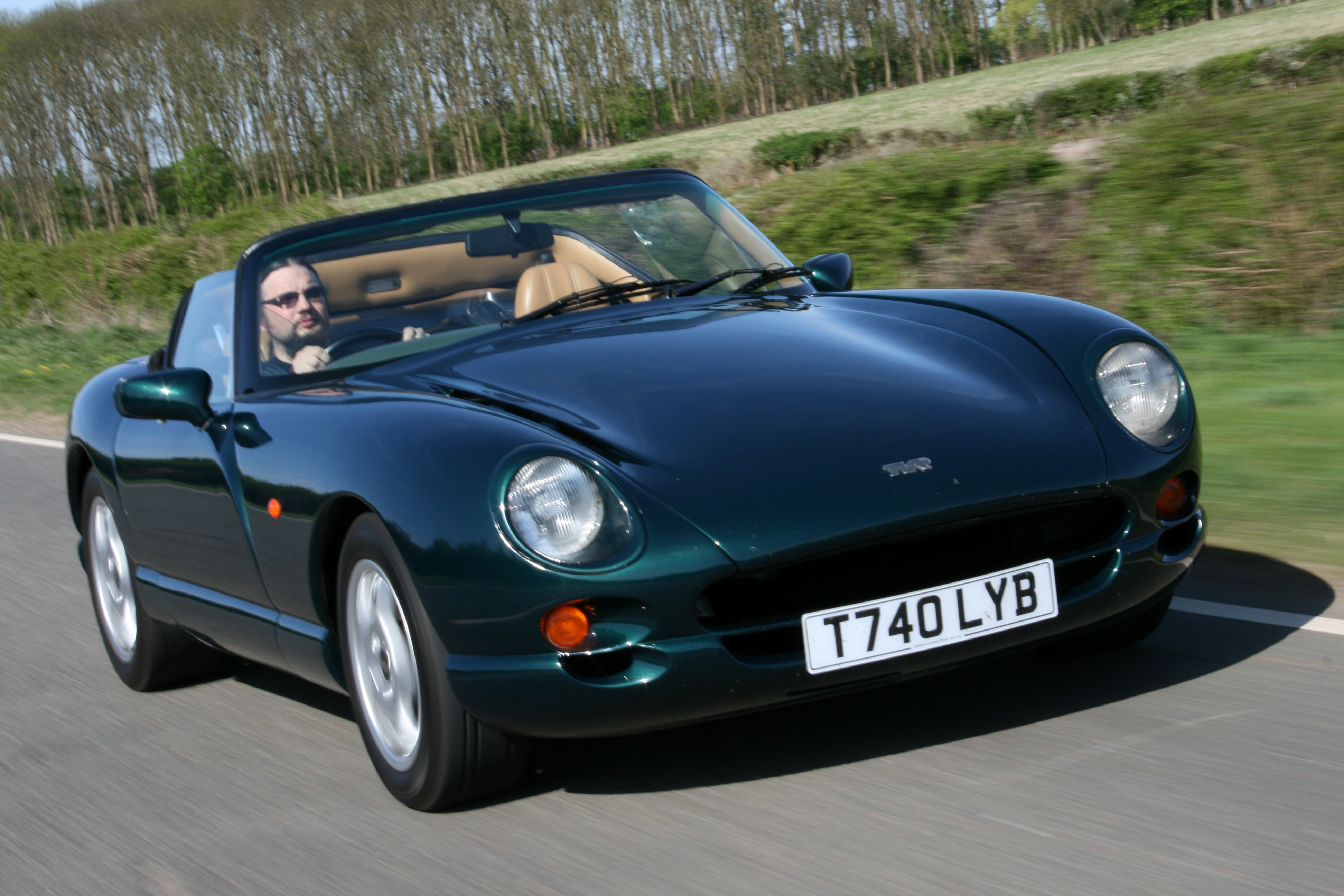
The ginger-one-in-Girls-Aloud carwise for me is the TVR Chimaera. It’s everything I dislike about sports cars. It’s a proper pose-mobile, it’s stupendously, unnecessarily quick and clambering aboard is like trying to get into one of those mummy-style sleeping bags without undoing the zip. But Peter Wheeler, who was TVR’s boss when the Chimaera was current, was a savvy old player. He even managed to build a sports car that people who don’t like sports cars want to own.

TVR Chimaera

I hate sports cars. See how unhappy I look

Look at the picture above,  taken in 2010. I’m trying to look grumpy because I hate sports cars. The problem is, I was having a whale of a time. I enjoyed temporary ownership of this TVR for 24 hours and every time I tried to clamber out of it to do the normal sorts of things like eat and sleep, I just wanted to get back in and listen to that thundering V8 a little bit more. The swooping lines are delicious. The hand-crafted interior is just lovely. The fact you press a switch under the mirror (Citroen CX mirrors no less) to open the doors is stupidly, boyishly silly. Grown men love that.

TVR interior

A bold colour choice, but I love it

Every element of this car makes you feel special. Yet under the skin, it’s simplicity itself. Electrical annoyances are very few and far between. No traction control, no airbags, just a powerful engine and a well-sorted chassis. It’s the engine that astonishes though. I can only assume that the noise and the acceleration invoke some of the excitement of being chased by an angry lion. It’s stupidly addictive. In the same way as poking a sleeping lion with a stick. You think ‘life is interesting enough. I can just potter through life and enjoy simple pleasures.’ But the desire to pick up that stick soon resurfaces, and you find yourself screaming towards the horizon at a slightly-terrifying rate of knots once more.

Annoyingly, a TVR Chimaera 450 gets from 0-60mph in just 4.6 seconds, so actually exploiting its 285bhp on public roads can be intensely frustrating. I had a lot of fun, but I didn’t get anywhere near its 158mph top speed. Which does reinforce my initial hatred of sports cars – it’s very hard to enjoy them to their full potential. I considered this dilemma when I returned home and parked the TVR in front of my Citroen 2CV, brown Renault 21 and ‘colourful’ Bedford CF camper.

TVR was fun, but so were these old clunkers

TVR was fun, but so were these old clunkers

The next day, I returned the fearsome TVR to a dealer and reclaimed my 71bhp Citroen BX diesel. I must admit, it did feel a bit slow, but it was like donning a pair of slippers after a long day on your feet in horrible, posh shoes. Rather lovely actually, and very comfortable. I had a lot of fun in that TVR, but I’m still not sure I’d actually want to own one. I’m convinced that at some point, the lion would catch me up, and I’d become dinner.


Disco comes to grief

It’s quite easy to get a bit blasé about greenlaning. I’ve been doing it for years, and have been proud of the fact that I’ve never got stuck and have generally avoided any damage to my car at all. That changed last night.

We were tackling a tricky lane in Nant-y-Moch, one which will be closed in a few days time for tree felling. Me and a friend thought we’d get in before the chop so to speak. It’s a lane we both know well, and one which I’ve travelled down twice in the past couple of months, with no drama at all. Going up the lane is much more difficult, but I’d successfully done so in the Maverick last year, albeit it was very much a challenge that required several attempts.

I got through what I thought was the tricky section with no problems. Easy! It’s all about momentum – going as slowly as possible, but quickly enough to keep moving. Then the lane began to tilt the Discovery onto its side. One side of the lane had been washed out very badly, and I mis-judged just how bad things were. The front end began to slide into the bank and the rear followed. I eased back and forth, but there was no escape. I was lodged firmly against the bank. My options were to attempt recovery or risk much damage.

Ouch! Firmly stuck, and a bit bent

Ouch! Firmly stuck, and a bit bent

With the front indicator housing already snapped off its mountings, recovery seemed the sensible option. I could drive forward to free the front end from the bank, but was powerless to do the same with the rear. My friend in his Defender was deployed and a short, sharp tug pulled the back end away. I could then reverse down the lane to ponder our next move and repair damage!

Putting it back together

Putting it back together

We used string to hold the indicator housing in place. I think superglue should mend it longer term. That wasn’t the only damage though.

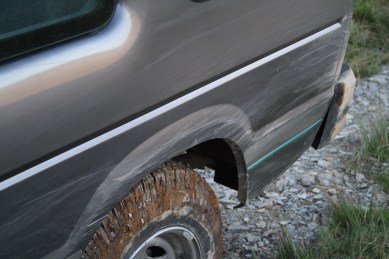
Oh dear. Paint took a beating

Oh dear. Paint took a beating

The entire side is now littered with scratch marks, some of them quite deep. Fortunately, the Discovery’s side panels are aluminium, so corrosion is not a problem. I’ll have to see what I can do about tidying it up a bit.

My friend then set about getting even more stuck than I had managed, so the rest of our adventure involved trying to free his Defender – a fine education in how to use a hi-lift jack and the importance of having a shovel. With his car free and light fading, we opted to abort our adventure. We’d got all of about half a mile into the lane! Our local laning group is already plotting repairs to this lane, so hopefully when it reopens in 2014, it’ll be in far better shape.

But for me, I’m now rethinking the future of the Discovery. My initial plan was one of preservation, keeping the Disco as original as possible. Now I’ve damaged it and also realised how poor a standard Discovery is when it comes to recovery points, I’m considering a change of direction. Is it time to make with the modifications? Do I really want a vehicle that looks more aggressive? It’s perhaps time to answer those questions.