Merc gets welded, Disco clutch fails

Sorry for the lack of Blogs. I got all of a grump last week, mainly because I was fed up with my increasingly-broken fleet.

I’ve been feeling a bit more positive this week lately though, with some improvements to the fleet, and some problems…

First of all, the Merc got welded up and I then overhauled the rear brakes. Thankfully, I’d caught the rot before it got too bad, so my mate Dave made busy with his welder and made it all solid again.

Merc gets welded

Merc gets welded

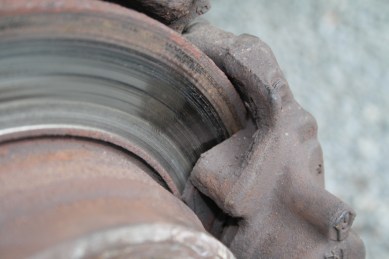
Both rear subframe mountings were repaired and there was a bit more work needed to the rear of the nearside wheelarch too. With the car solid again, I set about fitting new rear discs, pads, flexi-hoses and one caliper. It no longer makes horrible scraping noises and the brake pedal feels a bit better.

With that success chalked up, I got my mate to grind off the rearmost fixing nut on the 2CV. The thread it attaches too was just spinning as it was no longer captive. That was very much a short-term measure and I’m hoping to get it back to Dave so I can get a new thread welded into place. She’ll be attending the Capel Bangor Show this weekend, so folk are just going to have to cope with her looking absolutely dreadful.

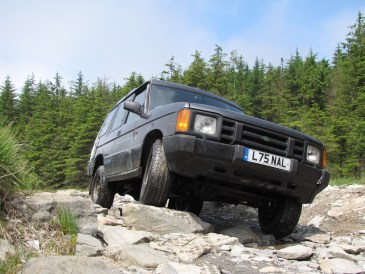
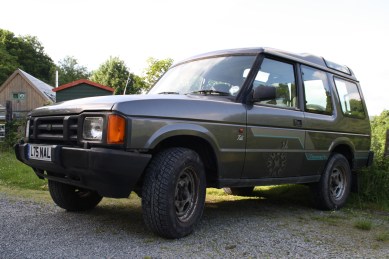
Then I thought it might be nice to do a little greenlaning in the Discovery. I always enjoy trekking around Nant-y-Moch and thought I’d tackle the ‘washout’ section. This can be pretty horrendous, but was fairly tame this time around. Repairs I and fellow West Wales Laning (now Wales and Wye Laning) members carried out last summer have held up well.

Doing lanes solo is a risky business, but one I mitigate by avoiding areas I know could easily lead to me getting stuck. That doesn’t rule out mechanical faults though – you are just in the lap of the gods for that. The gods were feeling a bit playful yesterday. When solo laning, gates are a pain as you have to stop, get out, open gate, get back in, drive forward a bit, get back out, close gate and get back in. At one gate-stop, the clutch suddenly started to feel a bit odd. After closing the gate, the Disco lurched forwards as I released the clutch, and then the clutch stopped releasing at all. I still stopped for some nice photos…

No clutch, but no worries. Yet...

No clutch, but no worries. Yet…

Progress on the lanes wasn’t too tricky. Staying in low range, I could pull away in first, second or third depending on what terrain lay ahead. If it was a steep descent, I had to stop, select low first and crawl down it. Some sections required the gentle pace of low second, while others were fine in low third. I just stopped to change gear, then started with it in gear. Jerky but no problem.

Roads were another matter entirely. It is possible to drive a manual car without a clutch, but it does require quite a lot of skill! The weak synchromesh on second gear didn’t help. Happily, I managed to get the 15 miles home without too much trauma. I then topped up the level and bled the slave cylinder. Success! However, I suspect the slave has failed and is allowing fluid to escape, so it’s only a temporary fix. A slave cylinder overhaul kit is on the way.

On the plus side, I think the oil leak has gone away. Use of blue sealant and actually tightening up the unions properly seems to have done the trick as it was rust-proofing the offside front corner of the chassis very merrily. Still plenty more to work on though…
I’ve got that failing feeling…

The theory behind owning several vehicles, is that at least one should be operational at any one time. It’s a great theory but once more, I find myself getting perilously close to having a fleet meltdown. This is not good.

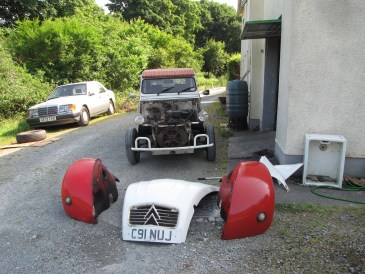
It was the 2CV’s turn today. I’d started stripping it for a much-needed brake overhaul, but then rather a lot of actual work got in the way. Rachel wanted to head out in it though, so during a lunch break, I attempted to get the front bodywork refitted again. It is not an easy job, for several reasons. One is that the rear fixing for the offside front wing is utterly ruined. The thread has come free and the nut cannot be removed. That’s a pain. Also, the wing – a pattern item – fits about as well as Bella Emberg (remember her?) in a schoolgirl’s leotard. Eventually though, I got the sodding thing fitted. The passenger side was much less bother. So, a quick light check and I could get back to work. Er, no. The driver’s side front indicator was not flashing. What usually happens here is that the contact on the back of the bulb, which can slide up and down a little tunnel, gets stuck. A quick, gentle tug on the wire usually frees it up. Not this time. The wire just came off in my hand.

A crap, old, worn-out car, yesterday

A crap, old, worn-out car, yesterday

If it was the other side, I could simply whip the wing off and chuck on one of my spares, which would probably work. Given how much trouble it is to remove and fit a wing to the driver’s side, I really can’t be doing with it. Removing the indicator unit is possible in theory, but small rusted nuts mean there’s more chance of the Queen dancing to Lady Gaga than it coming off without hassle. The 2CV got shoved back into the garage to await its fate.

The BX isn’t too bad, but needs an accumulator sphere, a rear arm bearing and the cooling fan wiring up properly. It’s on a switch, which is stupid as there’s no temperature gauge. How do you know if it’s getting too hot? Well, Citroen did kindly fit a warning light to tell you when your engine is cooked. Handy. Also, the clutch is horrible.

The Merc is out of bounds really, thanks to a seized rear caliper. It also needs critical welding.

I did think that left the Discovery as my sole working vehicle, but that’s far from perfect too. It pulls to one side under braking, suggesting a caliper issue, has play in a front swivel, still has no second gear synchromesh and is also still overdue a transfer box and axle oil change.

This is the problem with owning crap, old, worn-0ut cars. They’re crap, old and worn-out! Between them, the four vehicles have covered over 855,000 miles. Clearly, a new car isn’t the answer as I’m not made of money. I do think a fleet review is in order though, and perhaps I should entertain the notion of owning a car with less than 100,000 miles on the clock and a chunky folder of service history.

Why don’t I own anything old?

At the top of the page is a ClassicHub header, which the features the sidelight of a 1955 Austin A90 Westminster that I used to own back in 2010. It was a wonderful car – same engine as an Austin-Healey 100/6 in similar tune, thanks to twin-SU carburettors. It had no problem hurtling up the A1(M) on my commute to Peterborough at the legal speed limit – I used to love commuting in a 52-year old car. Sure, it regarded bends the same way I regard telemarketers – with absolute disdain – but it was great to roar about in.

What a lovely old thing the Westminster was

What a lovely old thing the Westminster was

It was with regret that I sold it to help fund our move to Wales. It was an extravagance that I could no longer afford. Not that it cost me a lot – it was very reliable needing nothing other than a service and some greasing. I paid £2200 for it, then sold it at action for £2050 just before we moved. That was a bit of a hasty panic as we’d bought the new house and needed to start moving vehicles over – one less would help a great deal!

Since then, the oldest vehicle I’ve owned is a 1975 Reliant Scimitar GTE – a proper ‘wish list’ car that left me slightly disappointed overall. Generally, since the move, everything I’ve owned has been post-1986. Yes, I know the 2CV is a pretty ancient design, but mine is still ‘only’ 27 years old. It’s a very-eighties paint scheme. Why don’t I own any proper old vehicles?

The oldest car I've owned since moving to Wales

The oldest car I’ve owned since moving to Wales

Cost is one reason. To get a decent example of a nice, older car – such as the Scimitar – I really need to spend c£2000.

Another reason is that I’d rather dabble in the world of retro-era classics – those less than 30 but more than 20 years old. After all, these were the cars that were brand new when I grew up, and that’s always been a large part of the appeal of classic cars. People want to hark back to carefree days. Not that I’m against older classics – they also played a part in my childhood and I remain incredibly fond of 1960s and 1970s stuff.

Cars of the 1980s have their advantages though. Generally, they’re well equipped and things work! There’s also fuel consumption. My Westminster could only dream of 27mpg at motorway speeds, but the much-faster Mercedes manages it with ease.

Still, I feel like a bit of a fraud at times. People ask me what I do and I reply that I write about classic cars. The natural first question is what do you own then? People seem a bit disappointed with Citroen BX, Land Rover Discovery and Mercedes-Benz W124 “the one from the eighties.” It isn’t that they aren’t good cars, they’re just not chrome-laden, classic-era icons that people can easily recall.

I’d like to do something about that, but it isn’t easy. The BX does many, many things very well and I’m struggling to think of one older car that can match it. Have a go yourself – it must do 50mpg, have a half-ton payload but also be able to carry five passengers in comfort. It must be able to tow a trailer and hurtle along motorways at decent speeds without causing your ears to bleed (the biggest problem with the 2CV).

Maybe I should buy a Triumph 2000 estate and lob a turbo diesel engine in it. If the Disco fails its MOT in September, maybe I’ll consider it…

Fettling the fleet – postponed

My wife, not content with scorchio weather in the UK, has headed to Spain, where it’s even hotter. “Ha!” thought I. “A chance to crack on with some car related chores!” I’ve been waiting for an ideal opportunity to give the 2CV a brake disc and pad change, but it always seems to find itself being used. It’s the only car that we’re both happy to drive. The poor 2CV also keeps finding itself dropped down the priority list – now the Mercedes has jumped the queue by wearing down one pair of pads to metal-scraping levels.

Added to that is the fact that my quiet week on my own has been anything but. It’s been quite hectic, with a lot of bus driving, a fair chunk of work and a foraging trip to collect a load of firewood.

This was a proper friend-of-a-friend tip – a chap who owned some woodland needed to get rid of some larch logs. They were not ideal for retail and were in the way, so he just wanted them gone. Free wood should never be declined and me and a friend have so far transported four loads to split between us.

Initially, we used the Discovery and my trailer. This was an ideal opportunity to test its towing prowess. With a recommended maximum towing weight of 3.5 tons, a half-ton trailer should be no bother at all. Well, it wasn’t quite that straight-forward. For a start, I think we may have overloaded the trailer a bit as it was weaving a fair bit. Secondly, a steep hill climb in baking heat made it lose quite a lot of oil – through two unions which should have rubber o-rings but in fact don’t. With the front axle and front section of the chassis soaked in oil, a substitution was needed.

So, my old Maverick got a run out! It had been offered by a friend to another friend as the second friend’s Mitsubishi Delica had become a bit broken. We didn’t load the trailer as heavily and the Maverick coped very well – I never really rated it as a tow vehicle, but it slogged away quite merrily.

The next day, I decided to use the BX as a secondary hauling vehicle. This is less ideal because using a car as a van makes a bloody great mess of it, but an estate is meant to be a working car, so that’s that.

BX estate turbo diesel

BX makes an excellent hauling machine

Ok. The BX may be working its way back into my good books. It moved a goodly amount of wood with little bother – that hydropneumatic, self-levelling suspension really is rather good at this sort of thing. Maybe, now we’ve got a good stock of wood, I can reward the BX by getting some of its issues resolved. After all, there’s a reason that I’ve owned BXs almost continuously for getting on for four years – they’re really rather good.

2CV gets a make-over

A really rubbish make-over. Like those women you occasionally see walking around who seem to be wearing enough foundation to coat a building.

Anyway. Back in April, I had some rust converter left over after another job, and decided to attack Elly’s front wing. I scraped the rust off, slapped a load of converter about and then did nothing else for ages. Until today. Now Elly’s appearing in Classic Car Weekly again, I decided she needed to look like I might actually care about her. Ultimately, she’ll have a new pair of front wings, but given budget and the mountain of jobs needed across the fleet, that isn’t going to happen any time soon.

So, I decided a quick rattle-can solution was in order. Eventually, I found my can of red primer, so I could begin. The wing came off, the indicators and mudflap were masked up (the mounting bolts are far too rusty to consider removing) and Operation Bodge began in earnest. Two coats of primer would probably be enough, and was about all the can could deliver anyway. I then rubbed down, cursing myself for not getting things smoother before I began. Where the rust had been, there was a LOT of bubbling. I decided this would be too time-consuming and tricky to sort out properly – this is Operation Bodge after all!

Nipping to Halfords this morning, I ended up guessing that Fiat’s Racing Red might be close to the 2CV red. It isn’t. It’s a bit dark really, though Elly’s other red bits have faded to pink quite badly, so for all I know, it might actually be a perfect match! I used two cans to deliver about two-and-a-half coats of paint. It looks pretty shabby, but it’s definitely better than it was!

2CV Dolly red and white

Elly is back to being a good twenty-footer…

I’m fairly pleased with the results and hopefully it’ll last long enough for me to sort out a proper solution.

Lovely bubbly

Lovely bubbly

The rust-affected areas were effectively left uncovered after treatment with Vactan Rust Converter back in April. I’m therefore impressed with the stuff as it did what it was meant to do. If I’d rubbed down the problem areas harder before treatment, I may have got a better overall result. As it is, the rust has definitely been banished for a goodly while – it’s not like we haven’t had the necessary moisture to cause corrosion!

Another little job I did was to change the flasher can relay. This is what makes the indicators indicate. The one fitted has been getting slower and slower, so I fitted a spare I had. They’re now spiffingly quick! Safer as well as more pleasing.


Strata Florida Disco Style

Strata Florida is a great greenlane, if not quite deserving of the praises often heaped upon it at the expense of other, local lanes. An invite from a friend saw me take to the lane with a bunch from the Nissan 4×4 Owners’ Club. My mate Franz had already defected from a (Nissan effectively) Ford Maverick to a Land Rover 90, and now I had followed suit moving from my Maverick to a Land Rover Discovery. However, despite the small-minded nature of some people, not everyone gets utterly blinkered by their own 4x4s and the day involved no petty ‘mine is better than yours’ banter at all. Refreshing.

Of the vehicle present – two Terranos, two Patrols and two Land Rovers – mine was probably the least well prepared. One of the Patrols was pretty much showroom, but did actually appear to have some grip on its tyres. My mis-matched all-terrains could be a struggle today.

And indeed, I almost got stuck within yards of the start of the lane. Strata Florida sees a lot of traffic, due to its iconic reputation, and things got tricky straight away. Not engaging the diff-lock didn’t help, but the Disco still scrambled its way over the obstacle. Just. An embarrassing situation was narrowly avoided.

Overall though, there were no problems other than the occasional loss of traction. Low first was ideal for crawling over rocks and at this, it was much more accomplished than my petrol Maverick. Diesels really are the way to go for a 4×4.  Through this tricky section, I reckoned that driving over the rocks was much safer than trying to straddle them and risk diff damage.

Low first allowed me to crawl over obstacles easily

Low first allowed me to crawl over obstacles easily

However, this low-speed work, over tricky ground, did highlight that at least one of the differentials has a fair degree of backlash in it. This means it clonks as the free-play allows too much movement. That’ll have to go on the To Do list. The Discovery also coped well with the fabled Strata Florida Bombhole.

A quick deviation is required here. I’ve had people express horror at tackling the bombhole before, as they considered it off-piste. For much of the Strata Florida lane, there is evidence of people just going off to the side of the track, making a huge mess. The Bombhole is not clear cut though. The important bit is that the Rights of Way department consider it the actual route. Treadlightly, which presents a responsible image to greenlaners, opted to sign-post people around the Bombhole. This is largely because the Bombhole can and does damage vehicles. Indeed, while my Discovery got away with clouting the substantial tow bar, the Nissans (excepting a much-modified Patrol) all picked up damage here. The greenlaning code of conduct does allow you to deviate from the path to avoid obstacles so Treadlightly recommends that people bypass the Bombhole unless they are sure they know what they are doing.

Anyway, the Disco got through and we continued along the lane, enjoying sunshine and some tricky sections. I spent most of the time in low second of the dual-range gearbox, with our speed rarely high enough to move the speedometer needle from its stop.

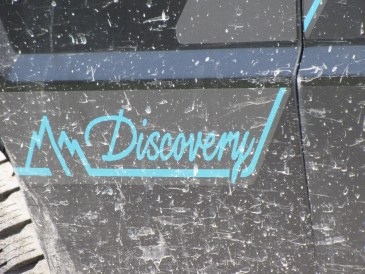
The graphics look better with mud

The graphics look better with mud

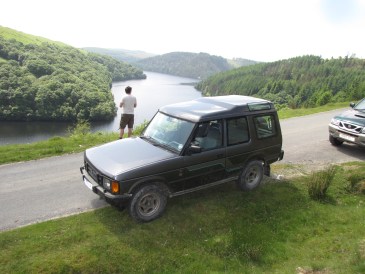
Everyone seemed to have enjoyed themselves, with some of the drivers very experienced, and others right at the novice level. That makes for a good day out, as you can swap advice. We then took to the sealed surfaces for a drive to Llyn Brianne. This is a man-made lake situated on the Tregaron to Abergwesyn mountain road. Incredibly, I had never been, despite it being less than an hour from home. What a place!

Pausing at Llyn Brianne after some grey laning

Pausing at Llyn Brianne after some grey laning

The views were truly jaw-dropping. After some serious gawping and a visit to the dam, we headed off to another favourite lane – Soar y Mynedd. More beautiful scenery, a tricky rock scramble and a few scary side-angles meant fun was never far away, and care had to be taken.

Overall, it was a great day out on the lanes and I’m looking forward to my next outing. The Discovery is firmly in the good books, though I do have an oil leak to try and sort out – oil is seeping from the connectors to the oil cooler in the new radiator. New seals required I think.


Disco – gearbox fettling

The second gear synchromesh on the Discovery’s gearbox is very worn. Synchromesh is magic stuff that acts just before you engage a gear, to bring the relevent cogs up to the required speed for a crunch-free change. In the old days, you used to have to try and do this yourself by double-declutching. I’ve been having to do that in the Discovery as the gearbox is shagged – that’s a technical term.

At 179,000 miles, perhaps that’s not surprising. Especially when you consider that the LT77 transmission used in the Discovery was actually developed for the Rover SD1 and Triumph TR7 – both launched in 1975. Yup, yet another component ‘borrowed’ from elsewhere on this marvellous parts-bin special. When people started having gearbox issues, even when these units were young, Rover changed the recommendation to automatic transmission fluid. I opted to use modern, synthetic Dextron III transmission fluid thinking that perhaps a posh fluid might improve the gearchange situation. Gearboxes are very sensitive to the right fluid – too thick and the synchromesh just won’t work at all.

Annoyingly, I had to borrow an enormous 32mm spanner from a neighbour to get the huge sump plug undone. Before I did this, I did of course ensure that I could undo the filler plug – a 13mm spanner handled this. Once the main part of the gearbox had drained, I undid the plug on the extension piece. I don’t know much about the construction of these gearboxes, but this is apparently where fifth gear lives. It is NOT the transfer box – that’s yet another box of cogs. The extension drain plug has a filter above it which needs to be removed and cleared out. This was done.

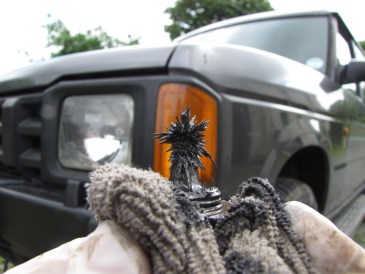
The stupidly huge sump plug on the other hand has a magnet in it. This is what it looked like when I removed it.

Land Rover gearbox plug

Sauron – Lord of the Synchro Rings

That’s a LOT of metal filings. You always expect a few – every time you crunch the gears, you’re chipping bits off the teeth – but this seemed quite bad. Not that surprising when you consider that the previous owner just crunched into second gear every time. I at least try to avoid a crunch by double-declutching.

With the plugs back in, I could refill the gearbox with my lovely new fluid. I used a pump with a long tube on it to get the fluid in, as there’s no way you can get a bottle high enough to fill it directly. Internet research before the job definitely paid off! Once the new fluid was in, I could head for a drive. There was a definite improvement. If I take it easy, I can now change from first to second without a crunch, even when the gearbox is cold. Third to second is still a bit of an issue though, so the problem has not entirely gone away – not that I really thought it entirely would.

While out on the test drive, I stopped off at a friend’s house and he helped me remove the side steps. I should have done this sooner really as it is now MUCH easier to crawl beneath the vehicle!

Discovery 3-door

Steps begone! A vast improvement

I think it looks much better without them. The steps had near enough rotted away anyway and they massively compromise off-road ability. The break-over angle is now much higher. I also hated the way that the sill, which actually sweeps up slightly towards the front wheelarch, left an ungainly gap because the side steps were entirely flat.

I also filled up the Disco the other day. It was reading just below a half on the gauge, but it’s a big old tank! I still got over £60 worth of fuel in, which allowed me to calculate that it has delivered 28mpg so far. That’s not bad at all for a mix of motorway, local roads, greenlaning and tinkering where the engine was left running for long periods.

Next up for the Discovery is a rather more challenging greenlane run this Saturday – the fabled Strata Florida.


Manky Mercedes Malarky

Selling the Mercedes has proved about as easy as taking to the air in the proverbial lead balloon. It’s hopeless. No-one wants it.

Their loss I’ve decided. Now its running sweetly, it’s much nicer to drive and I’ll happily pay at the fuel pumps when the car costs so little to run otherwise. But what’s that scraping noise from the rear? Sounds suspiciously like a brake pad with no material left on it. You ignore braking issues at your peril, so I decided to investigate. I started with the driver’s side, because that was nearer my garage. With the wheel removed, I could see plenty of material left on the pads. Super! Then I started picking at the underneal around the subframe mounting. This was a mistake as there was very little metal behind it!

Bugger. Mercedes suffers rear subframe mounting rot

Bugger. Mercedes suffers rear subframe mounting rot

Not as bad as it could be – I’ve seen some where there’s no metal left at all – but it needs attention. The plasticky underseal that Mercedes-Benz used is really good stuff, but if it gets breached, moisture gets in and then gets held against the metal behind it. Thankfully, this corrosion seems very localised and plans are afoot to get it welded.

So, it was on to the other side, where I soon discovered a very similar bit of corrosion, plus a bit more into the boot area. Two small patches should have it healthy again. Oh, why was I doing this again? That’s it brakes. Ah, I think I see the problem…

Merc brakes

Cripes! No pad material left here

That’ll be the problem then. You can just about see that the backing plate of the pad is all that’s left and is now rubbing on the disc – hence the scraping sound. With such uneven wear from one side to the other, it suggests that this caliper has seized, and is not releasing the pads when the brake pedal is released. It can’t be a handbrake issue as that operates a set of drums housed inside the brake disc. Not very well as it happens, so that’ll get looked at as well.

So, as a bare minimum, it needs a set of pads and discs and a reconditioned caliper on one side – probably an expenditure of £150 or so. I should really change the aged looking flexi-hoses too, and it might well need a set of handbrake shoes. I haven’t even looked at the front brakes yet! I’ve also found many tired looking bushes in the back end, but if I’m not careful, this could turn into a very expensive mechanical overhaul.

I can’t drive the car while the brakes are so perilous, and annoyingly, I can’t order the parts I need due to a lack of funds. Frustrating, especially as the car is now running better than it ever has done!


A busy BX weekend

I’ve rather fallen out of love with the BX, but the weekend just gone was a chance for it to redeem itself. I was attending 2CVGB’s Registers’ Weekend in Cambridgeshire, where I hoped to convert a spare 2CV gearbox and a pair of front wings into cash – or at least get them out of my garage in the case of the quite seriously broken gearbox.

Fitting those things and the camping gear into the 2CV would have been ambitious and knowing we needed to cover mileage at speed, Elly the Tin Snail was in for a quiet weekend. The BX was loaded up and off we headed. After two hours, we finally reached some motorway and could get the hoof down. Being able to travel at motorway speeds so swiftly and with sound levels so acceptable is always nice. It’s not as serene as the Mercedes, but compared to the 2CV, it’s like wearing ear defenders.

Citroens

BX one of quite a few ‘others’ at 2CVGB Registers’ Day

Naturally, it barely noticed the weight in the back with the self-levelling suspension being an absolute boon in these circumstances. It is starting to feel its many (307,700) miles though. The clutch is stiff, the engine mountings are worn, the engine is increasingly down on power (and horribly smokey) and the ride isn’t as good as it should be, even with new spheres.

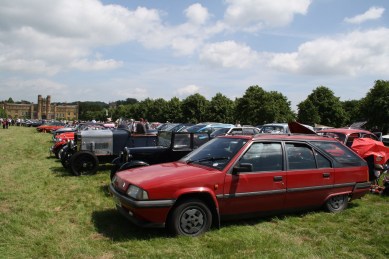
Still, we headed cross-country on the Sunday, taking in the excellent All-Rover Rally at Coughton Court in Warwickshire.

Allowed to park in the classic section at the All Rover Rally

Allowed to park in the classic section at the All Rover Rally

I was thrilled at being allowed to park in the ‘other’ section. We were pretty much the last to be allowed into this section – a Lamborghini Jarama and Ferrari 308 had to park in the overflow bit! It’s hard to say the BX isn’t old enough when there was a good selection of Rover 800s and absolute masses of 75s.

All too soon we were on the road again and gladly arrived back home on the Sunday evening. We’d covered about 400 miles in a car that is far from top health. I’m really not sure what the future is for this car. It needs an enthusiast with more time, money and inclination than myself to give it a proper sorting out. As it is, dare I say it but I’m actually feeling a bit bored with BXs. I’ve enjoyed the past four years of returning to them (after the odd flirtation since I was 19) but as ever, there are plenty of other vehicles I’m keen to own.

The problem is that running a BX every day is becoming harder as the remaining cars get older. They’re good at repelling rust compared to some rivals, but that doesn’t mean they’re immune. Keeping one going requires a dedication that I just can’t spare at the moment. My enthusiasm gets eaten up by my 2CV and latterly the Land Rover Discovery.

So, I think it’s definitely time to sell the BX (and the Mercedes hopefully) and once that’s done, give some thought to what could replace it. How to find that car that does all the dull, dependable things so well, but isn’t so dull that driving it makes me cry!


Mercedes – MOT time (again)

One thing I love about owning a Mercedes-Benz is the fact that those two companies – which merged in 1926 – are the two oldest manufacturers of motor vehicles in the world. Karl Benz and Gottlieb Daimler (who used the Mercedes name belonging to the daughter of one of his backers, Emil Jellinek) simultaneously developed their first cars – the first cars in the world. Benz got there first, just, in 1885 – the same year that Daimler built a motorbike. Daimler built a petrol-powered stagecoach the following year.

It’s a staggering history, unmatched by any other car manufacturer. Once the two companies merged, the Daimler-Benz organisation (now selling cars as Mercedes-Benz) fast gained a reputation for top drawer engineering.

Despite this reputation, I was still approaching today’s MOT test with some trepidation. After all, I’ve owned this car for a mere fortnight and have not seen the underside of it at all really, other than a quick inspection of the sills and front suspension mounting area when I bought it. 128 years of history was going to be little comfort if the underside had the structural integrity of a doily.

I needn’t have worried. The car didn’t disappoint and while on the inspector’s ramp, I could see that bar a couple of spots of light corrosion, there’s plenty of life in the old girl just yet. There were advisories for the surface rust, rusty fuel lines (still bone dry thankfully), a faulty fog light switch (it does work, sort of) and a wheel bearing with a hint of play in it. Phew. The gamble that was buying this car appears to have paid off. Jobs to do – but none of them too horrendous I hope, and I’ve now got plenty of time to get on with them. Or would have if work wasn’t quite so busy. Not that I’m complaining…

I’m not sure the Merc is going to be a keeper though. Don’t get me wrong, I really like it and have no plans to sell it just yet, but it doesn’t have the feel of a car that is going to win me over. One day, the lure of that smooth six-cylinder engine will be offset by the 24mpg it appears to be returning (which isn’t too bad to be honest). Fuel economy is not why I bought this car though. I wanted something effortless to waft around in. It does that very well. There’s just one problem. It’s not as comfortable as a Citroën BX!

I thought it might just be me but no, my wife agrees. The seats are ok, but the ride jiggles in a way that hydraulic Citroëns so marvellously don’t. It’s a reminder that the BX manages that comfy, big car feel in a package that isn’t unreasonably large. If only you could get a V6 BX. That would be an amazing machine.

In the meantime, the noise is something to enjoy – and now you can too with this snippet of video.