BMW Z3 – did I like it?

BMWs attract a bad press generally, and the people who like them are often considered of very bad judgement: People who love themselves and want to show the world how great they are by cruising around in an ‘enthusiasts’ motor car, not white good trash built for plebs. I’ve been one of the detractors for many years, though I was still alarmed to get accused of onanism on one occasion while overtaking a ‘classic’ Mini in a BMW E39 saloon. It wasn’t even mine and we owned a Mini at the time! At least, I think that’s what he was signalling. It definitely wasn’t ‘turning left.’

The annoying thing is though, BMWs often ARE really good cars, built for enthusiasts – though they do seem to produce feeble versions for the wannabe pleb-types. I always thought the four-cylinder Z3 roadster was such a vehicle. Surely the real enthusiast absolutely has to choose the sonorous, powerful six-pot version?

Apparently not. Because I drove this, and I liked it.

Annoyingly good

Annoyingly good

It’s a 1.9-litre, four-pot and the first Z3 I ever drove. (that’s not me at the wheel, this was only a couple of years ago). I jumped into it assuming I’d hate it. From the moment of its launch, it seemed to be a car that screamed ‘smug’ at the top of its voice. Even worse, James Bond abandoned his Aston for one in the film Goldeneye. I’m not sure I’ve got over that to be honest. It was a low moment for the Bond franchise. I’m not actually that bothered that all Z3s were actually built in South Carolina in the USA. Judging by this one, they did a decent enough job of screwing them together.

The quality was certainly the first impression. The way the doors shut, the interior plastics and the lack of rattles on the move all give a feeling of quality that you certainly don’t get in say an MGF, the sunvisors for which were stolen from Fisher-Price. The engine is punchy enough too for public roads, allowing you to build speed rapidly, with a nice exhaust note, without attracting the attentions of The Law. What really staggered me was the handling though. I thought I’d chuck it about a bit to see how good the grip was, but only managed to upset my internal organs.

Not rubbish

Not rubbish

I clambered out of it feeling like I’d had an absolute hoot. The same day, I drove an MGF and found it entertaining if flimsy, and an Audi TT Roadster which was about as exciting as a four-hour lecture on envelopes. The Audi went so far as to be a disappointment. It was so typically a German car. It worked so hard to be good that it ended up being dull. The sort of extrovert that you hide from at parties before they crack another ‘hilarious’ joke and try to get the pretty girls to drink too much.

This makes it all the more extraordinary that the BMW delivered. It manages to be good without losing sight of the need to be able to go ‘wheee!” as you zoom down the road. My short road test of the Z3 just left me wanting more. On paper, that’s not very surprising perhaps. It’s so like me to favour a lesser-powered version. Maybe I need to savour a six-pot to see whether less is more. What is surprising though is that this is far from the first BMW that has left me realising that behind the much-derided badge, is a series of very impressive cars.

Why I adore the Jowett Javelin

As Great Britain recovered from the ravages of the Second World War, its car manufacturers faces a huge battle to restart production. Some new models arrived – notably the Armstrong Siddeley Lancaster and Hurricane as early as 1945 – but generally most companies hastily relaunched their pre-war ranges. Progress was slow to arrive, so Jowett rather stunned the world with the Javelin of 1947. For a start, it looked very much of its time, not something styled in the previous decade. The sweeping lines hid torsion bar suspension all-round, rack and pinion steering and Jowett’s own flat-four engine in 1486cc form.

One of my very favourite cars

One of my very favourite cars, the Jowett Javelin

Gerald Palmer designed the car – he would go on to pen the delicious MG Magnette Z, a favourite sporting saloon of many, including myself. He was allowed to be rather unconventional for the time, with engineering seemingly inspired far more by the likes of Citroen than other British manufacturers. Sadly, crankshaft problems blighted the engines, gearbox woes were next in line and then Ford bought Jowett’s body supplier. It all went a bit wrong and the 23,307 sold just wasn’t enough. Jowett ceased production in 1953 and one of Britain’s most exciting manufacturers was dead and buried.

That’s all history though. What is a Javelin like to drive today? Naturally, it’s really rather good, or I wouldn’t like it. History is fine, but I won’t rate a car if I don’t like driving it. I demand a car that handles and stops. The Javelin does, with its distinctive flat-four engine noise giving a wonderful off-beat thrum familiar to anyone who’s spent time with Volkswagen Beetles or Subaru Imprezas. It remains refined though and delivers strong performance for its age and size – 80mph is comfortably within reach.

Large steering wheel and a great column gearchange

Large steering wheel and a great column gearchange

The huge steering wheel gives wonderful feel, and the column-mounted gearchange is an engineering delight. It makes you wonder why column change never became more popular. Reach a bend and you needn’t be too cautious as it’ll sail around pretty quickly if you ask it too. Full hydraulic brakes – far from universal in the late 1940s in Britain – ensure speed can be reduced without worry.

Time has enabled enthusiasts to overcome many of the car’s foibles. For my money, the Javelin remains one of the best classic saloons money can buy. I just wish I had enough money to buy one!


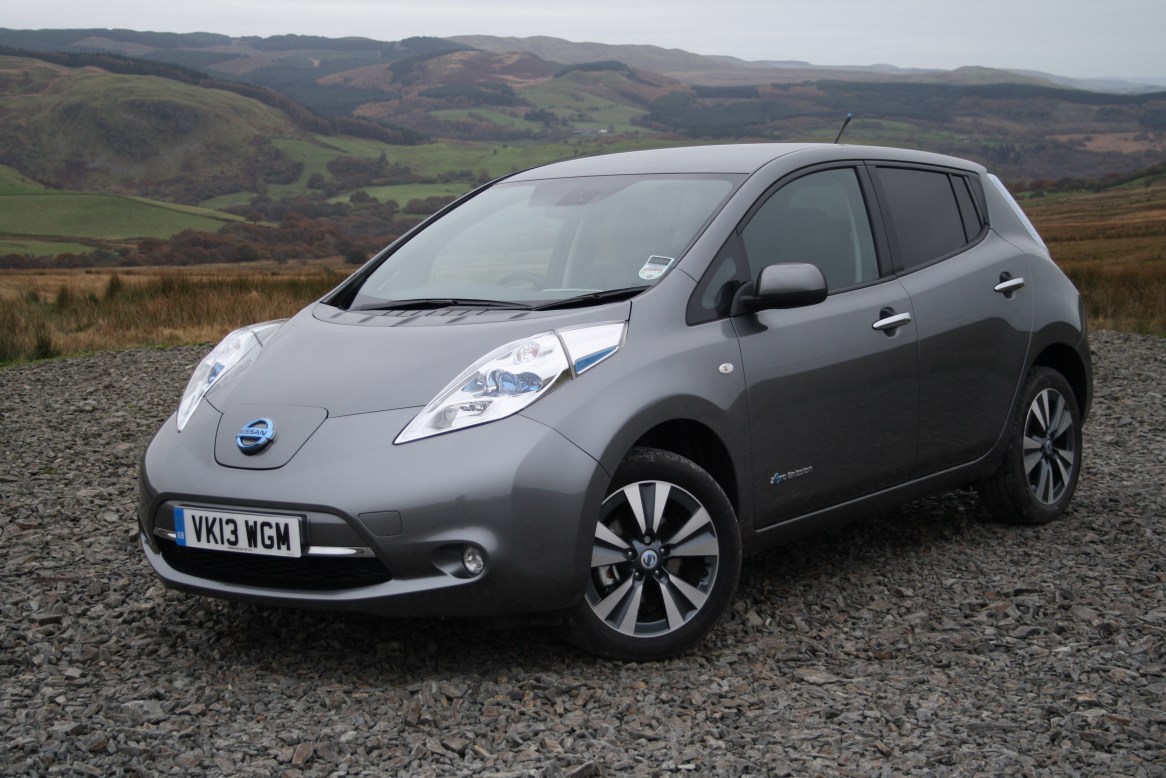
Nissan Leaf: The Full Review

A short review of the Nissan Leaf has been written by me already, and published at NextGreenCar.com. What now follows is a more in-depth review of my week with a brand new electric car. Bear with me. It’s quite lengthy.
Not a classic, yet...

Not a classic, yet…

Electric cars are certainly not new. They’ve been around for almost as long as internal combustion-powered ones. The BBC is about to screen a show looking at one from the 1960s – the Enfield 8000. Like most electric cars, the Enfield suffered from a short range, much slowness and great heavyness. Heating is minimal, though the cars did include a heated windscreen, so you could at least see where you were going. Few were sold and sporadic attempts at electric power since have not come to much.

So, when Nissan decided to mass produce an electric car, launched in late 2010, it was a bold step indeed. I was curious and decided that now production was UK-based for the European market, it was about time I tried one. Who said us Brits don’t make anything these days?

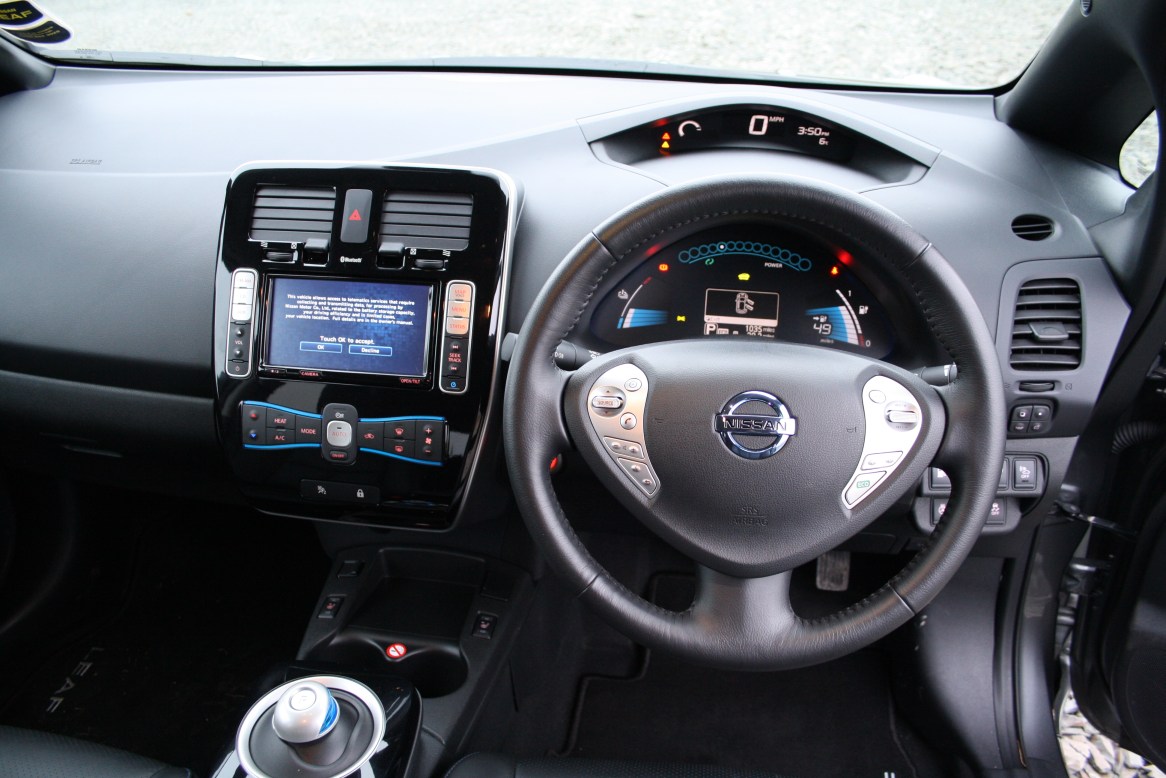
The car was delivered early one winter’s day. If I was going to test an electric car, I wanted to do so in the most challenging conditions. There’s no point owning a car that’s only good in summer. Hopping aboard, it felt like pretty much any other modern car. There were lots of buttons, precious little visibility but the usual steering wheel and some pedals that we’ve come to expect from a car.
Buttons, many buttons

Buttons, many buttons

I put my foot on the brake as instructed and pressed the On button. An ‘intelligent’ key means you can clamber aboard and start up without removing the key from your pocket. Rather than growl into life, it played a little beepy tune that I feel could cause insanity after a few months of ownership. It was like turning on a smartphone. Then it was a case of selecting D with the nifty gearlever, releasing the foot-operated (and thankfully not electronic) parking brake and beginning the oddest driving experience of my life – this coming from someone who has driven a Scootacar.

A quiet, high-pitched whir is all you get by way of sound as the car creeps away. Throttle response is instant but easily moderated. The brakes are super-sharp, the electric power steering surprisingly pleasant. Coming to a halt is particularly odd as it all just goes very quiet indeed.

Over the next week, I drove over 250 miles in the Leaf, using it as daily transport. The range was typically 50-70 miles before charging was needed, though I never left it perilously low on ‘fuel.’ The ambient temperature was very low, so the climate control saw a lot of use, as did the heated seats and steering wheel. I also live in a very hilly part of Wales, so the battery pack really had its work cut out.

Being a top-spec Tekna model (with an eye-watering £32,000 list price) the Leaf had a B-mode as well as D for going forward. B gives more ‘engine’ braking, generating more power as you ease off the throttle. This gives the sort of lift-off retardation that you just don’t get with a conventional automatic, boosting confidence on twisty roads as well as generating power to keep the main battery topped up. I left it in B mode for almost all of the time. I also kept it in Eco mode a lot too. This gives you a ‘lazier’ throttle pedal to help stop you burning volts and restricts power to the heater. I would occasionally drop it out of Eco mode which to me felt like giving it a burst of nitrous oxide! Great for overtaking.
Nissan Leaf

Actually bloomin’ good

I was absolutely amazed at how quickly I got used to it. The car had clearly been very well thought out and the comfortable ride was something I really didn’t expect from a Japanese car. Well, a modern car to be honest. Most are hopeless. But I found myself soon loving the seamless power delivery, the ease of driving around town and how relaxing and pleasant it was on the open road. Sure, it’s not engaging in the way a 2CV is, but it was quick, efficient and so simple.

Sure, it wasn’t all good. The automatic wipers were hopeless and the clever reversing camera – with four cameras all-around the car to give a view akin to Grand Theft Auto – was only good until the lenses got dirty. Minor switchgear was carelessly placed too. There’s that range too. When I needed to get to Birmingham and back, I was forced to use a petrol-powered car. It was the only realistic option.
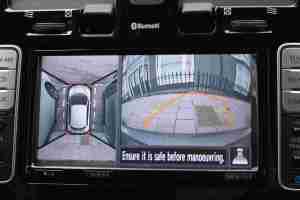
A nice gimmick, until the lenses get dirty

A nice gimmick, until the lenses get dirty

But I don’t drive to Birmingham and back everyday. For pottering (or even blasting) around my local area, it was ideal. I was genuinely sad to see it go. I love quirky cars, and they don’t get much quirkier than one without a conventional engine. I was astonished at how competent, comfortable and enjoyable it was to drive. Even with its range limitations, it did feel like a car I’d be very happy to own.

Nissan has been working to address other concerns too. Battery life is the elephant in the room for electric cars, but you can now lease the batteries, so they’ll be replaced if their efficiency drops below a certain level. No-one really knows how long that will take, but the new breed of fast chargers will certainly eat into battery life. Trickle-charging overnight is still best.

And I found that no problem. I’m fortunate to have a private driveway and a power socket within easy reach of the car. A full charge cost me a few quid and got the car 70-ish miles. Of course there is no fuel duty to pay, no road tax (it’s free) and servicing should be cheaper too (every 18,000 miles). Sure, there are concerns about the capacity of the grid to supply enough power for electric cars, and other environmental concerns too – where does the electricity come from and what about the chemicals in those batteries? For sure, the electric car is not the absolute answer to environmentalists’ concerns.

But the Leaf does feel like an answer. Sure, it’s not perfect but it is a really nice car with genuine benefits. It is the first British mass-produced electric car and perhaps the first electric car that can be taken seriously.

What I really love though is that other manufacturers have joined the race to go electric. Hybrids have been around for a while, but the latest breed use petrol engines purely as generators. Some still use battery power to boost performance and efficiency – like a Formula One racing car. Others use the petrol engine purely to extend the range as battery power drops – the BMW i3 being a key example of this.

For the first time in decades, the new car market is awash with variety and I’m starting to take interest again. It raises some very interesting questions about the classics of the future and I feel genuine excitement about where the future will take us. Electric cars make more sense than they ever have done. Will they start to take over from petrol? Only time will tell.

Perhaps I’m not a petrolhead after all

A bold statement but after spending a week with an electric car (reviews of which will appear at a later date) I’ve been very, very surprised that I can enjoy a car with no engine.

An enjoyable car, with no engine...

An enjoyable car, with no engine…

To those who don’t understand such matters, perhaps that isn’t such a shock. I know that some people, including my good lady wife, just can’t really comprehend why the firing of a certain number of cylinder is preferable to a slightly different number of cylinders. You either ‘get’ engines or you don’t. Naturally, I do. Whether it’s a screaming V8 dragster or the lusty grumble of a truck-size turbo diesel, I love the way that an internal combustion engine provides fitting sounds while it works. Just starting a vehicle feels like actually bringing it to life. Turning the ignition key of my Citroen 2CV really does feel like grabbing a lead and shouting ‘walkies’ to your favourite pooch. Though of late, it often seems that the 2CV looks at the weather and decides that going out is a bad idea.

But, I found myself clocking up 300 miles in a Nissan Leaf and really enjoying myself as I did it. For all their benefits, internal combustion engines have many downsides. I love torque. Most petrol engines (this side of a meaty, fuel-slurping V8) don’t have any. So, you have to rag them silly. Quite enjoyable in a 2CV or Sirion, but about as relaxing as hosting a children’s party, with E-number loaded jelly.

Diesels aren’t much better. Oodles of torque yes, but accessing it isn’t always fun.  Non-turbo diesels have linear power delivery, but not very much of it. Turbo diesels just don’t work. No, I’m right. They don’t. They’re almost always laggy and even with modern diesels, if you catch them off-boost, they display all the pace of Stonehenge. These days, they’re absolutely loaded with emissions kit and are highly stressed so things go wrong. Especially when you load them with Dual Mass Flywheels and Exhaust Gas Recirculation valves.

With the above in mind, perhaps it’s not so unusual that I found the power delivery of an electric motor really rather wonderful. Press the throttle and the response is, er, electric. Instant power, instant torque.

Transmissions are another problem. I like manuals, but there are times where a self-shifter is nice. The problem is, there isn’t an automatic out there that doesn’t get it wrong from time to time. Modern autos in particular are far too keen to kickdown, sometimes through several of their up-to-eight ratios. This leaves us trying to relax at kiddie party time again. Autos with manual control are no better because if I’m having to think about what gear to be in, I might as well just get a manual and enjoy better fuel economy. An electric motor effectively has no gears. There’s forward and there’s the other way. It took all of about five minutes for me to forget about gears. They suddenly seem rather quaint and old-fashioned.

It seems to have taken far too long for electric cars to get good, but they now seem to have done just that. Sure, range is still an issue but only for longer trips. I’m sure the batteries are not very environmentally friendly to make either, but sucking oil out of the ground didn’t seem all that friendly to Mother Nature the last time I looked, and where does all that platinum come from to make ‘green’ catalytic converters?

Now, my only problem is that, given the state of my fleet, I’m going to have to wait for 15-20 years for electric cars to fall within my price range/interest level. By which time the batteries will probably be junk and hydrogen fuel cells will have taken over. Oh well. The price I pay for being dangerously old-fashioned I guess. S’pose I could always consider converting the 2CV…

The scariest cars to drive…

There’s been very little to report on the fleet this week, so I thought I’d put finger to keyboard to talk about cars that have scared me silly.

While driving a 440bhp Lola T70 replica on a damp December morning rates as one of the driving experiences most able to loosen the bowels, even that doesn’t come close to how terrified I was doing 40mph in an elderly British classic.

I remember it well. The car appeared to be trying to drive in two directions at once, the clutch pedal had about a millimeter of travel and the brakes seemed not to exist. Never has a straight road been such a shoulder-tearing challenge. Changing gear was akin to waving a wand at a bucket of cogs. There were no brake lights, no indicators and the headlamps redefined the word dim.

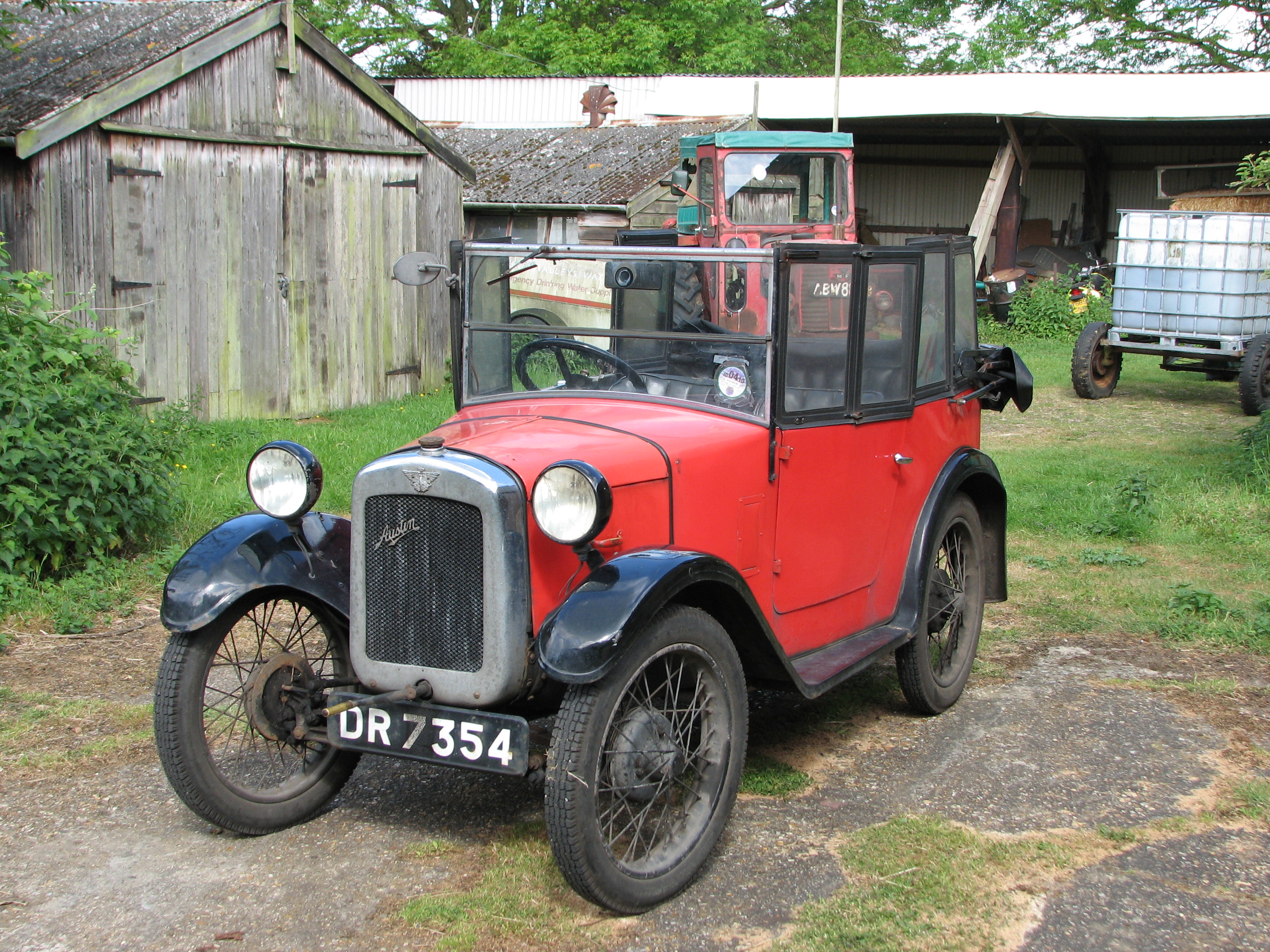
Terrifying isn't it?

Terrifying isn’t it?

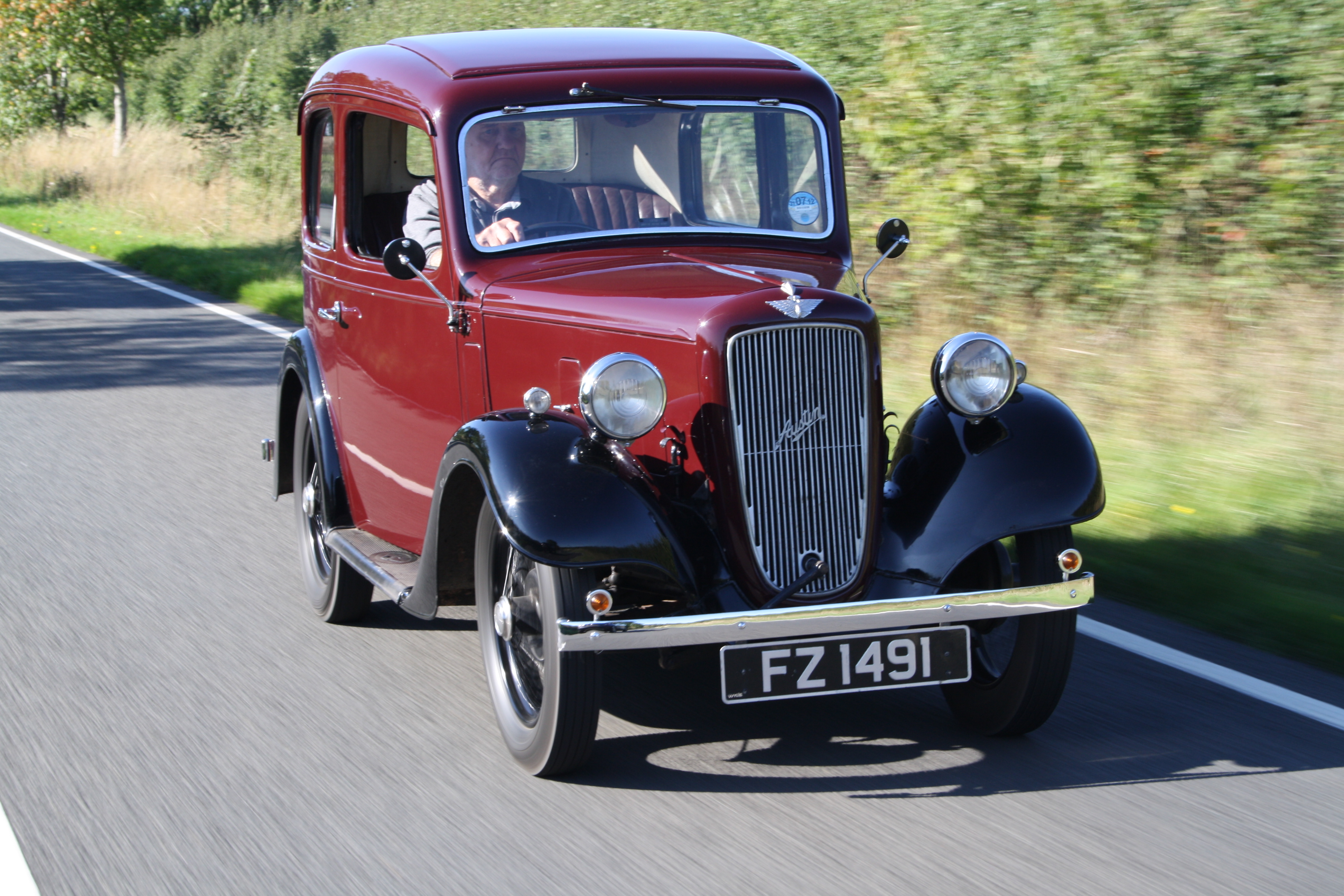
Yes, the car in question is an Austin Seven. I’ve driven several of them and they’ve all been pretty scary. Look at that picture again and you can just see the front brakes in the middle of the wheels. I’ve seen larger flies. I once drove one with an SU carburettor which could apparently do 70mph! I had enough trouble stopping it from 20…

But there’s something absolutely magical about a Seven. You really, REALLY have to drive one. You don’t just hop in and set off. Just travelling to the end of the road can be an adventure. I have major respect for the members of the Austin Seven world who drove the entire length of Route 66 in America. That’s just incredible.

The Austin Seven was conceived and developed in secret by Herbert Austin and a 14-year old apprentice. The management board thought it was a really bad idea, so Austin took to designing the car at home. Thankfully, the board were convinced that it was a good idea once they saw an actual car, and the Seven hit the road in 1922. It really was a shrunken down proper car, with a tiny four-cylinder engine, three-speed gearbox and mechanical brakes – the handbrake operated the front wheels, the footbrake just the rears. In 1930, the front and rear were finally linked.

Sales were hugely strong, backing up Austin’s bravery in conceiving such a small design. The Seven was developed into the Ruby of 1934, which had a little more luxury. In fact, the Ruby is quite different to drive. Sure, it still fights all over the road, but the brakes are better and it steers with a little more accuracy. Still a shock to folk used to modern classics!

Ruby at speed. But not very much of it.

Ruby at speed. But not very much of it.

Really, everyone should be forced to learn how to drive an Austin Seven. You develop much more of an awareness of the world around you. Hills must be anticipated as must danger. You feel more like you’re wrestling a snake than driving, which keeps you awake! It isn’t a car that transports you with the minimum of fuss, it’s a car you must pilot with the care of an aeronaut.

Yes, they may be scary, but I still regard any opportunity to drive one as humbling and entertaining. It’s an experience to savour, all well within the speed limits of our time. If someone offers you the chance to try one, take it!


The Ami Experience

Day two and the Ami is still making me giggle. Even just having it parked on the driveway is a pleasure.

Not as much of a pleasure as driving it though. Thanks to some choice modifications, including a Weber carburettor and gas-flowed cylinder heads, it’s ludicrously quick for a 602cc 4-seater built in 1965. At tickover, the exhaust sounds like it’s blowing badly, but give it the beans and it sounds insane! Acceleration is a bit of a shock to a 2CV owner too. This thing can actually shift.

It is unusual hearing that 2CV soundtrack in something which looks like a proper car – albeit one that looks most unlike any other proper car. But it is a little saloon, with proper doors, rather more comfort and a solid roof – one made out of plastic just to add to the quirky features. It feels like you sit much lower down than a 2CV, but I’m not sure that you actually do. The gearshift is a bit more of a stretch away, and not just because this car is left-hand drive. The cabin is wider than a 2CV, which means you seem to sit further away from the middle of the car – and therefore the gearchange. I’m sure there’s a gnat’s wing in it, but it does feel much wider.

Citroen Ami 6

Impress the chicks with an Ami

It’s quieter too. Sure, that exhaust is barking like an over-excited terrier, but wind noise is vastly reduced compared to a 2CV. With this punchy engine, an indicated 70mph is both relatively quiet and requires surprisingly little throttle. It’s quite unusual to be able to travel that quickly and still have power in reserve.

The seats seem to be even softer, closer to the feel of a DS – with that car also providing inspiration for the single-spoke steering wheel. The car bounces, and you bounce too, like the driver of one of those posh trucks where the seat and even the cab are separately sprung from the road wheels.

Not that the soft springing seems to bother the handling. The large wheel can induce comedy levels of lean, though the slightly lower stance of this one means it seems to corner with a little less drama. Fat 145 Continental tyres help too.

One intricate and quirky feature is the indicator stalk. Toggle indicators seem like a modern invention designed just to confuse people. Yet again, Citroën got there first! On the Ami, you flick the lever the way you want to indicate. It then returns to its normal position but the indicators flash. You have to pull the lever towards you to cancel it! Sounds absolutely ridiculous, but works well in practice, and at least the stalk doesn’t fall off in your hand like it can in a 2CV…

If all this makes it sound like I prefer the Ami to a 2CV, then you might just be right. I’m a bit shocked. Cars I’ve always wanted to drive can often be a bit disappointing in the metal. Not this one! The only problem is that I must force myself to remember that not all Amis drive quite as well (or as quickly!) as this one…

It’s been a long time Monty…

The first car I drove after passing my driving test back in 1995 was an Austin Montego 1.6L estate in the rather pleasant shade of Lynx Bronze. It was my dad’s company car and a pleasant ol’ bus it was too. Leaping from a Vauxhall Corsa straight into this slab of Austin-Rover loveliness was akin to going from a dinghy to a royal yacht. This car was so big that you couldn’t easily reach the passenger door from the driver’s seat! It felt enormous.

All credit to my dad then because the weekend after I passed my test, he jumped into the passenger seat of said Montego and let me take him for a drive. Now, my dad is a lovely bloke, but he’s about as comfortable in the passenger seat of a car as I am. If Jenson Button was driving me, I’d question his abilities and would be convinced that I was surely to die in a spectacular fireball. I think my dad is similar of mind.

Happily, I didn’t crash but I still have happy memories of that first drive and find it a bit sad that the Montego in question was, like so many, scrapped many years ago.

Incredibly, I’d not driven a Montego since, though I did briefly own a Maestro 1.3L, which redefined the word ‘disappointing’ in my mind.

So when I found myself heading to the exotic location of Crewe to drive a Montego for the first time in 17 years, I was rather concerned about how the experience would pan out. Would it be utterly boring and disappointing like the Maestro or would it rekindle a whole heap of nostalgic memories?

I must admit that I’m one of few people who consider the Montego an attractive car. Especially in silver, with a surprisingly pleasant set of alloy wheels attached.

Montego. Surprisingly attractive.

Montego. Surprisingly attractive.

I know that Roy Axe, who moved to Austin-Rover just as the Montego was developed, was horrified when shown a Montego prototype. He disliked the scalloped sides inherited from the Maestro and the uncomfortable rear side glass. To his credit, he tweaked as best he could and the Montego was one of the sharpest lookers of its time – though the blobby Ford Sierra and ruthlessly angular Vauxhall Cavalier were hardly masters of style themselves.

It’s not a bad story inside either. The interior hasn’t dated very much at all really, with clear, informative dials only let down by the rather scattergun approach to switchgear. One gimmick I love is indicator stalks that are gently illuminated. The fit and finish isn’t bad, but sadly there are some nasty plasticky creaks and groans. Nothing unusual to a Citroen BX owner it must be said…

Not bad inside, almost pleasant!

Not bad inside, almost pleasant!

But the time had come. Being a freelance writer allows you to indulge in moments like this. I was about to drive a Montego again.

You might mock, but I was genuinely excited about this. I’d hurtled northwards in my Nissan Bluebird with a genuine buzz, and not one generated by the Bluebird’s amazingly well constructed interior. I was putting the two cars head to head for a feature in Classic Car Mart – the details of which you can read in the November 2012 issue.

But this was it. The S-Series, 1.6-litre engine was up and running. Off we go!

The first thing that struck me is how un-boat-like it felt. That last Montego had felt wallowy and enormous, but I’ve driven an awful lot of cars since then. The Montego now felt really rather pleasant. There was no power steering, but it simply didn’t feel necessary, even with the extra width of the non-standard wheels and tyres. Noise levels were good, the engine felt perky and it was very comfortable.

Sure, it was about as composed in the bends as an X Factor contestant talking about how they were doing it for their guinea pig or grandfather or something, but that’s ok. This car harks from a time when family cars rightly placed comfort ahead of excellent on-track handling. It was fine if you didn’t push it. If you want a sports car, buy a sports car!

I really did enjoy this one though. It might seem odd to get excited about what has become such a forgettable car to so many people, but it was a firm reminder to me that ALL cars are worthy of collector status, for these are the cars that we remember from our younger days, and they’re often really rather good.

Montego - worthy of remembrance

Montego – worthy of remembrance

A Marina in drag. Does it deliver?

The Morris Marina may not seem the most ideal choice on which to base a sports car, but that’s exactly what the Yorkshire-based Naylor Brothers did in the 1980s.

They hit on the rather spiffing idea of combining the flowing-yet-traditional lines of the MG TF with more modern running gear and a few more creature comforts. The Marina and Ital’s new O-Series engine would provide rather more urge than the old XPEG MG engine, linked to the Morris gearbox and rear axle. Happily the Marina’s leaf springs were replaced by coils and the ancient trunnions of the Marina were replaced by MacPherson struts. The Naylor TF1700 was fully type approved, with backing from Austin-Rover. 100 were built between 1984 and 1986 before the venture failed. A further 61 were sold as Hutsons after the failed company was purchased by another enthusiast.

Hutson TF1700

The heart of a Marina lurks beneath the traditional bodywork

The car driven here is a Hutson and it was rather a revelation. There is a hint of kit car in some details, like the out-of-place front indicators and the chunky Chrysler door handles, but it is otherwise a very faithful copy of the TF. Like the original, there’s a steel chassis and the body is formed in ash, with steel panels wrapping around it. It therefore feels nice and solid.

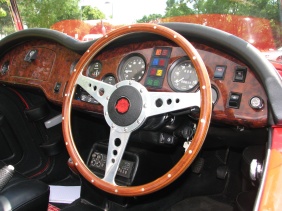
The interior is an interesting mix of tradition and modernity with controls nabbed from then-current Austin-Rovers. The walnut dashboard is a nice touch though and it doesn’t feel any more ‘wrong’ than a Morgan, which similarly mixes traditional wood with modern switchgear.

Hutson interior

Proper wood and modern switchgear combine

The biggest surprise comes when you drive off though. Who would have thought that a Marina engine could sound so rorty! Acceleration is strong enough too, feeling much quicker than the 12-second 0-60mph time. I may only have been blatting about the bumpy roads of Birmingham but this car felt taught, responsive and above all good fun. The Marina rear axle is better located, with a proper four-link set-up with Panhard rod. The coil springs all-round mean a much more comfortable ride than any original MG T-Type but this doesn’t seem to come at the cost of cornering ability.

There is a very passionate club for these cars, and it’s easy to see why. Who needs a Morgan if you want tradition and a few creature comforts? I was certainly impressed and in the best tradition of MG, the mechanicals of a thoroughly ordinary car have been transformed into something rather special.

Road Test: Mitsubishi Delica L400

EDIT – Video Review now available!

I’ve always loved off-roaders, though I’m very quick to distance myself from those who go tearing around the countryside upsetting ramblers, churning up byways and going where they like.

Nor am I particularly interested in getting stuck and needing thousands of pounds of kit to get me moving again. Pay and Play sites can be fun, but there’s a bit too much focus on driving like an idiot for my liking.

Mitsubishi Delica L400

Delica. No award winner for beauty!

No, to me, an off-roader is a car you use like a car, but which you also use for heading off the beaten track when needed. This brings me neatly to the vehicle tested here. It’s a Mitsubishi Delica L400, owned by someone for whom a 4×4 is essential. It gets used to drive across muddy fields to collect wood and even the chap’s driveway is a struggle at times. A 4×4 isn’t a nicety – it’s essential really.

A great off-roader isn’t enough though. Occasionally, it gets used as a tour bus for his musical endeavours, so the six comfortable seats it has are also necessary. As is the ability to eat up a lot of miles in comfort and relative quiet – something the traditional Land Rover is not exactly known for.

It was people carrying duty that gave me a healthy dose of wheel-time in this hard-worked steed. A 230 round-trip to North Wales gave me plenty of time to acclimatise. The first thing that strikes you about the Delica is how ridiculous it looks. She’s no beauty, and it looks  a bit like a home-brew attempt to make a monster truck out of a van. They’ve always looked rather precarious to me, so I was interested to discover how it behaved.

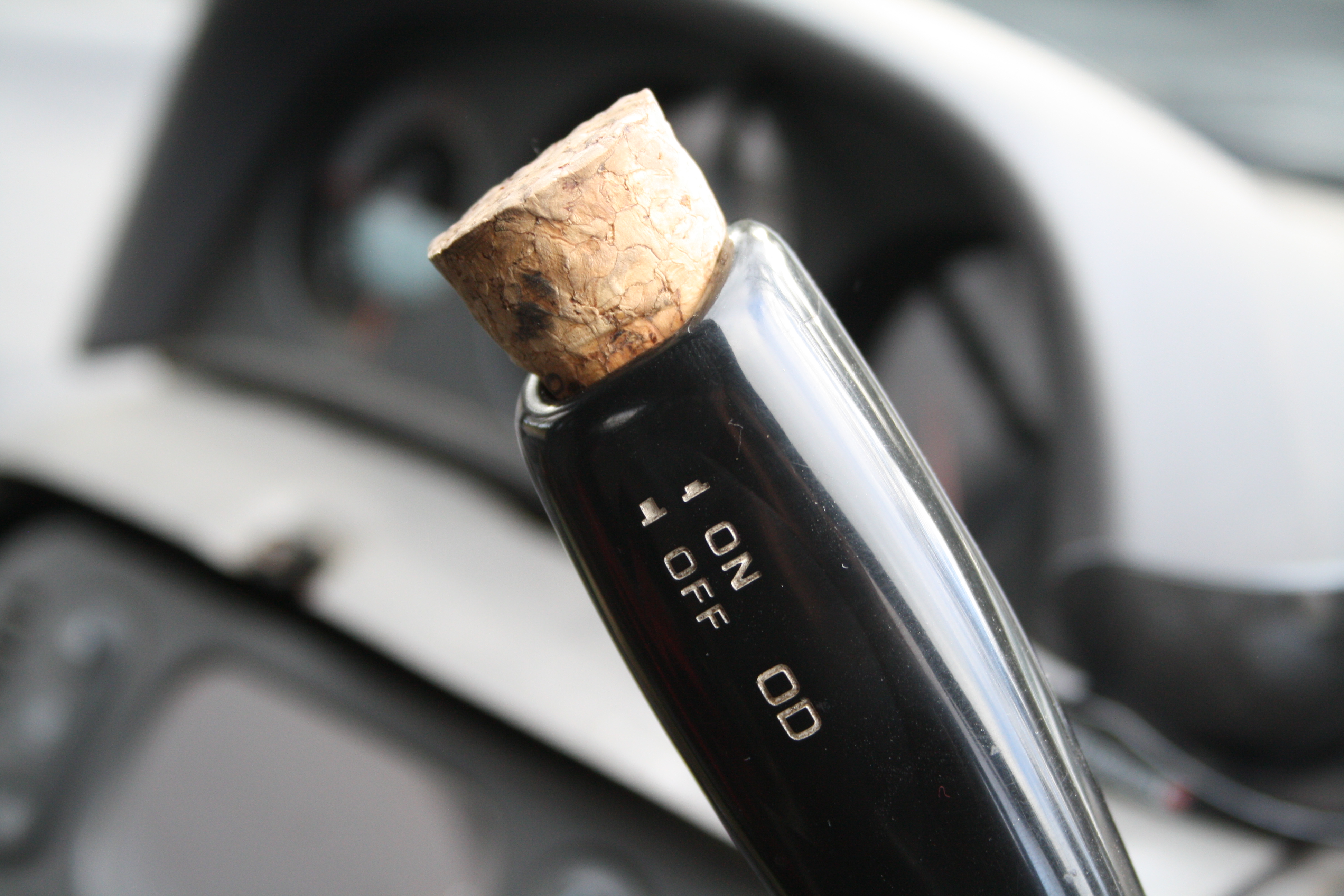
Clambering aboard, which is a bit of a challenge at first, I was struck by the typical Japanese ergonomics. There are buttons all over the place, though this example is further ‘enhanced’ by a large section of missing trim, some buttons that fall off when you press them and a cork that replaces the missing overdrive switch on the column-mounted gear lever. Oh yes, a column mounted lever! Just like the old days.

Cork gear lever

Well, if it works, why not?

The floor is quite high, so you don’t sit in quite the impressive manner of a Range Rover. Your view is certainly impressive however. Forwards at least. Large door mirrors aid rear visibility, which is good as ‘privacy’ netting rather restricts vision through the windows themselves.

On the move, it all feels rather tight and not as wobbly as you might expect. There’s very little bodyroll and while the ride can be crashy, it’s not uncomfortable. The steering is nicely weighted and accurate too. We suspect the transmission wasn’t in finest form on this one as it did a peculiar thing when it reached top gear, and actually accelerated despite lower engine revs. The ‘automatic with overdrive’ is a novelty too, but does mean low-rev cruising. Pulling the cork out turned the overdrive off and gave the engine an easier time when coping with gradients. Incidentally, FX4 Taxis with the automatic gearbox usually have a similar overdrive system.

While this certainly isn’t a fast-accelerating machine though, it does build up speed nicely – which is what you want when carrying passengers. You don’t really want neck-snapping power. It did feel like it could really pick-up pace if you wanted to, but it did also suggest that doing so would generate an awful lot of engine noise and cause the economy to suffer to a very large degree!

So, best to sit back and enjoy. It’s quite relaxing, which is good as 230 miles on Welsh roads is exhausting! Especially when it rains and gets dark. Overall though, I enjoyed my time at the helm. It’d be good fun to put one through its paces off-road next…

Reliant cherry popped

Yesterday was a very important day for me. I popped my Reliant three-wheeler cherry! And how.

Thanks to Joe Mason at Reliant Spares, I finally experienced the slightly-unbalanced world of plastic Staffordshire motor cars. I enjoyed the experience very much indeed.

Regal three-wheeler

Perhaps Del Boy chose well...

We began with a Reliant Regal. Makes sense. This car was an enormous leap forward for Reliant, with pretty Ogle-designed plastic bodywork and Reliant’s own four-cylinder, all-alloy engine. The engine was necessary so that Reliant could finally move on from using licence-built Austin Seven side-valve units. Knowing that low weight was essential, the company bravely decided to opt for an all-alloy construction – very brave at a time when most other British car manufacturers were nervous about using even just an aluminium cylinder head.

What struck me about the Regal was how iffy the build quality was – the doors banged on every bump – but also how perky and stable it was. With such light weight, power just isn’t necessary. It was also very noisy – the result of the engine effectively sitting in the cabin. The rear-ward mounting of the engine is one thing that helps keep the car stable.

We then moved up to a Robin, which felt very different indeed. Quality was definitely improved and the tiny steering wheel made it feel somewhat like a dodgem. It was much quicker too and thankfully also quieter. I was entirely charmed. Within a mile, you forget that you’re in a ‘different’ car, well apart from the expressions on the faces of people coming the other way. You don’t have to constantly worry that the car might fall over though. They really are stable and capable of cornering much more quickly than you expect.

The only problem seems to be that Reliants aren’t cheap anymore. I should have bought one years ago!