Discovery – saving the hopeless

Apologies for the quiet spell. I’ve been very busy playing with a brand new electric car, tackling the annual classic love-fest that is the NEC Classic Car Show and buying unnecessary musical instruments.

After some quite major surgery, the Discovery is very nearly ready for the road once more – with winter about to hurl some entirely expected weather our way. I didn’t own a 4×4 last winter and…things were absolutely ok. There is comfort from all-wheel drive when grip levels begin to plummet though, even if I am not one of those muppets who thinks a bit 4×4 can somehow defy the laws of physics. I still drive for the conditions!

Getting the Discovery back will be pleasing though. It now contains many less holes and boasts actual metal in many new and important places – such as the floor and sills. My welding friend suggested it was only luck that had prevented me falling through the footwell as the strongest part of it appeared to be the carpet.

Driver's footwell was well ventilated

Driver’s footwell was well ventilated

Dave is a handy fabricator though, and he was soon letting new metal in all over the place. Once he was done, I covered all new metal in zinc-rich primer and then added a top coat. The only paint I had kicking around was a tin of Tobacco Leaf – a delicious, non-PC shade that adorned the Rover P6. Fittingly, these Rovers were built in the same factory as my dear old Disco, so I felt it was fine to use. These sections will be out of sight once the vehicle is back together again, and Tobacco Leaf is pretty much the same colour as mud anyway.

The sills went from this:


Initial 'Discovery' of rot

Initial ‘Discovery’ of rot

To this:

Tobacco Leaf sills

Tobacco Leaf sills

The welds aren’t neat because they won’t be seen anyway. Spending time grinding them down seemed a bit excessive.

Mind you, some might say that spending £300 on welding up a tired, rusty £450 Land Rover was a bit excessive. They’re probably right, but I find myself becoming rather fond of this clapped out relic. My plan was to buy cheap and fix it if I liked it. It’s a simple plan and like many simple plans, it works and makes me happy. Now I need to try and stop some of the water leaks so the new floor doesn’t go the way of the old one. But stopping a Land Rover from leaking water is like trying to stop the Earth from turning. I feel a challenge coming on.


Discovery – rotten sills

While I’ve been healing, I’ve done very little driving in the Discovery. But good news – my thumb is much better! I can now drive all of my cars again and, as I discovered this afternoon, I can work on them again too!

The Discovery was lucky to get through the MOT due to sill corrosion. It was an advisory item because most of the rot was hidden by a sill cover, which the MOT tester is not allowed to remove. Me and my mate Dave are fully qualified though, so we pulled off the trim.

Initial 'Discovery' of rot

Initial ‘Discovery’ of rot

As you can see, it was properly rotten. Thankfully, rot seemed to be confined to the outer sill – the inner generally seemed sound. Gaining further access to the sill isn’t easy. A Discovery 3-door becomes a real challenge if you need to replace the sills. A common bodge is to just cut the lower bodywork. That’s a clumsy way to do it. We opted to drill out the spot welds holding the outer panel in place, which allowed us to wedge it out of the way.

Drilling out the spot welds allows this panel to be moved

Drilling out the spot welds allows this panel to be moved

Naturally, things were a bit grim behind there, but not as bad as they could be. There’s an inner skin of steel, which had started to corrode. This is because road muck from the rear wheels gets forced into the cavity, but it’s impossible to clean it out, so rot can merrily start. Further surgery was required though. It was time for power tools.

Cutting away the rusty metal

Cutting away the rusty metal

The key to a good repair job is to get rid of as much rusty panelwork as you can. You must find good metal – there’s no point leaving rusty stuff as it’ll just make your new repair fall apart. As we dug and dug our way in, I had to start stripping the interior out to prevent it catching fire during grinding/welding.

Some fabrication needed around the body mount

Some fabrication needed around the body mount

By the time I had to leave, my mate Dave had got to this stage. More of the inner sill needed removing that we first thought, but that’s the nature of rot-busting. Once all the rot is gone, Dave can get on with fabricating repair sections in nice, thick steel. I was tempted both by complete replacement sills and the idea of fitting seriously beefed up ones. I’ve decided I prefer Dave’s fabricated approach though, which will use good metal, only replace what needs replacing and by the time we’ve finished, will hopefully leave it looking pretty much stock.

I’ve decided that I don’t want a monster truck. The closer this vehicle remains to factory, the better.


Sirion: The transformation continues

With me technically not able to drive due to stupidity, it was an ideal time for my good lady to experience a little Daihatsu magic. Incredibly, she quite likes it! I’d convinced myself that she wouldn’t, as the power-steering is rather on the light side. I was wrong.

The powerful brakes took a bit of getting used to after months of 2CV driving, but it became apparent really rather quickly that this is a car that we can both enjoy. Perfect.

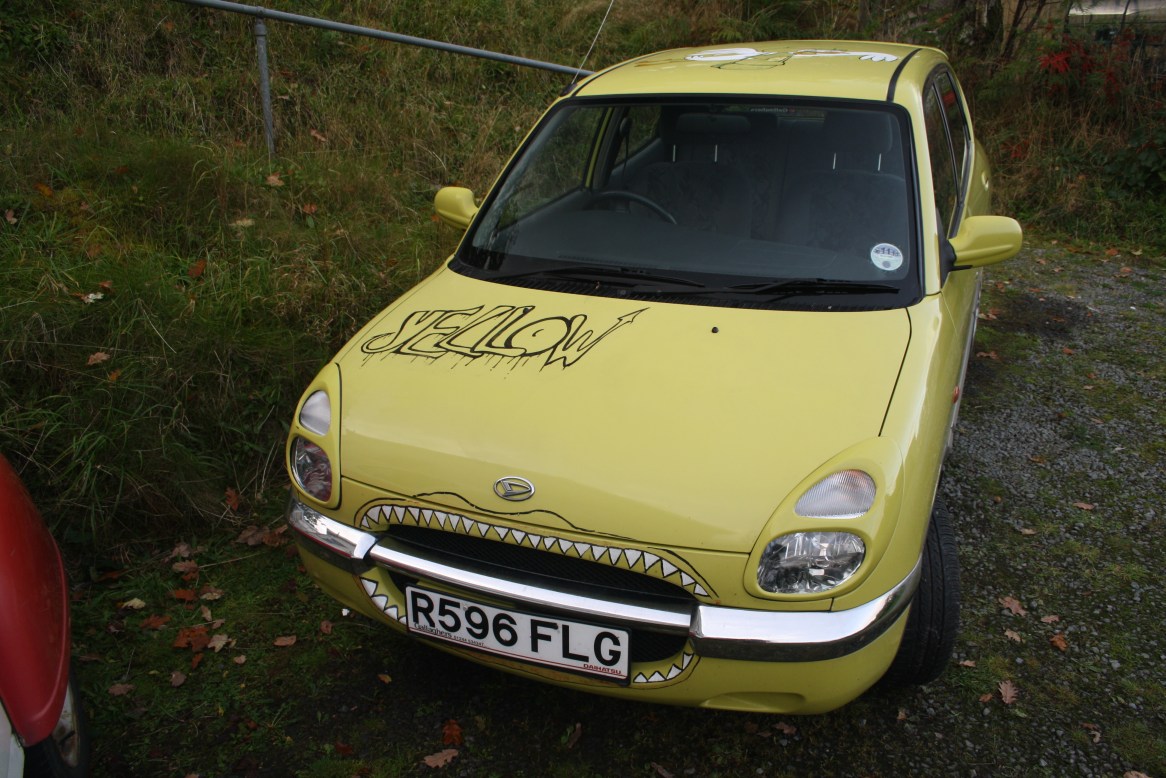
Sadly, this joy has come at a slight cost. As happy as she was to drive it, Rachel has long complained about the Yellow Peril on the bonnet now. Therefore, this happened.

Yellow Peril removal

Yellow Peril removal

It seems there was not marital agreement on the cool-ness of the writing. I really quite liked it.

Yellow

Yellow, yesterday

Above is how it looked for a time yesterday as we had to go out in it before it could all be removed. Even the Yellow has gone now though – the car is a far cry from the one I purchased at the beginning of the month.

It has been very satisfying to effect such a transformation using so little money – which is good as I really have so little money at the moment. I think I spent comfortably less than £10 on materials and the car has gone from a jokey mess (in most people’s eyes) to a still-quirky-but-more-sensible little hatchback. It has been a lifeline this week as I’m still struggling with driving. That super-light power steering becomes a real boon and the nifty gearchange also helps.

That said, I was tooling around in the Discovery today, which surprised me by being very comfortable to drive with my iffy thumb. We’re not contemplating using it for an upcoming roadtrip to Sussex though as it is far too thirsty. As it is, I’ll get a chance to see if I can crack the magic 50mpg barrier – as Rachel is likely to be sharing the driving, this seems very possible.


Discovery: Still performing

You could be forgiven for thinking I only currently have eyes for oddball Japanese city cars at the moment, for I seem to have been truly captivated by the Sirion. But there are other vehicles on the ClassicHub fleet, and I still like those too.

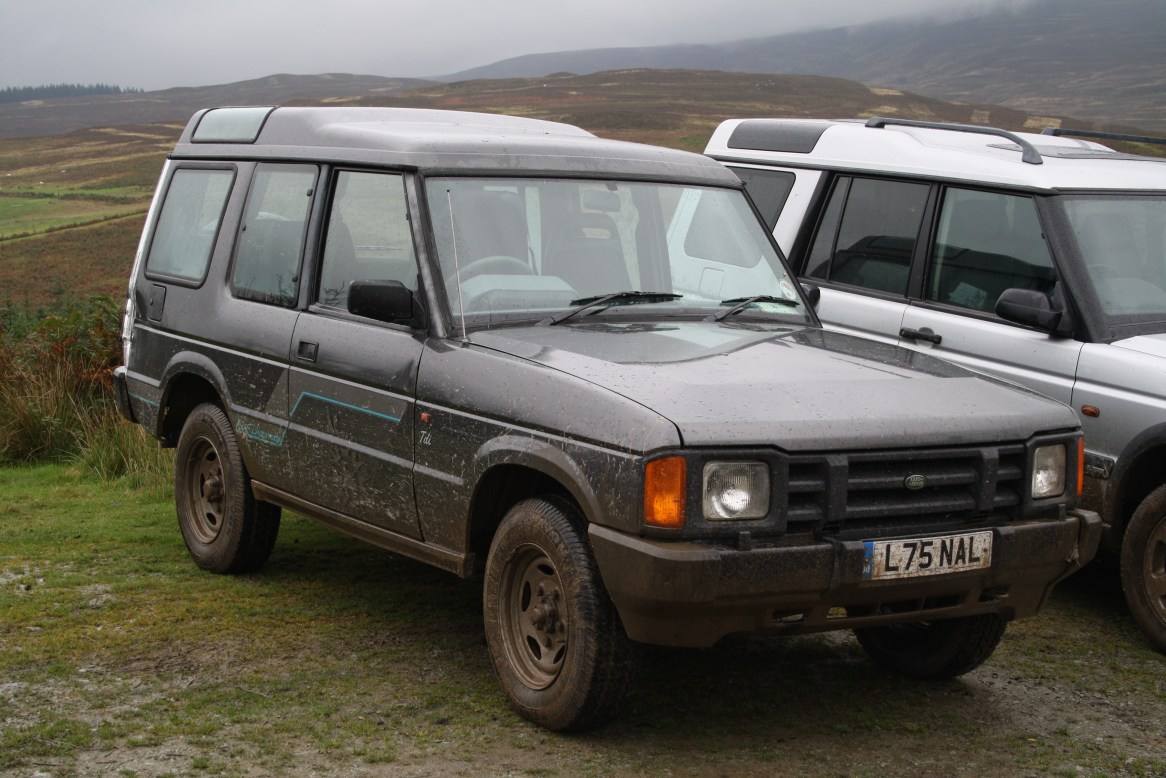
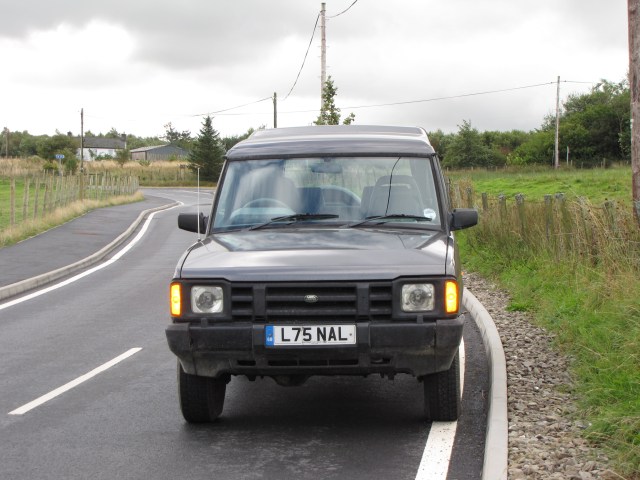
The Discovery continues to provide sterling service and is steadily improving as I get on top of its lengthy To Do list. I can’t really describe why I love the Disco so much, but it gives off vibes that just make me happy. This weekend just gone, I headed northwards for my second session of off-roading at Landcraft. I’d visited the site back in August, and a report of that has just been published in the December 2013 issue of 4×4 Magazine. Thing is, I enjoyed it so much that I just had to return!

As I tackled the many bends between our house and Bala, I must say that the Discovery feels very odd to drive after 250 miles in a small, Japanese hatchback. The Disco is heavier to drive, and slightly cumbersome, but still eats the miles effortlessly, with the rev counter rarely rising about 2500rpm – stark contrast to the frenetic three-pot in the Daihatsu.

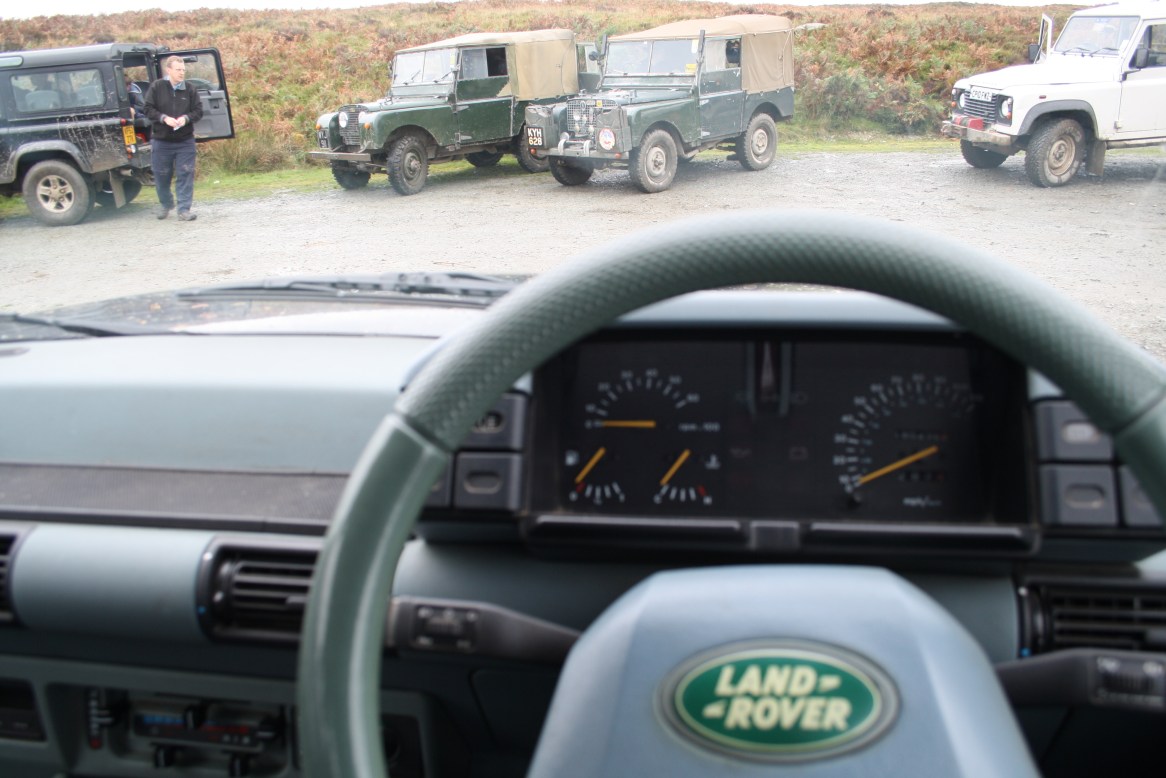
Once there, I had a splendid time once more. We were joined by Land Rovers of many eras, from a very early Series 1 to a Discovery 3, with all its many electronic aids. The Series 1s looked more fun! Again, my Discovery coped well. Its lack of modifications or aggresive rubber mean line choice and momentum are absolute critical. It’s a very good work out for car and driver.

Series 1 Landies looked great fun

Series 1 Landies looked great fun

In many ways, much of the technology of the Series 1 is still evident on my Discovery. It has similar beam axles (albeit with a change of suspension spring), a similar ladder-frame chassis and fairly simple aluminium bodywork. Both wear skinny tyres too, and traction was certainly an issue at times, for ancient and less-old alike. That’s all part of the fun really. The Discovery 3 seemed to just amble around the course without fluster. It didn’t look half as much fun!

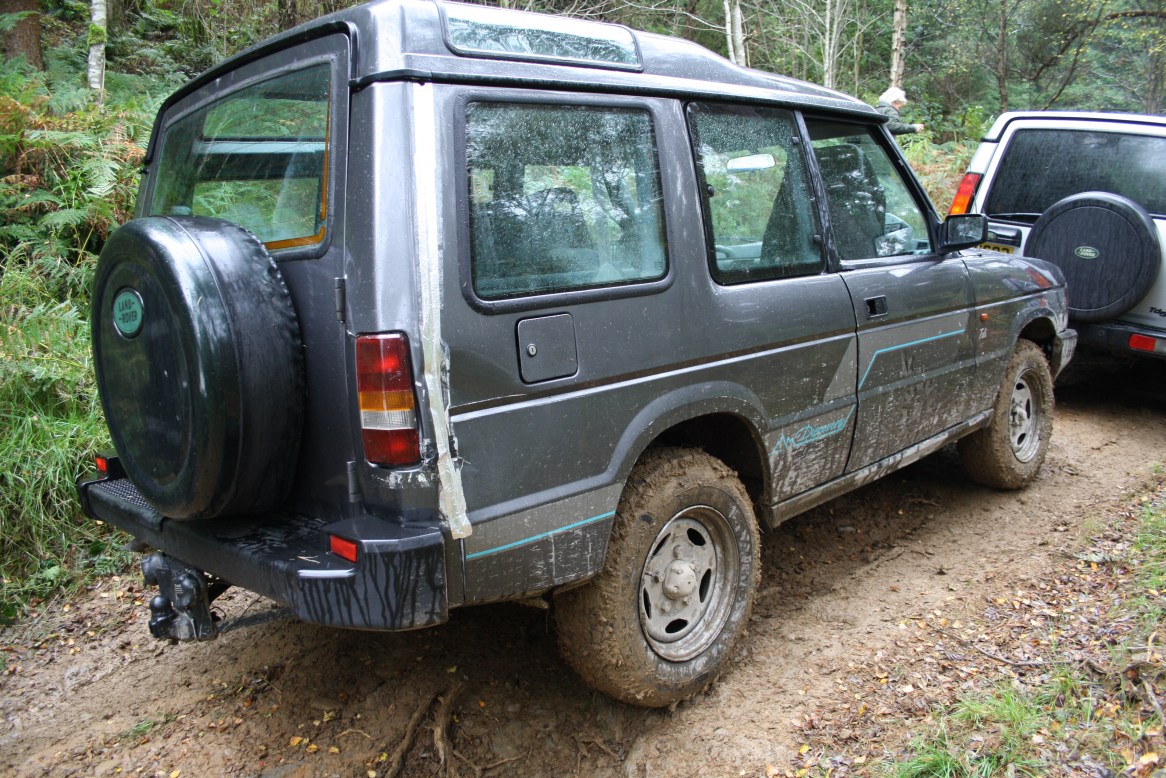
Skinny tyres worked hard in the mud

Skinny tyres worked hard in the mud

The Disco’s towbar took a few knocks, but damage was otherwise only notable by its absence. That’s what I like about Landcraft – it’s designed to be fun but these Adventure Days are gentle enough to easily avoid damage. I’d quite like to tackle one of the Adventure Plus days, but that brings me back to the main problem of recovery points. On the Plus days, it sounds like getting stuck is very possible – though it’s something I always try my utmost to avoid. The Discovery has no front recovery points though, and I’m struggling to find a way to fit any that doesn’t compromise the factory looks. Perhaps I’m going to have to admit defeat and fit a stronger Heavy Duty bumper.

Lack of front recovery points an issue. If you get stuck...

Lack of front recovery points an issue. If you get stuck…

It’s a dilemma for me. I love off-roading in stock vehicles and prefer the lack of on-road compromise that results from it. I don’t want to make my off-roader look butch and menacing. Sadly, if I want to enjoy myself more, it looks like modification is the only way.

Here’s a video of Sunday’s exploits as I have to carefully manage the throttle to avoid wheelspin while still keeping up enough momentum!

Video


Daihatsu Sirion: Cosmetics and more

Today’s main aim was to improve the cosmetics. That involved removing most of the artwork and then giving the cleaned panels a good coat of polish. Removing the remnants of old stickers was very hard work. I tried carburettor cleaner, electrical contact cleaner, white spirits, brake cleaner and tar & bug remover. Eventually, the rag which was by now soaked in all of the above managed to clean the gooey, gluey mess off the paintwork. I’m very pleased with the results.

Sirion cleaned

Looking much cleaner

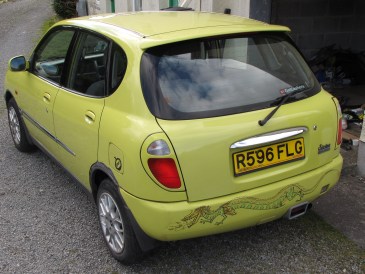
For the moment, I’m keeping the roof-mounted bird and the Yellow Peril bonnet artwork. Both may yet go, but I’m in less of a rush to get rid of them than I was some of the other stuff. I’ve kept one Muttley on the offside rear quarter too.

Arse dragon

Cleaned backside

You can just about see in the shot above that I’ve also tackled the rot in the rear wheelarches. It’s going to need some welding at some point, but I’ve rubbed back to decent metal and treated what is then visible for the time being.

I did discover some shoddy repairs. The tailgate has many shades of yellow upon it as whoever repaired some previous accident damage clearly couldn’t be bothered to paint the whole tailgate. I can’t say I’m that bothered though. Adjusting the rear washer was a pain as I had to remove the rear spoiler to do so. Great design! Fortunately, three nuts are all that hold it in place. I also changed all wiper blades and gave some parts of the underside a soak in anti-corrosion wax – namely the front crossmember and subframe mountings.

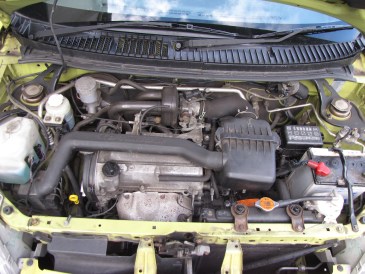
Tiny engine

Tiny engine

I almost checked the gearbox oil level too, but that can wait for another day, and possibly use of a ramp to make life easier. As you can see, despite the dinky engine, underbonnet access is still quite tight. The radiator and battery also seem to be scaled down!

I’m still very pleased with the car. I only really sold the Golf because the tax was up at the end of this month. The downside of a 1.6-litre engine is that it is just over the 1550cc cut-off for Vehicle Excise Duty. That means 12 months costs £225. That’s a lot of money to find at once, especially when I’ve recently had to tax both the 2CV and Land Rover. In fact, it angers me that road tax for older cars is so ridiculously expensive. Some moderns are super-cheap or even free. That doesn’t seem fair. A Golf costs as much to tax as a 6-litre Jaguar XJS-R. That’s just lunacy.

As it is, the Sirion doesn’t need taxing until the end of November, and will only cost £140 for 12 months. That definitely helps, and so should the theoretically better economy. I’m looking forward to finding out just what it’s doing, but it has only used quarter of a tank in the 120 miles I’ve covered so far. Shouldn’t take too long to use the rest up I reckon!


Disco: Stop, carry on

As described earlier, my plan to drive to North Yorkshire in the Discovery only last three miles. I think it probably goes down as one of my least successful journeys ever.

Going nowhere

Going nowhere

A bang, a clatter and then the front nearside wheel locked up. Fortunately for me, it was wet and the front wheel happened to be on a white line at the time, so the retardation effect was not too dramatic. Enough for me to know that my destination was well out of reach though.

I nervously limped home at 20mph (the hazard lights got a lot of use that day), not daring to go any faster because of the hideous noise coming from the front end. Knowledgeable people reckoned it was likely to be a failed wheel bearing and the grumbling noise certainly seemed to back that up.

Yesterday, I limped to my mate Dave’s house, where we pulled the front hub apart. The outer bearing looked fine, but when the pulled the hub off, the inner bearing simply fell out in many pieces. It was absolutely bone dry and the failure had been sufficient to turn the inner collar on the axle shaft – that takes some force. It took some force to remove it too, but happily, with plenty of grease and a fair degree of effort, the new bearings were soon in place.

What a transformation. The bump-shake tendency when hitting a pothole with the nearside front wheel has gone entirely and it all seems a lot quieter too. That’s the thing with permanent four-wheel drive – there are an awful lot of moving parts, and it becomes difficult to hear one over any other. I certainly noticed the difference once the duff bearing was gone though!

I’ll hopefully be putting it immediately to the test as the plan is to go greenlaning in Gloucestershire this weekend. Hopefully it’ll make up for the lack of Disco laning last weekend – fun as it was. I didn’t buy the Disco so I could go laning in someone else’s vehicle.

It has been interesting to find that I’ve now clocked up 1200 miles in the Discovery, even though it stayed at home last weekend. That’s in just over three months of ownership – IIRC I only managed 1500 miles in eight months with the Ford Maverick. The improved economy of the Discovery is certainly a factor – 27mpg compared to 20-22 – but the Disco is much more comfortable as well, and I find it much nicer to drive on the roads. Certainly, this is one vehicle I remain very happy about buying.

2CV: Enjoy the Silence

Thanks to a friend, I’ve finally discovered a more enjoyable way to drive the 2CV. Earplugs!

2CV noise

The best 2CV upgrade yet?

For £3.49 from Ebay, they had to be worth a go. You can get posh ones for £17-20, but I’m not posh. These ones are rated at -20. That’s important. I don’t want to block all of the noise out – it’s dangerous if you can’t hear sirens or other noises – like things falling off. Therefore, I apologise for the artistic licence used in my headline. I just happen to like that Depeche Mode song very much!

Today was the first time I’d had a chance to leap into the 2CV and test them and the results are staggering. I could still hear everything that was going on, even individual rain drops hitting the roof, but it was all turned down to a much more agreeable level. I could even hear the indicator relay clicking away. Engine noise was very much reduced and wind noise was now tolerable.

The best bit was how much more refined the car felt, because clonks and rattles are reduced and road noise is so much quieter. Heading up hill, with the engine screaming away, was nowhere near as painful on the ears. I’m going to rate this as one of the best upgrades you can make to a 2CV, and for only a few pounds! I’ll also be testing them in the Discovery as I attempt to quieten the rear axle howl on the way up to North Yorkshire next weekend.

Golf: Brakes finally sorted

At long last, I’ve fixed the Golf’s rear brakes. I even found what was causing the incessant whistling that nearly drove us mad on the trip to Devon.

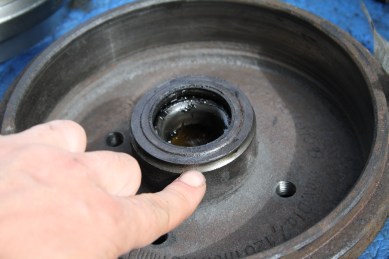
Volkswagen Golf noisy brake

Wear ridge – shouldn’t be there!

That wear really shouldn’t be there. It all stems from my initial attempt to check the condition of the rear brakes. When I was refitting the drum, I over-tightened the wheel bearing nut, as I hadn’t realised that this actually needs to be set fairly loose. I knew something was wrong immediately as the hub was hard to turn. I slackened it off after taking the desperate measure of reading the manual, but the damage was done – whatever it was. The drum was now running too close to the backplate and was rubbing merrily on the nuts that hold the backplate in place.

Having had to pull everything apart again, I opted to overhaul the rear brakes entirely. I’d need a wheel bearing for the nearside, but they are so cheap that I decided to replace both. Then I decided that the stub axles looked a bit scored, so I replaced those too. Annoyingly, I don’t think any of this work was really that necessary, had I not ballsed things up in the first place, but the brakes feel more positive now, which is nice. It was at least fairly simple to work on, though I needed professional help tackling the shoe springs and knocking in the new bearing outers. I farmed that job out for a few quid – a wise move!

I also treated the car to a fresh oil filter and new oil, in the hope that it might cure the occasional-clattery hydraulic tappet. It doesn’t seem to have sadly, though it always quietens down after a while. A new heater bypass valve has been fitted too, so all-in-all, it’s in far better shape than it was a few weeks ago. Hopefully, expenditure will now decrease somewhat, though I’ve just discovered that the heated rear window isn’t working – a faulty switch I reckon. There’s always something!

Now in better shape, hopefully for a goodly while!

Now in better shape, hopefully for a goodly while!


Mercedes – still here, and that’s not a bad thing

I’ve been trying to sell the Mercedes 300E for some time now, with For Sale adverts in many different places and a failed attempt to sell via Ebay. The W124 is widely regarded as one of the best saloons ever built by Mercedes-Benz, but that doesn’t seem to stop them being worth pennies.

So, I might as well continue to use and improve it. With that in mind, I used it for a trip to The SL Shop in Worcestershire yesterday. Well, it’s always nice to turn up in something fitting isn’t it? After all, my car shares its M103 engine with the R107 300SL. Yes, it’d be a fuel-slurping trip, but it’s nice to treat yourself sometimes – and that’s exactly why I bought this car in the first place.

My trip was very well timed as Tony Leach of the Mercedes-Benz Club was present. Under the banner of MercDoctors, Tony travels around the UK offering assistance to Mercedes-Benz specialists. His speciality is diagnostics, especially of the 1980s/1990s model range. Perfect! While I did my job, writing about cars for sale and taking photographs, Tony ran diagnostics on the car to check the electrical side of things and then did a smoke test.

Smoke test required some unusual methods...

Smoke test required some unusual methods…

I admitted to my complete ignorance of fuel injection systems – possibly over-stating my ineptitude, but I’m certainly not over-familiar with how they work. Tony explained that it’s not really that different to a carburettor – it’s just that bits are more spread out. Tony first sealed the induction system, using a latex glove atop the main air input and bungs elsewhere. One pipe was left open and the smoke machine was connected up. The theory is very simple. The smoke machine pushes smoke into the induction system. If you see any smoke escaping, you’ve found a leak. It doesn’t take much of an air leak to cause problems. The fuel injection system carefully and very accurately supplies the correct amount of fuel for any given situation. This relies on a known measurement of air, so if extra air is being sucked in, the mixture ends up being incorrect. Happily, the Mercedes passed with flying colours – no leaks at all.

Then Tony adjusted the mixture, with rather more care than I had. I’d simply weakened the mixture enough for it to run properly. It certainly wasn’t running properly when I bought it. Tony was able to hook it up to the necessary equipment to fine-tune the mixture. The result? The car now runs much more sweetly. It no longer hunts when slowing down and it doesn’t stink half as much! Previously, it smelt like the choke was stuck on. Not a nice smell.

I should now see an improvement in economy, though it already varies anywhere between 16mpg and 27mpg depending on how I drive it. I covered over 200 miles in the Merc yesterday though, and it reminded me just how pleasant a car it is to drive – though it also reminded me how ill-suited it is to tiny Welsh mountain roads! Too big and far too heavy. Far better to take the better roads, sit back and cruise.

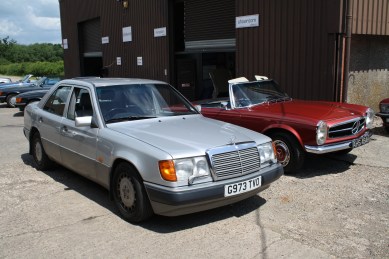
Merc pauses with some glamorous siblings

Merc pauses with some glamorous siblings

Above is the Merc having a rest between fettling sessions and next to one of its very glamorous siblings. I like to think that this is like a film star ending up stuck with an embarrassing sister, hoping that the paparazzi won’t pounce…

Showing the ol’ girl some love

“As soon as you get your new car home, give it a thorough checking over as you have no idea how well the car has been looked after.”

Wise words. At some point, I’ve probably written some advice like that for a magazine. Very sensible. And so easily ignored, even by me…

Naturally, I rarely do any such thing. In fact, I’m guilty of criminal neglect when it comes to the BX and Merc, both of which are still awaiting a service in my ownership. I really should do something about that…

But the Discovery came first in the queue, because it’s new and I’m still all excited about it. As a warm-up, I failed to change the gearbox oil due to a combination of unsuitable spanners and not enough oil. A poor start. Then I decided that new engine oil was a good idea.

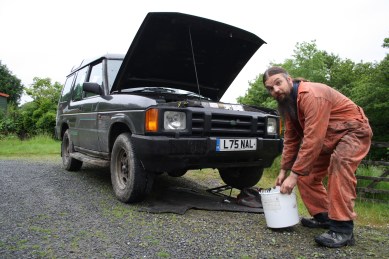
A dubious looking character steals a bucket of old engine oil

A dubious looking character steals a bucket of old engine oil

I’m very grateful for the fact that my wife has a large collection of buckets. With a 6.9-litre engine oil capacity, I’d need a pretty big bucket for the drain operation. I wasn’t too pleased to discover that both the sump plug and the oil filter were loose – both were leaking. Hopefully both are now tighter.

By the way, the above shows the advantage of an uneven driveway. By putting one front wheel on a ramp, the car is level but the ground sloped sufficiently to allow really quite good access to the underside. Brilliant. I also greased up the propshafts while I was under there, and admired how solid everything seems to be.

I then enjoyed a nice test drive in the pouring rain. Gearchange aside – it’s ever so vague and 2nd gear still crunches – I really do like spending time at the wheel of this thing. I’m tuning in to how it behaves now – it can’t match the majesty of a Citroen, with its independent springing – but it is comfortable. The torquey engine means its relaxing too, as there’s no point going beyond about 2500rpm. This is it’s biggest strength compared to the Maverick – the petrol engine in that had very poor low-down grunt and was frustrating to drive. It was almost as thirsty as a V8 too – not the right engine for a 4×4 at all. This didn’t seem to stop Land Rover putting a 2-litre, 4-cylinder engine into the Discovery for a time. The Mpi is not one of Land Rover’s best efforts. The Tdi is much more like a truck engine, which suits the slightly-agricultural Disco perfectly.

I digress. Once the weather improves, hopefully I can complete the service. Still some filters to replace, and the brakes need inspection.