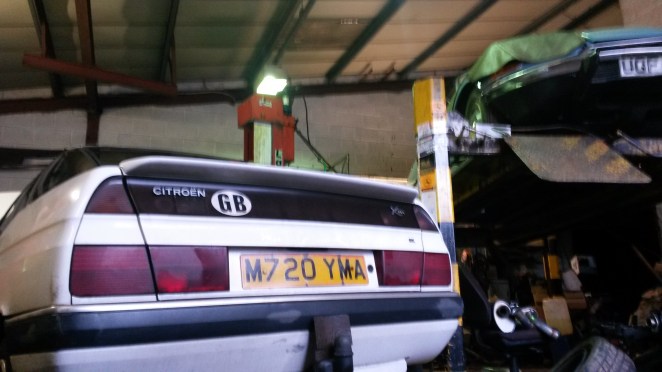
The problem with modern classics

The XM has recently reminded me just how difficult it can be to run a modern classic. The problem? Parts availability.

The XM was a car that sold over 300,000 units, so it was never exactly rare – albeit Citroen probably wanted to sell more. It was still in production just 15 years ago and was launched in 1989. Yet when I needed just one tiny brake component, I was left frustrated and unable to find what I needed.

XM brake overhaul

Discovering the problem, a month ago!

There are two problems here. One is that Citroen is generally HOPELESS at supplying parts for older cars. Unlike the German manufacturers – BMW and Mercedes-Benz seem able to supply pretty much any part you’ll need – Citroen instead starts to ramp up the cost of parts after, well, about 15 years. When demand understandably dies away, they then clear their stocks and suddenly you can’t get the parts at all. We’ve already seen this with the GS, CX and BX and now the XM is next in line.

It isn’t just Citroen to be fair, other manufacturers can be just as sniffy. They blindly refuse to support older models as they only want to deal with people who buy new. They ignore the brand loyalty that a lot of owners have – someone with a Citroen DS might well own a C5 for instance.

So yes, Citroen could supply me with a brake slider kit, but they wanted £50 for it. Ludicrous. But here’s problem number two. Something had gone wrong in the information sent to motor factors to show what size slider is fitted. When the XM moved to a larger design, it seems no-one thought to tell the wider world. So, I could buy a slider kit for a far more realistic £12, but it was the wrong size. That effectively gives Citroen a monopoly on supply. Nice! As it happens, Chevronics had one kit on the shelf, which I was able to buy for a bit less than Citroen’s price (once delivery and VAT were factored in). Still more than I’d like to have paid, but hey, I have the part now.

You can see how uneven the brake pad wear has been.

You can see how uneven the brake pad wear has been.

I can see this problem only getting worse and I’m sure it’ll be the reason that I stop using an XM as daily transport. There will come a day when some tiny but essential part needs replacing, and I won’t be able to get hold of it. The XM is in that struggle between modern car and fully-supported classic – where suppliers can invest in getting parts remade to plug the gaps. I’ve seen the 2CV go through such a transition, and I’m thrilled to see the BX heading that way too. Question is, will the XM get there before I need the bits? Time will tell.

So, I now have all the components necessary to overhaul the XM’s brakes – I now just need for it to stop raining so I can fit them! It could be a long wait, but hopefully not as long as the search for a brake slider kit…

Let’s just have a quick thing about why this has become such a problem though. Why is it still easier to find geniuine OE spares for classics that are decades old? One reason is commonality. Back in the 1950s and 1960s, parts were often shared between manufacturers. They often used the same headlamps and even brake components. Now, parts are often unique to a model.

There’s greater complexity too. The XM (and many other modern classics) are just in a different league to 1960s classics. A quick glance at the engine bay will tell you that.

I do find this worrying, but perhaps I needn’t stress. After all, if modern classics to begin to fail me, I can always jump in a nice, simple, air-cooled Citroen!

XM: Sphere changing success!

I’ve got a seriously busy workload at the moment. It’s great! I look forward to telling you more about why that is in the new year. However, it is causing me to struggle for tinkering time. I somehow found enough moments in the previous week to rip the Dyane’s engine apart, but the only reason I was working on the Dyane is that it’s in my garage. It seems to have been raining here for weeks, so working on the ‘big’ cars of the fleet is just a complete no-no. That’s a shame, as there’s plenty I could be getting on with. Like the XM’s sphere change.

As you’ll recall from a previous post, I’d run into issues trying to replace the rear centre spheres (months ago!) but a specialist had managed to crack it free for me. When I woke up this morning, it was actually not raining so after enjoying a few minutes of wondrous surprise, I got up and went straight out to work on the XM.

XM on ramps

Essential early morning workout.

The centre rear sphere lives up above the exhaust, under the rear floor. So, it was out with the ramps, suspension on full and nervously reverse the XM up the ramps (they’re about as wide as the tyres are). Then I could crack the sphere off, which would have been better if I’d cracked it the right way first time around. Hey ho. Once I forced my non-breakfasted, very sleepy brain to work out which direction the sphere should turn, it quite easily turned a few milimetres. Now I had to drop the suspension and release the system pressure by undoing the screw on the pressure regulator. This is buried right down the front of the gearbox and is best accessed from below – not an option when the nose of the car is now millimetres from the ground. I had to go in from the top. Which makes a frustratingly fiddly operation as you can’t actually see it.

Not as frustrating as trying to undo a sphere underneath an XM which is on its bumpstops, even if it is on ramps. You see, the human arm just doesn’t bend in quite enough places for you to get your hands where they need to be. Cue lots of wriggling, a lost hat and a fair amount of swearing. The neighbours probably prefer it when I have a lie in…

Eventually, I got my sphere removal tool in place once more and off it came. Almost straight into my face in fact. Naturally, LHM (liquid mineral oil) began dripping everywhere and I’m pretty sure quite a lot of it was mopped up by my hair. I chose not to shower BEFORE this activity with good reason.

Then it was a simple case of lubing the new seal, then trying to fit it in the dark, then trying to fit the new sphere without dislodging said seal. Still in the dark. While not having my hand in quite the right place. And every time i dropped it, it plunged towards my face (saved by the exhaust!).

However, I was soon able to tighten it up hand-tight (all you need) and then it was another frustrating root around the lower reaches of the engine bay to do the regulator screw back up. Then I was able to start the engine, select high and watch the car lift itself gracefully into the air – something it seems much happier to do after this sort of a job than any BX I’ve ever owned.

dead sphere

Alas poor sphere…

I had a peek under the rear, just to make sure there were no signs of escaping LHM, topped up the reservoir (every time you remove a sphere, you lose a little LHM) and dropped the car to normal height. I then gave the rear corners a good bounce. Wow! Floaty!

Back up on high, off the ramps and I was able to go for a test drive. Now, I’ll concede that it still isn’t brilliant – no strut-equipped Citroen ever is – but the ride certainly seems more refined. Still not great over really rough terrain, but out on the open road, it wafts as it should! Going over crests, you feel the car just float back down to its regular running height in a way no coil-sprung car can match. I’m quite seriously pleased. Now I’m STILL trying to find a caliper slider kit (for less than the £50 Citroen wants for what is a pretty small bit of metal) so I can finally overhaul the brakes. Another frustrating business!

XM: Sphere unchanging

I found myself visiting family in Devon this week – another 400 miles for the XM – and on the way home, decided it was about time I visited Tony Weston’s Citroen garage in Gloucestershire. Perhaps he could free the stuck rear centre sphere. It’s a place I’ve always wanted to visit anyway – and rightly so! Check out the works van.

Cripes! A Citroen GSA Service van! Exceedingly rare.

Cripes! A Citroen GSA Service van! Exceedingly rare.

The XM was lifted on the ramp and special tools were deployed. This seems to consist of a centre punch to try and break any corrosion on the threads (I presume) and a massive pair of pliers – the sort that look like you’d use them for removing teeth from a T-Rex. And? Success! They got a firm grip and sure enough, with a bit of effort from Andrew Weston, the sphere moved. Then he could depressurise the system to enable full removal. Good job I’d brought the replacement sphere with me. Oh. I hadn’t. I’d actually brought the old outer rear spheres that I’d replaced already! Idiot.

XM gets its spheres fettled. Almost.

XM gets its spheres fettled. Almost.

However, I now know that I’ll be able to remove that iffy sphere – we did confirm it was very dead. I’m just waiting for dry weather before I crawl under the XM again. I’m looking forward to seeing what difference it makes to the ride.

I’m a bit frustrated at my own stupidity, but hey, I should be used to it by now. Here’s a video of my day.

XM: Brake caliper overhaul

Yesterday, I hoped to deal with a sticky brake caliper on the XM. Initial inspection revealed torn slider boots. The XM uses a single-pot caliper, with a single slider on which the caliper ‘floats.’ The best calipers simply have (at least) one piston per pad, either side of the disc. As on a 2CV, original Mini or Range Rover. These pistons push on the bad when you press the brake pedal, and braking occurs. The only thing that goes wrong is that the piston gets stuck in its bore due to corrosion, which leads to the brake sticking on – lots of heat, lots of wear and an accident if you don’t sort it out. The use of steel pistons (Mini/Range Rover) doesn’t help here. The alloy ones on my 2CV don’t corrode.

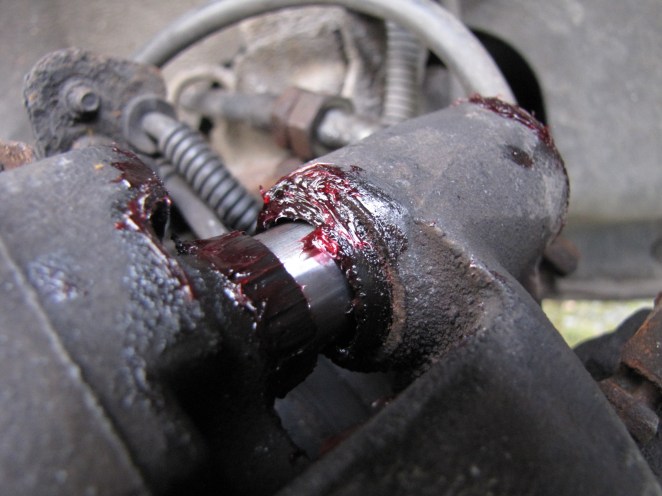
Here's the problem. Torn boot offers no protection for this slider.

Here’s the problem. Torn boot offers no protection for this slider.

Later floating designs cheapen the design by having only one piston. As well as pushing directly on one pad, the pushing power is transmitted by one or two sliders, so you get a gripping pressure on both pads – like your hand crushing a drinks can. Now there is more scope for problems, as these sliders can stick as well as the piston. Again, they can stick in such a way that the brake can’t release – as I once had on my Daihatsu Sirion – or they can stick in such a way that the brake application is uneven – as is the case with my XM right here. That’s because the seals that should protect the slider were torn, allowing muck to get in and damage the slider.

I ordered a new slider, because it seems you can’t order the boots separately. Besides, the old one was probably damaged. I also ordered new discs and pads as the uneven wear had caused one pad to wear very badly, and one side of the disc.

Sadly, I got sent the wrong slider, so this job is abandoned for now. I cleaned up the old slider as best I could, slapped it in red caliper grease, and reassembled. I’m not fitting the new discs and pads until I can fit a new slider. What a pain!

But if you’d like to see the work in action, here is my latest video.

Video: The Eco Car Con

The government is working hard to encourage us to buy brand new, environmentally friendly cars. But is it actually better for the environment than just keeping our existing cars going? Inspired by a question by one of my followers, I decided to investigate.

Could it be that new is not best after all?

Could it be that new is not best after all?

Now, this is not that easy to get to the bottom of, because there are an awful lot of variables. Certainly, my XM doing 10,000 miles a year kicks out about the same amount of pollution as a brand new Land Rover Freelander diesel auto doing the same mileage, or better than an electric car doing 25,000 miles a year. Yes, electric has a dirty footprint too – in the UK at least. Paraguay is actually leading the way with renewables while we still rely on dirty gas and coal. Encouragingly though, this summer apparently renewables were more productive than coal. A step in the right direction?

But it’s manufacturing that still generates most emissions. Now, this will vary dramatically from car to car, but as far as I could find out, building a car the size and specification of my Citroen XM today probably produces about 20 tons of CO2, whereas driving it for a year generates 2.5-3.0 tons. I do more investigation in my latest video.

Dyane: The New To Do List

Having successfully proven that it can actually undertake journeys of a goodly length, the Dyane has nonetheless managed to acquire quite a To Do list.

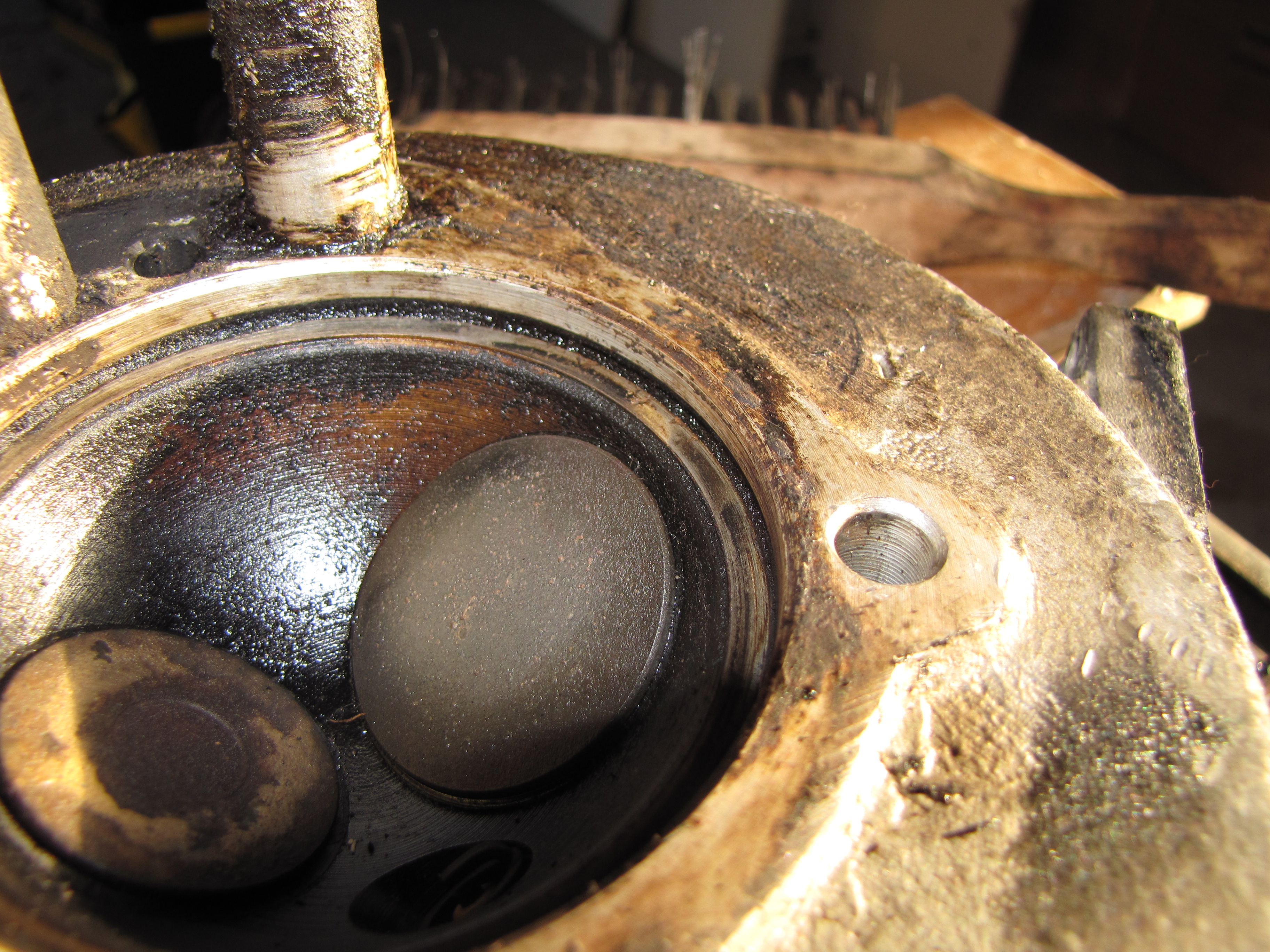
First and foremost, it really does need the cylinder heads removing, lapping in and refitting. There’s a very strong smell of fumes inside the car. This is something of a 2CV trait and is because there is no gasket between the cylinder head and the barrel. Things are made worse if the ignition timing is too advanced, as the subsequent pinking – where the spark plug fires before the piston has reached the top of its travel – puts enormous strain on the joint. I have to hope that the head has not become too corroded.

This joint leaks and causes fumes to enter cabin.

This joint leaks and causes fumes to enter cabin.

You learn as a 2CVer to smell the difference between head fumes and general exhaust fumes. I have one or two leaky clamps so I get that smell too! The cylinder head leak fumes are a bit sweeter. Less sharp. They typically occur when the engine is under high load, with a surge in aroma as you lift off the throttle. Exhaust fumes tend to be at their worse as the car is slowing or travelling downhill on a closed throttle, but in gear. There may also be a popping noise.

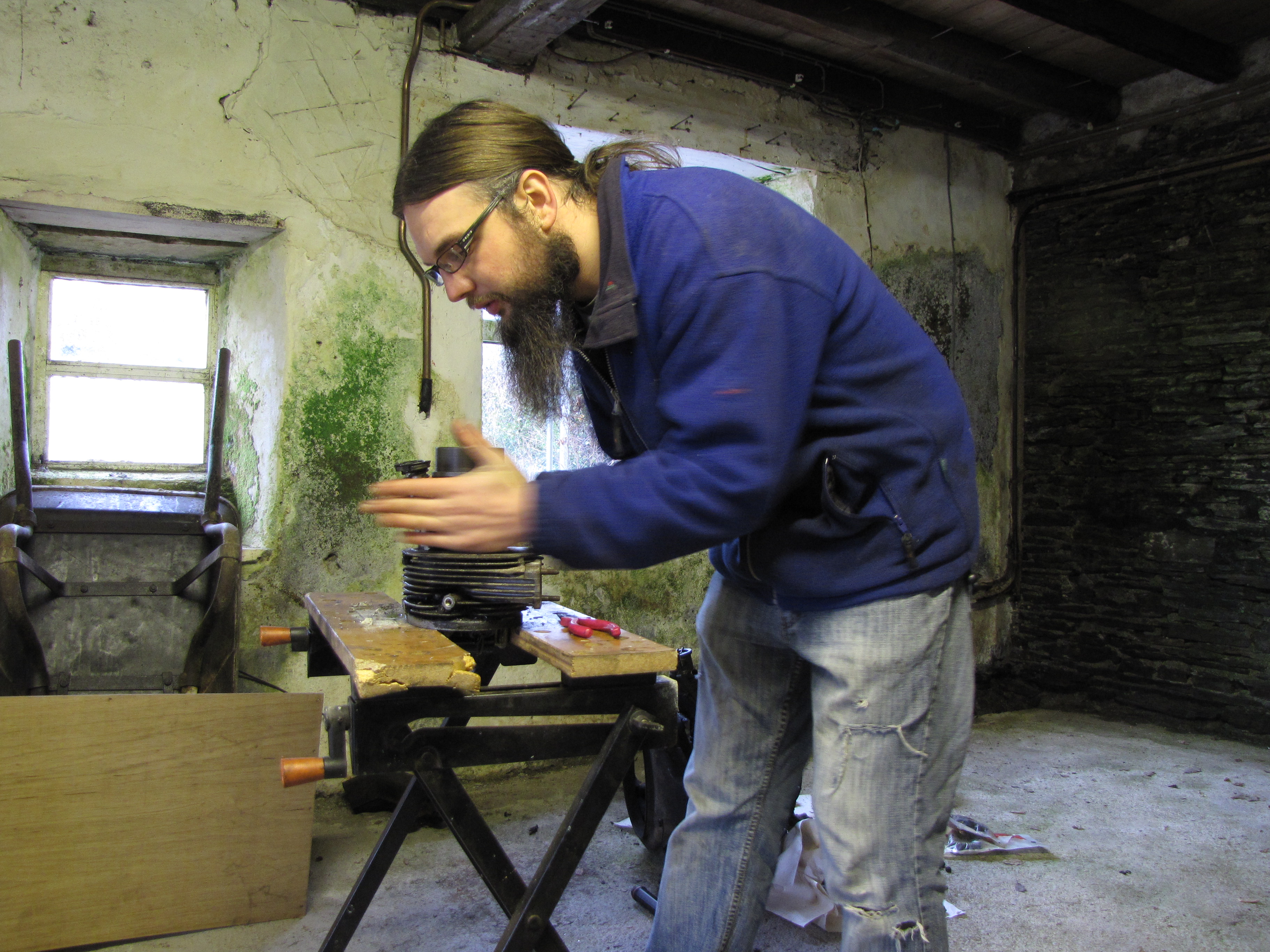
The drill is to get the cylinder head off the car, apply some grinding paste and I use a cut-down barrel to clean up the cylinder head. You turn the old barrel back and forth repeatedly, pushing down as you do so. You have to use a barrel with the cooling fins cut off as the fins otherwise prevent the barrel from turning between the pushrod tubes. You have to do all of this very carefully, as the soft, aluminium head can quite easily be damaged. You need to be especially careful when refitting the head to the engine. Ask me how I know…

I’ll fit new ‘spectacle’ seals when doing that, and will inspect all other oil seals and pipes. The engine is still losing some oil, just far, far less than it was. After 625 miles, the level had dropped to about halfway on the dipstick.

lapping it up

Lapping the cylinder head with an old barrel.

The windscreen wipers and washers need some improvement too, and I need to stop quite so much water getting into the car – though I will also try to reduce wet weather use, especially over the winter. I also have clacking CV joints to replace – the entire lower driveshaft needs replacement, so I’ll probably pinch the good ones from the 2CV.

Finally for now, I’d like to go over the braking system. The front discs have quite a lip on them and may need replacement, while the pedal feels a bit firm to me – I may need to check all is well with the rear brakes. I’m not convinced they’re proving as much stopping power as they should.

This all ignores the fact that there are bodywork problems to overcome too. All in good time. I hope!

Dyane: The zero budget project

I’ve been massively busy with work, community bus stuff and trying to keep the Dyane working for longer than five minutes. It has been a frustrating week or two. I’ll try to recap without getting too waffly.

Intermotor condensers are rubbish. This one lasted barely 5 miles.

Intermotor condensers are rubbish. This one lasted barely 5 miles.

Ever since I collected the Dyane, it’s had an occasional tendency to ‘lose’ tickover. It starts chugging and struggling and makes town driving nightmarish. The first thing to do was to pinch the known good coil from the 2CV. This made no difference. I then set about replacing fuel lines – I could see that the front ones had degraded really quite badly, and suspected the same might be true on the section above the fuel tank. You have to drop the tank to replace this.

This led to a rare moment on this project. I actually had to buy something. There’s no point fitting second hand fuel pipes. A few quid later, I had some new pipe. The front pipework was no bother, and I took the opportunity to fit an in-line filter. Dropping the tank was a right pain, as the underside was caked in mud. A lot of this went in my eyes. Even more went in my hair and beard.

All the old pipe was degrading, but I doubt it was actually enough to cause any running issues. Sure enough, no difference. So, I set about changing the points and condenser. I have loads of old ones. I was planning to take the Dyane to Cholmondeley Castle, but ran out of time. I’d got stuck because using a timing light to set the static ignition timing, the light wouldn’t go out!

While I was away, a friend gave me a fresh set of points and a condenser. These were Intermotor items and the condenser failed after just a few miles. I had to push the car home. Thankfully not far! When refitting an old condenser, I discovered that the connection to the point box was really not very good. That was why I couldn’t get the timing light to go out. I fitted the old condenser, tweaked that connector and reset the ignition timing. Result! She runs beautifully again.

This project is brought to you by almost no budget at all.

This project is brought to you by almost no budget at all.

Throughout this project, I have been raiding my poor 2CV and my parts stash for components. There’s a simple reason for that. I have no budget! I cannot simply throw money at the car, something I think some people struggle to comprehend. “Just fit electronic ignition,” they say – ignoring the fact that buying one would cost me £139 plus delivery. I am therefore hugely grateful to the chap in 2CVGB who sent me a Boyer-Brandsen points-assisted ignition box. I have a similar set-up on the 2CV and it is BRILLIANT. These systems do away with the need for troublesome condensers, and also reduce the voltage going through the points. That means they can last tens of thousands of miles – as the ones in my 2CV have. But you get better starting and cleaner running, just as you do with expensive electronic ignition. I can’t wait to fit it. Until then, I’ll have to keep a spare condenser and tools close to hand.

Having no budget does force you to be resourceful but it is also quite rewarding. I have done LOADS of work to gently improve the Dyane, but it has cost me almost nothing. I even had service items and oil on the shelf (bought in bulk for cost savings). When you live a low-income lifestyle, the luxury of just replacing stuff with new doesn’t exist. It’s a mindset that more people should explore. Naturally, I would prefer to have fitted four brand new dampers, but the truth is that the car now drives much better with just one dodgy old one replaced by a better one stolen from my 2CV. The wheels and tyres were pinched from the 2CV. Low budget doesn’t mean a total disregard for personal safety – the tyres on the Dyane still had tread, but were obviously perished.

For now, the Dyane remains a fixer-upper on the cheap. I think I might like it all the more because of that.

Dyane: A greenlane, more issues

I spent yesterday trying to get to the bottom of the Dyane’s occasional poor running. Sometimes it’ll idle very nicely. Sometimes it’ll idle not at all. I’m having to employ a lot of heel and toe – using all three pedals at once. This is bothersome.

What I actually ended up doing was splitting the carburettor, then somehow dislodging the floats so that when I tried starting the engine, it filled one cylinder with petrol.

Floats in the wrong place. ie my hand.

You can probably see the issue here. With the carburettor rebuilt, I then had to remove the spark plugs as so much petrol had flooded in that the engine would not turn. The pretty, potentially-explosive fountain thankfully was not ignited. I’d cleaned out all of the jets while the carb was in bits, but this seems to have made no difference. More work to do.

Or, I could go greenlaning instead. Guess which option I went for!

Dyane off-road Greenlaning Dyane in the hills of mid-Wales
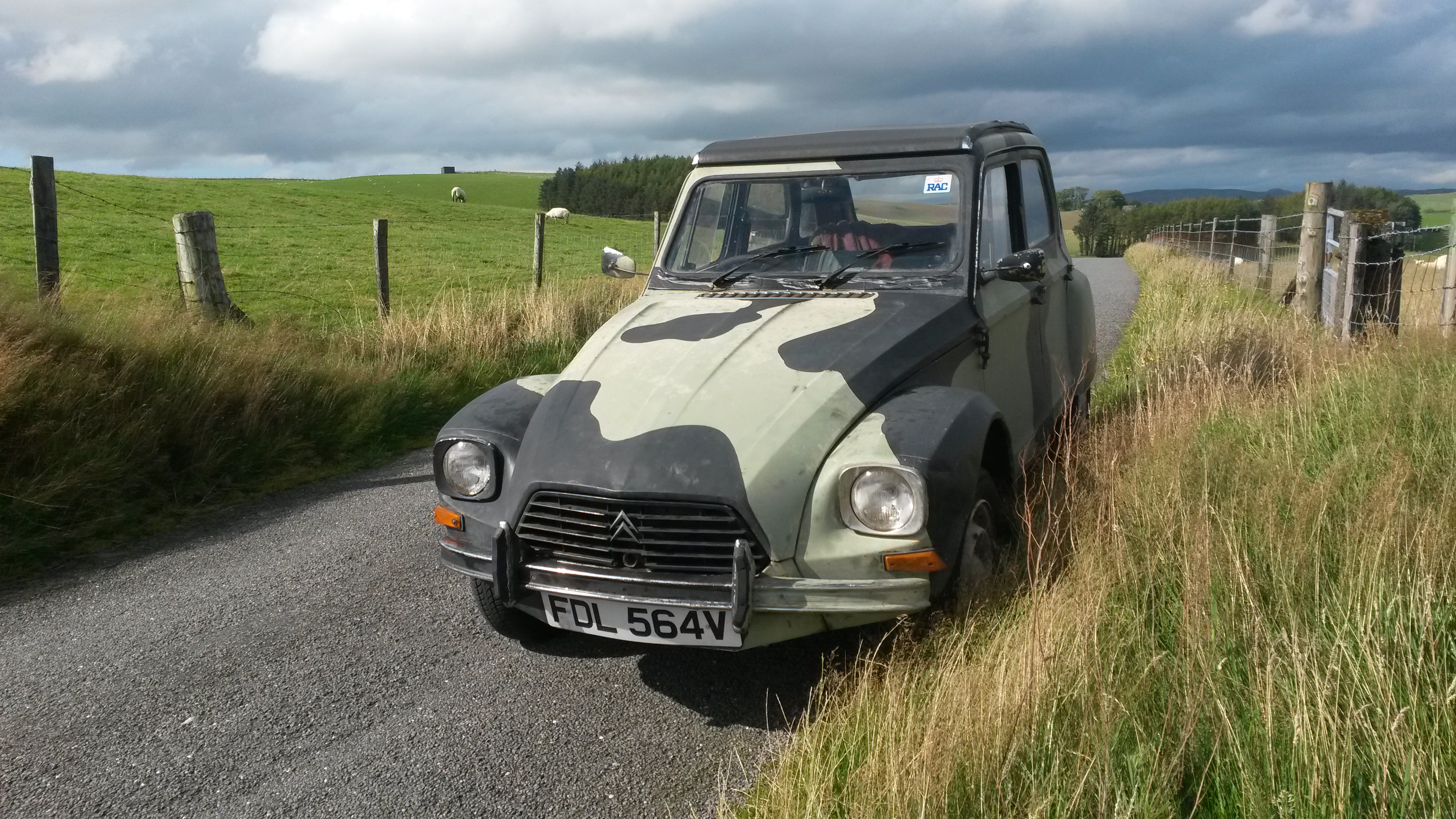
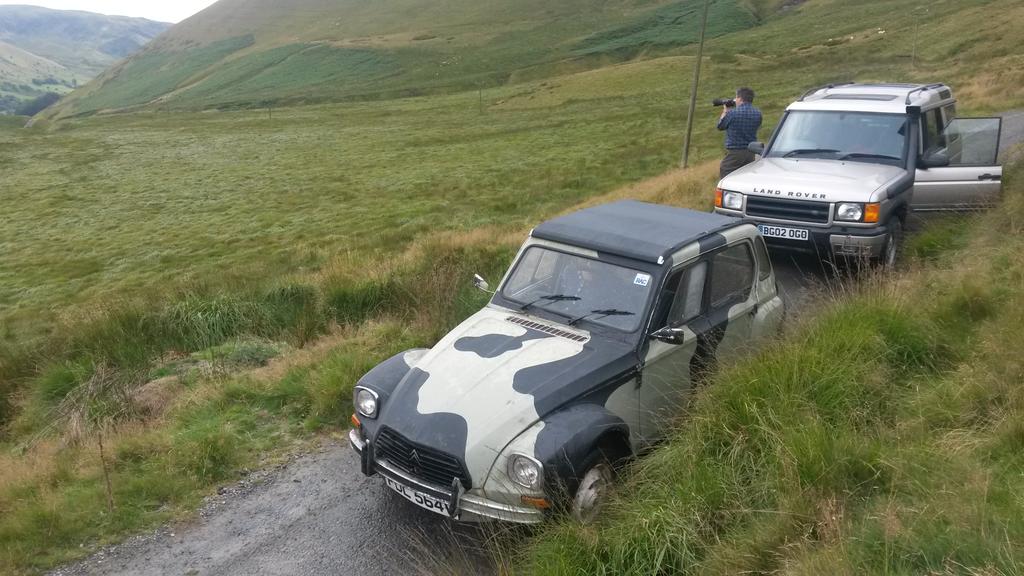
Yes, greenlaning. That is, seeing “Unsuitable for Motor Vehicles” and going for it anyway. The Land Rover is our neighbours, who were joining us as we went Vulcan spotting. Sadly, we failed as the Vulcan was actually running late. This particularly scenic part of mid-Wales lacks any phone signal, so we had no idea. This was the first time I’d tried this Byway – checked on an OS Map and then with local greenlaner types. You’d struggle in a modern, but the Dyane lapped it up. Must do the whole lane at some point.

Having failed at plane spotting, we turned around and headed home. When I got there, I found this:

Yikes

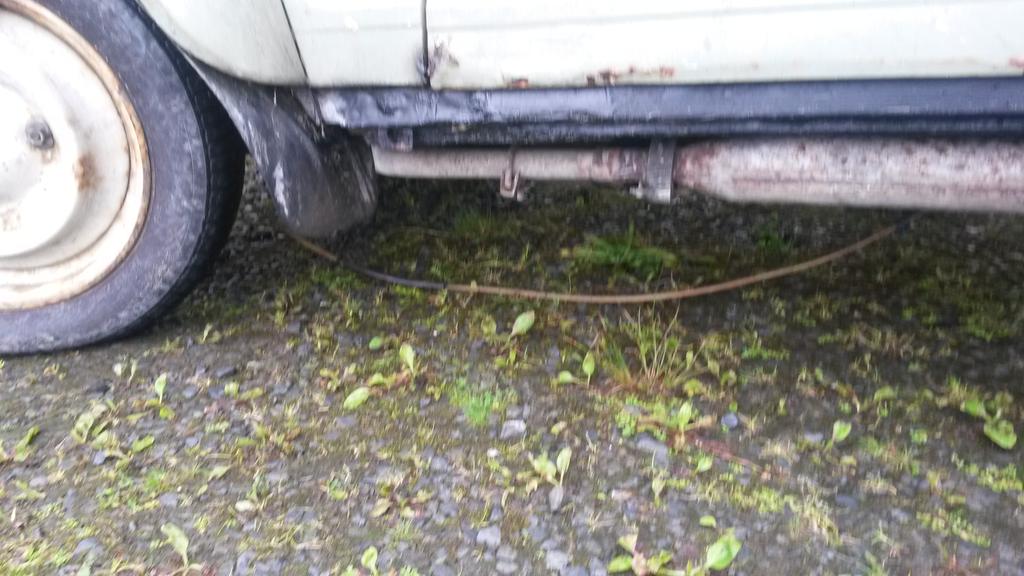
Ah. The fuel line really shouldn’t be on the ground.

Not good. The fuel line must have got snagged on some long grass and had been pulled away from the chassis. Thankfully, there’s a short metal section near the front, which was so firmly bonded to the rubber either side that the pipe had not come away entirely. Just enough to cause a minor leak. I like this car. It seems to refuse to die.

I’ll replace the front pipework and will include an in-line filter. I’ll also find a better way to secure the fuel line further back. I’m prone to explore greenlanes. I need a better solution! It may be that this isn’t helping with the poor running. We’ll see.

One thing I must say though. I may have to fast-forward my art project plans for this car. Some have told me I should keep it as it is, and I do see the appeal in that – it appeals to my lazy side. However, the biggest problem with this car is that EVERYONE jokes that they can’t see it when I post photos. It was slightly amusing the first time but every time? Really?!

I’m going to have to get creative all the sooner I think.

Dyane: Actually working! Sort of

Unsurprisingly for a vehicle that was last taxed in 1995, the Dyane is proving rather a project. Having successfully got it home (somehow), the tinkering began in earnest. I began work last week, but then had to dash off to Anglesey for the 2CV 24-hour race – what an epic adventure that was. I’d hoped to go in the Dyane, but realised about halfway through Wednesday that this wasn’t an option.

After getting back home, I could return to the fettling. Monday saw me achieve a great deal. The ignition timing was set, the alternator wiring was repaired and the wiper linkage replaced. That’s one MOT advisory dealt with right there. Sadly, doing all this just after the 24-hour race was rather a mistake, and Tuesday was mainly spent in a great deal of pain, feeling absolutely awful.

Yesterday, I got the Dyane back together again. The exhaust was blowing, but I needed lunch, needed to go shopping first and the Dyane was going to take me whether it wanted to or not!

Out on the open road!

Out on the open road!

I did attempt the drive with the roof back, but didn’t even make it off the driveway before it began to rain. Roof back on. Then it REALLY pelted it down! Fortunately, the speedy little wipers were up to the challenge. Thank goodness I’d changed that linkage.

Around town, the stiff clutch and occasional lack of idle proved annoying. I don’t think there’s much I can do about the former, but I will try getting some lube into the cable in case that’s the fault. The idle is likely to be gunk in the carburettor. I’ll have to get the jets out for a clean, and perhaps take the top of the carburettor off to check whether there is muck in the float chambers. I must also fit an in-line filter.

On returning home, complete with new bolts that don’t fit the clamp I was hoping to use (go me!), I discovered that the crossbox to swan neck joint was completely loose. No wonder it was noisy! If you imagine the sort of hideous noise a Harley Davidson makes, it was like that but (if you can believe such a thing) even worse. Accessing that clamp on a Dyane is a right pain, but I found that reasonable access was on offer if I removed the nearside front wheel. So, while doing that, a good time to put grease in the kingpins eh?

The pin refused to take grease. Probably because old, hard grease was clogging everything up. So, now I had to get a blowtorch to gently warm the kingpin housing. I removed the grease nipple and watched a hideous stream of manky old grease ease out. Then I could finally get fresh grease in.

And that’s what this car is like. One job inevitably turns into several jobs, and every job seems to throw up issues of some kind! This is what happens with cars that have been off the road for some time. At least it’s giving me plenty to write about!

Other issues I know are on the horizon are a clattering CV joint (only occasionally), a possible sticky front brake (nearside) and I need to see if the engine is still losing oil. I’ve replaced the crankcase breather in the hope this’ll encourage oil to stay inside. I’m just over a week away from a long trip to the Cholmondeley Castle classic show, so need to keep tinkering away!