Ranty Yan: Disappearing Trim Levels

I can’t make head nor tail of modern trim levels on cars. They usually involve some marketing guff that creates some meaningless name such as Eronomy or DreamSpiritEcstacyWaft which could be bottom of the range, a sporty little number or the most luxurious version you can get. One thing’s for sure, they’ll all look exactly the same.

Not like the good old days. Remember when a Fiesta could be had as a Popular or a Ghia? One was painfully lacking any sort of kit, while the other was plush and crammed with velour and a five-speed gearbox. Here’s a pic to show how easy it is to spot a sporty Fiesta against the complete poverty model – or perhaps austerity is a topical phrase to use.

Fiestas compared. Very obviously different.

How different can you get? Notice that the black XR2 has driving lamps, a bodykit, a sunroof and pepperpot alloy wheels. The Popular doesn’t even get a rear wiper. Or wheel trims. Or a passenger door mirror. It is very obviously the bottom of the range.

Here’s another comparison. First up, the Vauxhall Cavalier Mk2 SRi.

Sporty Cavalier goodness.

Undeniably sporty. Again, alloy wheels help give the game away, but there is a subtle chin spoiler and sill trims, while spotlights, headlamp wipers and side graphics ensure everyone in the sales manager car park knows that this is a premium product.

This is a Vauxhall Insignia SRi.

Sporty my arse.

This is a normal Insignia.

Yawn.

Ok, so it looks like front fog lamps still make a difference, but the SRi doesn’t really look sporty does it? The Design is what I think is bottom of the range – it’s one of those stupid non-name names. They should call it the Deluxe, or Fleet. There should actually be a difference!

Of course, it’s always harder to sell a bottom of the range car if it screams Austerity in the same way as a Ford Fiesta Popular, or a Vauxhall Astra Merit. Buyers don’t really want a car that shouts how much of a skinflint they are apparently. Or if they do, they just buy second-hand instead. But could they not make a bit more effort? Should a Vauxhall SRi not at least have a bit of red trim or lairy, Recaro seats? I know they have the sporty VXR models for those really desperate to try and look cool whilst catering for the family – a bit like putting alloys on your pushchair – but the SRi was always about having that sporty look without necessarily having that much grunt. It was a bit more trouser, but not the full blown latex shorts. At the very least, it was about looking different. Something manufacturers seem more and more scared of doing. Come on folks. Swallow a brave pill and give us back some actual variety.

Dyane: The New To Do List

Having successfully proven that it can actually undertake journeys of a goodly length, the Dyane has nonetheless managed to acquire quite a To Do list.

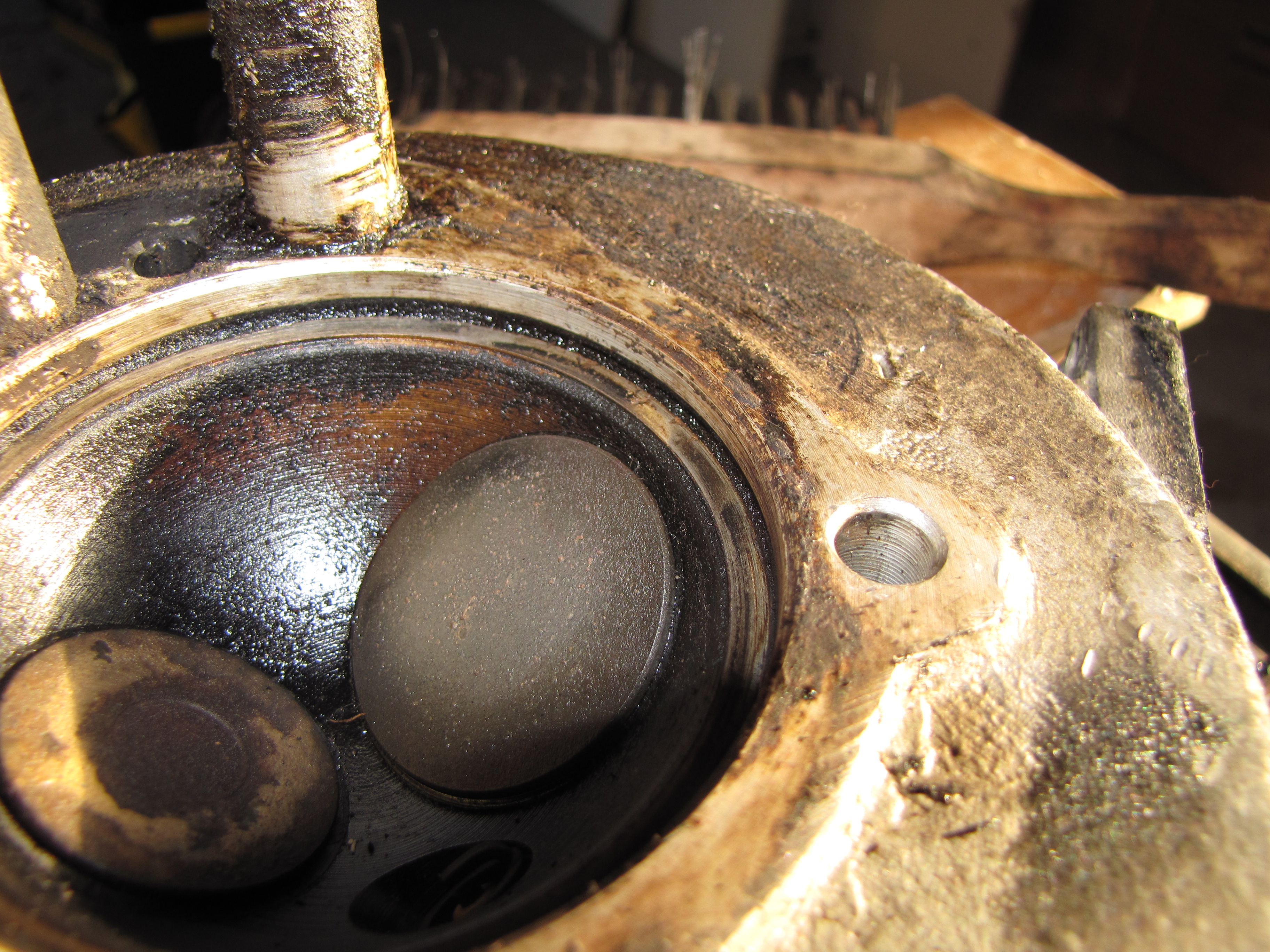
First and foremost, it really does need the cylinder heads removing, lapping in and refitting. There’s a very strong smell of fumes inside the car. This is something of a 2CV trait and is because there is no gasket between the cylinder head and the barrel. Things are made worse if the ignition timing is too advanced, as the subsequent pinking – where the spark plug fires before the piston has reached the top of its travel – puts enormous strain on the joint. I have to hope that the head has not become too corroded.

This joint leaks and causes fumes to enter cabin.

This joint leaks and causes fumes to enter cabin.

You learn as a 2CVer to smell the difference between head fumes and general exhaust fumes. I have one or two leaky clamps so I get that smell too! The cylinder head leak fumes are a bit sweeter. Less sharp. They typically occur when the engine is under high load, with a surge in aroma as you lift off the throttle. Exhaust fumes tend to be at their worse as the car is slowing or travelling downhill on a closed throttle, but in gear. There may also be a popping noise.

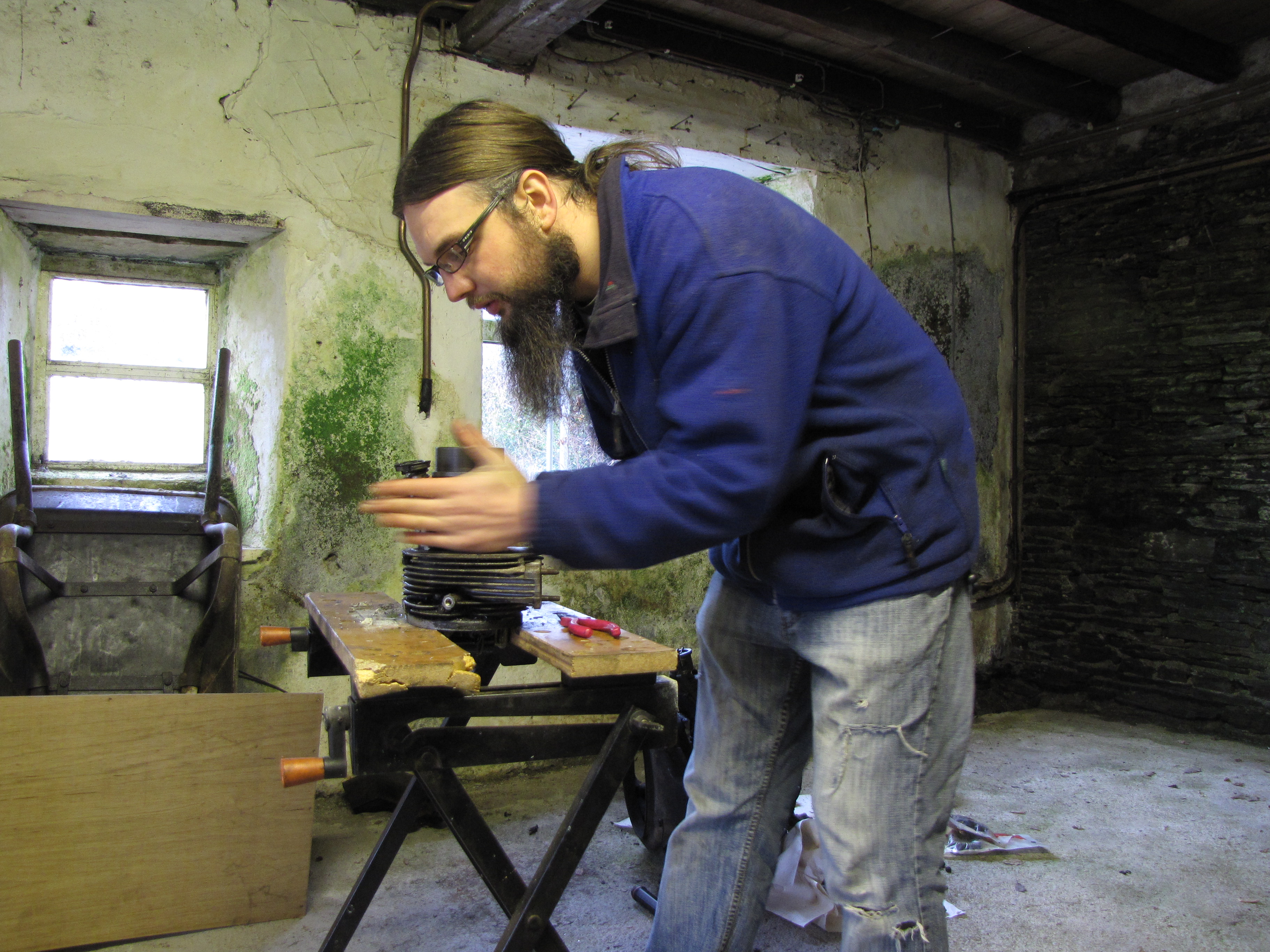
The drill is to get the cylinder head off the car, apply some grinding paste and I use a cut-down barrel to clean up the cylinder head. You turn the old barrel back and forth repeatedly, pushing down as you do so. You have to use a barrel with the cooling fins cut off as the fins otherwise prevent the barrel from turning between the pushrod tubes. You have to do all of this very carefully, as the soft, aluminium head can quite easily be damaged. You need to be especially careful when refitting the head to the engine. Ask me how I know…

I’ll fit new ‘spectacle’ seals when doing that, and will inspect all other oil seals and pipes. The engine is still losing some oil, just far, far less than it was. After 625 miles, the level had dropped to about halfway on the dipstick.

lapping it up

Lapping the cylinder head with an old barrel.

The windscreen wipers and washers need some improvement too, and I need to stop quite so much water getting into the car – though I will also try to reduce wet weather use, especially over the winter. I also have clacking CV joints to replace – the entire lower driveshaft needs replacement, so I’ll probably pinch the good ones from the 2CV.

Finally for now, I’d like to go over the braking system. The front discs have quite a lip on them and may need replacement, while the pedal feels a bit firm to me – I may need to check all is well with the rear brakes. I’m not convinced they’re proving as much stopping power as they should.

This all ignores the fact that there are bodywork problems to overcome too. All in good time. I hope!

Dyane: The Goodwood Revival Mission

I had hoped to take the Dyane to the 2CV 24hr. It was broken. I had hoped to take the Dyane to Cholmondeley Castle. It was broken. Two days before the Goodwood Revival 2015, it was broken. But I would not be defeated a third time. Frantic fettling occurred including replacing all of the rubber fuel line, opening the carburettor and cleaning the jets out (more than once) and replacing the points and condenser. Then replacing the new condenser again after it almost immediately failed.

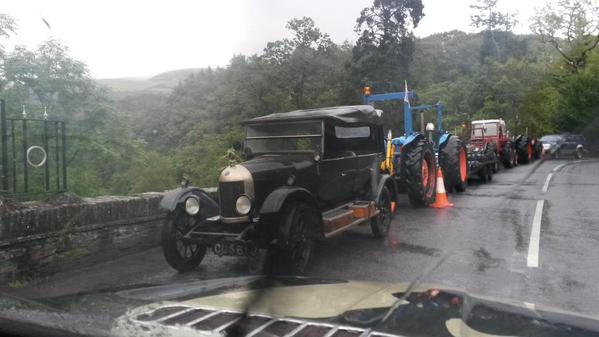
In the week leading up to Goodwood, the Dyane was struggling to complete just one short journey without breaking. On the Tuesday before, I had even had to push it home. So, I was a bit anxious when I got up on Saturday morning. The plan? Drive to Sussex, enjoy a kip at my sister-in-law and family’s home, spend Sunday at the Revival, then drive home Monday. So, stage one was get to Sussex – about 270 miles away. The journey started well as a tractor run was visiting our village. Some classics had joined the fun.

Lovely old Morris Cowley sitting in the rain.

Lovely old Morris Cowley sitting in the rain.

Not a bad start. I drove over the entertaining Elan Valley Mountain Road and tried to ignore the sound of the fanbelt trying to escape. I need to replace it but didn’t have a better one. I had a spare BX belt as emergency back-up.

After a couple of hours, I had almost reached something approaching a dual carriageway. I stopped in the pretty town of Crickhowell to visit independent traders and stock up on supplies.

Dyane pauses in the sunshine in Crickhowell.

Dyane pauses in the sunshine in Crickhowell.

I did consider rolling the roof back, but opted not to. As I encountered fierce showers on the M4, this was the correct choice. After a great many hours, the M25 was encountered. Incredibly, the car was still running beautifully. At a previous service check, I had discovered that it had lost pretty much none of its engine oil. A far cry from the first drive back to Wales, when it seemed to lose quite a bit. Perhaps that newer breather has done the trick. Naturally, things slowed down on the M25 and as I wasn’t moving at the time, I snapped this pic.

Stationary on the M25. Quelle surprise.

Stationary on the M25. Quelle surprise.

The traffic may have been a blessing. The steering wheel obscures the fuel gauge, plus the XM has got me in the habit of rarely checking the level, because it can drive 800 miles on one tank. When I did finally look at the Dyane’s gauge, it was rather low! I managed to get to Cobham services, which was horrendously busy, but parked up away from the building to munch on pre-bought supplies, and then got 23 litres of fuel into the 25 litre tank. Close.

I made it to Sussex tired, but very, very pleased with the little Dyane. It had run majestically all the way and despite me thrashing it pretty heavily – cruising at 65-70mph where traffic levels permitted – it had returned 45mpg. The next day, I set off early and avoided the worst of the queues. Me and the Dyane had made it to the Revival!

Dyane and hippy me at the Revival.

Dyane and hippy me at the Revival.

At this point, I need to thank several people. My friend Pete Sparrow sorted me out with a complimentary ticket, as he was driving one of the safety cars. Unfortunately, I managed to leave this ticket at home, which I realised as I was driving towards the event. Oops. I secondly need to thank Andrew Page, who sell autoparts. A frantic call to a friend and they were kind enough to sort me out with a pass for the day. You can’t believe how grateful I was! The bacon was saved.

I’ll talk about the event itself some other time, but it was suitably amazing. It was my first visit in six years, but was every bit as good as I remember. Expensive too. £6.80 for a bacon roll! I was thankful that my sister-in-law had provided me with food.

My good lady wife deserves a special mention, as my colourful outfit – her handiwork – went down very well indeed. As I wandered barefoot around the aircraft displays, I realised this was the most comfortable my feet had ever been at this event. Previously, I’d always dressed smartly – and uncomfortably! The hippy look is recommended. (I had -non-sixties sandals for the gravelly bits!).

Another sleep and it was time to drive home after a really fantastic weekend. I was calling in to see the chap who sold me the Dyane on my way back, to collect a few spares. That meant driving along the south coast and that was as horrible as it always is. I’ve got to go back to Portsmouth in a week’s time to catch a ferry. Joy.

An accident on the M27 didn’t help matters, and my ‘quick’ diversion through Southampton saved me no time at all. I rejoined the motorway with the traffic I’d left behind at the previous junction. Worse, the Dyane had begun spluttering and refusing to idle again. However, that didn’t really matter on the motorway and after a couple of hours of foot-to-the-floor, it got rid of whatever was ailing it and ran beautifully again.

After finally making it to Warminster, I collected bits, drank a much-needed cup of tea and headed northwards. Actually, I thought it was probably time to look at the fuel gauge again. JEEPERS! It was some way below zero. I limped to a petrol station and fitted 25.5 litres into the 25 litre tank… I’m an idiot.

I’m utterly sick of the M4 Toll and refuse to pay it, so that meant Gloucester and the pretty roads of Monmouthshire – where this Dyane used to live. It continued to run very well. In fact, I was not doing half so well as the car. I’d replaced some seat rubbers before the trip, but none in the seat back itself. This was a mistake and backache was very much setting in! Despite the emergency measure of sticking a jumper behind my back.

I was very tired as we crossed the border and thought a short break was wise.

A quick pause in Wales

A quick pause in Wales.

It was still raining. I’d been battling through showers and mild flooding since the very start of the journey. The wipers were struggling to cope. In fact, at 70mph, they were struggling to stay on the windscreen! Side gales near Bristol left me worried that the wipers were simply going to blow away. I need to make improvements here.

But, some nine hours after leaving Sussex, I’d made it home. In three days, me and the Dyane had covered 652 miles together, which is pretty impressive! It takes our total tally to very nearly 1000 miles since purchase. Given how much of that time the Dyane has spent in the garage being broken, that’s really not so bad at all. Well done Dyane. It was the perfect bonding experience. I think I like this car.

Yes, my garage really is that messy. Have a nice rest Dyane. You deserve it.

Yes, my garage really is that messy. Have a nice rest Dyane. You deserve it.

Dyane: The zero budget project

I’ve been massively busy with work, community bus stuff and trying to keep the Dyane working for longer than five minutes. It has been a frustrating week or two. I’ll try to recap without getting too waffly.

Intermotor condensers are rubbish. This one lasted barely 5 miles.

Intermotor condensers are rubbish. This one lasted barely 5 miles.

Ever since I collected the Dyane, it’s had an occasional tendency to ‘lose’ tickover. It starts chugging and struggling and makes town driving nightmarish. The first thing to do was to pinch the known good coil from the 2CV. This made no difference. I then set about replacing fuel lines – I could see that the front ones had degraded really quite badly, and suspected the same might be true on the section above the fuel tank. You have to drop the tank to replace this.

This led to a rare moment on this project. I actually had to buy something. There’s no point fitting second hand fuel pipes. A few quid later, I had some new pipe. The front pipework was no bother, and I took the opportunity to fit an in-line filter. Dropping the tank was a right pain, as the underside was caked in mud. A lot of this went in my eyes. Even more went in my hair and beard.

All the old pipe was degrading, but I doubt it was actually enough to cause any running issues. Sure enough, no difference. So, I set about changing the points and condenser. I have loads of old ones. I was planning to take the Dyane to Cholmondeley Castle, but ran out of time. I’d got stuck because using a timing light to set the static ignition timing, the light wouldn’t go out!

While I was away, a friend gave me a fresh set of points and a condenser. These were Intermotor items and the condenser failed after just a few miles. I had to push the car home. Thankfully not far! When refitting an old condenser, I discovered that the connection to the point box was really not very good. That was why I couldn’t get the timing light to go out. I fitted the old condenser, tweaked that connector and reset the ignition timing. Result! She runs beautifully again.

This project is brought to you by almost no budget at all.

This project is brought to you by almost no budget at all.

Throughout this project, I have been raiding my poor 2CV and my parts stash for components. There’s a simple reason for that. I have no budget! I cannot simply throw money at the car, something I think some people struggle to comprehend. “Just fit electronic ignition,” they say – ignoring the fact that buying one would cost me £139 plus delivery. I am therefore hugely grateful to the chap in 2CVGB who sent me a Boyer-Brandsen points-assisted ignition box. I have a similar set-up on the 2CV and it is BRILLIANT. These systems do away with the need for troublesome condensers, and also reduce the voltage going through the points. That means they can last tens of thousands of miles – as the ones in my 2CV have. But you get better starting and cleaner running, just as you do with expensive electronic ignition. I can’t wait to fit it. Until then, I’ll have to keep a spare condenser and tools close to hand.

Having no budget does force you to be resourceful but it is also quite rewarding. I have done LOADS of work to gently improve the Dyane, but it has cost me almost nothing. I even had service items and oil on the shelf (bought in bulk for cost savings). When you live a low-income lifestyle, the luxury of just replacing stuff with new doesn’t exist. It’s a mindset that more people should explore. Naturally, I would prefer to have fitted four brand new dampers, but the truth is that the car now drives much better with just one dodgy old one replaced by a better one stolen from my 2CV. The wheels and tyres were pinched from the 2CV. Low budget doesn’t mean a total disregard for personal safety – the tyres on the Dyane still had tread, but were obviously perished.

For now, the Dyane remains a fixer-upper on the cheap. I think I might like it all the more because of that.

Snobbery, and provoking it

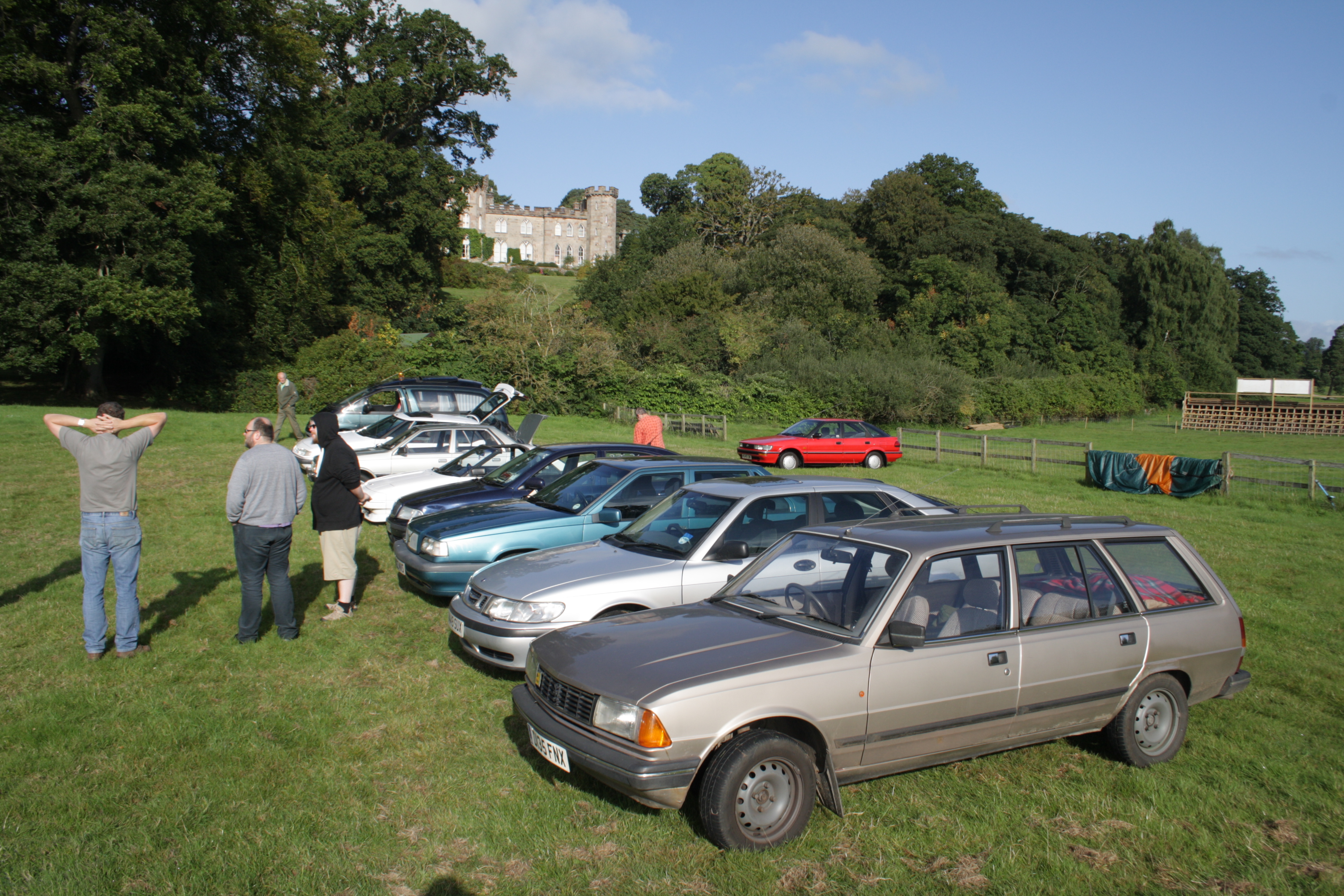
The past weekend saw Autoshite descend upon the Cholmondeley Castle classic car show. It was brilliant. Within minutes of arriving on site, one club took so much offence to our cars that they drove elsewhere on site! Autoshite had had the audacity to arrive in seven fairly modern classics, all in somewhat shabby condition admittedly. I had hoped to clean the XM, but hey, it’s my daily driver. Even if I had cleaned it, I’d driven about 60 miles in it just getting to the show.

The 1993 Toyota Lucida Estima Charme Pleasure Wagon seemed to cause particular offence, but given the event is for cars built before 2000, I can’t see what their problem was. Ok, so one car was a 2001 Skoda Octavia, but then one of their cars was a sodding 2003 Vauxhall Astra! We didn’t mind. They were replaced by the Toyota Enthusiasts’ Club, who were a jolly decent bunch displaying some lovely motors, and some deliciously dreary Corollas. Wonderful.

Autoshite

Disturbing images that caused Vauxhalls to flee. Yes, we were drying our tents in the sun.

We heard many derogatory comments over the duration of the show, but it’s water off a duck’s back to be honest, just as I’m perfectly able to ignore ‘experts’ proclaiming that Citroen hydraulics are nothing but trouble. What was pleasing was the POSITIVE comments we got, and there actually were some. We got pretty much ignored by the compere – but then he seemed rather short of car knowledge so probably just didn’t know what our cars were. Highlights of his commentary included a ‘nice Audi’ (actually a DKW 1000) and a Ford Corsa. (Corsair).

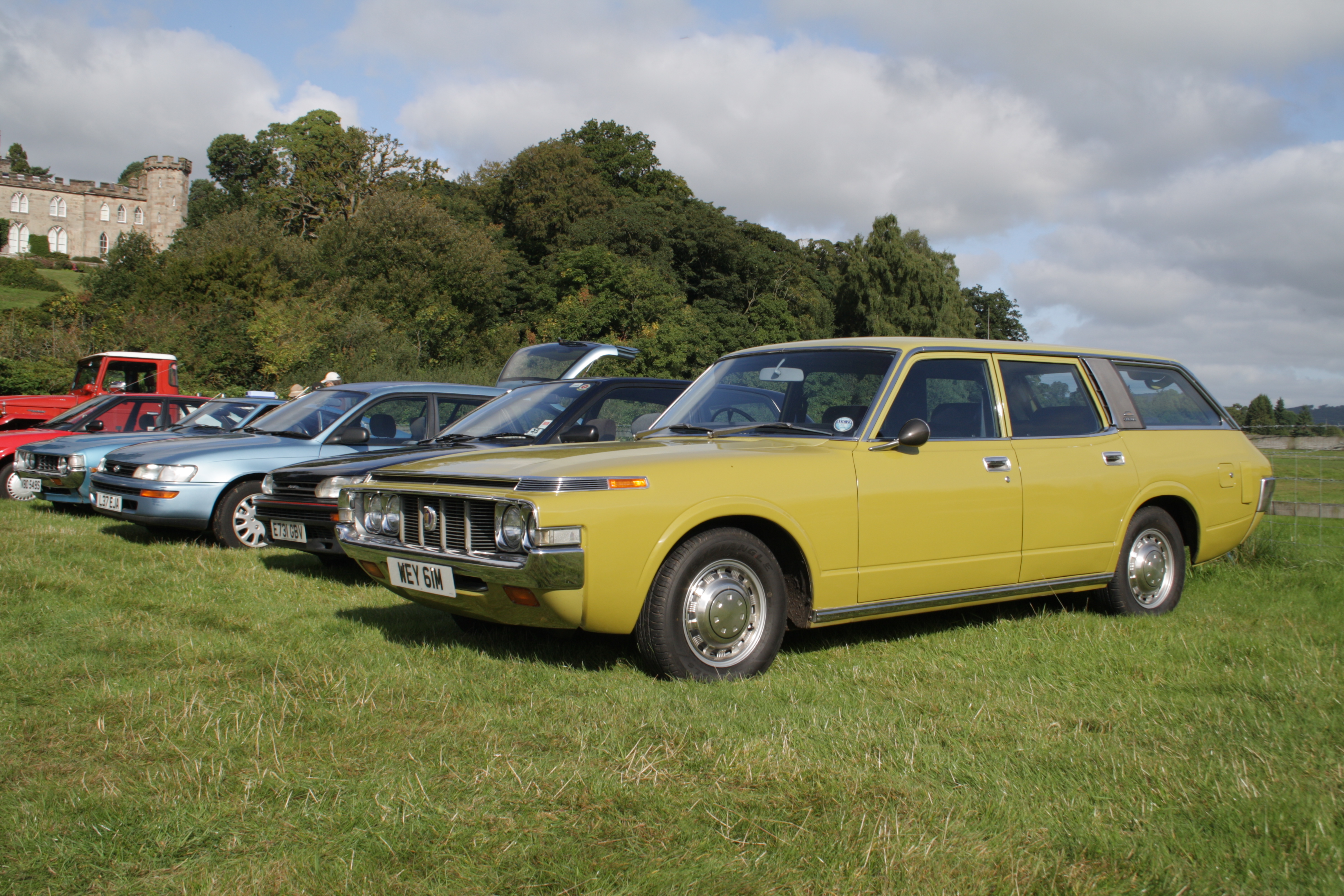
It was a great show really. There was a huge variety of classics on display, of all eras and types. From enormous Americana to Alpine Renaults, 1930s Austins to Toyota Crown estates. It’s nice to that a lot of visitors did take an interest in our cars. Some of them had travelled from as far as Fife (Volvo 850 TDi) and Glasgow (Kia Pride, Volvo 740 and Citroen AX 1-litre). These cars may not be shiny, but there’s enormous pride of ownership. Loving your car does not have to mean you get the cotton buds out to polish the exhaust pipe. Some like to keep their cars immaculate, and that’s fair enough. But there needs to be room in the classic car world for cars that aren’t immaculate or particularly common.

Toyota

What a fabulous rarity! Toyota Crown Custom estate.

I’ll certainly continue take pride in my shambolic fleet. Some cherish, some prefer to use. My 2CV would still be immaculate if I had cherished it more after its restoration, but I bet I wouldn’t have had half as much fun in it. So, don’t judge cars that aren’t perfect. They may have many interesting tales to tell, if only they could.

20 years of driving – well done me

Last month, it became 20 years since I passed my driving test – at the wheel of a Vauxhall Corsa resplendent in British School of Motoring livery. This fact startles me a little. How is it two decades ago already?!

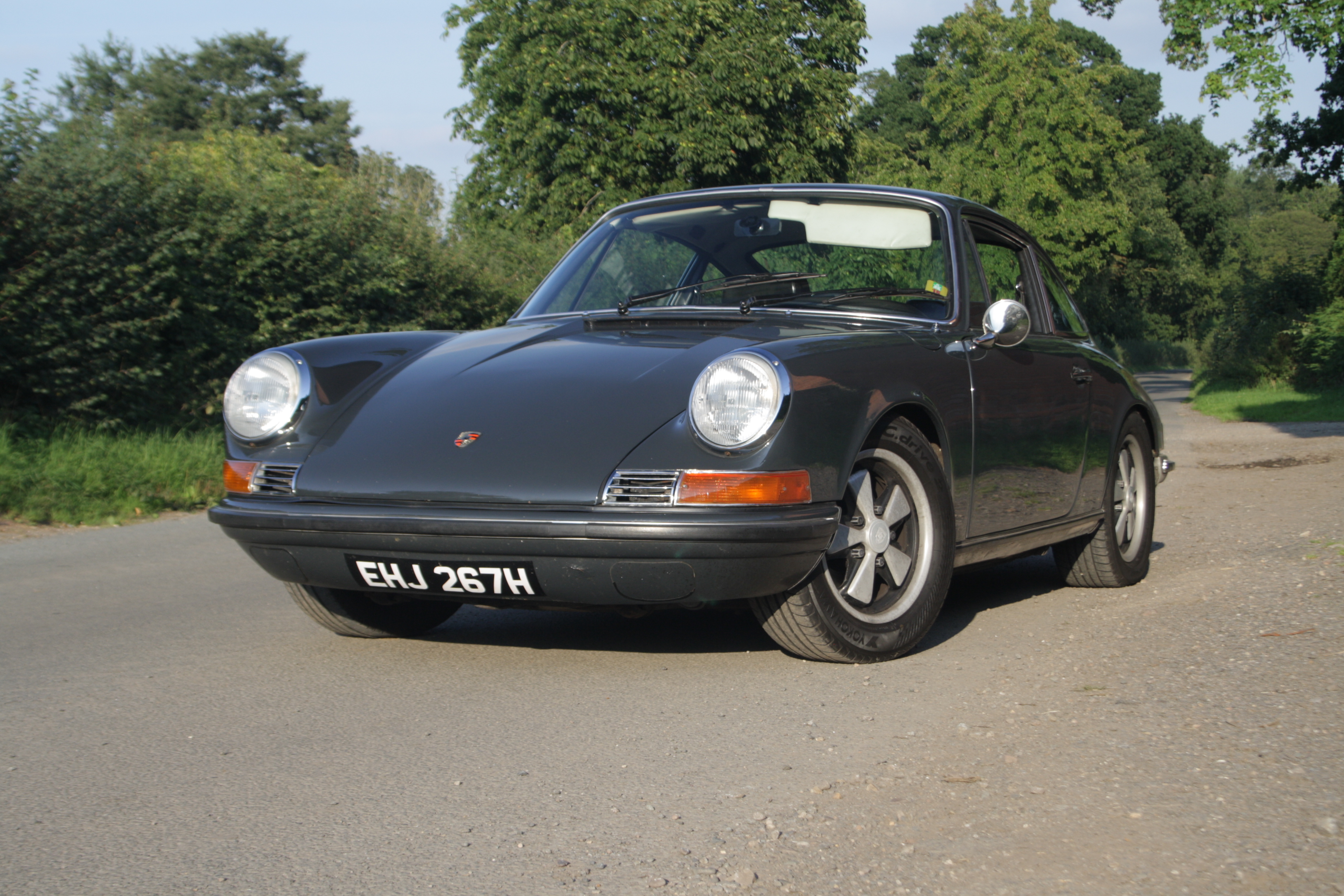
As luck would have it, I found myself yesterday driving on the roads I sometimes used when learning to drive, and very often used once I had cars of my own. Roads in what was Hereford and Worcester back then, but is a mixture of Warwickshire and plain old Worcestershire now. I remember how much fun these roads were. How fabulous then that I was getting to enjoy them from behind the wheel of a Porsche 911T – you’ll have to wait quite a while to read my full report on that I’m afraid. You can drive the car yourself at Great Escape Classic Car Hire.

Porsche 911

Desperately seeking excellent driving roads in a 911.

Alas, there was disappointment, for it seems that many of these roads have now had 50-mph speed limits imposed upon them. Even when driving a Porsche, I’m very reluctant to exceed a speed limit. This was frustrating. I should have remembered really, as these are much the same roads I used when I tested a Tesla Model S last year!

To get my 60mph kicks, I was often forced to take smaller, twistier roads where even in a 911, I didn’t really dare do 60mph. Visibility was insufficient for a start, but this is the countryside, which means horses, walkers and tractors. It’s too dangerous to drive at full chat.

A far cry from my journey home then, which saw me tackle three absolutely outstanding and very challenging roads. The first is the A4117 that goes from the A456 at Callow Hill, through to the A49 at Ludlow. As well as the staggering views from Clee Hill, the road chucks occasional very sharp bends at you, and rarely manages to be straight for any length of time. In the peaceful, dusky conditions, I was able to drive the XM very briskly (within the speed limits). It was an absolute hoot.

After a short spell on the A49, it was time for Challenge Two – the A4113 that takes you through the pretty village of Leintwardine. Before that, it is another twisty challenge, with many bends that can catch out the unwary. Concentration really does have to be set to maximum. Some bends are tight enough to require second gear.

XM rear

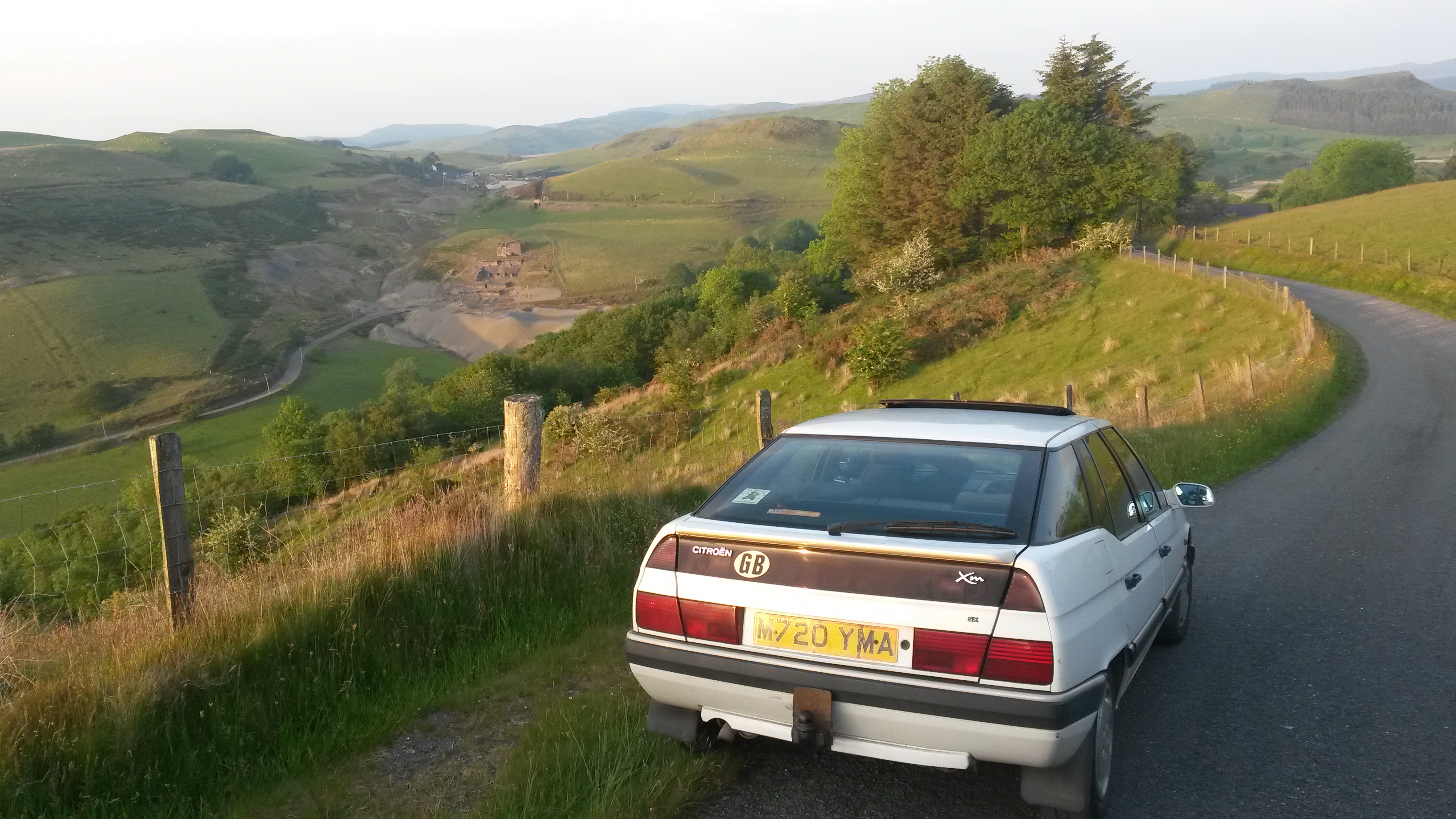
The XM is an absolute delight on Welsh driving roads.

From Knighton, I then headed along the A488 to Pen-y-Bont. This road is another vigorous test of driver and car, and I’ve been witness to the aftermath of no fewer than three accidents along its length – albeit one of those was in snow. One of those cars was on its roof though! Again, plenty of challenges all at entirely legal speeds and with suitable consideration for stopping distances – you cannot drive a public road like a race track, because you don’t know what’s lurking around each corner.

Not that the rest of the journey home wasn’t interesting. I took the Elan Valley Mountain Road for the final leg home, and encountered many foxes in the dark. I was pleased that the sheep were not attempting to sleep on the road. This cannot be guaranteed.

It all left me feeling very glad that I was driving my XM. It has fabulously secure handling, and the low-revving engine lugs you from corner to corner without screaming at you. While it certainly seems that you have to travel a fair way to find good driving roads, I’m glad that twenty years after passing my test, it is still very possible to have a good time on British roads.

Dyane: A greenlane, more issues

I spent yesterday trying to get to the bottom of the Dyane’s occasional poor running. Sometimes it’ll idle very nicely. Sometimes it’ll idle not at all. I’m having to employ a lot of heel and toe – using all three pedals at once. This is bothersome.

What I actually ended up doing was splitting the carburettor, then somehow dislodging the floats so that when I tried starting the engine, it filled one cylinder with petrol.

Floats in the wrong place. ie my hand.

You can probably see the issue here. With the carburettor rebuilt, I then had to remove the spark plugs as so much petrol had flooded in that the engine would not turn. The pretty, potentially-explosive fountain thankfully was not ignited. I’d cleaned out all of the jets while the carb was in bits, but this seems to have made no difference. More work to do.

Or, I could go greenlaning instead. Guess which option I went for!

Dyane off-road Greenlaning Dyane in the hills of mid-Wales

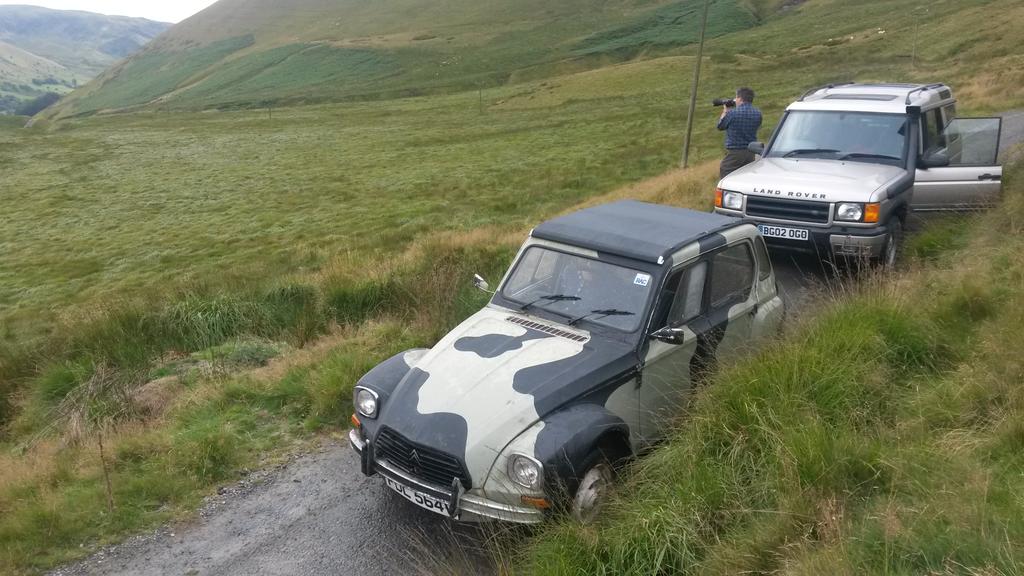
Yes, greenlaning. That is, seeing “Unsuitable for Motor Vehicles” and going for it anyway. The Land Rover is our neighbours, who were joining us as we went Vulcan spotting. Sadly, we failed as the Vulcan was actually running late. This particularly scenic part of mid-Wales lacks any phone signal, so we had no idea. This was the first time I’d tried this Byway – checked on an OS Map and then with local greenlaner types. You’d struggle in a modern, but the Dyane lapped it up. Must do the whole lane at some point.

Having failed at plane spotting, we turned around and headed home. When I got there, I found this:

Yikes

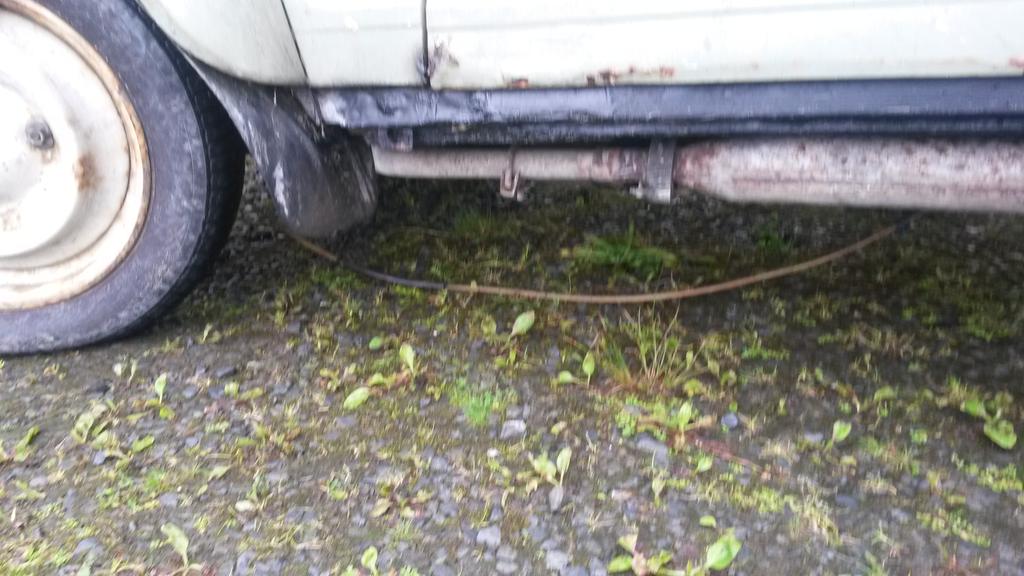
Ah. The fuel line really shouldn’t be on the ground.

Not good. The fuel line must have got snagged on some long grass and had been pulled away from the chassis. Thankfully, there’s a short metal section near the front, which was so firmly bonded to the rubber either side that the pipe had not come away entirely. Just enough to cause a minor leak. I like this car. It seems to refuse to die.

I’ll replace the front pipework and will include an in-line filter. I’ll also find a better way to secure the fuel line further back. I’m prone to explore greenlanes. I need a better solution! It may be that this isn’t helping with the poor running. We’ll see.

One thing I must say though. I may have to fast-forward my art project plans for this car. Some have told me I should keep it as it is, and I do see the appeal in that – it appeals to my lazy side. However, the biggest problem with this car is that EVERYONE jokes that they can’t see it when I post photos. It was slightly amusing the first time but every time? Really?!

I’m going to have to get creative all the sooner I think.

Dyane: Actually working! Sort of

Unsurprisingly for a vehicle that was last taxed in 1995, the Dyane is proving rather a project. Having successfully got it home (somehow), the tinkering began in earnest. I began work last week, but then had to dash off to Anglesey for the 2CV 24-hour race – what an epic adventure that was. I’d hoped to go in the Dyane, but realised about halfway through Wednesday that this wasn’t an option.

After getting back home, I could return to the fettling. Monday saw me achieve a great deal. The ignition timing was set, the alternator wiring was repaired and the wiper linkage replaced. That’s one MOT advisory dealt with right there. Sadly, doing all this just after the 24-hour race was rather a mistake, and Tuesday was mainly spent in a great deal of pain, feeling absolutely awful.

Yesterday, I got the Dyane back together again. The exhaust was blowing, but I needed lunch, needed to go shopping first and the Dyane was going to take me whether it wanted to or not!

Out on the open road!

Out on the open road!

I did attempt the drive with the roof back, but didn’t even make it off the driveway before it began to rain. Roof back on. Then it REALLY pelted it down! Fortunately, the speedy little wipers were up to the challenge. Thank goodness I’d changed that linkage.

Around town, the stiff clutch and occasional lack of idle proved annoying. I don’t think there’s much I can do about the former, but I will try getting some lube into the cable in case that’s the fault. The idle is likely to be gunk in the carburettor. I’ll have to get the jets out for a clean, and perhaps take the top of the carburettor off to check whether there is muck in the float chambers. I must also fit an in-line filter.

On returning home, complete with new bolts that don’t fit the clamp I was hoping to use (go me!), I discovered that the crossbox to swan neck joint was completely loose. No wonder it was noisy! If you imagine the sort of hideous noise a Harley Davidson makes, it was like that but (if you can believe such a thing) even worse. Accessing that clamp on a Dyane is a right pain, but I found that reasonable access was on offer if I removed the nearside front wheel. So, while doing that, a good time to put grease in the kingpins eh?

The pin refused to take grease. Probably because old, hard grease was clogging everything up. So, now I had to get a blowtorch to gently warm the kingpin housing. I removed the grease nipple and watched a hideous stream of manky old grease ease out. Then I could finally get fresh grease in.

And that’s what this car is like. One job inevitably turns into several jobs, and every job seems to throw up issues of some kind! This is what happens with cars that have been off the road for some time. At least it’s giving me plenty to write about!

Other issues I know are on the horizon are a clattering CV joint (only occasionally), a possible sticky front brake (nearside) and I need to see if the engine is still losing oil. I’ve replaced the crankcase breather in the hope this’ll encourage oil to stay inside. I’m just over a week away from a long trip to the Cholmondeley Castle classic show, so need to keep tinkering away!

Anglesey: Track testing the BMW 2CV

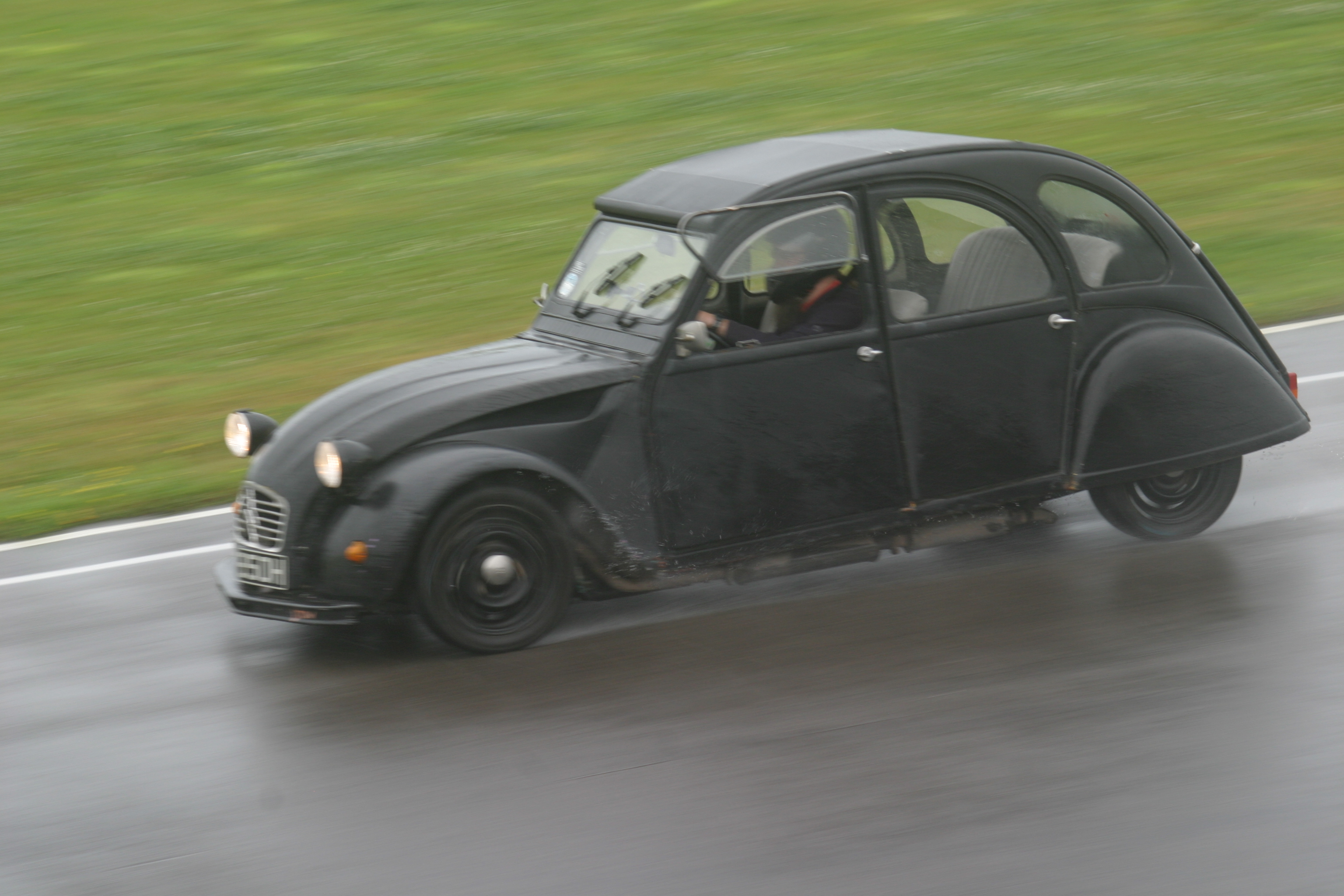
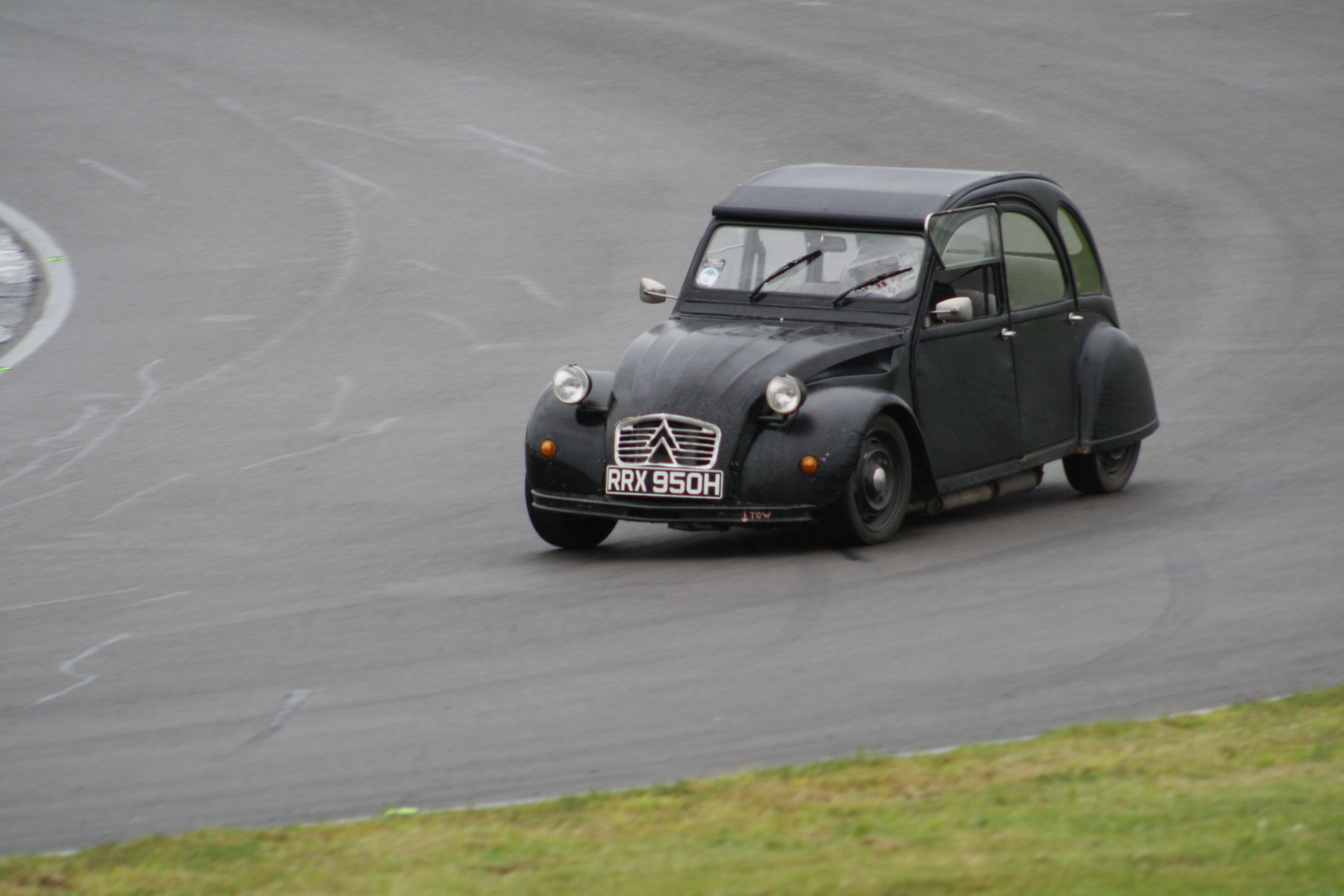
In the run up to the Classic 2CV Racing Club’s annual 24-hour race, Pete Sparrow had promised me another go in his black, BMW-powered 2CV. It’s the one built for the filming of RED2 but since used as a road-legal fun machine. I first drove it in May. Public roads just weren’t the place to explore its considerable potential.

Trying not to crash the 100bhp 2CV (thanks to Ed McDonough for the photo)

Trying not to crash the 100bhp 2CV (thanks to Ed McDonough for the photo)

As it happens, Anglesey in August wasn’t the ideal place either. It was absolutely pouring with rain, making it a tricky place to try and drive a 2CV with three times the normal power output. Worse, an organisational mix-up meant three of us would be trying to drive the car in just thirty minutes. That meant just one flying lap. It also meant there just wasn’t time to set up my video camera. I managed to install my phone, but that just recorded my face in extreme close up, with me swearing occasionally as I attempted to get the power down.

But what a rush! I barely managed to utter a word to camera as I drove around the sodden track, enjoying the huge rush of power as the 2CV sprinted towards the next bend. I kept a modern hatchback at bay as I chased down slower cars, passing a Toyota Yaris and my friend in her Citroen Dyane. It’s an astonishing testament to the 2CV that it can cope with such a daft amount of power. When the 2CV was launched, it had NINE bhp. Nine! Yet here was much of that basic engineering coping with 100. The steering is just fabulous, so you know exactly where you’re going to be heading. The pedals are perfect for a spot of heel-and-toe – though I found it hard to adjust to the quick-revving nature of the BMW engine versus a normal 2CV, which has a very heavy flywheel.

Pete Sparrow giving it some welly in his BMW 2CV.

Pete Sparrow giving it some welly in his BMW 2CV.

The racers don’t much care for bodyroll, but I absolutely love it. This car is a bit stiffer than standard, but still isn’t afraid to show of its underside when you’re really pushing on – not that I went too crazy, as I knew Pete was meant to be heading off on holiday in this car after the race.

The buzz I felt as I clambered out of the car was amazing. If nothing else, this was a very useful insight into the world of the racing driver. It explains the wide-eyed mania you see when they clamber out of the car after a stint. I’d also gone some way to understanding the challenges of getting around the superb Anglesey Circuit. Getting your line right through the corkscrew, as you descend through a tight left then right hander, is very tricky. How rewarding though, when you gradually feed in the power and feel the car push wider out to the kerb before giving it all you’ve got until the next bend. The ridiculous thing is though, I was here driving the most powerful 2CV that went around the track that weekend. Even the super-modified Belgian overall winner ‘only’ had 70bhp! I would love to try a racer to see how it compares. Less power, but more cornering potential. Unfortunately, with the race just an hour away, no-one seemed to want to lend me their car. Maybe next time!

I’ll conclude by saying if you get a chance to take part in a track session, whether your car has power or not, do so. The 2CV/Dyane road car drivers seemed to be having just as much fun as everyone else. You don’t need power to have fun, but by jingo it’s entertaining!

Thanks to Pete Sparrow of Sparrow Automotive for yet another chance to try this incredible car. 

Dyane: The Collection Story

I’ve had to wait patiently for this collection caper, but finally, the day arrived! It was hard to plan for the day, as I wasn’t entirely sure when the paperwork would allow collection.

You see, the problem is that despite many changes to the vehicle tax system, it’s still not possible to tax a car you don’t yet own. The logbook had been lost in the mists of time for the Dyane, so I would have to wait for the logbook to arrive in my name before I could tax it. Or would I?

The DVLA kindly sent me a letter suggesting that the logbook would be processed on 17th August. I phoned on the 18th, and they were able to confirm that yes, the logbook had been processed. The Dyane was now in my name. Even better, I could tax it with them over the phone, so I didn’t have to wait for the logbook to physically arrive with my name on it. Brilliant!

A neighbour just happened to be driving to south Wales, and that proved very handy. Getting from here to Wiltshire by train is a bit of a nightmare. Seven hours or more. Getting a lift to pretty Abergavenny meant a total trip duration of five hours. That’s more like it! The first train took me to Newport.

Now, I’m not the biggest fan of rail transport, but I have to admit that I do like it as part of a car collection trip. You get to sit and watch the world go by, while that anticipation gently builds. Plus, you sometimes get to ride on trains like this!

Train

A classic train, still in extensive frontline use.

If my research is to be believed, this particular Intercity 125, or Classic 43, was built in 1982 – so it’s not quite as old as I am. This was the first time I’d been on one since I was a child and while the scream of its Paxman Valenta V12 engine is long gone, the MTU engine fitted during a refurbishment is undeniably smooth. This is still an exceedingly fast diesel locomotive and while the four miles of the Severn Tunnel did hurt my ears, it was a very pleasurable journey to Swindon. The next train was utter rubbish though. Swings and roundabouts!

I now found myself in sunny Warminster, where the train station is ideally situated right next to a scrapyard.

Glamorous Warminster, and my little 'taxi.'

Glamorous Warminster, and my little ‘taxi.’

Gary Dicks of 2CV Imports was waiting for me in a Suzuki Wagon R. Gary has been working to get the Dyane road legal, though I hasten to point out that for a road-going Dyane, this one was very cheap! Which explains why the journey home was not without incident. I have no complaints.

Anyway, tea was consumed, cats were discussed (yes, cats rather than cars) and I was soon on my way. This was my first drive on the road in my new Dyane, and the first Dyane I’ve owned since 2002. I think. Well, ok. There was another Dyane, but it was horribly rotten and I never actually drove it! Back on topic, it was fuel time.

Citroen Dyane

The ‘can you see it’ gags have begun. First fill-up!

The bonding process began in earnest now, as she dumped a load of super unleaded down my leg. How grateful is that?! It seems in the few months that I haven’t been 2CV-ing, I forgot that you have to ease off the pressure as the tank nears being full, or fuel tends to shoot out all over the place. Oops. I treated her to super unleaded for the simple reason that the last time she was on the road, she would probably have been drinking four star. I decided higher octane might be beneficial.

As we departed Warminster, I gently increased the speed. After so long off the road, it seemed kinder to take things gently. That said, I suspected the car had remained in regular use, as it seemed to run so sweetly. I was not wrong. The previous owner rang me while I was stopped for food on the way back and explained that the Dyane had been used as a shooting hack on a farm in Montgomeryshire! It had only been laid up for a few years, some of those in a barn. More on that another time.

As the roads got twistier, the tired state of the dampers became more apparent. Unsurprising, as they’re at least 20 years old I suspect, if not older. It therefore feels a bit precarious and unpredictable in the bends – grippy still, but prone to sudden pitch and yaw that is unsettling even to a seasoned 2CVer.

Bradford-upon-Avon proved stressful, which is a shame. It was the home of Dr Alex Moulton, who developed rubber cone, hydrolastic and hydragas suspension for BMC/BL. The link? He was a compulsive Citroen owner. His bicycle company is still based in Bradford-upon-Avon.

Not that I got to enjoy that fact very much, as the Dyane was struggling to idle. In fact, she cut out several times, and several more times, I just managed to catch her with a blip of throttle to narrowly avoid more starter motor use. Fortunately, the pedals are beautifully set for heel-and-toe, which is good. I was having to operate all three pedals at once! A very useful skill.

After 20 miles, I pulled over to give the car a quick checkover before we hit the motorway, and to have a quick drink. Given the lumpy idle, I turned the engine off. This was a mistake as after my short break, she wouldn’t restart. ARSE!

Bother! 20 miles in and progress is halted.

Bother! 20 miles in and progress is halted.

Fortunately, I’m not one to panic. What’s the main reason for a 2CV refusing to hot start? Yes, a weak coil. Certainly, this one was very hot. I left the bonnet up, stretched my legs and a few minutes later, she purred into life. Phew.

Annoyingly, I went straight from this layby into another sodding traffic jam – pure coil-killing conditions and further three-pedal driving was required. That thankfully didn’t last too long, and I sound found myself racing down the sliproad to the M4.

This was a nervous moment. I’d already discovered that the engine was pinking under heavy load and that coil was causing concern too. I was taking to the motorway in a car that required a certain amount of nursing. I needn’t have worried. She was soon sailing along very comfortably at an indicated 70mph, highlighting the main difference between Dyane and 2CV. No doors flapping, far less wind noise and more space for the driver. This was actually quite pleasant!

Then it was on to the M5 up to Gloucester, then onto the A40 towards Ross-on-Wye. As we enjoyed the traffic-free A road conditions, with much hooning, I can to concede that the car seemed to be running very nicely now. The tickover had come back and she felt a lot happier. Could this be because she used to live near Ross-on-Wye? Did she think she was going home?

She wasn’t. We continued on our way to Hereford, where there was a longer-than-planned stop for food and a rest at a pub that was having problems with its clever till system. My food order got lost. At least this gave longer for the coil to cool…
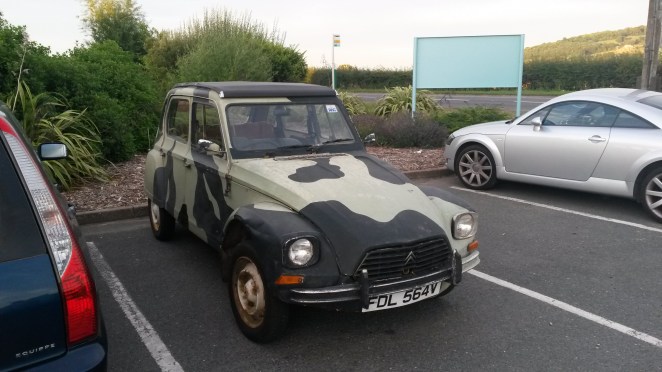
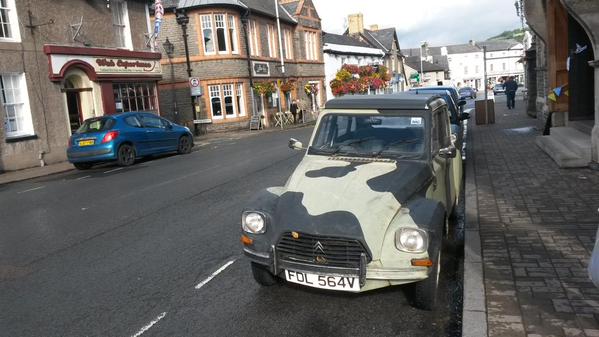
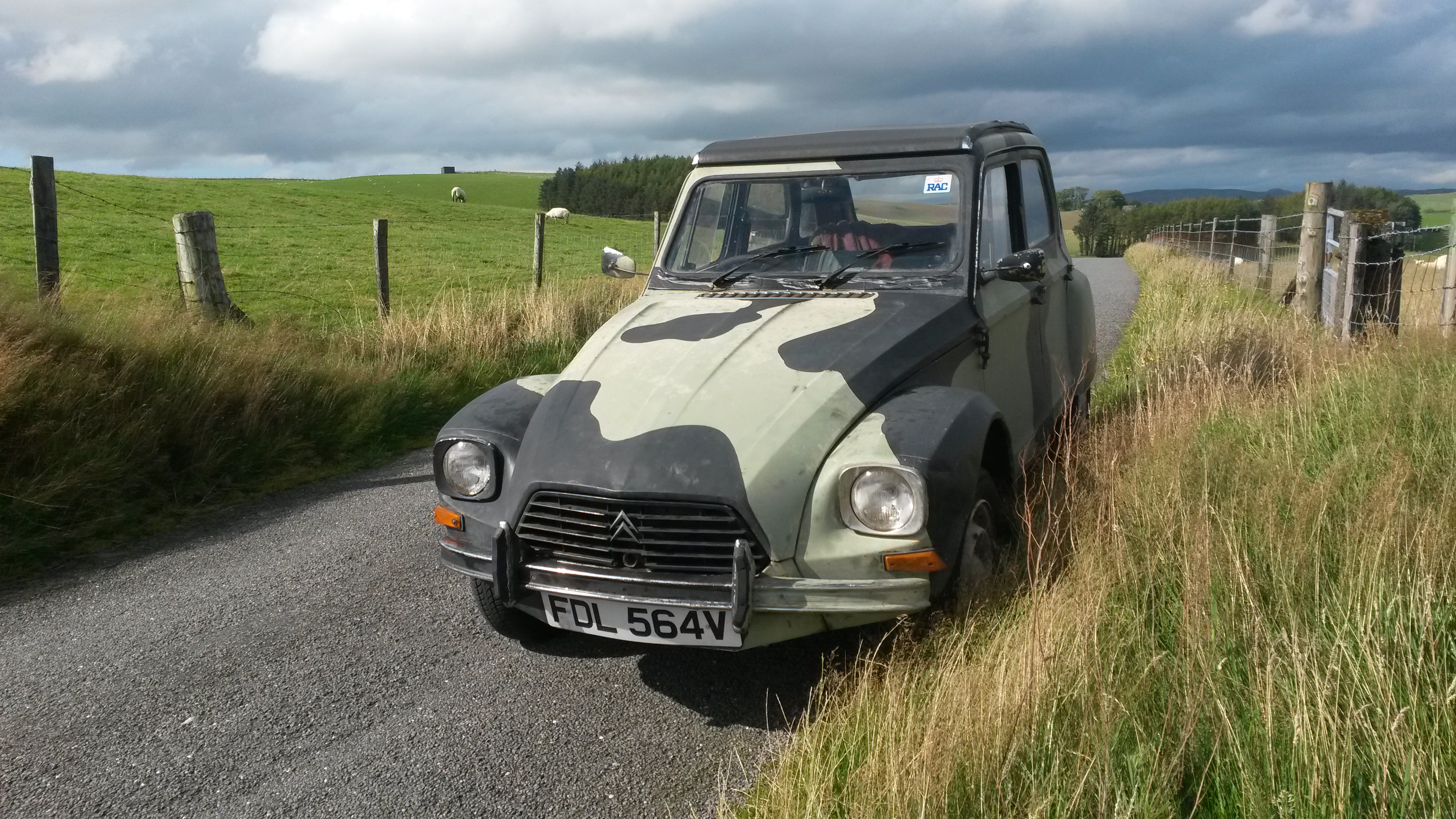
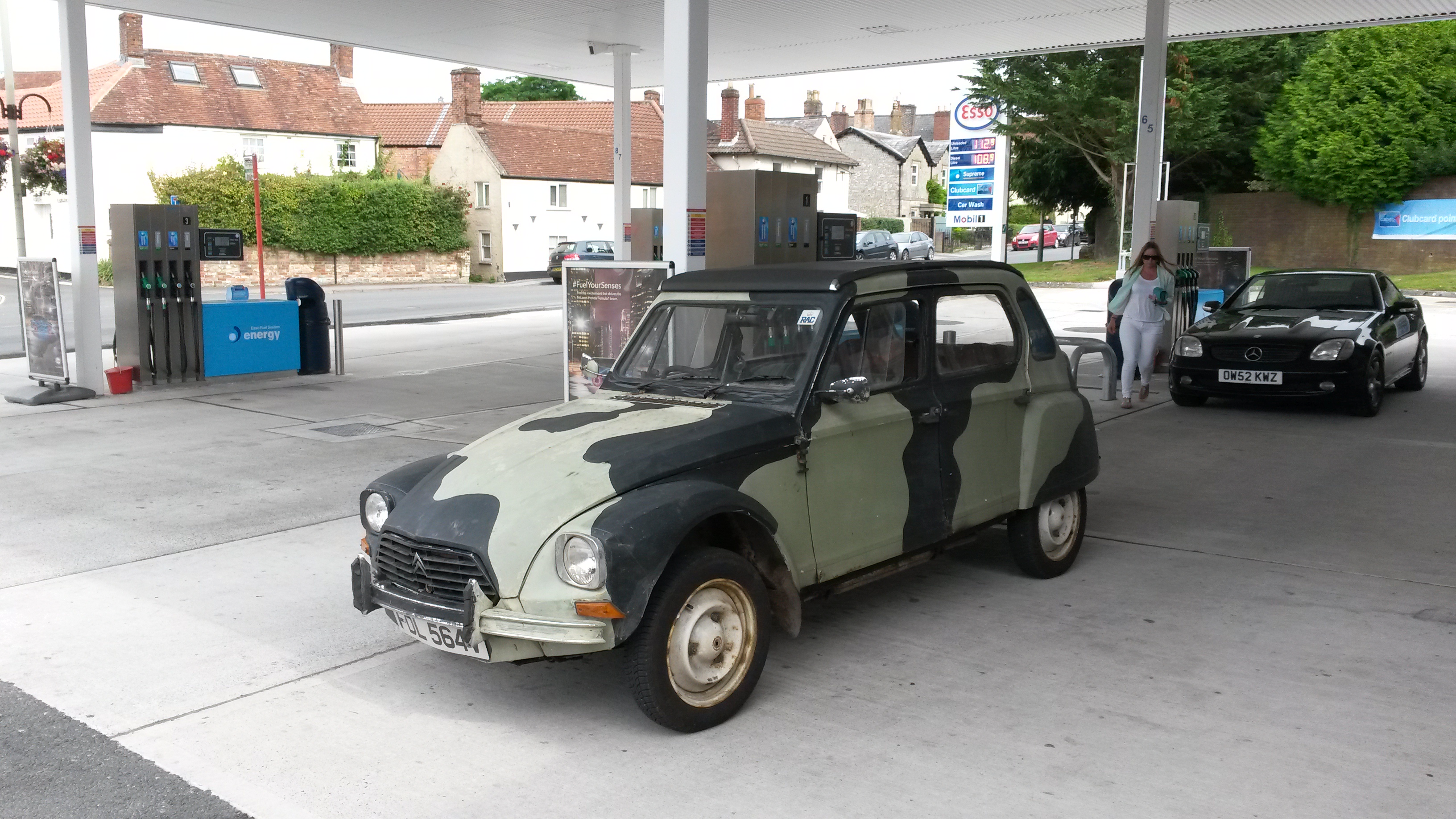
This camouflage is not much use in a car park.

This camouflage is not much use in a car park.

When I finally got back to the car, I decided it might be an idea to check the oil level. It’s a good job I did, as it was right at the lower end of acceptability. Fortunately, I’d left some oil in the car from when I nipped down to tinker with the Dyane the previous week. Nice, expensive synthetic stuff too. So, it was a bit dismaying to notice that this nice, expensive oil was leaking out all over the engine. I suspect several minor leaks, but it’s certainly enough for the car to mark its territory. Given the crap service, I can’t say I feel too bad about the Dyane marking this particular car park!

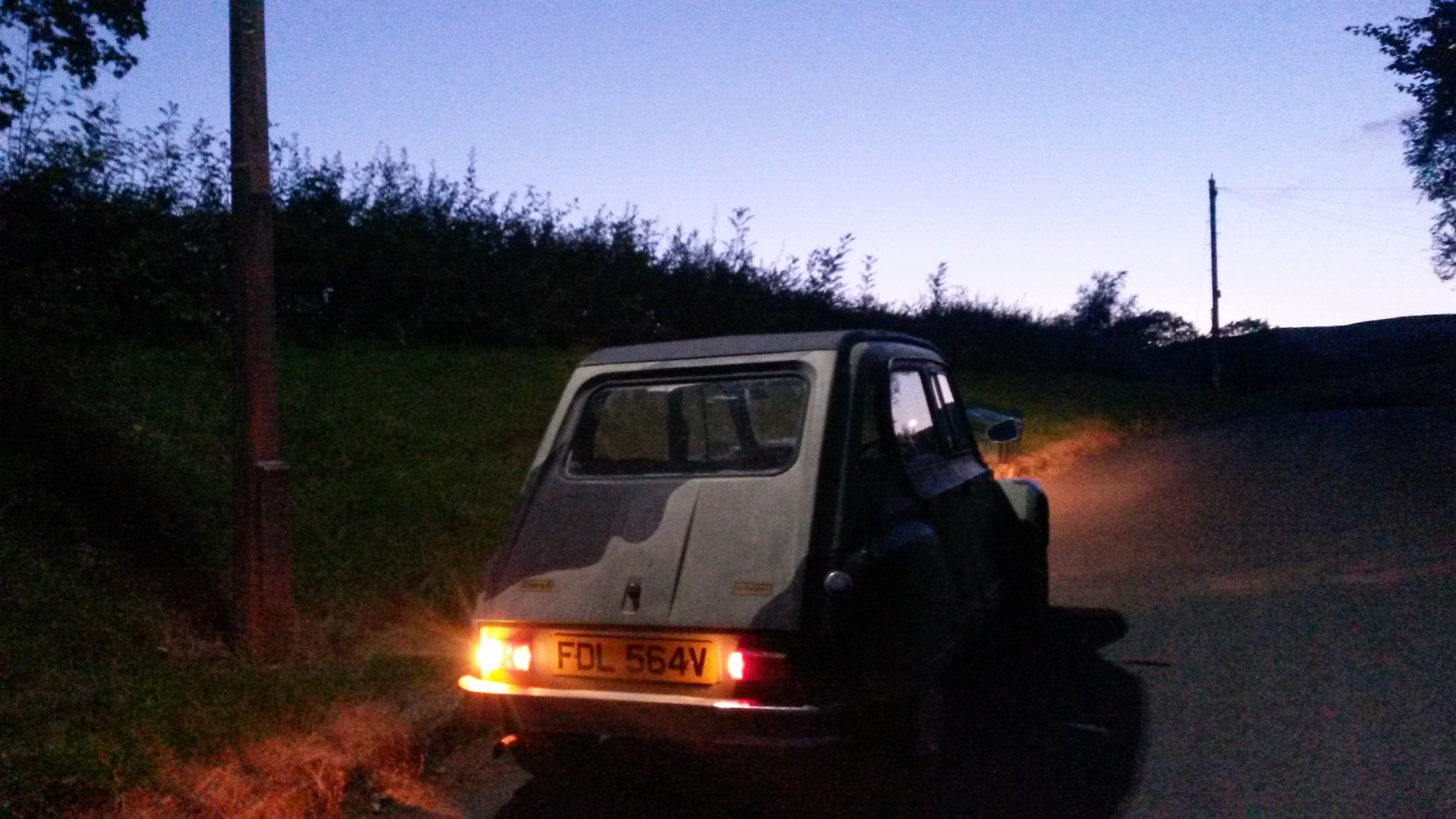
So, onwards I drove, being blinded by the setting sun. It was quite pretty though to be fair.

A beautiful evening for a long drive.

A beautiful evening for a long drive.

We’d now covered over 100 miles, but there was still a long way to go! I’d discovered the lack of heater tubes as the temperature dropped, but at least I could close the dash vents. The climb over the Elan Valley mountain road was tricky, as I had to keep dropping a gear to avoid pinking. It tends to happen when the engine is under maximum load, so the trick is to drop a gear, so you end up with lots of revs, but less load on the engine. Noisy work, but we made it.
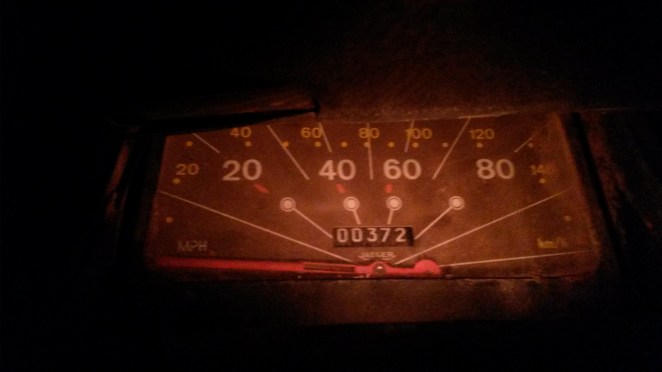
Home! 172 miles covered.

Home! 172 miles covered.

172 miles covered, in a car last on the road in 1995, that has a 602cc engine developing 33bhp. We averaged 34mph and the journey home took about the same time as the train. I can’t really be anything other than pleased.