New Rover: What’s it like?

Apologies for the radio silence. Things have been rather busy of late. However, the new Rover has been collected. It didn’t make for a particularly exciting collection caper though. I handed over £230, drove it to London, stopped the night, actually had to put some fuel in it, then drove back home to Wales. The only problems were both indicator related – the offside side indicator fell out of the wing (it had obviously been glued in after failing before) in the final few miles, and the nearside front indicator bulb fell out of its housing (and then into the lamp where I couldn’t retrieve it) somewhere around Gloucester.

So, what of the car? First, some boring geekery. The Rover 600 is very much a Honda Accord. No surprise there, as most of Rovers cars at this time had shared development with Honda. Here’s the thing though, of all the Rondas, the 600 was the one that Rover had least say in, under the skin at least. Honda didn’t want to mess with a successful formula, so Rover were pretty much restricted to styling tweaks. What tweaks they were though! Here’s a Honda Accord of this period.

The 1995 Honda Accord yawnfest.

Bland is the key word. The rear end is even worse. A featureless rump that has absolutely no design interest whatsoever. Now, Rover had a challenge. It had to use the same basic structure as this, with the same windscreen, roofline and even the front doors. Yet somehow, designer Richard Woolley came up with this marvellous design.
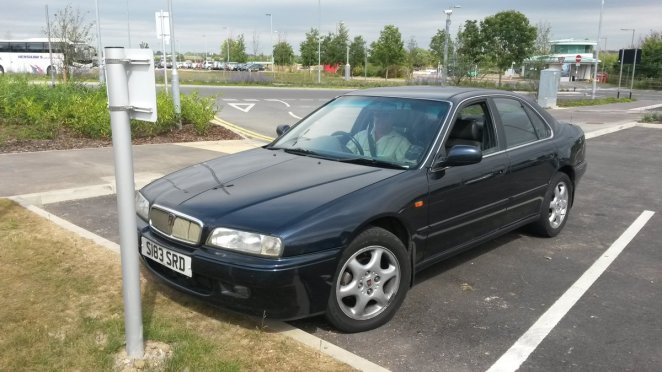
Rover's design magic.

Rover’s design magic.

Frankly, I consider the 600 one of the best looking Rovers of all time. I rate it ahead of the 75, which always looked a bit bulky to me – and the front indicators were always odd, or even ugly. I may concede that a P4, 5 or 6 win it, but move into the 1980s and 1990s and there’s simply nothing to touch it. In my opinion.

Under the bonnet, there’s a further step away from Honda as Rover’s own L-Series turbo diesel is fitted. This is a rather fine evolution of the old Perkins Prima, as used in the Maestro and Montego, but now with electronic control of the throttle – albeit with a cable still involved. It’s a bloody marvellous engine, with practically no turbo lag at all. It pulls very smoothly indeed from just 1000rpm. Honda actually started to use this engine in its own cars. It is very good – I’d rate it as even better than the 2.1 turbo diesel in my old XM. It isn’t as powerful though, a shade over 100bhp in quite a large car. It never feels slow though, just not neck-snappingly brisk.

The steering is good too, though it was some hours and well over 150 miles into my ownership until I really got to exploit it on entertaining terrain – ie Welsh border country. It turns in very nicely and doesn’t have the worrying nose-heavy feeling of the XM.

Looks nice from behind too.

Looks nice from behind too.

It ambles along beautifully at motorway speeds too, which is good. Frankly, the only reason I have bought this car is because I need something good at motorway speeds. I’ve only used quarter of a tank of fuel so far (65 litres, 15 smaller than the XM), so I’ve no idea what the economy is like. Pretty bloody good is my best guess.

Downsides? Well, naturally, there are some. For a start, the suspension is rather on the firm side. Pity the poor Rover engineers who must have wanted something rather more supple. Instead, they got Honda’s short-travel, double-wishbone suspension. It makes the handling superb, but at the cost of ride comfort. It does crash a bit over broken terrain (ie London streets), and never really feels like it’s settling. It’s always jiggling about. Mind you, I’ve driven many modern cars that behave in exactly the same way, so maybe it was just ahead of its time…

I must concede that I’m not entirely won over by the colour either. These cars actually work well in lighter shades. I would have liked a sunroof too, and that was made even more desirable by the non-working fan blower motor and therefore non-working air conditioning. I’ll include something about that in my next report.

The gearchange isn’t the best either. I know bits on this one have been replaced, so it feels nice and tight, but it is also heavy in operation. It’s not great for quick changes.

But mostly, this story is all about the positives. The Ti-spec seats are a touch firm perhaps, but I got out after six hours at the wheel with no notable backache. There is a flick wipe feature. I can listen to Test Match Special on long wave radio. There is a foot rest (something I always longed for in the XM) for your left foot. I also got a ton of history with the car, including the owner’s handbook.

Frankly, it seems utterly ridiculous that such a good looking, competent car can be bought for so little money. Rover 75s attract plenty of enthusiasts, but the 600 remains overlooked. Having owned both, I know which I prefer already.

The next report will contain fault-finding and even some eradication! After that, I’ll be putting 1200 miles on it in a week. Let’s hope it really is reliable…

Rover 600: New purchase!

I’ve wanted a Rover 600 for a long time. In fact, I test drove one over two years ago. This one in fact.

The perfect car. Almost.

Too crap even for me, though not because it was a 600

Before that, I’d extolled the virtues of them in this post. It’s fair to say, I’ve long been a fan. It shows you how poor an example the above was (or rather, how dodgy the folk were selling it) that I managed to turn it down.

As it happens, I then got horribly sidetracked by the XM, so that put my 600 desires on hold. But, I really need a comfortable cruiser to cover distance at the moment, so the 600 was firmly back on the radar. That was especially urgent because in a few years’ time, I reckon the 600 will be very hard to find. Corrosion is fast claiming them, and values are stupendously low, so it’s not really work getting one welded up.

I found a likely target on Ebay at £199 with no bids. Had an email conversation with the owner, and liked the tone of his advert and the subsequent conversation. There was no use of the word ‘m8’ at any point. I felt confident. With less than an hour to go, there were still no bids. At seven minutes to go, a bid finally came in. Not from me. I pondered what to do next. Did I bid my full amount straight off or drop a cheeky bid in to see if it provoked a response? I went cheeky, offering £224. As I did, another bid came in, but I was still highest bidder. There followed a nervous few minutes, in which I decided to chuck a larger bid in. I’m glad I did, as the price rose to £231.52. My heartbeat rose. Excitement built.

Yes! My second sub-£300 car purchase in a fortnight had occurred. Contact was established, and trains were booked. I now have another car to collect, and it’ll be heading straight into another mega-mile roadtrip as I visit friends in London. Mind you, that’s just the start. On Wednesday, my new steed will be transporting us 600 miles to Normandy. I hope it’s ok…

It should be. At 174,000 miles, it’s hardly fresh from the showroom, but the current owner has been using it heavily. I find that’s a good thing. It seems to have a fair chunk of history, because this owner needed it to get him to where he wanted to go. The rear arches look a little problematic, but they all do these days. It’s a classic Honda rot-spot. And, of course, this is pretty much a Honda under that styling Rover suit. Not the engine though, that’s Rover’s own L-series turbo diesel. It should deliver 45-50mpg. That’ll be nice! Especially on the cheap diesel of France.

Amusingly, the registration number of my new car is part of the same series as the Rover at the start of this feature. So far, that red one is the only 600 I have ever driven, and only then a short distance around Coventry. However, I have high hopes for my £230 motor car.

Seller's pic, stolen from Ebay. Another S...SRD!

Seller’s pic, stolen from Ebay. Another S…SRD!

I’ll be live reporting progress on Twitter tomorrow (@Dollywobbler) and other social media if I have chance. I’d better give my beleaguered insurance company another call…

Mitsu Mission – I don’t like it

After not even a fortnight of ownership, I have come to the conclusion that I really don’t like my 1987 Mitsubishi Colt.

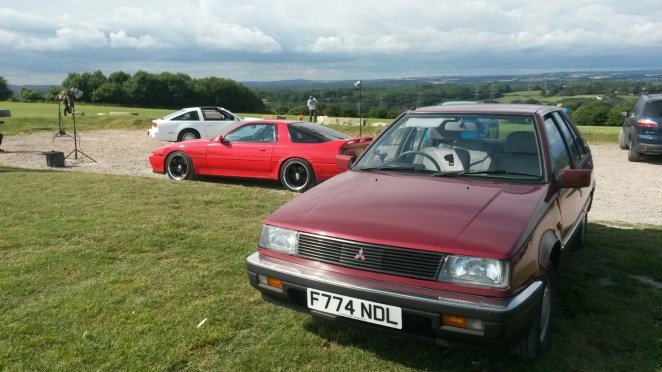
Colt hatch

Sorry Colt, but you’re not for me. Easier to get in than the sports cars in the background though!

Poor F774 NDL shouldn’t be considered a dreadful car though. That would discredit it when it has been quite remarkably loyal in the 500+ miles I’ve covered since purchase. It has done everything I have asked of it. As a conveyance, it is brilliant.

But, it is not just ordinary to drive, it’s actually unpleasant at times. It has steering which inspires as much confidence as a speech by Donald Trump. The engine sounds about as exciting as underwater snooker. It has all the body control of a walrus in a wheelbarrow. It is to car handling dynamics what baked beans are to the world of fine cuisine.

Sure, I admire it’s ability to start, impeccably every time, just as I admire beans on toast, but this will not go down as one of my better purchases. To be fair, the list of not-very-good purchases is very long in my case…

Do I regard this as a disaster then? No, I do not. I greatly enjoyed buying a sub-£300 car and trusting it with my 500-mile crazy roadtrip weekend. I also appreciate the chance to reset my baseline when it comes to trying other vehicles. It doesn’t pay to stay too blinkered in one particular area. I’m appreciating Citroen BXs and XMs all the more right now, for their remarkable blend of comfort and handling. It’s an opportunity to forget the flaky electronics and problematic brake calipers! Hmmmm, rose tinted glasses.

It’s proof that I love variety. During the short time I’ve owned this vehicle, I’ve been able to drive it back-to-back with a Jaguar XK140, a Nissan 300ZX Z31 and a Toyota Supra Mk3. The Colt is much easier to climb in and out of than all of them, and has a more comfortable ride. See? It does have good points!

But, it has also served to remind me what I really want in a car. Handling prowess is important. I like to drive a car that feels like it wants to corner well. But not at the cost of comfort. I don’t like being jolted, so an actual sports car probably isn’t what I want. That’s why the Prelude had to go (fantastic handling, but it was rather firm of suspension).

To be fair to the Colt, I fell out of love with the Austin Maestro for very similar reasons. Oddly, I found the van version more entertaining to drive. It’s also why the Nissan Bluebird didn’t tick the magic box for me. Even a Volkswagen Golf Mk2 proved a disappointment – more for ride than handling. Dynamics are important to me. I think it’s why I like French cars so much. They really understand suspension.

Another car that didn't tick sufficient boxes.

Another car that didn’t tick sufficient boxes.

So, the search is on for the next vehicle. I’ve done a lot of head scratching already, but I think what I’d really like to own is something actually nice! I will be attempting to do that after a little holiday in France. I was hoping to buy something pleasant in which to travel, but I bought the Colt instead. So, it looks like the RAV4 will be getting that gig after all. Who knows what I’ll end up with after all this!


RAV4: Flaws, more flaws, but CUTE!

On Thursday evening, I felt the need to celebrate some serious graft during the working week. So, I took the RAV4 greenlaning – the first time I’d done so for months. After all, what’s the point in having a 4×4 if you’re not prepared to use the extra ability such a transmission gives you?

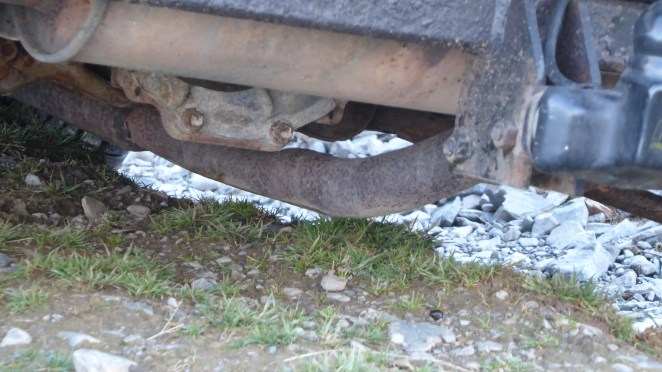
All too soon, the limitations of the RAV were coming to the fore as the underside began scraping. I had entered only mild ruts, but the exhaust system hangs very low, right down the middle of the car. You’ve also go the spindly little lower control arms to each wheel. They seem horribly vulnerable. I tried to keep the speed down as much as possible, but that revealed another limitation – the lack of a low-ratio gearbox. First gear is lower than in a normal car, but I’d say it’s only as low as third or fourth in a proper 4×4’s low range gearbox. That’s fine for pootling along, but just does not allow enough control when you want to crawl, or descend steep hills.

It can go greenlaning, but it's not very good.

It can go greenlaning, but it’s not very good.

I wasn’t enjoying this as much as I’d hoped, but things were to get worse before they got better. As the ground became more uneven, I started to lose traction. This was no fault of the Michelin Latitude Cross tyres, as I discovered when I stopped. I got out of the car, and realised I could rock it and lift one of the rear wheels off the ground! The lack of suspension travel was the issue here. The RAV just isn’t flexible enough. I was forced to engage the diff lock to keep me moving. This locks the front and rear axles together, so even if one of the four wheels starts spinning, the two at the opposite end should be able to keep you moving. They did.

Oh dear. Exhaust is rather vulnerable. This isn't a deep rut.

Oh dear. Exhaust is rather vulnerable. This isn’t a deep rut.

I progressed steadily along the lane, getting better at spotting where traction and/or ground clearance might be an issue, and adjusting my speed to suit. I was a bit concerned about a tricky section of this lane known as The Steps. However, as I continued on, I began to realise that I must have already driven up it! The little RAV had clambered up it so easily that I had not even noticed. The Steps don’t have ruts, so ground clearance wasn’t an issue. Brilliant!

RAV4 greenlane

This shot neatly demonstrates the maximum suspension travel. Not much.

I made it to the end of the lane, disengaged the diff lock and hurtled home, enjoying the excellent handling that the RAV4 offers – certainly not something most ‘proper’ 4x4s can match.

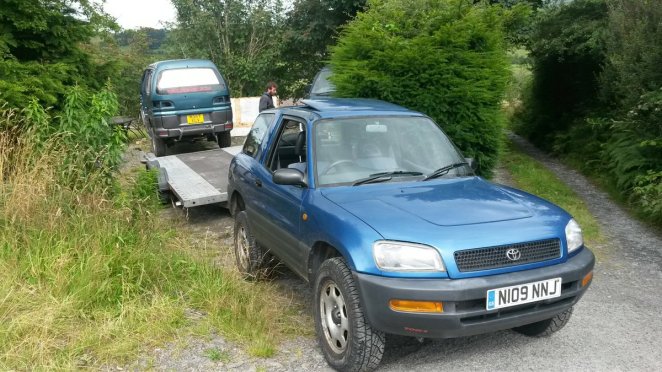
The next day, I had to help a friend remove a dead Delica from a car trailer. This spares vehicle had no front axle, so the plan was to pull the front end off the trailer, put it on blocks and then pull the trailer out. Simple, though things were complicated when his own working Delica refused to play ball due to a charging issue – ie no alternator! It wasn’t happy to work.

So, the RAV was called into action. Again, I would have loved a low ratio gearbox, as I was having to work the clutch quite hard to control the pace. We didn’t want to do this quickly! Also, the driveway was very uneven, with the front offside wheel of the RAV heading up a steep bank due to the limited room we had to manoeuvre. This neatly took the weight off one of the other wheels, and so the difflock was called into action once more. It did the job, but there was quite a whiff of clutch!

RAV4 towing

Not ideal for towing projects, but it did do it!

This has highlighted some difficulties with this car. It isn’t very good as a 4×4. Now, I don’t need the ability of a 4×4 very often, so it does make it difficult to justify owning one. The RAV can just about cope with what a throw at it, so perhaps it justifies itself?

But, it’s not a great car to cover distance in. The seats are particularly poor, and the ride isn’t what you’d call comfortable. Despite that, I think I’ll be taking it on a mini-roadtrip next week, before probably taking it to France.

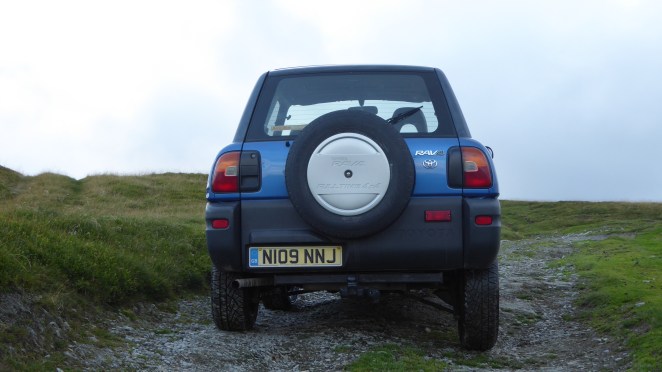
I must conclude though, despite its flaws, the thing that keeps saving this car from a fleet cull is the fact it’s so bloody cute! I absolutely adore the styling, front and rear. How dull and dreary the RAV4 would become in later forms. It would never have this much character again. It may not be very good at all the things I ask of it, but the fact is that it can and has done them. The lack of off-road ability makes it more challenging for the driver. Isn’t that a good thing? It may have struggled with the towing task, but it did manage it in a way a two-wheel drive car would not have. Doesn’t that make it good? After all, it tows the caravan rather more comfortably than the XM, which I truly did not expect (they have the same stated maximum towing weight of 1500kg).

Maybe I should give this little soft-roader a bit more credit. Sure, it’s a master of absolutely nothing at all, but it can turn its hand to many different activities. That sort of requirement is exactly why I love the Citroen 2CV. Maybe my little inferior 4×4 will be the steed for our upcoming trip to France after all.

Now with video!

Citroën destroys brand loyalty

Brand loyalty is a strange thing. I consider myself a Citroen enthusiast, but its products have changed a great deal over the years depending on who was calling the shots. André Citroën himself never got to see the Traction Avant do so well, and never got a whiff of the 2CV and DS (launched during Michelin’s custodianship). Some of my favourite Citroens came out of the Peugeot years, and were better because of it – BX and XM in particular.

Spot of the holiday? Perhaps. Certainly joyous.

Very much a Citroën, whatever marketing numpties think.

But show me a Saxo and I’ll turn my nose up at it. Wave a Xsara in my direction and I will not get excited. Hand me the keys to any of Citroën’s current line up, and I’d probably just give them back – ironically apart from the e-Mehari, which isn’t actually a Citroën at all.

My loyalty to the brand has been diluted by Peugeot’s with chevrons, and by Citroën’s frankly callous regard for its own heritage. For years, the conservatoire was impossible to visit. A hard working team kept some incredible machines in storage, and Citroën will, rather begrudgingly, let you poke around the place today. For now. If you apply for a visit through a club. And only on certain days.

Citroën has also been one of the worst for supporting older models. They cannot wait for the period to expire in which they must make parts available for their old cars. Even before then, they’ll ramp the prices up to quite ridiculous levels, so demand falls away.

But circumstances have taken a far darker turn of late, with the spinning off of the DS ‘brand’ from within Citroën. This triumph of marketing over substance has seen Citroën now airbrush one of its most iconic designs from its history files. You can see it right here. A lovely list of Citroëns from the ages, but the DS (and, oddly, the SM) are nowhere to be seen.

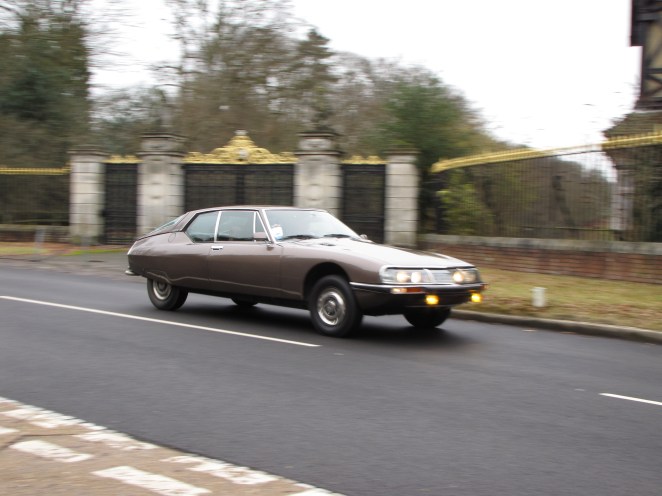
Citroen SM

Apparently the SM isn’t a #CitroenIcon either. Insanity.

How utterly ridiculous. The DS was one of the most incredible cars of the 20th Century, but because some marketing bod who was born decades later had a blue sky moment, it apparently isn’t a Citroën anymore. Frankly, I’m starting to wish that Peugeot had just killed off the Citroën brand rather than subject it to this. Hydropneumatic suspension has already been killed off, and now history is being altered to make it easier to sell the hideous DS range of cars.

PSA, the group that owns Citroën, really doesn’t seem to get it. It has no understanding that heritage sells. No, not like that. It isn’t something you just dig out once in a while to try and get a sale. Heritage is something manufacturers need to invest in. BMW, Mercedes-Benz and Porsche understand this, and Jaguar Land Rover is fast following suit.

None of these companies are attempting to erase cars from their history. Citroën overlooking the DS is like Jaguar overlooking the E-Type, or Land Rover pretending the Range Rover didn’t happen, BMW ignoring the M3 and Porsche denying it had anything to do with the original 911.

It’s the final straw as far as I’m concerned. The Citroën of today is not worthy of my attention. Instead, I will forever enjoy it’s actual heritage. The one that has the DS firmly at its centre – a car which was very much about substance, not empty promises from a design agency.

Ford Puma: Dirty fun

I had a Jaguar XJS on the fleet recently. Not sure I remembered to mention it on the Blog, but it was borrowed from Kelsey Media to act as my muse for the next issue of Classic Jaguar magazine. You’ll be able to read loads about it when the next issue comes out (19th August 2016).

But, all good things come to an end, and Kelsey wanted it back. I had to drive it Birmingham, where it was picked up to return to Peterborough. I was planning to catch the train home, but then I got a better offer. Julian Bailey, who has been a long-time supporter of HubNut, decided to offer even better support. Would I like to drive home in his Ford Puma rather than catch a train?

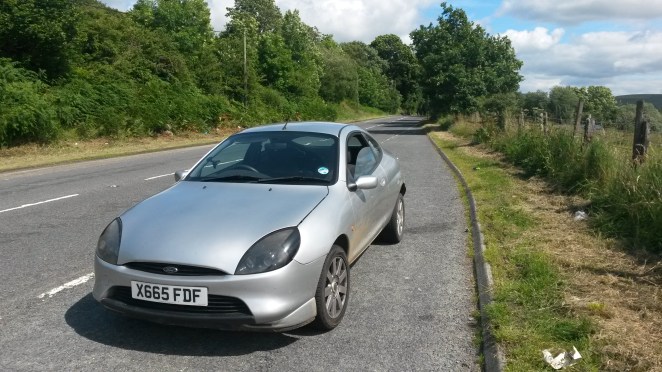
Pooma

Ford Puma. Better than the train.

Well, to be honest, that would still be a much better offer than the tired, noisy, slow contraptions that Arriva Trains Wales considers suitable or travel, even if the car in question was a Ford Fiesta Mk6. Diesel. Happily, it wasn’t the disgustingly grim Fiesta, but a Puma. Fiesta-based, but a GOOD Fiesta!

To be honest, Pumas have long been on my wish list. I almost bought one a couple of years ago, and found it utterly charming to drive – so easy! Just how a good Ford should be. I’d not really had a chance to try one for anything more than a quick trip around the block though. Today was my lucky day.

This one isn’t without issues. The clutch bite is rather high, the rear arches are rusty (no surprise there!) and it seems that snails have been crawling around on the windows. Inside. The fact that the rear seat has been replaced by a wooden load bed suggests it may have been on gardening duty quite recently. Which may explain the trails. And the mouldy sunvisors…

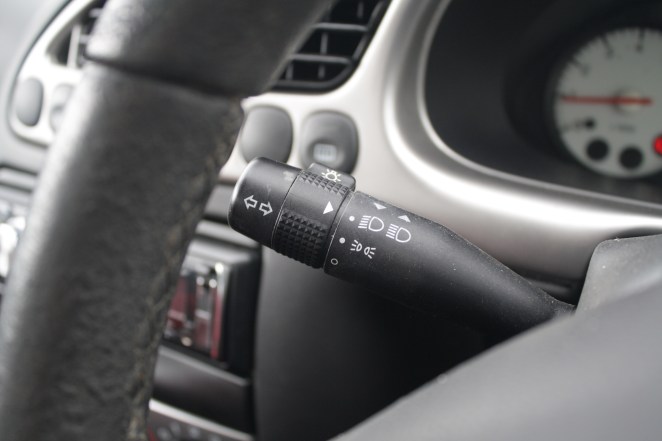
But, if you’ve seen my house, you’ll understand that this is hardly off-putting. I threaded my way around the West Midlands and began to assess the new, borrowed steed. First off, Ford column stalks are HORRIBLE. Not one action feels pleasant. Also, the self-cancelling doesn’t work on left turns. The brakes also feel as trustworthy as a government’s promise. They do stop the car, but they never feel like they’re really committed to the process. They’re still far better than the RAV4 though, so maybe I’ll let them have that one.

UGH! Horrible, horrible, cheap, nasty stalk.

UGH! Horrible, horrible, cheap, nasty stalk.

The engine is surprisingly tractable. Surprising because I found myself accelerating from 30mph in fifth gear. Now, sure, the gearing is fairly low, and the ratios are neatly stacked together. The engine really is very happy to pull throughout the rev-range though. Let it rev, and it gets you moving very nicely indeed – this is the 1.7-litre version. Those close ratios then help you keep it ‘on the boil.’ Acceleration almost doesn’t feel like a decision you make. The car decides. And it want to do it very quickly.

There’s no neck-snapping VTEC effect, it just pulls very cleanly, from whatever engine speed. Yes, there’s more punch higher up, but the torque delivery is delightfully progressive, in a way modern petrol engines often just are not.

Eventually, I leave modern conveniences like motorways and dual carriageways behind me and get a good old hurtle on. On the sweeping A roads of Wales, this car is astonishing. Often, I found myself glancing at the speedometer on the exit of a bend to find I was practically at the legal limit already. Alrighty then! It corners well. The steering doesn’t offer tons of feel, but it is very nicely weighted and geared. The brakes are no concern at all, because you don’t really need to slow down.

Definitely the best angle. Love those rear lights.

Definitely the best angle. Love those rear lights. Note wheelarch bubbles…

The gearchange is an absolute delight, even with 122,000 miles of wear. It’s so pleasant to snick your way around the gearbox.

The ride is a bit crap though to be honest, though hard clonks from the back end suggest all is not entirely well in the suspension department. It thumps over potholes and dips in the road, and seems to bounce an awful lot. It’s not a very comfortable car to travel in, and the firm, unsupportive driver’s seat helps not at all. Most annoying of all, the modern hi-fi thing did not have Long Wave, so I couldn’t listen to the cricket. This failure to equip cars with Long Wave needs to stop NOW! I was suffering serious TMS withdrawal symptoms.

This is all going on a bit more than I expected, but I’ve got Jack Johnson on the stereo now, so I’m chilled out and the words are flowing. So, I’ll relate today’s adventure.

I had to get to Oldbury in the West Midlands. I decided to take the Puma, seeing as it was here and that I’d actually put petrol on it. I eyed up the route. No, I didn’t fancy driving the Puma through the horror of Newtown and then on to the horror of the M6/M5 interchange. So, I set the sat nav to avoid motorways, pumped up the rear tyres (they have slow punctures) and set off.

Within a few miles, I’d already overtaken two cars. I swear I’ve never overtaken cars as often as I have in this thing! It zips past slower moving traffic so sweetly. With the 2CV, overtaking needs serious amounts of precision, luck and, often, gravity. The XM was good, as long as you caught it on boost. The RAV doesn’t really have confidence-inspiring power. I’d chosen the right car though. This was huge fun! Yes, it was 8am in the morning, and I was having huge fun on British roads. See? It is possible!

One hour later, the fun had been ramped up to at least eleven. The sat nav, which has a habit of choosing entertaining routes, took me to Pen-y-Bont, then that twisting road to Knighton – the A488. Then it was the B4113 to Leintwardine and Ludlow. By heck, this was ASTONISHING!

Sat nav wasn’t finished though. It then selected the B4364 from Ludlow to Bridgnorth. WOOT! Yes, I had to concede, this was a LOT better than Newtown and the motorway. I was completely ignorant of how much my back was hurting, because I was having a simply magical day. The Puma has the perfect amount of power for Welsh border roads. Not so much that bends approach you with terrifying speed, but enough to accelerate strongly out of bends, even up hill.

Alas, such good times could not last forever, and things got rather more dull after Bridgnorth and into Stourbridge. You know, all urban and boring. Even worse, the sat nav then decided it wanted to ignore the ‘no motorway’ rule. I do hate rebellious technology. By now, I was on roads I knew, so I told it to sod off and found my own way.

Job done, I could then head home. After taking just over 2.5 hours to get there, I was buzzing to drive another 2.5 hours back home! In fact, at one point on the B4113, I did actually yell out loud. It was that much fun.

The only slight issue was the placement of the 12v power outlet. It seems you can either charge something up, or change gear. Attempting both is foolhardy. The sat nav cable got yanked out one last time (it doesn’t help that my sat nav reboots everytime power is restored) and technology got told firmly to do one. I cheered myself up with a drive through the Elan Valley. Bloody lovely!

So, there you go then. If it’s fun you want, a Puma is very capable of delivering it. It’s practical too. A friend of mine, who I suspect of using magic, can transport her three children and the dog in her Puma, and often does. It’s probably economical. I’ve no idea, but it definitely uses less fuel than a Jaguar XJS.

But would I buy one? No. I wouldn’t. I just like my comfort too much, and this car has not enough of it. The French seem able to combine ride and handling in one glorious package – or they did. Why is this so hard to replicate?

Puma roads

A fantastic car, that I do not want to own.

Sorry for coming to the conclusion you probably weren’t expecting, but it just goes to show that I’m a real awkward sod to please. Which is probably why I’ve owned over 60 cars and only one has truly managed to get the claws in. I definitely appreciate a car that’s fun to drive, but I want comfort too. Finding that in a small package certainly is not easy. But, if you’re less fussy than me, and the appalling ride of most modern cars suggests people are, the Puma truly is a bargain fun pot. Buy one, before there aren’t any left.

An old friend!

I got a real surprise at 2CVGB’s Registers’ Weekend event, when a pal pointed out a car that looked familiar. Could it be? Yes! It was C798 KOJ, or Colette – a 2CV I was given in 1998, and sold the next year.

Colette! I owned this car 1998-99.

Colette! I owned this car 1998-99.

Now, this is a pretty rare moment, and one I treasured. Generally, as I usually own rubbish cars, the chances are they don’t last long after I’ve owned them. In fact, I’d sold Colette primarily because she was too nice for an oik like me – I would have been 20 when I took her on.

The story of how she came to be mine is an interesting one. I was a local group contact at the time, living in King’s Heath in Birmingham. One day, I got a phonecall from a chap not too far away, who said he wanted to give his 2CV away to someone deserving. Obviously I was interested, though I expected something of a heap at that ‘price.’ But Colette was immaculate. She’d been rechassied, by Citroen no less, and was clearly very well cared for. The chap, Eric I think his name was, just wanted her to go to a good home as he was going to stop driving. I collected Colette a few days later. Wow. I actually owned a nice car!

But, I was young, and therefore stupid. I took Colette to the 1998 2CVGB International rally, which was a big one – it marked 40 years since the launch of the 2CV. But, I also took poor Colette greenlaning! So much for care eh? In fact, I think I took her greenlaning twice with 2CV chums.

Oh gawd. Me and Colette in 1998. Same event!

Oh gawd. Me and Colette in 1998. Same event! 18 years ago.

I drove her all over the country. I distinctly remember driving her to Wales for an Easter camp, possibly in 1999. That was the year that I decided I had to sell her for her own good. Clearly, I was not looking after her in the manner she would have hoped. So, I put her up for sale, and she sold for £1100. That was an awful lot of money, though I had recently paid £1600 for a Citroen BX, so it merely helped me keep the wolf from the door. It did cause me a serious amount of guilt – I had been given the car free after all – but it’s ok. I’m still wracked with guilt even today.

Colette didn’t move far away, and I saw her a few times after the sale. Then she came off the road, and I never knew why. She was sold to the chap’s friend, who had come to check the car out back in 1999, and he got her back on the road. However, she was involved in an accident in 2012, and off she came again. I think I checked her reg number around this time – a sorrowing experience. Why wasn’t she on the road?!

That was some years ago though, so I was delighted to see her in a field at the same event I’d taken her to in 1998 (albeit a different field!). Turns out the current owner had only got her back on the road again this year, so it was her first event! I can pretty much guarantee that it was her first Registers’ Day since 1998.

She’s changed a bit since then, but still has the ‘incorrect’ dark grey wheels – they would have been silver from new. The best bit is the pair of Honda front seats – heated leather no less! And very comfortable. Well, having tracked down the owner, it seemed only right to have a quick sit in my old friend. I think we’ve both changed a fair bit since the last time we’d seen each other!

Renault 5: 782cc, dash-change

It’s pretty typical of me to turn up at a 2CV meet and get all excited about a Renault. It should be noted that my love of French cars certainly isn’t restricted to those with a Citroen badge. There are lots of amazing French cars.

The Renault 5 is one such machine. This is the car that, along with the Fiat 127, really created the supermini class. Small cars, with tons of charm, and a practical hatchback. The 5 was launched in 1972, which seems pretty remarkable when you look at it. Remember, 1972 was one year after Morris stopped building the Minor. The BMC 1100 was still in production. The baby Vauxhall and Ford were still three-box saloons.

For me, what really sets the Renault apart is that styling though, especially the rear end view. It’s somehow so French, so stylish, so individual and so practical. It’s a view I remember well, because I owned an exceedingly rare right-hand drive, dash-change 5 myself some years ago. I was a fool to sell it, especially as it has not survived. Regrets? Yes, actually!

Renault 5

Cor! What an arse.

But that was then, and this is now. My friend Julian Kettleborough owns this car, and I got very excited when I first saw pictures. It’s a 782cc, dash-change 5 that was saved from a French scrapyard. For some reason, this little beauty had an appointment with the crusher. Happily, that appointment was missed and the car now has a UK MOT and a happy future ahead of it.

We didn’t get the 782cc model here, as it was deemed too feeble. I must admit, the 845cc version I’d owned didn’t exactly feel like a ball of fire. What would this one be like?

Firstly, let’s talk interior. It’s fantastic! Switches are arranged around the wheel in a way which is convenient, but far less wacky than say a Citroen Visa. Sure, you do actually have to talk your hand off the wheel to operate some switches, but not the major ones. There is some intrusion from the engine, which sits behind the gearbox. There’s enough room for pedals though. The gearchange works quite well, but not as sweetly as that in a 2CV – perhaps because the rod has to go over the engine to the front-mounted gearbox.

Renault 5

Full of cheeky charm. Oooh la la!

Out on the road, the pace is familiar to anyone who’s driven a 2CV. It certainly isn’t what you’d call brisk, but it’ll haul itself up to 50mph with far less high-revving fuss than its Citroen rival. It’ll even do 60, though the gearing is asking a lot of the engine by this point. This isn’t an engine that’s particularly refined or happy to run at higher speeds.

The brakes are not that good, though I suspect they may benefit from adjustment. Contrary to the modern looks, the stoppers are good old drums, with manual adjustment. The ride is superb though, even over a grassy field. There’s bodyroll ahoy when cornering too. It’s so French!

I thoroughly enjoyed my little drive in this car though. It marks a real turning point in the history of the motor car. Style needn’t just be reserved for the wealthy. With the 5, Renault provided it for everyone.

Citroën Visa: Twin-pot Twin Test

I’m just back from a thoroughly lovely weekend at the 2CVGB event known as Registers’ Weekend. In short, lots of 2CVs, lots of sunshine, lots of friends, no politics, no sodding Pokemon. LOVELY!

I met quite a few people who commented on how much they enjoy the blog, which has given me a major attack of guilt. I have been neglecting it an awful lot recently, though it’s not entirely my fault. Quite a lot of actual paid work has certainly been getting in the way, but I’ve also been on the road a lot, which included two days in my caravan with barely any signal. Besides, writing blog posts on a stupid ‘smart’ phone requires far more patience than I have. Oh, and then our landline at home failed, so woe is me, no blogs, etc, etc.

But I’m here now, and even though I’d really like to go to bed, I’m putting finger to keyboard to share some twin-pot Visa excitement.

Greeeeen

A pair of aircooled Visas. Are they any good?

First, a very brief Visa history. Citroën developed a cracking little supermini idea, but when Peugeot completed its takeover in the mid-1970s, it told Citroën to stop being so oddball. Instead, it could keep some of the styling cues, but had to fit them over nice, sensible 104 running gear. To stem the tears of the Citroën engineers, they were allowed to develop an enlarged version of the 2CV’s aircooled, flat-twin engine to act as entry level models – the Spécial and mildly posher Club (it had a cigarette lighter). Citroën engineers are a rebellious lot, so they flogged their original idea to the Romanians, who built it as the Oltcit or Axel.

The Visa was launched in 1978, with the 652cc aircooled flat-twin, or 1124cc Super E with a radiator and other posh things. The engineers focussed their efforts on the interior, with satellite pods to control pretty much everything you need to control, and a single-spoke steering wheel. Awesome. There were later other engines, a facelift in 1982 to make it (slightly) less odd, and, horror of horrors, a sensible interior facelift that involved actual column stalks. Boring.

Happily, I managed to get my hands on TWO of these twin-cylinder Visas, one pre-facelift and one post. Even more happily, the wacky interior lasted for a good three years post-facelift.

I began with the earlier Club. This is a left-hand drive car, that was once white, but is now the most magnificent shade of green. It feels slightly tinny as you get in, though not as much as a 2CV does. The driving position is nice and comfortable, and the switchgear falls neatly to hand – albeit neatly in a way your brain may not actually understand. Let it learn and all will be fine.

I didn't break it, honest

I didn’t break it, honest

Starting the engine is a strange experience. It’s like starting a 2CV engine, only like doing so from inside your house while the car is out on the street. It sounds like a 2CV, but one that is far away. Then there’s the conventional gearlever, that sprouts from the floor in a thoroughly ordinary way. It’s quite clunky to use, with a bit too much travel; just like a GS, or a Nissan Cherry Europe. The clutch in this example seems far too light, but it’s still easy enough to pull away. I did have some issue finding the gears I needed, and can confirm that it doesn’t like going from first to fourth. On grass.

Across our test field, it really was pretty comfortable. It couldn’t match a 2CV or BX, but it could beat nearly every car currently in production. It’s certainly far better than a Cactus. Generally, the feeling is of refinement, though it’ll roll just like a 2CV if you decide to corner a bit briskly. I was quite enjoying it, I must admit. Thanks George. It was ace.

The next day, I got to drive a later, right-hand drive Visa, only I took this one out on the actual road. I even got slightly lost in it, though don’t tell Mark who was sitting in the back. No, it wasn’t his car. He just came along for the ride, so he could pretend to be a really poor person who couldn’t afford a limousine – only a Visa driven by a hippy.

This car belongs to my mate Chris, who recently let me live in his field. I like people like that.  The clutch certainly feels more normal in this one, and my left-hand proved far more adept at finding the gears.

Blueeee

Minimalist, very-different dashboard. You didn’t even get a clock on the Spécial

So, 0-60mph. Well, the claimed time is 26 seconds, which is a few quicker than a 2CV. This is a big-bore engine after all. It certainly isn’t brisk, but nor does it feel as hard work as a 2CV – thank sound deadening for that I reckon. The gearbox is also much, much quieter, as is the exhaust. Once up to 60, it feels very comfortable there. Even 70 doesn’t feel out of bounds, or just for special occasions. It feels eminently possible, and is nice and peaceful.

The switchgear works really well once you’re trained your fingers, and this is a very relaxing way to travel given the lack of power. Of course, grippy handling helps, so you don’t have to lose too much momentum. This is a fun car to corner quickly. It turns in very nicely, then the body also turns in. It’s like a 2CV, though a little less frantic. It doesn’t feel quite so hilarious.

Overall then, a staggeringly competent little car that does pretty much everything you could reasonably expect a car to do. It’s delightfully simple, but has enough of what’s truly necessary. Drat. Another car to add to the wish list.

Caravanning Experiences

LIVING IN A BOX

It’s probably about time that I wrote up my caravanning experiences to date. I’m sure you’ve all been desperately* waiting for an update.

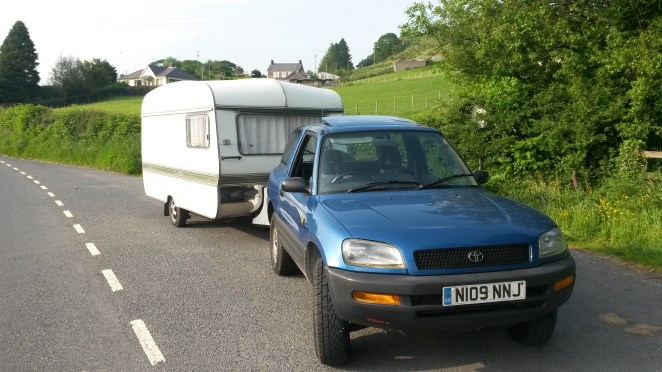
RAV4 shortie towing

Caravanning – better than you think. This was a test tug before our big trip.

Easter was the first big outing, when I still owned the XM. In theory, the XM should have been the perfect tow car. In reality, the weight of the caravan made it utterly frustrating to drive. Normally, the XM could be kept on-boost very easily, right down to just 1500rpm. Sadly, the legal maximum of 50mph (single carriageway) co-incided with around this engine speed. It meant that the slightest loss of speed caused a loss of boost, and therefore a downchange was needed. May not sound much, but it made the XM much more of a pain to drive, and much louder.

Frustrated, I put the caravan up for sale, though it didn’t attract much interest. So I sold the XM instead!

We didn’t go caravanning again until the last weekend in June, when we hitched up the caravan to my new Toyota RAV4 3-door and prepared to drag it all the way to Buckingham for Shitefest.

To be honest, I was nervous. After all, the RAV is much, much shorter than the XM, even though it has the same plated towing weight (1500kg braked). In a tow vehicle, length is your friend. It makes the tow car more stable. Mind you, the RAV at least has no rear overhang, so the tow bar is practically between the rear wheels. This is a good thing as there’s then no pendulum effect.

We set off, with me being very cagey at first. As the miles built up though, I began to realise that the little RAV is excellent for towing. The gearing is that much lower than the XM, to make up for the lack of torque at lower engine speeds. On the flat though, it really wasn’t bad, and while downchanges were needed to climb hills, the sound of a revving petrol engine is much kinder on the ears than an dirty diesel.

The only real struggle was climbing the very steep Fish Hill, near Broadway in The Cotswolds. I had to drop down to second gear, and the engine was working very hard indeed. It stank as old engine oil and muck began to cook on the hot engine. Thankfully, the temperature gauge stayed resolutely in the land of sensible.

It felt remarkably stable though, with caravan yaw (that wagging sensation) only apparent if you braked hard from speed, and even then only until the caravan brakes kicked in. Another benefit is that sitting higher up means I could see right through the caravan, to back up the towing mirrors. It’s so much nicer knowing what’s behind you. Amazingly few cars was what I saw. Far from creating huge tailbacks, there was only the occasional car. I had visions of irritating everyone as a mobile road block, but this never seemed to be the case. Nice.

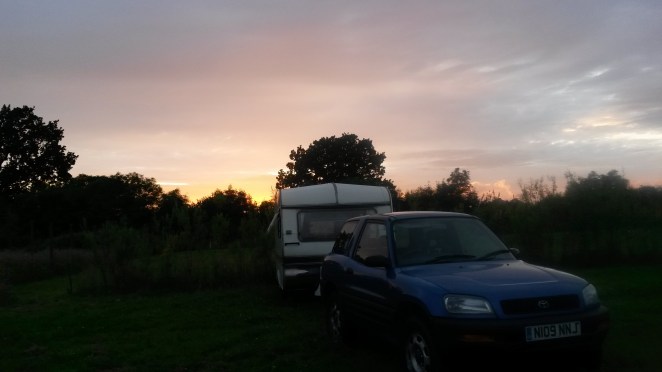
On arrival in Buckinghamshire, the RAV had to drag the caravan into a very damp field. It did this with no trouble at all. In fact, when a friend got stuck in his Xantia trying to tow his caravan in, the RAV was able to take over with barely any wheelspin. I’m sure the Michelin Latitude Cross tyres helped – they’re brand new and have lots of lovely, semi-aggressive tread.

On-site. Pretty. Or something.

On-site. Pretty. Or something.

It also managed to drag his caravan back out again, by which time things had got seriously churned up. I really do like the RAV a lot. Which is good, as I’ve just had to pay £282.50 for a new timing belt, tensioners and water pump after the original pump came seriously close to failing (and taking the old timing belt with it). Oh well! At least it feels worth it.

I haven’t actually brought the caravan home yet. It’s still in a field in Buckinghamshire, where I’ll be sleeping in it for a night or two very soon. The following weekend, we’ll be collecting it and taking it to a 2CV camp in Warwickshire, before finally bringing it home.

That’ll be nice, because the caravan offers dry space to sit during poor weather, decent cooking facilities and a very comfortable bed. It feels like outrageous luxury to be honest, compared to a tent at least. I can certainly see the appeal of the ‘wobble box,’ and the downsides seem much reduced with a decent tow car. I am very surprised that a hydropneumatic, diesel Citroen has seemingly been out-performed by a tiny, Japanese soft-roader with a petrol engine, but there you go. Things aren’t always as they seem.

Certainly, I must concede that this is true of caravanning. Sure, I wouldn’t fancy going to a regimented site and calling that a holiday – I already live somewhere beautiful and peaceful, so I don’t need to sleep in a flimsy box to escape from modern life. But as an upgrade from a tent, it feels infinitely preferable. There’s only one problem really. There’s no way my 2CV is going to be able to tow it…