People do sometimes ask me why I drive such dreadful cars. It’s a fair point. Apart from brief spells, I have generally owned tired old cars that are 20-30 years old. Loads of them.
Partly, this is because these are the cars of my childhood and teenage years. Nostalgia is a huge part of the classic car world after all. Mind you, I’m starting to find that I’m being priced out of my cosy dreams. Cars that were a few hundred quid are now pushing over a grand.
My beautiful Bluebird. Too good for me, that was for sure.
Price isn’t the only issue though. There’s also condition. These survivors are getting more expensive purely because they are survivors! These are the cars that have never seen daily use, and have probably spent more time snuggled away in a garage than on the road. Today, that makes them collectors’ cars, which is a problem for me.
I don’t have much in the way of undercover storage you see, and I live in Wales. Moisture and old cars are not ideal bedfellows, so I’m incredibly reluctant to own anything that could actually be described as ‘nice.’ I had a 36,000-mile Nissan Bluebird a few years back, a car of which I was very fond. But, it wasn’t fair to leave it parked up outside every day and to drive it through a Welsh winter. So, I reluctantly sold it (for just £360!).
So, I stick with what’s cheap and yes, I’ve probably run cars into the ground as a result. I’ve owned several BXs that have given fantastic service to me and subsequent owners, but that has come at the cost of those cars’ survival. Eventually, I had to concede that there are not enough BXs to keep doing this.
I’m actually doing my utmost to protect the S-MX and RAV4 from the ravages of corrosion – both have undergone extensive wax protection. However, neither is exactly a museum piece – they’ve both clocked up over 140,000 miles each, and are covered in blemishes. So, if either did fall by the wayside, it would be no great loss to the world of cars.
But, it does leave me pondering what the future is. The cheap cars of today are more and more the problematic, overly-complicated cars of 15-20 years ago. Cars like the Rover 75, which for all its finery, has some major downsides. Stuff like clutch slave cylinders that are mounted INSIDE the gearbox. There’s plenty to stop these cars from being cheap transport.
I could buy an older car, and hope that advances in rust protection can keep it solid. I’m already doing this though, with the much-anticipated return of the 2CV. I must concede that I’ve long had a dream of turning a Morris Minor into a decent daily – up-gunned engine and brakes, better-controlled suspension and a heater that is less like a man blowing on the windscreen. First things first though, I’ve got to get the 2CV back on the road.
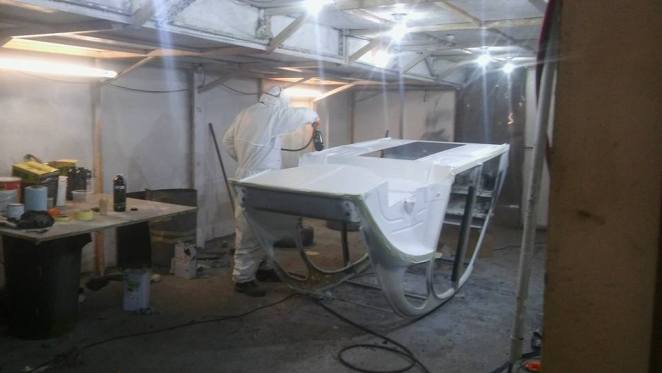
2CV body gets paint! Will it survive better this time?
That in itself reveals the problem. The 2CV has already undergone one very expensive rebuild in my ownership. It’s now reaching the end of its second. Every 100,000 miles, I have to entirely refurbish the body – and it had plenty of patching up in that time too. I’m yet to find a truly effective way to stop old cars from rusting – bear in mind I use the 2CV for greenlaning, and also hurtling along motorways in the winter. Challenging conditions for sure.
Much as I love Japanese tin though, I’m not sure an older Japanese car would be rewarding. My time editing Retro Japanese magazine has taught me that you need a LOT of patience to own older Japanese cars. All those aftermarket panels and parts that MG, Morris and even 2CV owners take for granted and almost entirely denied the owner of a 1970s Datsun or Toyota. I could not bring myself to daily an old Japanese classic, knowing that rot could see it entirely beyond restoration.
My other magazine is Classic Jaguar, and I’ll just have to admit that I simply can’t afford the price of admission. Maybe if we sell more magazines! I do allow myself the odd dream of an original S-Type as daily drive, but at 18mpg and with body parts problematic, a dream is what it shall remain.
Which all leaves me no clearer to knowing what form daily transport will take in the near future. I’m increasingly seduced by the world of electric, but the price of admission there is still out of reach. It’s getting far less so though. I wonder what 2017 will bring…
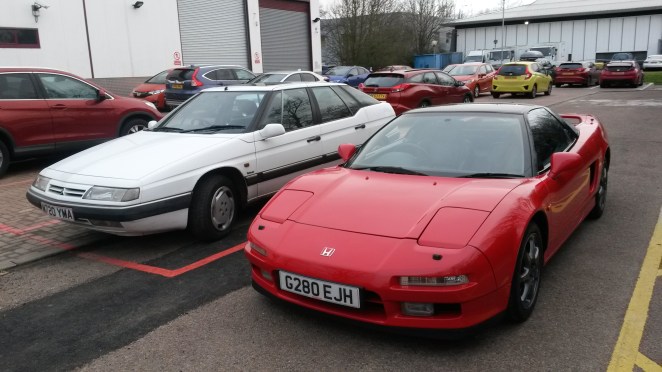
Earlier this year, I achieved a dream! I drove a Honda NSX – the all-alloy masterpiece with suspension tuned by Ayrton Senna himself. In fact, he had once driven this very car! A short distance…
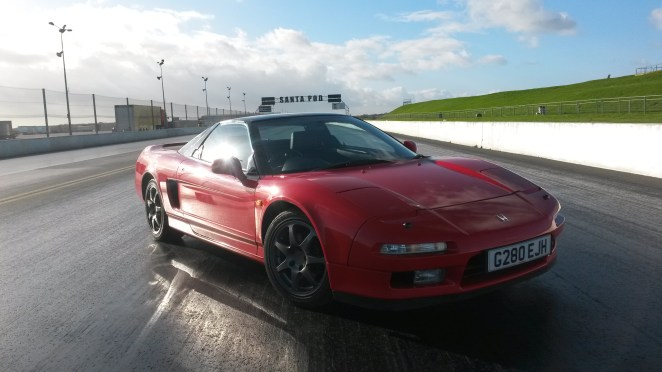
A fantastic driving machine, and an NSX.
A fantastic experience then? Er, no. Really, not at all.
Things didn’t start well when we collected the car, hitting rush-hour traffic as we desperately tried to get from Bracknell to Santa Pod for a photoshoot. A super-quick supercar is not much use if the traffic is barely moving. Not that it was really super-quick. This one had an automatic gearbox, which meant a drop in power to just 252bhp and a 0-60mph time of around seven seconds. Hardly supercar stuff. It really is a dreadful gearbox too, far inferior to the one in my S-MX, though it did at least take the sting out of the seemingly endless jams. There’s no sport mode, which seems shameful on an alleged supercar. It was also reluctant to kick down, changed up too soon and thumped through full-bore changes – when we got the opportunity (Milton Keynes).
The biggest problem isn’t really the car itself though, but the overall experience of driving a supercar on public roads. I surely can’t be the only journalist who’s felt uncomfortable in such a situation, but you absolutely cannot enjoy what this car is all about without getting up to some very naughty speeds. I’m not the sort of person to get up to very naughty speeds, whether I’m in a Chevette or a Corvette. The Honda’s zingy engine doesn’t deliver maximum power and torque until over 6000rpm though, so for the most part, it just felt sluggish and unexciting – punctuated by very brief bursts of ‘WOW!’ as the engine screamed and before I decided that was quite quick enough for the public roads thank you very much.
Better to look at than drive on the roads.
I did a full-bore acceleration test at Santa Pod, and that highlighted the difficulty. It got quite exciting once we reached about 80mph – in second gear. By which time I’d started running out of space.
After all that, we then had to fight our way back to Bracknell, where the super-firm suspension really did get quite annoying. I’d covered 180 miles in the NSX and I was bloody glad to get out of it, with my hopes and dreams lying shredded on the floor. Getting out is a good idea, because it really does look bloody stupendous. It is a fantastic looking car. I think it is a car best enjoyed via the medium of a poster. How pleased I was, though, to jump into my soft, floaty XM – its turbo diesel engine provides plenty of performance for public roads thank you very much, even if it doesn’t even sound one tenth as pleasant.
It feels like sheer rebellion to be a motoring writer and conclude that a drive in something like an NSX was anything other than ridiculously fabulous, but that’s the truth. I’m not Chris Harris, I don’t have access to a race track and even if I did, I’d probably crash. I just can’t relate to cars like the NSX. It’s telling that when I arrived at Honda’s fleet storage facility, I got quite excited about the Mk1 Civic they also have. “Not available for drives,” I was told. How depressing. When it comes to motoring heroes, I think I shall stick to the real world variety. There’s a lot more joy to be had in a bland, family hatchback than in a car you can’t even exploit. Driving a supercar on the road is like winning the lottery, and being told you can only spend your winnings on soap.
Here’s a video of the NSX (and some others). Great fun! When not on public roads.
If someone offers you the chance to drive a race 2CV, then it’s hard to say no. After all, this was a car I had helped nurture through 24 hours of racing in August 2015. I had spent much of the time trying to imagine what it must be like to drive. Very different from a normal 2CV I thought. These ponderings were useful as I attempted to overcome the very strong desire to actually sleep during my pit duty.
What’s a 2CV race car like to drive?
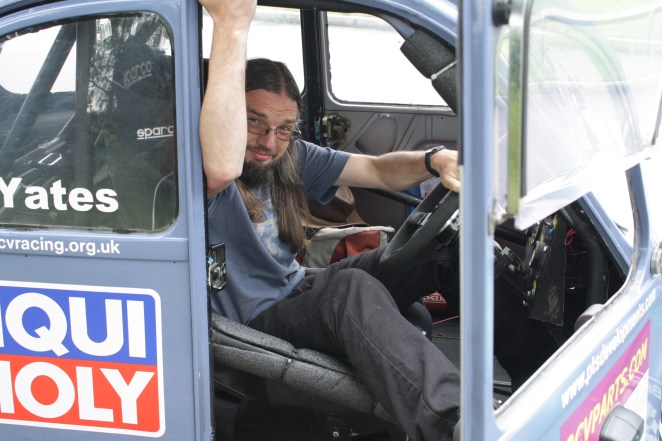
Roll forward to 2016 and the owner of the car, Chris Yates, offered me the chance to actually drive The Blueberry Muffin. Well, I was hardly going to say no was I? I originally wrote a feature on the experience for Classic Car Buyer, which was published prior to this year’s 2CV 24-hour race – one I sadly couldn’t attend. Here, I’ve re-written things for a slightly different audience. HubNutters!
Chris had got the car road legal to assist with engine-running-in duties. Well, that’s what he told me. I reckon he just wanted to see if he could make his race car road legal. An awful lot had changed since this 2CV last saw the highway!
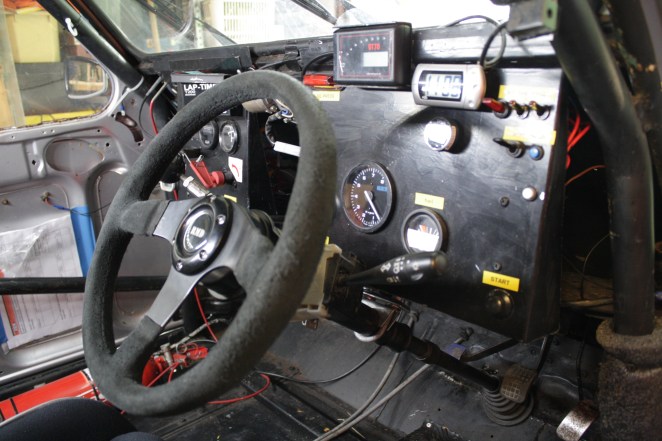
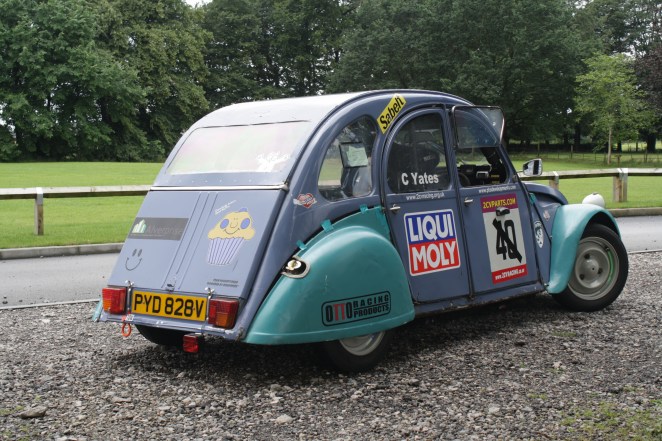
So, what makes a race 2CV so different then? For a start, it actually has more in the way of interior appointments than it ever had before. Far from being stripped out, it’s actually packing a lot more kit. There’s just the one seat, a proper race one of course, and a rather impractical roll cage. The seat is placed further back, and lower. From it, you can’t see the bonnet, and you look sidewards pretty much straight out of the rear side door glass.
Not very 2CV-ish in here.
The steering wheel is smaller and lower, and the column stretched to place it in your hands. The gearlever is extended and the dash-mounted handbrake has been replaced by a proper floor-mounted one. You’d never reach the original.
Then there’s a generous smattering of gauges, a fire extinguisher and a bank of resettable fuses.
Outside, the 2CV sits much lower, on shorter, stiffer springs. The ride height is terrifyingly low, with the axle bolts almost skimming the surface of the road. The windscreen is glass, but all other glazing is polycarbonate. The front windows still flip up as normal.
Suspension is very different to stock.
The canvas or plastic roll-back roof is gone, replaced by a sheet of aluminium, while the rear wings and entire front bodywork are amended 2CV items designed to be removed in double-quick time. The bonnet already slides off in seconds – standard fitment.
Under the bonnet, rules dictate that you must use a 602cc 2CV engine and standard gearbox, though modifications are allowed to the exhaust and carburettor – a Weber DTML is used here, along with the compulsory club specification camshaft. The heat exchangers are gone, with the two exhaust pipes merging neatly into one near the bulkhead. Power output is somewhere around 45bhp at the wheels, compared to 29 (at the flywheel) in road trim. The standard crankshaft is used, which is good for a 6800rpm rev limit – a standard 2CV engine produces maximum power at 5750rpm. These engines are used to high revs.
Still 602cc, but with a Weber carb and exhaust mods.
I go about the difficult process of clambering aboard, and strap myself in. A quick press of the starter and the engine fires noisily into life. It has a purposeful snarl to it. I find the gearlever a little tricky to use – it seems to have some extra play as a result of several extension pieces. I pull away and my ears adjust to the sheer volume. A normal 2CV is hardly quiet, but this is very much louder.
Let the revs rise and it gets noisier still. It never feels all that quick, which is probably my fault for having driven a 2CV with a 100bhp BMW motorcycle engine in it, but it’s certainly entertaining. It may be loud, but it’s a good noise. It isn’t unpleasant and encourages you to go rev-limit hunting.
A race car is rubbish at some things.
Do passers by find it all amusing or just annoying? I’m not sure, but they certainly take notice.
The cornering experience is very strange. There’s not a hint of bodyroll! I’m sure that’s great on a track, but must concede that I find it all a bit wrong and disappointing for road use. Worse, the ride is terrible! I actually ground the car out at one point, all because of a pothole. It doesn’t take long for me to miss a normal 2CV’s ability to go charging over speed humps with nary a whimper. That’s not the case here. I’m having to work very hard to avoid undulations and bumps.
An utterly ridiculous vehicle for shopping. And a race 2CV.
There’s certainly a novelty value to driving something quite so ridiculous, but getting in and out is a right faff. I must concede that there are better vehicles for pottering to the shops – though perhaps it’s still better than a 4×4 pick-up…
I thought it was about time I did a quick fleet update, so recorded a Vlog to update you all. If you don’t have time to watch the video, I’ll do a quick recap.
Nippa suffers its first serious mechanical issue.
Firstly, the exhaust fell apart on the Nippa. Apart from a duff temperature sensor, that represents the only mechanical failure since we bought the car in March 2015. It has otherwise been a paragon of reliability.
The RAV4 is still here, and doing fine – mostly as a back-up car. I’m using it to try and keep the mileage down on the new S-MX (which I’ve talked about plenty already), and it stepped in as substitute when the Nippa suddenly got horribly noisy.
The 2CV is hopefully going to be painted in the next few weeks. I’ve got a few small jobs to do on the chassis in the meantime, and I can’t wait to reunite the two.
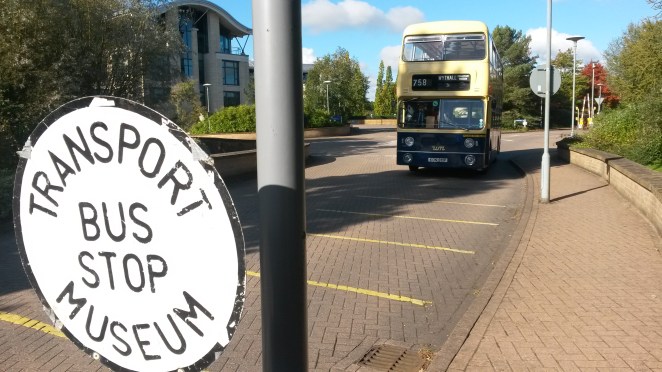
I had a nice day yesterday, full of lovely bus action. Here follows my report. EDIT – video now at the end!
I arrived at Wythall in good time, thanks to the hurtling capabilities of the S-MX. I couldn’t pass up the opportunity to celebrate Transport Museum Wythall’s commemoration of the day the buses of Brum passed from WMPTE – the West Midlands Passenger Transport Excutive – to West Midlands Travel 30 years ago. After all, I was just a child back then, and this would be one of the biggest gatherings of the buses from my childhood ever seen. Not just seen of course, but also heard and experienced, as many of them would be out doing trips. Wow.
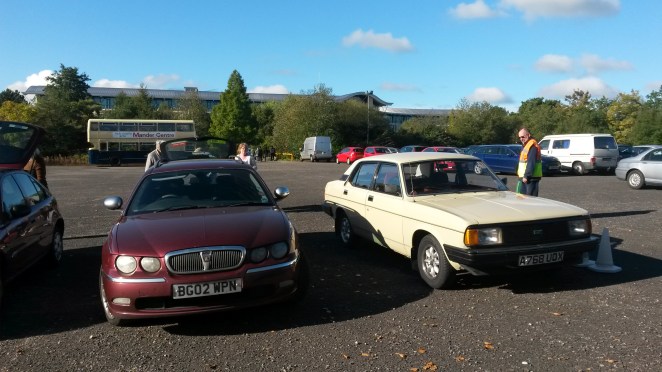
You know it’s going to be a good day when the car park looks like this. A Rover 75 in my favourite colour, next to a beige Morris Ital.
Rover 75 and Morris Ital – not a bad start!
I used to work in that large office block in the background, about 16 years ago. It wasn’t just the buses that formed part of this nostalgia trip, but also the location – just a mile or so from where I went to secondary school.
First bus, a fitting Fleetline.
I ignored a waiting Optare Spectra, because it didn’t relate to my nostalgia trip. They came into service after I had my first car, so didn’t really figure on my radar. No, better to wait for something a bit more suitable. This Daimler Fleetline certainly delivered! Birmingham City Transport built up a huge fleet of (ahem) Fleetlines, fitting most with near-identical bodywork by the local Metro-Cammell Works or Park Royal. Things got muddied a little later in the Fleetline’s life, with some badged as Leyland, at the same time as Leyland’s own Atlantean. BCT took both in the end, with the last Fleetline only coming out of service in 1997 – not bad for buses approaching 20 years old.
I hopped aboard and grabbed my favourite pew – right above the passenger front wheel. I loved sitting here as a child, as it gave a perfect view of the driver. How I delighted in watching the snick of the semi-automatic transmission’s gearlever and the frantic wheel twirling for bends. My mother liked this seat rather less, as it left her feet dangling in the air…
Best view ever.
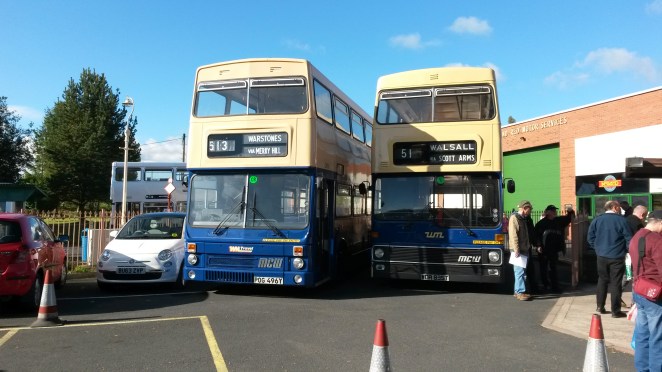
Things were pretty special on arrival too, with a pair of MCW Metrobuses greeting visitors.
A pair of West Midlands Travel Metrobuses.
If anything, the Metrobus is even more the bus of my childhood than the Fleetlines. The first West Midlands Metrobus went into service in 1978, the year of my birth – WDA on the right here is one of those first five prototypes. These Mk1s were always my favourite, as I loved the asymmetric windscreen. So did London Transport, who specified this style well into 1985. Not WMPTE though, who moved to the MkII specification (left) in 1982.
I remember seeing this recovery truck very often as a child. Now in defunct North Birmingham Busways trim.
This recovery truck is another reminder of my childhood, as I often saw it parked up at the Digbeth depot. The poor thing never seemed to move, though I assume it did when needed. It’s actually an AEC Matador, new in 1943, became a recovery truck in the Midlands in 1947, but was rebodied with bus leftovers in 1962 – courtesy of BMMO, Midland Red’s own in-house bus company. It had many stints at Digbeth over the years, before passing to North Birmingham Busways in 1997 – whose colours it still wears. I like North Birmingham Busways as, before they ceased operations, they let me drive their Atlantean and National 2. When they stopped trading, the Matador passed into preversation. I’m glad it survives.
Back to the buses.
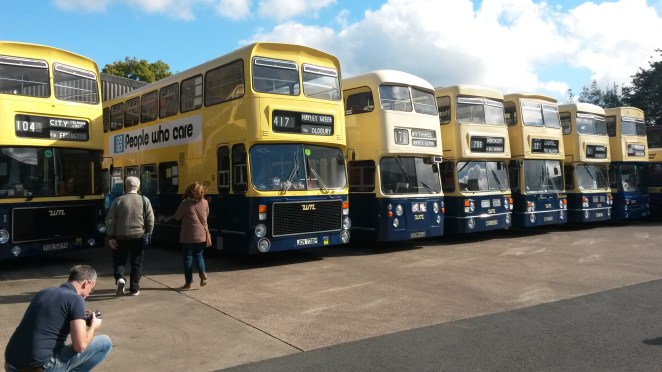
Cor! What a line-up!
Yes, that’s TWO Volvo Ailsas, as well as a mixed bag of Fleetlines and a Metrobus. The Volvo Ailsa was a bit of an oddity on the WMPTE fleet, with its unusual Alexander bodywork and even more unusual layout. A 6.7-litre turbocharged engine is squeezed between the driver and the passengers, so it’s a flat-fronted, front-engined bus. On the left is TOE, which is the original prototype demonstrator. JOV is one of the batch of 50 that WMPTE bought in 1976. I have a distinct memory of catching one of these as a small child in the 1980s, but it wasn’t a bus I encountered very much. They left WMT service in 1987.
What really marks out the Ailsa is the fantastic noise they make. An ususual belt layout means they shriek in a most ridiculous manner! When TOE rolled out for its first run, there was a huge queue waiting! I was glad to be able to get on board. There will be video footage at some point.
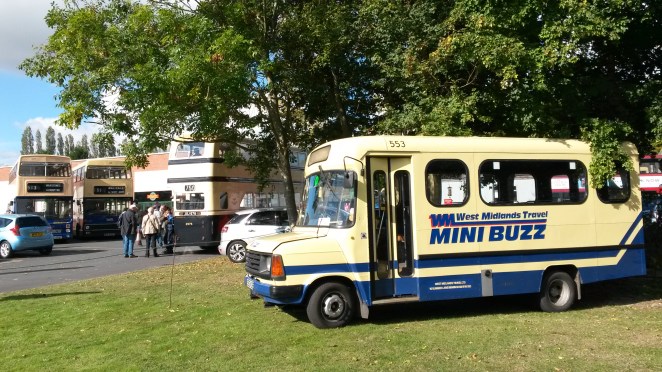
A rather different scale – Transit bus.
I don’t remember seeing these Transits as a child, but always loved this ‘parcel van’ style, with its enormous wipers. It doesn’t seem an ideal choice of bus, but remained in service for a good ten years it seems.
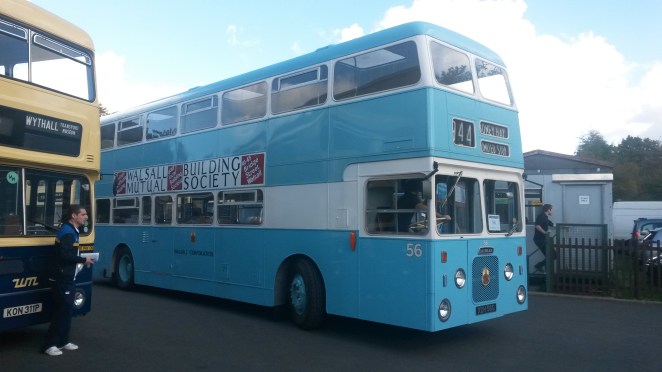
The beast! Legendary 56.
And now for something completely different! Walsall 56 is a quite remarkable Daimler Fleetline, built to the most bizarre specification. It has a V6 Cummins engine, mounted immediately behind the offside rear wheel. Its 36-foot long body (by Northern Counties) seats 86, even with two staircases and two doors – front and rear. The noise it makes is quite ridiculous, and it was apparently notoriously unreliable in service. Walsall Corporation had always gone its own way, but that came to an end after this bus, as the corporation was drawn into WMPTE. By 1975, this 1969 bus had been sold on. It only returned to the road last year after a lengthy overhaul. The time had come to indulge in more rides out. Here’s a nice moment.
Stepping back into the past!
That’s a Foden recovery truck passing MCW Metrobus 3057. This beautifully restored Metrobus is painted as it would have been originally, in WMT’s rare silver over blue. It was only in use for a couple of years, before being redesigned along the lines of what you see on the Foden – more blue, and a larger red stripe. The Metrobus is one of the Mk3 specification, delivered (I think) on E, F and G plates. The stand-out features were larger wiper blades, a larger desination box at the front, an orange section on the grab handle by the doors, and an enclosed rear number plate. I think the upper emergency exit was a larger design too.
These were the last Metrobuses of WMT’s considerable fleet. What replaced them around my way was the Scania N113, with Alexander bodywork. I would have liked to see one at this event, but it was not to be. Nor was there a Leyland Lynx – I remember these thundering past my house on the 18 route.
Where did the upper deck go?
Here’s an unusual single-decker though, one that began life as a double-decker. This Fleetline was new in 1978, and so one of the last. In 1994, it had the upper deck removed and was converted to single-deck format, complete with aerodynamic appendages! It was done to investigate whether converting these buses could save money – the drivers could be paid less. At £25,000 for the conversion, it would have needed a lot of saving! It seems wage changes also rendered this a magnificent white elephant – note that the lights were converted to these standardised items at the same time.
I first saw this bus not long after passing my test, so probably 1995-1996, at Robin Hood roundabout in Hall Green. I did a proper double-take!
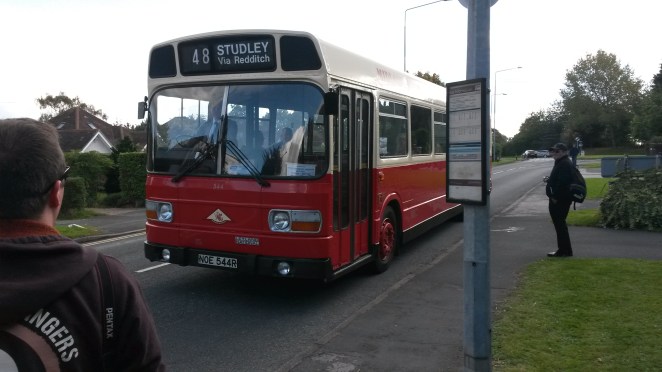
Ah, the lovely National.
Leyland Nationals are another key bus from my youth, as they are for many people. They were everywhere! I’d often catch a Midland Red West National on my way to school. How nice it was to ride on a bus from that time, on the same road – with the cackling engine and crashy ride. Giovanni Michelotti blessed the National with some actual style, and I always loved the pod on top of the roof at the back – not visible in this shot. Caves Buses, who also transported me to and from school, built up quite a fleet of Nationals, and the buses that took me home from school would later be taking me home from nightclubs, with the same poor drivers!
Next generation National
I can’t recall riding much on National 2s, but I definitely remember the much gruffer engine note they had. I enjoyed my ride on this one very much indeed. You can see the rear pod clearly on this one, and the notably longer nose, which now houses the radiator.
There were many other delicious bus moments, but I should probably stop there before you all go to sleep. So, I had one last brew and then hopped aboard the Spectra.
Last ride, aboard the Optare Specta
As R1 NEG entered service in 1998, it was well into my car-owning years. To think, just one year separated this bus from the Daimler Fleetlines in operation with (what was now) Travel West Midlands! The Spectra used DAF underpinnings, and it truly is a world away from the Fleetlines in terms of comfort, noise and pace. It has genuine low-floor capability too, the first double decker in the UK to offer such a feature (though this was not quite the first Spectra so-equipped to enter service). There was just time for one more photo before I headed home. What a fantastic day out.
Yes, I promise. This’ll be the last you hear about the S-MX for a while. There have been many other things going on!
In short though, the S-MX has been improved and has been on another adventure, as related earlier. Now, there’s a fresh video taking a look at recent developments.
I’ve now got the video uploaded for the S-MX Collection Caper. Sadly, it seems very slightly out of sync. Not sure why that is.
In other news, the track rod ends seem to have play in them, though there’s some debate about whether that play is in the inner or the outer. I’ve ordered up the outers as I thought that was where the problem is (on the advise of my local garage) but an S-MX expert (yes, there is one) reckons it’s the inners that usually fail. The outers are £50 a pair, the inners £66 a pair. Here is one very apparent downside to owning a car not sold in the UK.
I’ll keep you posted. I guess I need to get my jack out and explore where the free play is.
Having awoken in Cornwall, it was time to head to a friend on Autoshite who happens to run a garage. The seller of the S-MX claimed there was no history of a timing belt change in the service history. This turned out to be lies, but I didn’t realise it at the point of sale. Thinking the timing belt was probably in dire need of replacement, I’d booked it in to be done, and my pal had offered a very good rate.
Off with the top cover. How old is the timing belt?
It didn’t take him long to get cracking. He’s a bit of a Honda fan boy, so I knew the car was in good hands. I opted to replace tensioner and water pump as well, having been let down by a cheap water pump on the RAV (fitted by a previous owner). I’d rather know everything is ok.
I also decided to change the oil and filter while we were there. With the oil filter buried down the back of the engine, this turned out to be a wise move. Much easier with the car raised several feet into the air. The filter looked quite old.
Yuck! Clearly not changed for a while.
The amount of Japanese writing was slightly worrying. Could it be the one fitted to the car when it arrived in the UK in 2008?! Having since gone through the hardly-comprehensive history, there is no mention of basic servicing. A timing belt change and alignment checks yes, but not a sausage about a basic ‘oil and filters’ change. In fact, the timing belt change included a transmission fluid swap too, yet apparently not an engine oil change! Worrying. The state of the air filter also confirmed sheer ignorance of the basics.
Spot the difference. Bleargh!
The air filter (red) was quickly ordered up from a local factors at short notice. You’ll note there was no trouble locating one. Thankfully, a lot of items are shared with other cars.
I don’t really understand this level of neglect. Yes, a Honda should be a reliable car, but any car needs looking after to give its best! I can’t comprehend this level of sheer ignorance.
I also decided to replace the transmission fluid. It turns out that this had been done three years ago, but it still looked pretty horrible.
ATF fluid should be clean and red. This is neither.
That’s the sort of condition that I tell people to run away from when I’m writing buyer’s guides. I never was one for following my own good advice…
The fact that it had already had a fluid change three years ago suggests this is not a gearbox in the best of health. The slipping into gears simply confirms the fact. Hopefully, it’ll keep soldiering on…
My friend also replaced the melted headlamp connectors, so hopefully my headlamp woes have now been banished. With fresh fluids (including fresh antifreeze), I was ready to continue my journey. I refuelled just before crossing the border back into Devon again having finally used up the ‘free’ fuel that came with the car.
After an overnight halt in Bideford, I drove back today. It was a pretty blissful journey to be honest, with little traffic and a very pleasant halt at Gloucester Services.
Bar Tebay, the nicest motorway services in the UK.
By the way, note how neatly the rear fog light has been fitted. Far better than a lot of grey imports, where a square, dirt cheap aftermarket job is hanging by its wire after the bracket inevitably failed. This is a lot smarter. Though it doesn’t actually work…
The services marked the end of the motorway section, which the S-MX dispatched with great merit. It sails along very nicely at motorway speeds. Still not sure about the torque converter lock up, but fourth is a lot taller than third. No idea what’s going on to be honest, but it feels very comfortable at motorway pace, and excellent, large door mirrors are a big boon.
It does lose its composure on more minor roads though. Generally, it’s fine bar the light steering, but if a bend tightens, it feels slightly like it’s going to fall over its outside front wheel. The Nippa does something very similar. The RAV4, despite a notably tall stance, does not do this. You do have to accept that it is going to kickdown a fair bit too. Top gear is so tall that it runs out of puff, but third gear is so short that it’s immediately up at 4000rpm. Generally though, it’s not bad at all. Respect its limits and it’s fine.
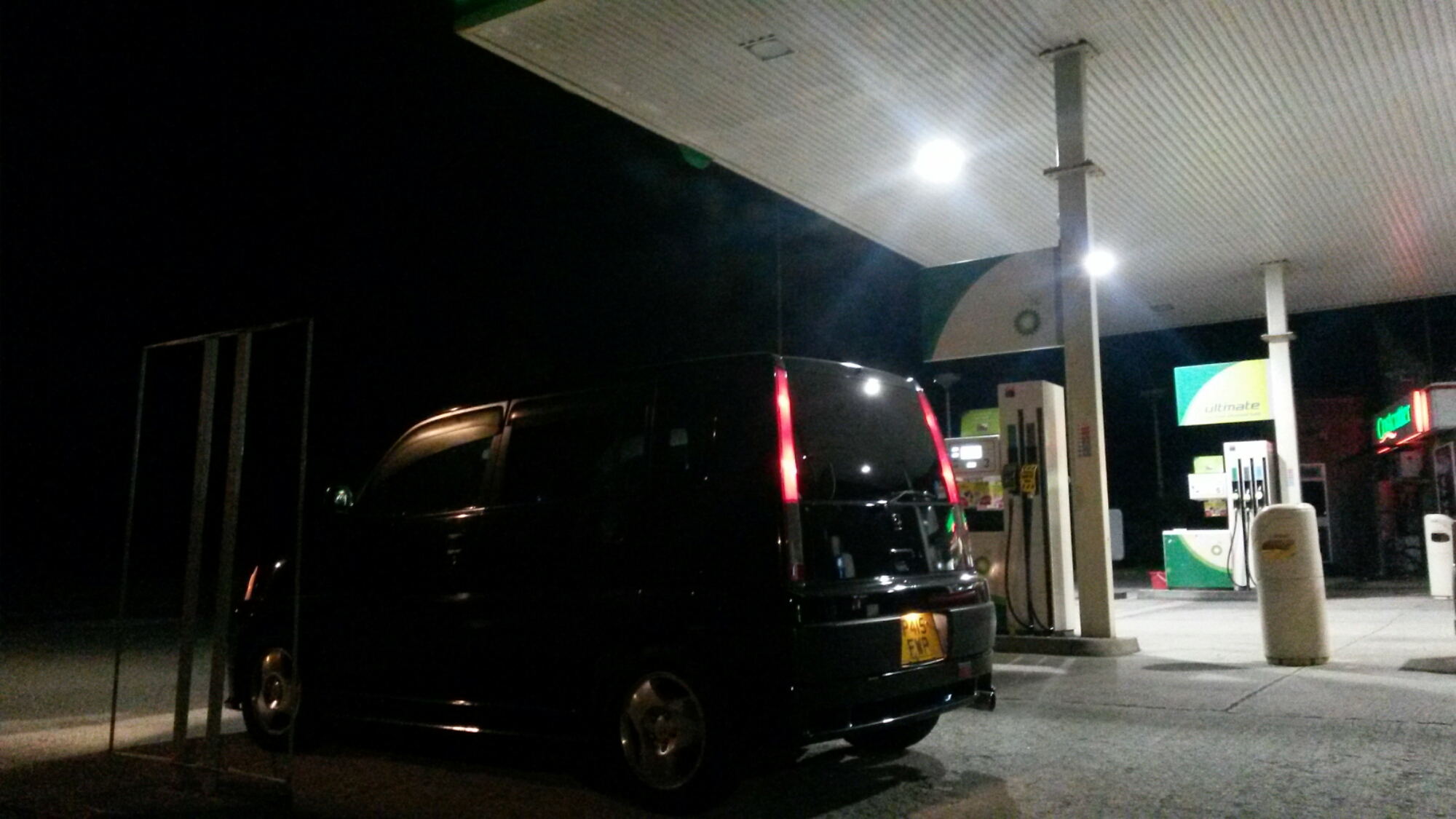
After 285 miles, I had to stop for fuel again. This allowed my first fill-to-fill calculation. I was quite pleased when the sums revealed a figure of 31.95mpg. My hope was that it would do 32mpg. My hope was not in vain.
Refuelling for a second time. 32mpg achieved!
Now, 32mpg is perhaps not that impressive by modern standards, but it’s pretty good for the time given the boxy dimensions, the engine size, the automatic gearbox and the fact that the engine is not running as efficiently as it might due to the stuck thermostat. Certainly not diesel economy, but then it runs on less smelly fuel and sounds a lot nicer too.
In conclusion then, this one is far from perfect, but doesn’t seem a bad base for further improvement. Certainly, it seemed nicely solid when it was up on the ramp, though I’ll need to protect it with anti-corrosion products aplenty to keep it healthy through a Welsh winter.
I’m going to boldly put this one down as a good buy then. Let’s hope it lasts longer than the Rover…
I’m writing this on my phone, so there may be even more errors than normal. The reason for that is that despite this Collection Caper starting yesterday, I’m still not yet home. Why is that?
Let’s start at the beginning. The journey began at 10:30am with the trusty Perodua Nippa providing a fine steed.
At Caersws station, I swapped the Nippa for the first of three trains, though the first of many train seats. Two trains got me to Birmingham, where I’m afraid I made use of the best toilets I’m aware of. The Museum and Art Gallery. Sorry for my preference for lavatories facilities over art…
Coming out of the gallery, you can see that Paradise is indeed lost.
I then jumped aboard a Cross Country Voyager which would take me to Plymouth. Boarding was chaotic, as everyone seemed to have a suitcase. I had to find a spare seat for my large backpack and my reserved seat was surrounded by spilt crisps and litter. Joy!
It was also horribly hot. Everyone was sweating. Mobile sauna. Oh, and no catering, because the food person hadn’t got on the train…
At Cheltenham, I thankfully got to move from hideous coach C to coach F. This was a bit cooler, but still warm. At Bristol Temple Meads, I had to change to coach D. This was the coolest one yet. So cool that at Taunton, where my cheap tickets instructed me to return to coach F. At the risk of causing anarchy, I refused. At Tiverton, the electronic display instructed me that my seat was now available. Ace. I could legitimately stay here until Plymouth, where I complained to Cross Country on Twitter about the overpriced tea (with UHT milk, horrid, though at least there was catering again) and rubbish-strewn carriages. I can’t help thinking having more bins, that can actually be found, would improve things.
Anyway, if you’re still reading, I did get to Plymouth on time, at 1742hrs. Long day, but I still had to collect my new Honda S-MX and make a bed in it…
I thought the collection had gone well. I checked the car, paid my money and headed off. But, problems!
I’d turned the headlights on, and the main beam light illuminated. I pulled the stalk but it remained illuminated. I quickly switched to sidelights, thinking I was blinding everyone. I found a petrol station to stop at and discovered I wasn’t blinding anyone at all. No headlights. Not a sniff.
I’d spotted a spare bulb in the glove box, so fitted it. Nothing. As it was a new bulb out of the box, I began to realise the car was the problem here. I gave the bulb connector, which was slightly melted, a wiggle. Light! Ouch. H4 bulbs are quite bright. Now I had to refit the bulb without losing the working connection. Difficult. A wiggle soon had the other side working too. Phew! It was fast getting dark, and I still had distance to cover. To Cornwall!
In the next blog, I discover what it is like to sleep in the Honda S-MX, subject it to more fettling and talk about what it’s like to drive.
Tomorrow morning, I set out on yet another crazy car collection caper – this time, it’s Cornish!
The car in question is a Honda S-MX. It is located in Plymouth, so my first challenge will be to get there. I will be using a combination of Perodua Nippa, awful Arriva Train Wales and then a hopefully-more-pleasant Cross Country fast train from Birmingham. The train is costing £59.75, though I’ve saved about £60 by booking through Split Ticketing. This website has become an essential tool in the car collection caper business, because it uses clever calculations to break up your journey into the cheapest possible format. You could do this yourself, due to the utterly stupid way in which our railways are run, but it would take many hours.
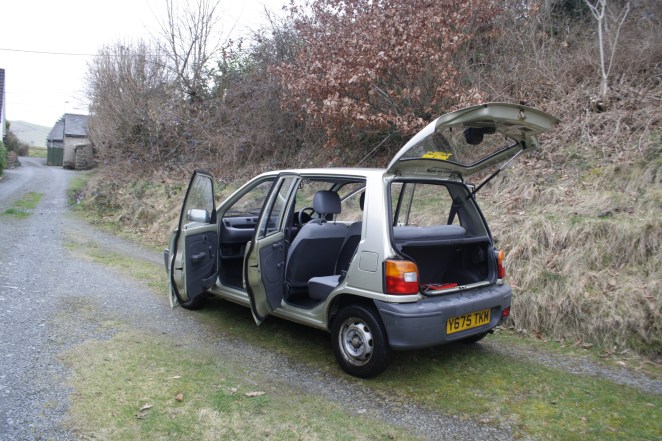
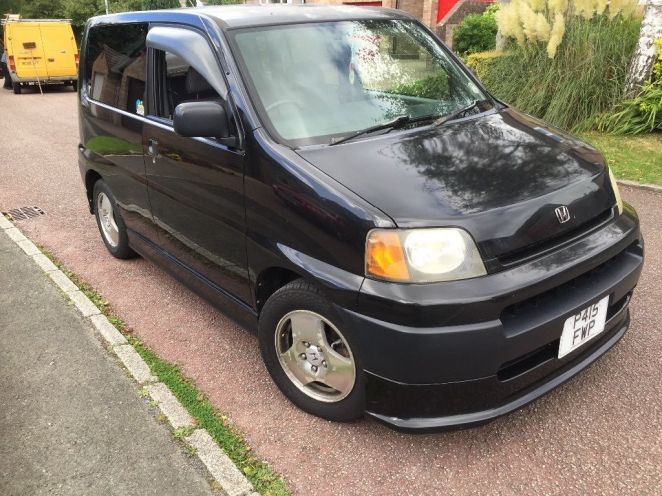
This actually is my new car. Hope it’s ok!
In effect, my journey is broken into several chunks, even though the reality is that I’ll be on the same pair of trains as if I’d paid full price. My first ticket takes me from Caersws to Birmingham, but the next leg is broken down into Birmingham to Cheltenham, Cheltenham to Bristol, Bristol to Taunton and finally Taunton to Plymouth. The only minor inconvenience is that I have reserved seats for each ticket, and they’re not the same for each leg. I shall combat this by either hoping the train is quiet, and just staying in the same seat, or taking an unreserved seat all the way.
It’s annoying that such tactics are necessary. Rail travel in this country is hopelessly expensive. The normal £129.50 price for this journey is just ridiculous.
Train travel can be grim. These Arriva Trains Wales things are horrible.
I’ll be arriving in Plymouth at 1742hrs (all being well) where I shall set eyes upon my new car for the first time. Assuming it is as described, money will change hands and I’ll then head to Cornwall. I will then find somewhere to sleep in my new car, because the seats transform into a bed, and I need to test this. Immediately.
My ultimate destination will be Redruth, where a friend will perform a timing belt change on my new steed. There doesn’t seem to be any mention of a belt change in the history and at £750, this car goes down as an expensive purchase by my standards. I need to protect my investment. We’ll also give it a good going over to see what else is going to be necessary in the future. I’d guess the transmission fluid hasn’t been changed in a very long time. I’ll also assess whether it needs a general service, but may wait until I get home to sort that out.
It’s all very exciting and I look forward to seeing what my new car is like, seeing what it’s like to sleep in and seeing where I manage to find to park up for the night. Stay tuned!











 HubNut - celebrating the average!