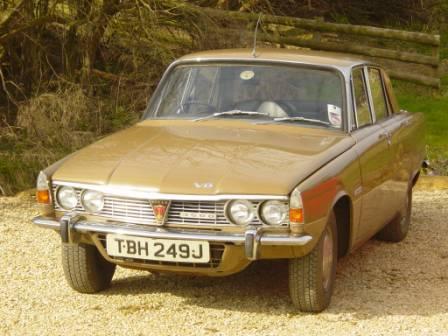
A Marina in drag. Does it deliver?

The Morris Marina may not seem the most ideal choice on which to base a sports car, but that’s exactly what the Yorkshire-based Naylor Brothers did in the 1980s.

They hit on the rather spiffing idea of combining the flowing-yet-traditional lines of the MG TF with more modern running gear and a few more creature comforts. The Marina and Ital’s new O-Series engine would provide rather more urge than the old XPEG MG engine, linked to the Morris gearbox and rear axle. Happily the Marina’s leaf springs were replaced by coils and the ancient trunnions of the Marina were replaced by MacPherson struts. The Naylor TF1700 was fully type approved, with backing from Austin-Rover. 100 were built between 1984 and 1986 before the venture failed. A further 61 were sold as Hutsons after the failed company was purchased by another enthusiast.

Hutson TF1700

The heart of a Marina lurks beneath the traditional bodywork

The car driven here is a Hutson and it was rather a revelation. There is a hint of kit car in some details, like the out-of-place front indicators and the chunky Chrysler door handles, but it is otherwise a very faithful copy of the TF. Like the original, there’s a steel chassis and the body is formed in ash, with steel panels wrapping around it. It therefore feels nice and solid.

The interior is an interesting mix of tradition and modernity with controls nabbed from then-current Austin-Rovers. The walnut dashboard is a nice touch though and it doesn’t feel any more ‘wrong’ than a Morgan, which similarly mixes traditional wood with modern switchgear.

Hutson interior

Proper wood and modern switchgear combine

The biggest surprise comes when you drive off though. Who would have thought that a Marina engine could sound so rorty! Acceleration is strong enough too, feeling much quicker than the 12-second 0-60mph time. I may only have been blatting about the bumpy roads of Birmingham but this car felt taught, responsive and above all good fun. The Marina rear axle is better located, with a proper four-link set-up with Panhard rod. The coil springs all-round mean a much more comfortable ride than any original MG T-Type but this doesn’t seem to come at the cost of cornering ability.

There is a very passionate club for these cars, and it’s easy to see why. Who needs a Morgan if you want tradition and a few creature comforts? I was certainly impressed and in the best tradition of MG, the mechanicals of a thoroughly ordinary car have been transformed into something rather special.

The joy of the road trip

You can’t beat leaving your life behind and heading off on a high-mileage jolly. I’ve done it several times and while each trip had its own stressful moments, looking back, these were good times for sure.

The first big road trip that my wife and I undertook was to drive to Sweden. Via France. In an undergeared Citroen H van of a design first launched in 1947. This would be a classic grand scenic tour with a big difference! Rather than using an exotic sports car, we’d be travelling in a corrugated shed on wheels with a comfortable-ish cruising speed of 50mph, servoless drum brakes but the advantage of a bed and kitchen area. Tea would be in endless supply.

In the space of three weeks, we drove through France, Belgium, The Netherlands, Germany (where the windscreen exploded in our faces), Denmark, Sweden, Norway and then back home via Newcastle. We clocked up 3100 miles with no mechanical trauma other than the exhaust setting fire to the carpet on the floor.

Road tripping H van

H van takes a break in the Norwegian mountains

The next year, we undertook The Eight Ball Challenge. This was a 2cv-only event driving around Great Britain in a figure of eight. That allowed us to clock up 3500 miles in 15 days, in cars with 29bhp (one was an old one with only 12bhp, and it turned out to have lost several of those!). It was one of the best experiences I’ve ever had, meeting different people around the country and having a lot of fun with the folks who took part in the event. The 2CV had a few mechanical issues that needed occasional fettling, but got us there in the end.

Then the year after that, I headed off with a friend to take part in the BXagon Challenge. We drove 3500 miles around the perimeter of France (taking in Belgium, Luxembourg, Switzerland and Spain for good measure) in 14 days. Apart from a coolant pipe failing and a rear disc shroud falling off, the car coped perfectly.

In 2010, our big road trip was to take the 2CV to Switzerland, via Normandy (where my father-in-law lives). That was great but in a moment of madness (well, 17 hours of madness) we drove all the way from mid-France to home in Cambridgeshire in one hectic day. That was 660 miles of driving! We filled up with fuel in four different countries.

All of the above took us to places we’d never usually visit, often well away from major routes and civilisation. The scenery was often truly breath-taking and you begin to revel in the freedom of the road. Don’t get me wrong – these are expensive holidays, even when the BX we used on the BXagon only cost us £266 to buy. Even with a rather excellent 50mpg, we used over 315 litres of fuel, so that’s probably £350 on fuel alone, without considering ferries, catering, accommodation etc. We did avoid paying for tolls by keeping away from big roads – France allows you that and you see far more of the country.

Scottish adventure in a 2CV

A good road trip includes plenty of gorgeous scenery to make it feel like a grand tour!

Trips like this are perfect to re-ignite the joy of driving. Cities and commuter routes can leave you thinking that driving can no longer be a pleasure. That is not the case. Take a road-trip in your classic or tackle a grand classic tour and remind yourself that driving CAN be darned good fun. Even in an underpowered old Citroen.

2CV – fun in the sun

It’s been a while since the 2CV has appeared on this blog and I apologise for that massive oversight. I’ve been rather busy with other vehicles and work, but that’s not to say that I haven’t been using the 2CV. In fact, the little Tin Snail has been very busy recently, reminding me why I love it.

When it comes to bombing around the roads of rural Wales, I honestly think there isn’t another car I would rather be in.

Citroen 2CV Dolly

For hurtling around Wales, few things can match a 2CV

That may seem a bold statement, but there’s a reason for it. For a start, much as I love TVRs, it would be left for dead by the 2CV on some of the twisty, trecherous mountain roads around here. It simply doesn’t have the ground clearance and with bends coming at you like a herd of demented cattle, there are few opportunities to exploit the power. You might as well have a mere 29bhp that allows you to keep your foot down.

So, with undulating roads, perhaps a 4×4 would be useful? Well, not really. 4x4s are big, bulky and generally don’t handle as well as smaller cars. If I was in one of those, I’d have to be seriously worried about meeting another car. The 2CV is skinny enough to nip past most things.

A modern supermini then. They’re nippy things aren’t they? Well, no. They’re heavy with city-friendly and therefore lifeless steering. Oh, and huge blind spots. I’m here to appreciate the view, so it’s roof back in the 2CV, which makes it easier to keep an eye on kites and the like. Well, until I got too cold…

Mix in the 2CV’s keen steering, sharp brakes and fabulous all-independent suspension and you’ve got an exceedingly entertaining machine that’s also very comfortable. Also, it took in a forestry commission lane (to a legit car park, don’t just go heading off down random lanes) and transported a household door. The 2CV may not be brilliant at everything, but it’s bloody good at a lot of things.

Project Budget 4×4: Off the tarmac at last!

I didn’t actually set off from home with the intention of tackling some local byways, but found myself in Nant-y-Moch. I’d gone for a drive primarily to get some new photos of the Maverick and also to help the new brake pads and discs bed in. The Nant-y-Moch area has many byways, though still some idiots insist on heading off-piste. I always stick to the routes signposted by Tread Lightly as I consider myself a responsible 4×4 owner.

On the drive over there, while I checked that my injured back was up to it, I began to compare the Maverick to the Range Rover I owned last year. The Range Rover was the first European 4×4 that made any attempt to behave like a car. It was quick, comfortable and handled well. That was by the standards of 1970 though, and by 2011, my 20 year old Rangie felt far too much like a wallowy barge.

The Maverick behaves much more neatly, with controlled bodyroll and a surprisingly comfortable ride for such a short 4×4 – though it can’t match the Rangie for sheer comfort. It beats it hands down for handling though, with a delightfully sharp turn in. You do have to be careful though. It’s rear wheel drive only on the road, with a limited slip differential and the short-wheelbase combining to make a spin an easy possibility if you aren’t careful. I am careful, but I do bear it in mind.

After a pause for photos, I decided to tackle one of the Nant-y-Moch lanes. I know it pretty well, so I knew that there shouldn’t be anything too challenging. Heading away from tarmac on your own is always a risk though, especially in a new vehicle.

Ford Maverick green lane

The Maverick tackles a Nant-y-Moch byway

Once on to the rock and gravel track, I dropped it into 4-wheel drive and the low ratio gearbox. That gives greater control and as this lane is mainly rocky, and I was not wanting to damage my back, I would be travelling slowly. Initial impressions were good. While the ride was firmer, I wasn’t in any pain and a few tricky sections were tackled without a lack of traction.

Pictured is a sinuous, rocky climb up a very narrow passage. The Maverick seemed to be handling this fine, and while the petrol engine lacked the lugging torque of the Range Rover’s diesel, it was making light work of this. All good.

Then I got stuck. One very rocky section required maximum flex from the suspension. I hadn’t considered that it would struggle here as the Range Rover just plodded through here using its massive axle articulation to keep all wheels on the ground. The Maverick came to a wheel-spinning halt. I tried a bigger dose of power, but it was no good. No traction here, despite that limited-slip rear diff.

The only option was to reverse. This is the good thing about getting stuck on an incline. It’s usually quite easy to get yourself moving again. I then tackled the section with more momentum, in low second. This time – and no doubt with at least one wheel waving in the air – it cleared the obstacle. Phew!

For a modern 4×4, the Maverick actually has pretty decent axle articulation, but chatting with friends on the Nissan 4×4 Owners Club, it seems likely that the rear anti-roll bar is hampering flexibility. The advice is to remove it, but I shall consider this decision for a little longer yet.

There then followed some icy fording sections, reminding me that it had been very cold out this way recently. Thankfully the depths were not an issue and I was soon able to return to the beaten track once more.

So, there we have it. My first off-road spell and I’m pretty impressed. It struggled with axle articulation, as I suspected it might do, but I did not get irretrievably stuck and it felt very capable. A longer, more challenging route will be attempted as part of a group this coming weekend. I shall report back.

Road Test: Mitsubishi Delica L400

EDIT – Video Review now available!

I’ve always loved off-roaders, though I’m very quick to distance myself from those who go tearing around the countryside upsetting ramblers, churning up byways and going where they like.

Nor am I particularly interested in getting stuck and needing thousands of pounds of kit to get me moving again. Pay and Play sites can be fun, but there’s a bit too much focus on driving like an idiot for my liking.

Mitsubishi Delica L400

Delica. No award winner for beauty!

No, to me, an off-roader is a car you use like a car, but which you also use for heading off the beaten track when needed. This brings me neatly to the vehicle tested here. It’s a Mitsubishi Delica L400, owned by someone for whom a 4×4 is essential. It gets used to drive across muddy fields to collect wood and even the chap’s driveway is a struggle at times. A 4×4 isn’t a nicety – it’s essential really.

A great off-roader isn’t enough though. Occasionally, it gets used as a tour bus for his musical endeavours, so the six comfortable seats it has are also necessary. As is the ability to eat up a lot of miles in comfort and relative quiet – something the traditional Land Rover is not exactly known for.

It was people carrying duty that gave me a healthy dose of wheel-time in this hard-worked steed. A 230 round-trip to North Wales gave me plenty of time to acclimatise. The first thing that strikes you about the Delica is how ridiculous it looks. She’s no beauty, and it looks  a bit like a home-brew attempt to make a monster truck out of a van. They’ve always looked rather precarious to me, so I was interested to discover how it behaved.

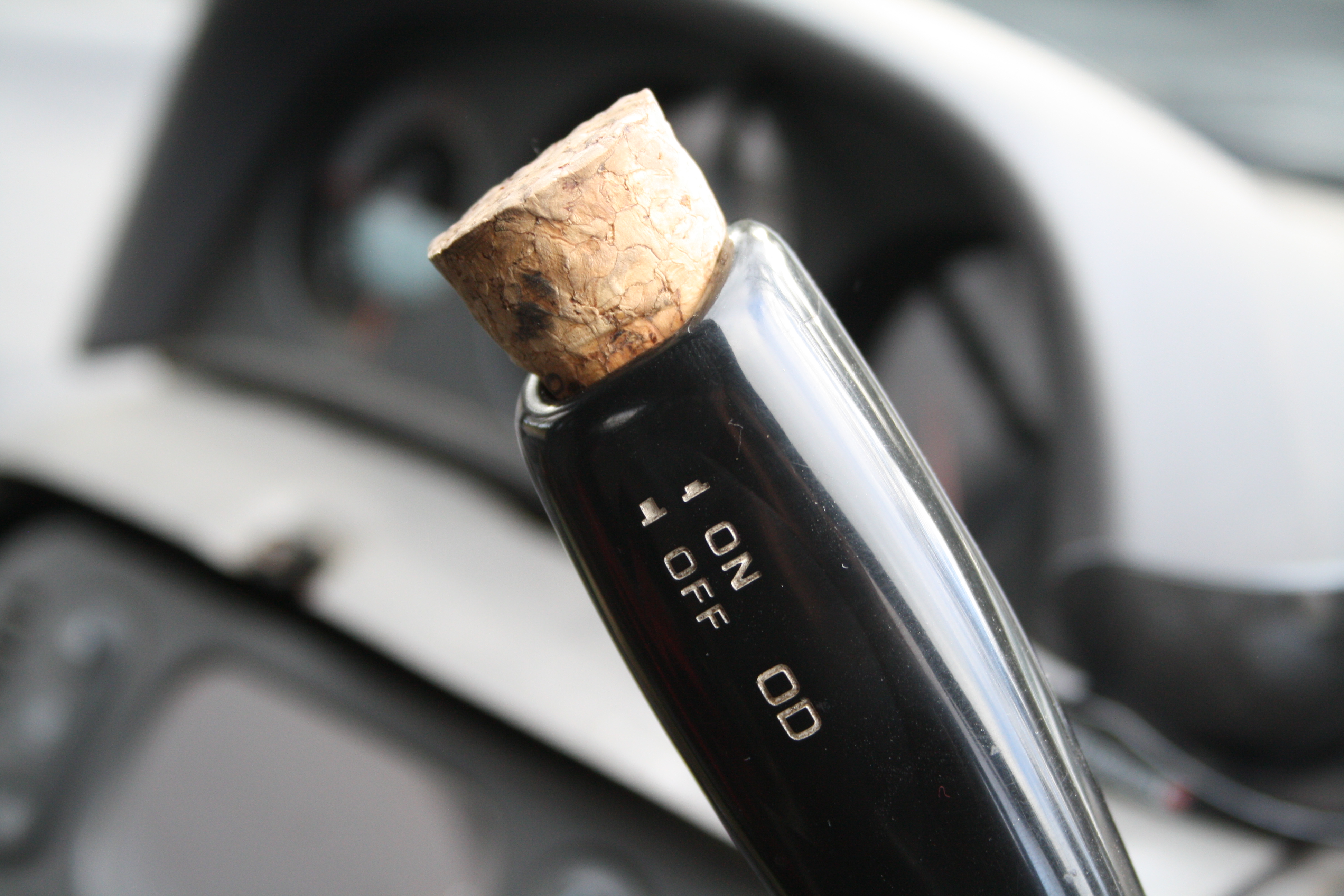
Clambering aboard, which is a bit of a challenge at first, I was struck by the typical Japanese ergonomics. There are buttons all over the place, though this example is further ‘enhanced’ by a large section of missing trim, some buttons that fall off when you press them and a cork that replaces the missing overdrive switch on the column-mounted gear lever. Oh yes, a column mounted lever! Just like the old days.

Cork gear lever

Well, if it works, why not?

The floor is quite high, so you don’t sit in quite the impressive manner of a Range Rover. Your view is certainly impressive however. Forwards at least. Large door mirrors aid rear visibility, which is good as ‘privacy’ netting rather restricts vision through the windows themselves.

On the move, it all feels rather tight and not as wobbly as you might expect. There’s very little bodyroll and while the ride can be crashy, it’s not uncomfortable. The steering is nicely weighted and accurate too. We suspect the transmission wasn’t in finest form on this one as it did a peculiar thing when it reached top gear, and actually accelerated despite lower engine revs. The ‘automatic with overdrive’ is a novelty too, but does mean low-rev cruising. Pulling the cork out turned the overdrive off and gave the engine an easier time when coping with gradients. Incidentally, FX4 Taxis with the automatic gearbox usually have a similar overdrive system.

While this certainly isn’t a fast-accelerating machine though, it does build up speed nicely – which is what you want when carrying passengers. You don’t really want neck-snapping power. It did feel like it could really pick-up pace if you wanted to, but it did also suggest that doing so would generate an awful lot of engine noise and cause the economy to suffer to a very large degree!

So, best to sit back and enjoy. It’s quite relaxing, which is good as 230 miles on Welsh roads is exhausting! Especially when it rains and gets dark. Overall though, I enjoyed my time at the helm. It’d be good fun to put one through its paces off-road next…

Project: Budget 4×4

After the massive enjoyment factor delivered by my Range Rover last year, I decided I just had to get another 4×4. You may recall that the Rangie had to go due to a heater problem and the onset of winter. I’m still not sure it was the right decision, but too late now…

After anxiously enjoying a mild winter, that has generally failed to deliver OMG SNO KAOS thus far, I felt it was time to get another 4×4. A sensible person would wait until March, because 4×4 prices tend to slump as the weather gets milder. Not me though. I reckoned that if I was lucky, I’d grab a bargain despite the season. I was helped by mild conditions that have left people less desperate to get a 4×4 themselves.

Ebay is just one tool for finding a car. I’d also gone along to a Brightwells 4×4 auction for a magazine feature (to be featured later in the year in 4×4 Magazine – another reason to get a 4×4 again!), and watched the bidding with interest. Very little was coming into my meagre budget in either avenue, though perusing many classifieds sites left me in hope that I could achieve a purchase. The question was what do I go for?

I decided I didn’t much care as long as it was within budget, and this technique can be useful. I still drew up a short list. I decided I wanted reliability, solidity, a low-range gearbox and something that wouldn’t be horrific on the road. Mitsubishi Pajeros were an early contender, but they’re not as reliable as you may think. Both 2.5 (head gaskets) and 2.8 (cracked heads) have their issues, and they’re a bit blingy. Vauxhall Fronteras looked to fit the bill, but they’ve always been a bit agricultural, and they’ve had some poor engines fitted over the years.

A forgotten vehicle is the Ford Maverick, also known as the Nissan Terrano II. In fact, Ford’s input was a heap of cash and a box of blue oval badges, so the design is 100% Nissan, down to the engines and the factory they were built in – Nissan’s Spanish one. I’d never driven one, but they were well regarded when new for good road manners and decent off-road behaviour – the latter due to low ratio gears, a separate chassis, good ground clearance and a limited slip rear differential. I began to cast around for an example and had a look on Ebay. I was surprised to find one up for auction in Swansea. It had two minutes to go but hadn’t managed to attract an opening bid of £500. This despite MOT and Tax. Sure, the pictures weren’t brilliant and the text ran to an entire 74 words, but surely this was a bargain? I clicked ‘bid’ and began to very much hope so!

I didn’t have long to wait to see if anyone else would bid. No-one did. I was the winner! Now the anxiety really began to kick in. I’d not bought a car blind since our Mini in 2006. It’s generally a bad idea I think, but 2 minutes didn’t give me time to drive to Swansea and back. I had to be brave.

Maverick 2.4i petrol swb

New purchase seems actually quite good...

I also had to plan how I’d get there. Public transport in Wales is very hit and miss and Arriva didn’t really help by refusing to indicate what their bus fares were. Happily, a friend of a friend offered me a lift for fuel money. A lot easier, even if it was in a Vauxhall Tigra (not a bad little car really, bar the horrific ride). There were issues getting hold of my money (thanks to banks) but eventually the amount of £500 was acquired and I could go buy a car.

On arrival, it certainly looked good. There was a dent (as shown on Ebay) below the left-hand rear side window, and a few scratches, but otherwise all was well. It started first turn of the key, ran smoothly and a quick test drive failed to reveal anything suspicious. Cash was handed over, the V5 was signed and we were on our way. After a cup of tea… (some sellers are very nice!)

I really wanted a Maverick or Terrano with the excellent 2.7 Turbo Diesel engine, but this £500 Maverick had to make do with the Nissan 2.4-litre, four-cylinder petrol engine. That means torque is not exactly prodigious, but it’s possible to make good progress without having to wring its neck. In fact, my pal in the Tigra was surprised at how quick it could be – though that’s often said of people trying to keep up with me in the 2CV as well. It’s not what you’ve got…

Not that I was hurtling into bends with reckless abandon. You can’t help feeling that it’s going to fall over if you really push it, though I’m sure it’s more stable than it appears. Certainly, I was able to push on a bit later in the journey, encouraged by accurate steering and reassuring grip.

The ride was a touch bouncy, but not as bad as I expected. Sure, it’s some way short of Range Rover composure, but then it handles far less like a wallowy barge. One real surprise is how tight the turning circle it is, especially after a day behind the wheel of a Mitsubishi Delica L400! (see separate Blog once I’ve written it…). The gearchange is as I like it. Very tight but quite clunky, as if you can feel the cogs merging when you change.

In fact, the only downside was very squeaky windscreen wipers. They were horrific! Happily I cured them with some spray grease when I got home.

There are some other minor grumbles, but way fewer than you might expect of a cheap ‘banger’ such as this. Some interior trim is broken and the electric windows are both slow. More grease should help here. I’m also slightly concerned at the lack of a ‘following’ for these vehicles. Forum help and advice is never in short supply if you own a Range Rover or Pajero.

I reckon it might just be the perfect car for me at the moment though. I look forward to putting it through its paces off-road!

The love that left me

Some years ago, I had more money than sense. Now I have little of either. Back then, I worked in IT Support for a large utility company, enjoying the highest earnings of my life up to that point. Then I turned 25. I decided to celebrate this momentous occasion by hiring an MG RV8 for a day. We clocked up 200 miles hurtling around The Cotswolds, enjoying the acceleration and wonderful noise as we exited every village. Other than the engine, the RV8 was nothing short of a massive disappointment. The interior was a horrible mix of controls pinched from such wonderful machines as the Rover 100 and LDV Pilot, the suspension seemed to have been forgotten completely and bends became terrifying as it skitted about like a tea tray skidding down a cobbled street. I digress.

Rover P6B

Ah, the car that broke my heart. What a machine!

It was my first encounter with Rover’s V8 and it was soon clear that like an addict, I needed another hit. The choice of what to go for was enormous. The engine has been fitted to so many cars. Here’s a few for you. Rover P5, P6, SD1, Land Rover, Range Rover, Land Rover Discovery, Land Rover Forward Control 101″, Ginetta G32, TVR 350, Griffith and Chimaera, Freight-Rover van, MGB, MG RV8, Triumph TR8, Marcos (various), Morgan Plus 8 and even, in Australia, the Leyland Terrier truck. It’s a bit of a whore is that engine.

I rushed out and found a Rover 3500 for sale, more commonly known as the Rover P6B. It was a car I’d long had a hankering for. It mixes British engineering, but with a large dose of Gallic flare – for the base unit construction is very similar to the Citroen DS, the big giveaway being the similar treatment at the top of the windscreen. So won over was I by the wuffle of that V8 (the Rover P6 DID get the engine it deserved, unlike the Citroen), the stunning Tobacco Leaf paintwork and the fact that it was a rare pre-facelift model. I ignored the rotten sills as a mere technicality.

Driving home in my new machine was certainly quite an experience. It was the oldest car I’d ever owned and driven up to that point. It didn’t have power steering, but that seemed no great loss as the large wheel seemed to do a pretty good job of making the thing go where I wanted it to. It was also my first automatic though, and while I had driven autos before, the old Borg Warner 35 gearbox used in the P6 is a clunky old devil and it took time to work out how to get the best out of it. The brakes were superb though – all-round discs were standard on the P6 even from launch in 1963.

I think I’d utterly fallen under its spell by the time I got back home. The cosseting ride and surprisingly nimble handling just left me to savour that V8 as it effortlessly bore me along. I did discover that the kickdown didn’t work, but that would probably end up saving me a small fortune. With so much torque on offer, who needed it? I could always snick the gearlever down into 2 if I fancied a bit of full-blooded acceleration, with the V8 screaming magnificently. It turned out I did fancy this, quite often! Especially as I accelerated out of Lower Boddington in Northamptonshire. I apologise to the residents. Not my neighbour at the time though, he loved it!

I can’t imagine there were many IT professionals (I use the term very loosely in my case…) who were sauntering around in a 24-year old, petrol-slurping executive car, but I was, and I loved it. Sadly, I was becoming aware that the sills were going to need attention before too long. The car went off for some expensive surgery. The bill for £1400 almost floored me, but around this time, I got a job that paid almost twice as well, so all was well. Wasn’t it?

Not really. Despite a wonderful random trip to Wales just after Christmas (not very far from where we live now, and we passed through our current village!) there was no denying that 20mpg was getting a bit tiring, despite my new income. Maintenance bills were making me weep too. Keeping a P6 in fine fettle gets very painful very quickly if you can’t do the work yourself, and I couldn’t then. In the end, I sold her on Ebay for a few hundred pounds less than I paid for her, after throwing a LOT of money at her in the time I owned her.

I still miss that car very much now. Would I forgive TBH 249J (or Tabatha) and take her back? I suspect my wife hopes that opportunity never arises…

2CV, Peugeot, Rover

The fleet was certainly varied in 2003! Only the 2CV survives various fleet culls...

Rover 75 – impressions

I’ve owned the Rover for just over a week, and a trip to south England has allowed me to clock up 531 miles in two days. That’s a total of about 12 hours at the wheel – more than enough time to get a feel for what is the first 21st century car that I’ve ever bought.

Classy Rover interior

Not a bad place to be, which is fortunate!

Generally, impressions are really rather good. They should be. With BMW’s money behind it, Rover engineers had the funds to do a decent job – something they’d not really enjoyed since the Rover P6 was launched over 30 years before the 75. Sure, there are one or two annoying rattles, but wafting along in the Rover is pretty close to bliss. It’s quiet, smooth and with the engine chugging along at a mere 2300rpm at motorway speeds, incredibly relaxing. Economy is good too – despite much time spent at an actual 70mph, and a bout of city driving in Croydon, the Rover returned 49mpg overall. That’s really not bad for such a large car – I can expect the BX to deliver that, and the 2CV if I’m gentle, but they’re much, much lighter and far noisier…

One feature I’m already enjoying is the automatic wipers. A positive boon for someone who lives in Wales and sure enough, our trip involved pretty much every strength of rain from drizzle to monsoon. Being able to adjust the heater output temperature separately for each side of the car has its advantages too…

In terms of handling, the Rover is very much a car that is competent but not corner-focussed. I was able to chuck it around a bit on some Welsh roads on the way back home – after I’d had plenty of time at the wheel to get a feel for the thing – but it doesn’t enjoy being driven quickly like that, and I didn’t really enjoy pushing it. That’s ok – the 2CV delivers plenty of cornering thrills! The ride comfort really is rather good though, and the seats are good too.

There are some issues to be resolved, one of the worst of which is badly juddering brakes. I shall look to replace the discs as soon as possible. This may have proved hairy for passengers as I was reluctant to brake too hard for bends. Sadly, crunchy third gear synchromesh meant my usual high standards of chauffer-ship were somewhat lacking as I attempted to operate all three pedals at once! By the return trip, I’d got the knack of double-declutching about right. Bye bye crunching!

I have discovered a hugely enthusiastic following for the 75 though, and this makes ownership much more bearable. It’s incredible just how much people do on their own 75s – the hype about electronics stopping DIY work is a definite myth!

A stay of execution?

A week ago, I was quite prepared to wave goodbye to the Range Rover.  It’s appalling interior quality, electrical faults and non-working heater made it seem like a vehicle perfect to get rid of.

Range Rover off road

The Strata Florida bombhole provides plenty of entertainment

Now, I’m not so sure. After a hugely enjoyable day off-roading with a friend from the West Wales Laningclub, the Rangie is definitely back in the good books.

After all, the Range Rover is one of the most iconic vehicles ever built, with astonishing off-road ability and entirely acceptable road manners. It is practical, hardy (interior plastics aside) and thanks to the ‘dreadful’ Italian diesel engine, not too bad on fuel.

Yes, it has its faults, but then so do every one of the other cars on the fleet. So, it may be that the Range Rover stays around a bit longer. Well, unless I get tempted by the higher prices paid for 4x4s as winter approaches…

The first long journey

Well, after just under two months of ownership, a lot of hard graft had the BX prepared for its first long journey. It now had MOT, replacement second-hand tyres, a new battery, radiator, water pump, cambelt, oil and filter. Test drives and local journeys had allowed me to clock up about 80 miles since returning it to the road. I was now going to undertake a 250 mile road-trip to Anglesey and back in a bid to locate some much-needed parts.

A drive the day before revealed a sudden drop in coolant level, but this seems largely to have been down to trapped air in the system. I carefully bled the system again, raising the front of the car by driving it onto ramps. Time was running out though, so I could do little else than keep my fingers crossed!

BXs

Ian's BX meets a few friends on its first long drive in years

After about 30 miles, I was really settling into the groove. I had some concerns about a slight looseness in the steering. I suspect a tired strut top and wishbone bushes. There was an occasional scraping from the rear too, which I suspect is flakes of rust resting on the brake disc. I’ll get that checked out. Being a normally aspirated diesel, and the earlier 65bhp incarnation of this engine (later BXs had 71bhp), she was struggling on the hills a bit, and perhaps more than I remember from my last BX. There was no doubt that she was barreling along quite merrily though, especially on the flatter sections. The engine settles down to a gentle hum on the move.

A quick stop at my mate’s house to fit a new accumulator sphere didn’t hold us up for long before we headed out onto the road once more, discovering just how bad the wind noise is. There are many broken window seals, and a massive hole in the boot floor! The tailgate still doesn’t fit very well either.

With parts collected – including a new tailgate – we could return home, with only the rhythmic THUMP of the windscreen wiper detracting from an otherwise easy first trip. I guess that needs some work as well as it’s going off the bottom of the windscreen…

So, still lots to do, but at least the BX seems happy to be used while the work continues. Now it’s just a case of finding the time…