Brake Stuff: The art of stopping

It seems an awful lot of people don’t know how to use the middle pedal. “How hard can it be?” I hear you ask. Well, more difficult than you might think.

Some of us have experienced that awful feeling on a bicycle, when you cook the brakes going down a steep hill. Everything gets too hot and slowing down doesn’t really happen anymore. Some of us have experienced it in cars too. Tragically, it can happen with lorries and other heavy things.
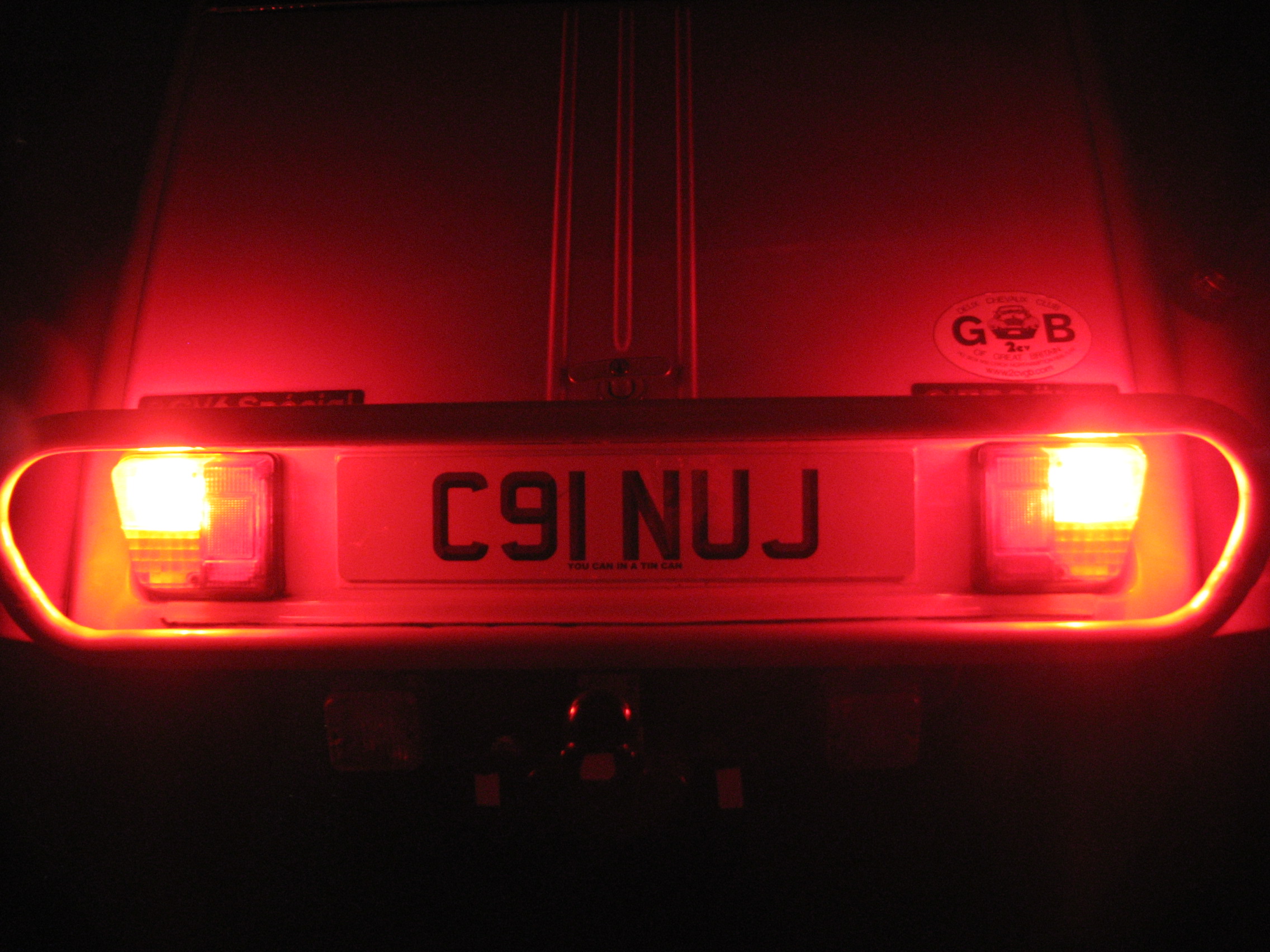
Are you brake wise?

Are you brake wise?

I think the problem stems from a lack of understanding. Petrolheads know that a brake generates heat when applied. It’s pure energy conversion – slowing the car by producing heat. Naturally, car makers know this and braking systems are designed to let the heat escape. It’s one of the reasons disc brakes are better than drum – it’s easier for the heat to escape, so you can apply a stronger stopping force and not cook everything. Petrolheads also know that a binding brake can generate a LOT of heat. That’s like driving along with the brake gently applied. Even a short journey can generate enough heat that you can’t touch the wheel without burning yourself. It’s why I’ll often do a quick check of wheel temperature when I get out of a car, especially if it’s new to me.

So, I get rather horrified when I see cars going down hills with the brakes applied constantly. I can only presume that people don’t realise the danger they are exposing themselves to. Keeping pressure on the middle pedal means heat just builds and builds. If it gets bad enough, you can start to boil the brake fluid and cook the friction materials. Both with have a disastrous effect on your stopping power. If brake fluid boils, bubbles appear in the fluid and pressing the pedal squashes the bubbles rather than apply the brakes. If the friction materials get too hot, they just don’t work very well – what’s known as brake fade. With older cars, you really had to know not to cook the brakes. Modern cars are far better at venting heat even under difficult conditions. However, I would still recommend you review your middle pedal treatment.

It’s better to brake harder than you otherwise might, then come off the middle pedal. Brake in bursts, but ease off again to allow the brakes to cool. Even a second or two makes all the difference. Modern cars don’t have anywhere near the engine braking of older cars, so easing off the throttle and downshifting won’t necessarily be enough – you still should though!

Disaster averted. Just!

This technique saved me from total disaster in Snowdonia once. I was travelling far, far too quickly down a very steep hill in the 2CV. That was fine – the road was straight, visibility was good and the opportunity to race up to 60mph-ish like the car was supercharged was too much to resist. Thankfully, I realised that the road was going to get curvy, well before we got there. What followed was a truly bum clenching experience, as I began my on-off braking. Bends were approaching, I was still going too quickly, but I still forced my foot off the pedal, then back on. Trees were whizzing past and if anything, the hill seemed to get steeper, but I kept up my routine. Now the brakes were getting very hot. I could smell them. I could feel the fade effect starting to creep in. I kept coming off the pedal, for as long as I dared, before a brief application, then off again.

Braking performance was pretty poor by the time I got us slowed down enough for the first bend, but thank goodness I had! Had I just stood on the brake pedal and held it down until we’d stopped, I’m pretty sure I would have only succeeded in cooking the brakes entirely, before I’d slowed to a safe speed.

So, do have a think about how you brake. Remember to check your mirror before you do – in case someone is driving too close – and give your brakes an easier life. And for goodness’ sake, PLEASE don’t sit in traffic jams with your foot on the brake! That’s what your handbrake is for. Drive safe.

The best cars of 2014

I’ve mentioned my EV experiences of the year, but what about those infernal combustion engines? Which was my favourite?

Firstly, I should point out that my job isn’t all about driving cars and then writing about them. That forms a very, very small part of what I do. Most of my working time is spent either reading books or hammering out words on my poor, tired laptop.

Has the time come to try XM ownership?

2014 has been the year of the XM – marking the 25th anniversary by driving four, and owning one at last!

I did get to drive a Citroen C6 this year, but it wasn’t anywhere near as good as I’d expected. Just like the looks, which rear-end aside are rather on the bland side, the car just wasn’t exceptional to drive. It wasn’t awful, but it didn’t impress. It wasn’t interesting enough. I was more impressed when I had a drive of a C5 Mk1 – a car where the looks are horrendous, but the driving experience surprisingly pleasant.

I organised an Autoshite gathering earlier in the year, where I got to drive quite a few different cars. The Mk3 Cavalier impressed, as did the Kia Pride. I can’t say either were amazing though.

What about the Skoda Rapid 135RiC? This is the very last rear-engined Skoda produced and the first time I’d driven a rear-engined Skoda for some years. There was a lot to like, that’s for sure. It was wonderfully quirky, and a car where you could feel every bit of the country in which it was produced. That sort of individualism just doesn’t exist anymore. Fittingly, it was built in the same year that 2CV production ended – another very individual motor car. Nice as ‘HURB’ was though, it wasn’t the highlight.

Maybe the Citroen XM then? I got to drive my first one in February for a Practical Classics photo shoot. I was mightily impressed. Later in the year, I got to drive a four-cylinder petrol, and a beautiful V6, but it was the 2.1 turbo diesel that I knew I simply had to own. I did too. It remains something of a fleet highlight, that’s for sure. I can’t believe I left it so long to get my XM kicks. It isn’t the highlight though.

No, it is to the Heritage Motor Centre in Gaydon, Warwickshire that we must head, for a very special day. I drove there in a tired Jaguar X300 – it could almost have been a contender itself actually. A short while earlier, I’d driven it across London and it was the first time I’d ever enjoyed driving within the M25! It was a bit tired though, so a contender it is not – fine automobiles that these XJ6s are.

This was simply one of the most exciting days of my life. I actually got to drive some of the exhibits of this marvellous collection. But here’s the next challenge. How do I pick just one? How can you compare HUE 166 (the first Land Rover) with NWL 576 (the first Morris Minor)? Is it more exciting to drive the one-off Triumph Lynx that never made it to production, or the Rover P6BS that similarly remains a tantilising one-off?

First Land Rover

HUE 166, the first Land Rover, and a hairy bloke (Pic: Richard Gunn)

As it happens, NWL suffered brake failure, so my drive of this iconic Minor was short-lived and very exciting (good job I know how to use a handbrake). HUE 166 gets rather more use, and was a sheer joy once I managed to find first gear. I even operated the trafficators, because trafficators are cool. The Alvis/Rover P6BS was suffering from sticky carburettors, so was rather poorly. That took the shine off a momentous drive – it was the first car I made a bee-line for.

The one car that really surprised me though was the Darien Gap Range Rover. I love how this car still wears the scars from the time it trekked the full length of the Americas in 1971/2. The 18,000 mile journey took over six months. The Darien Gap section itself, thick forest and swamp, saw them take 96 days to cover just 250 miles! Oh if only cars could talk.

This Range Rover has an amazing history, from over 40 years ago!

This Range Rover has an amazing history, from over 40 years ago!

Being an early Range Rover makes it a joy to drive just in itself though. A lovely V8 soundtrack is allied to great handling, even though the expedition vehicles are very top heavy. This is a car, like all the others that day, that I’d read so much about – but it’s also arguably far closer to original condition than ‘Huey’ and NLW – both of which have seen some restoration over the years. It was an absolute honour and I still can’t thank the Heritage Motor Centre enough for making the day possible. Exhibits have remained tantilisingly out of reach of journalists for far too many years. It was great to see the volunteers and staff enjoying the experience just as much as those who attended on the day. I don’t often do favourites, but the Range Rover was the icing on the cake on that great day. The memories will live on for a long time, that’s for sure!


Never say never?

I have long proclaimed that I could never be without my 2CV. This is a rather bold statement really, especially as when I married my wife (in a Humanist ceremony) we proclaimed only to love each other as long as love lasts. We didn’t fancy that whole ‘until death do us part’ thing, even though we have no intention of bringing our relationship to an end.

So, it would appear that I am declaring a stronger attachment to my car than my wife. Even taking my love of motoring into account, this seems a bit off!

2CV Dolly

Can I see a day when Elly is owned by someone else?

So, today I’m rescinding my previous comments. I will keep my 2CV until I no longer want to. So far, and absolutely incredibly, she’s managed to last 13 years on my fleet, and over 100,000 miles. By far and away (by about 11 years by my reckoning) she’s beaten every other car I’ve owned into submission. They come and go, but the 2CV remains.

Problem is, I don’t seem to be enjoying the 2CV as much as I once did. Perhaps I’m out of practice. Perhaps I’ve recently spent too much time enjoying other cars. Perhaps the deafening scream of a horizontal flat twin engine has damaged my brain. Whatever, I’m really not liking the 2CV as much. I’ll qualify that by adding ‘on longer journeys.’ For a quick blat around the Welsh hills, the 2CV almost always comes up tops. But driving the 2CV 320 miles at the weekend really was hard work! If you don’t drive a 2CV long distance regularly – and I don’t think I’ve used it on a long trip since July last year – you do forget what it’s like. You forget how precious momentum is, and how easily it is lost when hills are encountered. You forget what it’s like to have your ears pounded by wind, road and engine noise for hour after hour.

It’s like this in fact. (Warning – requires several minutes of your time)

I’m not sure if it’s me or if there’s something wrong with Elly the 2CV at the moment, but she ‘feels’ rough to drive and not all that pleasant. I was seriously glad to make it home on Sunday, so I could get out and rest my ears and brain. Ok, so three hours on endless twisty roads is hard work in any vehicle. Maybe I’m just being harsh on my poor 0.6-litre, 29bhp tin can on wheels. It was at least less exhausting than driving a Reliant Scimitar on such roads.

Don’t worry though. I’m not ready to hurl in the towel just yet. Elly and I have been through too much together. We’ve lived in the City of Birmingham, a lovely, rural Northants village, the bland open spaces of Cambridgeshire and the eye-wateringly pretty scenery of Wales. Elly has transported me to at least six different places of work, to my own wedding, on (first) honeymoon and to the funeral of a best friend’s mum. I’ve taken her apart, rebuilt her, transplanted engines, driven across continents (well, one but we did cross four countries in one day), driven her to Land’s End and John O’ Groats, gone greenlaning, drag racing, sprinting, auto-testing, rallying and off-roading. She once met Pat Moss and Erik Carlsson (Pat liked her a great deal). She appeared on the Live Stage at the NEC Classic Motor Show in 2006 and dragged Mike Brewer off the stage as he clung to the rear bumper. I once made her tow a caravan (she responded by blowing a rear tyre and then blowing her indicator relay).

Citroen 2CV handling cornering

Giving it hoon on the Haynes Motor Museum test track


I’ve built up a stash of memories and while memories are good to have, I’m not sure I’ve finished adding to them just yet. She’s some how become more than just a car, she’s a rather enormous part of my life. One day, I fear that I’ll find the magic car that makes me lose my need for a 2CV. That time is not now, and history suggests it isn’t going to be any time soon!

The perfect car?

Yes, I reckon I might have found it. The perfect car. The 2CV isn’t it, or I wouldn’t bother owning other vehicles. The Land Rover isn’t it, because it’s rightly compromised by its great off-road ability. The Golf? Oh please. I never bought that thinking it was anything special! It continues to fill a gap on the fleet, get me where I want to be and be nowt more than a car. I like it for that very fact.

However, as is the natural way of things, I am considering what to get next. I’m in no rush. I actually fancy the idea of trying to scrape some pennies together so I can buy something nice rather than continue buying cheap rubbish. The Golf gives me some breathing space to work out what I want. Here’s the remit.

1) It must be properly classic. Preferably older than the 2CV (1986).

2) Rachel must enjoy driving it. That means no electric windows, no power steering, front-wheel drive and good visibility.

3) I must enjoy driving it! That means good handling, a good ride, a certain amount of quirkiness and stonking brakes.

4) It must be practical. Ability to carry passengers is important but a good loadspace is also essential.

That’s about it really. So far, I’ve really struggled to find something that meets all requirements. The BX got close, but I rather prefer the ones with power steering and Rachel doesn’t like it. I’ve owned several, enjoyed the benefits but at the moment feel I’ve ticked the BX box. Other cars have been woefully wide off the mark. Most fall down on the pre-1980 requirement, others have been packed full of fancy kit (Rover 75, Alfa 164) or been too big (pretty much anything larger than a BX, and even that’s pushing it). Finding comfortable small cars is a challenge – rather a large one funnily enough. Small cars don’t often ride well, but I really do like my comfort.

But help is at hand after a visit to the Citroen Car Club Midland Section Rally at the weekend.

Citroen GS GSA

Inspiration, yesterday

Yes, the answer has been staring me in the face since eight years before I was born. The Citroen GS or later GSA. This is the forerunner to the BX and Citroen’s second attempt to plug the yawning chasm between 2CV and DS. The Ami was the first attempt, using a 2CV chassis and running gear and poshing it up a bit. It could hardly be described as a failure, but the world moved on and something a bit larger was needed.

1970 is often keenly remembered as the debut year of the Citroen SM. A Maserati V6 engine was clothed in a super-sleek body by Robert Opron and it remains one of the most glamorous (and complex) cars of all time. But Opron also penned the GS, launched the same year and it was the smaller car that took the Car of the Year plaudits for 1970.

Beautiful detailing on early GS

Beautiful detailing on early GS

And rightly so. In 1970, you could still buy a Morris Minor, yet here was a family car with sleek bodywork, clever hydropneumatic suspension and brakes that could detach your retinas. They were literally worlds apart. And don’t think I’m picking on Morris – Ford’s Escort still used cart spring rear suspension and had about as many fancy features as a paper bag. The Citroen was extraordinary – even though it came along a staggering 15 years after the similarly revolutionary DS.

No other car in its class would rise gracefully into the air when the engine was started, or stay perfectly level whether empty or full of passengers/luggage. Yet despite the clever suspension, the engine was a simple but well-designed aircooled flat-four based on the principles employed so well with the 2CV. The 1015cc engine produced 55bhp, but the little car could nudge 90mph.

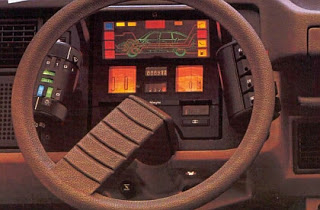
Larger engines followed, up to an eventual 1299cc for the GSA, which took over from 1980. Now there was a hatchback, though both were available as capacious estates too. The GSA used an entirely wacky dashboard, with all controls within fingertip reach.

You even had the option of a clutchless, semi-automatic gearbox known as the C-Matic. This replaced the clutch with a torque converter – a trick seen on the remarkable NSU Ro80.

I find it hard to decide which of the many versions I’d like. Early GSs are beautiful things, but early estates are very rare and saloons are not as practical. A GSA probably makes more sense. Yes, the styling is less pleasing but they’re a lot more practical and while UK-market GSs were dumbed down with conventional dashboard dials, the GSA really was utterly bonkers inside.

See?

Bonkers. I love it!

For the early 1980s, that’s pretty wacky. Sorry to mention Morris again, but they were still churning out the Marina and later Ital, which was a glorified Morris Minor under the utterly conventional skin. Ford had only just accepted front-wheel drive.

So, I think a GSA could just be the perfect car. Quirky, fun, practical and acceptable to both myself and my wife. That’s the theory anyway. I’ve owned many, many cars where theory was shot down in flames. Could car number 60 actually be the right one?


Dreams vs reality

You may have noticed that my fleet often (and currently) seems to consist of rubbish old cars. Even the ‘nice’ one, the 2CV, is in a pretty shambolic state. The 2CV is also the oldest vehicle, at 27 years. Yet, it often doesn’t feel old enough. It’s not truly of the ‘classic’ era, even though it is clearly a vehicle of the 1930s in some aspects.

It’s not a cute, cuddly, chrome-laden piece of 1950s-1970s tin. A vehicle of this nature is something I’m very keen to own. I’ve not owned much pre-1980 stuff, and that’s not right. My contributions to true classic ownership are made up of: A 1955 Austin A90 Westminster, A 1967 Bond Equipe, a pair of Series 1 Rover P6s (one a marvellous V8, both crippled my finances), a 1973 Renault 5L, a 1975 Reliant Scimitar and a poo brown 1978 Vanden Plas Allegro that I never quite got back on the road. For someone who has owned 59 vehicles, it’s a pretty poor showing.

One of my lovelier vehicles. I'd love another

One of my lovelier vehicles. I’d love another

One reason for that is that I think people have a natural tendency to own the vehicles they grew up with. While a Morris Minor and Oxford Series VI Traveller were important in my life, I am a child of the 1980s, and that’s reflected in my fleet. Over 40 of them date from 1980-1994 (when I left school). No surprise there then. But I did grow up reading The A-Z of Cars 1945-1970 and have always loved vehicles of this era.

There is another factor at work here though, and that’s cost. We have chosen a low-income lifestyle because of our natural hippy tendencies. Yes, I may seem a pretty poor hippy when you consider my love of meat and fossil-fuel-slugging vehicles, but that’s how I am. It’s a clash I have to live with and it can be challenging. Trying to find a decent pre-1980 runabout for less than a grand is getting pretty tricky these days, and any classic I own has to earn its keep (the 2CV is very practical and often transports stuff about).

So, while I dream of owning a Renault 16, or a Hillman Avenger/Hunter/Imp, or an Austin 1300 estate, it sadly seems that it won’t happen any time soon. Not unless the tax man plans on accepting my words in lieu of actual money anyway!

Renault 16 hatchback

Topping the wish list at the moment. Please donate kindly

Golf comparisons – Mk2 vs Mk6

Visiting my sister gave me a chance to compare my Mk2 Golf with her Mk6. Sadly, due to insurance limitations, this comparison was on a strictly cosmetic basis, but it was interesting nonetheless.

Golf Mk6 meets Mk2

Golf Mk6 meets Mk2

The first thing that strikes you, as with any car these days, is how much the Golf has grown. The Mk6 really is a large car, and that’s driven home by impressive rear passenger comfort. There’s loads of space! The Mk2 isn’t too bad in the back, but is nowhere near as luxurious in feel.

Aside from the chunky C-pillar though, there’s very, very little to tie the two cars together in styling terms. It shows just how far the Golf has evolved of the years, even if it doesn’t seem that many changes were ever made at each generational transition.

Inside, it’s notable that just the indicator switch of the later Golf seems to have more controls than the entire dashboard of the Mk2. It doesn’t feel much different to any other car out there, while the Mk2 definitely feels ‘Volkswageny.’ Of course, there has been some progress. This 2-litre turbo diesel can blow the older Golf into the weeds, and deliver 50mpg compared to 32. It’s a very nice car to travel in as well, though sombre and a bit too dark inside. The Mk2 at least has grey seats and carpets to brighten things up a little, and a sunshine roof.

overall though, the only similarity is a massive blind-spot-inducing piece of poor design that was constantly complained about when the Mk2 was current. How sad that it’s the only similar thing is something that arguably should never have been there in the first place.

Golf: Mixed fortunes on a long trip

We spent the past two nights in Devon, wisely choosing to head down late on Friday night to avoid the worst of the Bank Holiday traffic. The drive wasn’t entirely joyous with the biggest problem being that the rear brakes were making a horrible squeaking noise. I’m amazed it didn’t drive us mad. I desperately tried to slacken off the handbrake at one point, thinking maybe it was dragging a bit. Nope! We squeaked onwards.

Thankfully, the noise was much reduced at motorway speeds, so once we hit the Blue-signed highway, our sanity was in much less danger. Then, as it got cooler, Rachel noticed that moving the heater control did not make it any warmer inside the car. Bother.

There was nothing I could do about the heater, but I did decide to investigate the rear brakes yesterday, before folks started arriving for a family party.

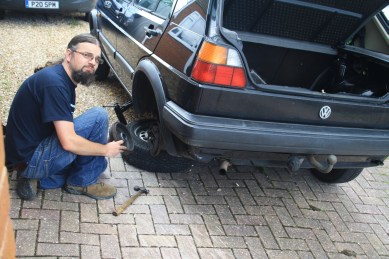
Essential party preparation. Rear brake overhaul

Essential party preparation. Rear brake overhaul

You would have thought that such a horrible, incessant noise, made during a 160-mile journey would leave some evidence. Not a bit of it. What I suspect is that the wear edge on the drum is catching the shoe and setting up a high-pitched hum. With this in mind, I borrowed some sandpaper and attempted to knock the edge off the lip and the shoes. Ultimately, new drums are going to be needed I suspect, but I had a party to get to. I put it all back together, re-centered the brake shoes and took it for a test drive. Negligible improvement.

However, on the trip back home today, it was far better. Thank goodness! Sadly, all was not well. The ride is hopeless. It’s pretty firm, but hitting a cat’s eye on the motorway feels like running over a brick. Clearly, something is amiss. It handles well, so I wonder if someone has fitted stiffer springs. I also suspect that mountings and bushes are far from healthy.

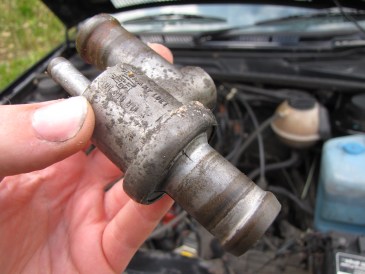
On the plus side, having got back home, I set about removing the heater bypass valve. This is fitted because apparently Volkswagen got the spec wrong for the heater matrix, and it can explode under pressure. This is considered a bad thing, especially as if it happens, it’ll dump scalding hot coolant all over the occupants. It has happened and the results are not desirable. Volkswagen responded by fitting a load-restricting valve to ease pressure on the matrix under recall.

I have a lovely, working heater again now but am considering the long-term solution. I either stump up for a second-hand valve and hope it works, or fit a Mk3 Golf heater matrix, which is stronger.

Faulty valve removed. A recall fitment to stop the heater matrix exploding!

Faulty valve removed. A recall fitment to stop the heater matrix exploding!


2CV finally gets brake overhaul

I haven’t really got any excuses for neglecting the 2CV. I’ve been meaning to overhaul the front brakes for several months, but keep distracting myself with other cars.

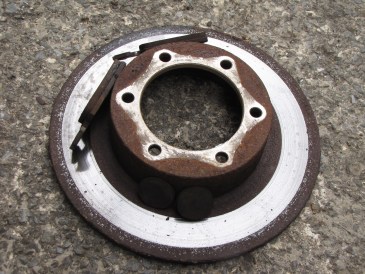
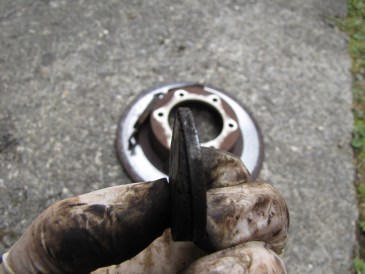
I started the job yesterday. The bodywork came off first, then the driveshafts are disconnected, the pads removed, the caliper disconnected and the disc removed. I also popped out the handbrake pads, which left me with this mess.

2CV brake

Rusty brakes – they really did need replacing

The main brake pads were fairly worn, but not bad for what I estimate to be 40,000 miles or so of driving. The disc was in a shocking state though. Last year was a bumper year for corrosion on the 2CV, and the brakes did not escape damage. As far as I can remember, the discs have done about 70,000 miles and were probably last changed in 2006.

The handbrake pads were very badly worn.

badly fitted handbrake pad

Very unusual wear due to incorrect fitment

This unusual wear is apparently because they weren’t fitted properly. Not me guv! Thankfully the other side were fine, but I replaced all four anyway. Hopefully I fitted them correctly – time will tell!

It was a truly joyous experience today, in constant drizzle. Here’s me enjoying myself.

Working on cars is fun!

Working on cars is fun!

Thankfully it did stop drizzling after a while – it’s amazing how wet light rain can make you. The blanket was because I’d discovered how wet a soggy tyre can make your clothes. Nice that 2CVs come with a built-in seat for when you are working on the engine though.

As jobs go, this one was pretty pleasurable. Access is astonishingly good, nothing broke and everything that should come apart did. The biggest headache was a sticky bleed nipple, but it didn’t put up much of a fight. The 2CV uses alloy pistons in its brake calipers, and this is brilliant. I’ve never, ever had a problem with a sticky caliper on a 2CV, yet the same can’t be said of many modern cars I’ve owned. Let’s see. Alfa Romeo 164, Saab 900, Ford Maverick, Range Rover, Mini City, Saab 9000, Audi 100 – I’ve had caliper issues with all of them. Why? Because the pistons are usually steel – often cheap steel. They corrode, then stick and then you’re into rebuilding the caliper. Fun on the Range Rover as it had four pistons for each corner!

I did have to buy a special tool to adjust the handbrake but to be honest, I should have bought one of these somewhat earlier in my 17-year 2CV ownership! On the plus side, the only tool you need to remove the main brake pads is a screwdriver. If only all cars were this joyous. It’s easy to forget what a beautifully engineered little car the 2CV is. I now need to spend more time driving it.


Why I don’t ‘do’ sports cars

I’ve always loved older vehicles. Perhaps I spent too many hours sitting in my Aunt’s derelict Morris Minor pretending to drive, but old cars very much float my boat. Other people have their boats floated by older cars too. The glamour of a classic sports car is as alluring as a hollywood starlet, and far more realistic. So, why have I owned so few?

As recently as 2007, I’d simply never owned a sports car. I did buy a Subaru Impreza once, but I was only 21 and so I crashed it into a tree after just two days. I decided the best ‘cure’ for this was to pay for a Supercar Driving session on a racetrack. I took my medicine in the form of a Porsche 911 (996), Noble M12 GTO, Lotus Exige, Maserati 3200GT and a 408bhp Dodge Viper. Medicine is rarely this much fun, and I also learnt where I’d gone wrong with the Subaru – I had none of the necessary skills to drive the thing safely.

Now fully kitted out for a life of handling powerful machinery, I went out and bought a Peugeot 306 Diesel. To be fair, I didn’t even come close to crashing it into a tree.

When I reached the magic age of 25, I could have decided to make the most of cheaper car insurance by getting a sports car. Instead, I bought a 1970 Rover P6 V8 – a big, wafty saloon that on a good day could probably still get close to its published top speed of 112mph (I never tested this). After that, an enormous procession of the slow and the bland filled my driveway. An Austin Maestro, a Honda Civic, a Bedford CF Autosleeper camper, a Volvo 740 estate, an Audi 100 etc etc.

In 2009, things changed. My first sports car pushed the limits of the term entirely. It was a Bond Equipe. If you imagine a squashed Aston Martin body, crammed onto a Triumph Herald chassis, you can imagine what a delightful machine it was. No, I’ll save you the bother. Here it is.

Probably the worst car I've ever owned, and that's saying something!

Probably the worst car I’ve ever owned, and that’s saying something!

I bought it during a spell as Acting Editor on Classic Car Weekly. At the time, the still anger-inducing Scrappage Scheme was in full swing and this rare classic was one of the cars traded in for a new Kia. We naturally ran an ‘outrage’ story and begged someone to save it. At £2000 – the cost of the trade-in – no-one was much interested. I carried on beavering away at the dealer involved and Kia, and to give them credit, they agreed to let it go for £1000. Still, no-one was interested.

So, I did the honourable thing. I bought it. It gave us a headline news story for that week and left me penniless and broken. It was an absolute horror. It had been awfully neglected for many years, and someone had crammed a poorly Vitesse 1600cc engine into it. I threw money, sweat and tears at it and it rewarded me by being as joyous to travel in as a suitcase falling down a flight of stairs. In desperation, I swapped it for a £350 Saab one winter. The Bond is still undergoing a restoration.

As a first dabble at ‘sports’ car ownership, it was a resounding failure. I’ve only had one more go. It also had a plastic body.

Scimitar red Wolfrace

A much better car, but still not my cup of tea

Here, I made the much more sensible move of buying a really good one, for only £700 than I paid for the Bond. The lusty, 3-litre V6 engine provided an engaging soundtrack and great performance. The handling was pretty good too and the condition was simply first rate. So why did I sell it?

The simple answer is that I don’t like sports cars. Yes, you get that initial excitement – acceleration, exhilaration, g-force-neck-hurts-ation – but these are cars compromised by their ability to deliver those things. Comfort is barely given any thought at all, practicality is not exactly a priority – even with the GTE’s estate-like styling. I hate having to clamber down into the things as well.

So, I stick to the ‘boring’ world of the family car. I’ve discovered over the years that most cars are good fun to drive briskly, if the mood takes you. Some are better than others for sure, but somehow a saloon or hatchback driven quickly on public roads feels more of a challenge than driving a sports car with oodles of power and handling to impress a Schumacher.  Simply put, I regard sports cars as total overkill for public roads, which means you need to start going to track days to get any enjoyment out of them, which means you them own a car that’s only fun when you don’t drive it on the road – which is where most of us do our driving.

Don’t get me wrong – I have had fun with sports cars on the road. A 440bhp Lola T70 replica was exciting, and I simply adore TVR Chimaeras. There’s a problem though. That much performance gets very boring, surprisingly quickly in a speed-limited world. When you can get to naughty speeds in second gear, the remaining cogs seem rather superfluous. Do you want to enjoy working an engine hard through the gears without worrying about a speed camera? Take my advice. Flog the sports car and buy a small, unexciting hatchback. You’ll find yourself having more fun than you ever imagined.*


* The author cannot be held responsible if you replace your Bugatti Veyron with a 1990 Seat Ibiza and find it a bit too much of a come-down. Yes, the author is now dreaming of owning a 1990 Seat Ibiza.

Discovery: Go on, get dirty!

You really can feel the Range Rover DNA in the Discovery – which is hardly surprising, as it just a Range Rover with a bumpy roof really. I’m just a bit worried about how much I’m enjoying the driving position.

Lofty. I mean, look at how tiny those houses look

Lofty. I mean, look at how tiny those houses look

If anything, it’s even better than the Range Rover. In that, your head is practically brushing the headlining (especially if it’s sagging a bit). The Discovery has a higher roofline, so there’s no hemmed-in feel. The top of the seat base is a long way from the floor though, so you sit as if on a dining chair. Also, the body is very high up, perched as it is upon a strong, steel chassis. At first, this can be a bit alarming when cornering, but you do quickly get used to it. As the months (yes, months!) have gone by, I’ve begun to love it more and more. You do feel like king of the road.

Now, I have to quickly point out that I don’t drive like I’m king of the road. I drive a 2CV, so I know what it feels like to be at the other end of the scale. They say might is right, but I refuse to believe it…

Yet I find myself enjoying the views over hedges and there is something magnificent about pottering down the road sitting upright and dignified. Yes, dignified in a Discovery held together with tin foil. It doesn’t matter how shabby it looks when one is taking the wheel.

I got so carried away last night that I drove into town in the Discovery. Not really what it was built for. I have other, smaller, more economical cars for such missions.

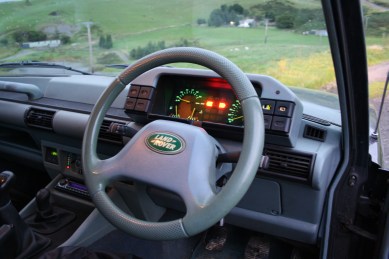
Disco Lighting

Disco Lighting

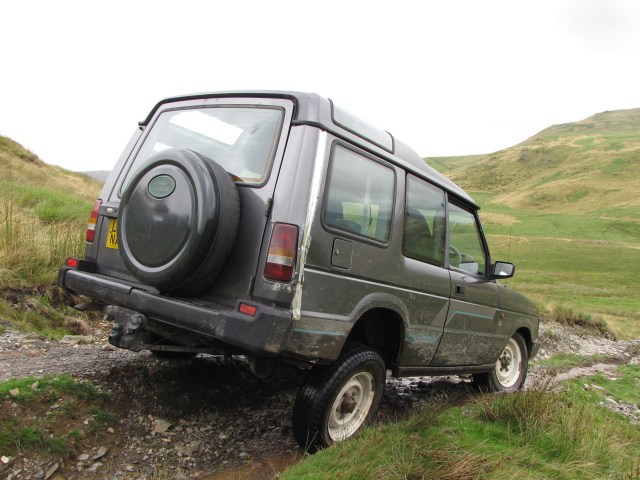
Even in that slightly blurry shot, it looks quite at home though I reckon. After all, this was a 4×4 built to offer the best of all worlds. Yet, as I discovered last weekend, it is superb in the mucky stuff, but it was also designed to be good around town. Sadly, far too many were bought with nothing else in mind, which seems a bit like buying walking boots to go ballroom dancing in. Often, snow is cited as a reason that a 4×4 ‘must’ be owned but it seems silly to live with significantly higher running costs all year round when chances are, if it does snow, you’ll want to stay at home anyway.

Go on. Admit it. You want a 4×4 because you want a 4×4. There’s no harm in it! Some people opt for the higher running costs of petrol over diesel just because it’s a preference. For some, owning a 4×4 is a preference. 4×4 owners are often seen as the root of all evil – some get their vehicles egged by over-zealous hippies. Why not BMW saloons instead? Or Jaguars? They’re no more of a waste in a city than a 4×4. Or Toyota Piouses! Those batteries contain some hideous, Earth-scarring chemicals yet they STILL burn fossil fuels as well. It’s amazing what clever marketing can do for a car.

I digress. The point is that there’s no shame in having a 4×4 just because you want one, though I do urge any 4×4 owners to get acquainted with their vehicle’s off-road abilities. These vehicles are built to do well in many different situations. Dare I say it, but I’m sure my Discovery feels happier when I drop it into low ‘box and engage the diff lock. Like an eager puppy, it doesn’t want to sit in the house all day. Go on. Go and get it dirty!

Land Rover Discovery any good off road

Go on. Find out what your 4×4 can do!