Disco demonstrates abilities

Found time this morning to stop tinkering with cars and actually drive one for a bit. Took the Land Rover up to a favourite greenlane that I’ve not yet tackled in it.

As you can see, that long travel suspension is marvellous stuff for loping over rocks. As you can hear, there really is a lot of play in the transfer box.

Hope you all have an enjoyable Bank Holiday weekend!

Mercedes – still here, and that’s not a bad thing

I’ve been trying to sell the Mercedes 300E for some time now, with For Sale adverts in many different places and a failed attempt to sell via Ebay. The W124 is widely regarded as one of the best saloons ever built by Mercedes-Benz, but that doesn’t seem to stop them being worth pennies.

So, I might as well continue to use and improve it. With that in mind, I used it for a trip to The SL Shop in Worcestershire yesterday. Well, it’s always nice to turn up in something fitting isn’t it? After all, my car shares its M103 engine with the R107 300SL. Yes, it’d be a fuel-slurping trip, but it’s nice to treat yourself sometimes – and that’s exactly why I bought this car in the first place.

My trip was very well timed as Tony Leach of the Mercedes-Benz Club was present. Under the banner of MercDoctors, Tony travels around the UK offering assistance to Mercedes-Benz specialists. His speciality is diagnostics, especially of the 1980s/1990s model range. Perfect! While I did my job, writing about cars for sale and taking photographs, Tony ran diagnostics on the car to check the electrical side of things and then did a smoke test.

Smoke test required some unusual methods...

Smoke test required some unusual methods…

I admitted to my complete ignorance of fuel injection systems – possibly over-stating my ineptitude, but I’m certainly not over-familiar with how they work. Tony explained that it’s not really that different to a carburettor – it’s just that bits are more spread out. Tony first sealed the induction system, using a latex glove atop the main air input and bungs elsewhere. One pipe was left open and the smoke machine was connected up. The theory is very simple. The smoke machine pushes smoke into the induction system. If you see any smoke escaping, you’ve found a leak. It doesn’t take much of an air leak to cause problems. The fuel injection system carefully and very accurately supplies the correct amount of fuel for any given situation. This relies on a known measurement of air, so if extra air is being sucked in, the mixture ends up being incorrect. Happily, the Mercedes passed with flying colours – no leaks at all.

Then Tony adjusted the mixture, with rather more care than I had. I’d simply weakened the mixture enough for it to run properly. It certainly wasn’t running properly when I bought it. Tony was able to hook it up to the necessary equipment to fine-tune the mixture. The result? The car now runs much more sweetly. It no longer hunts when slowing down and it doesn’t stink half as much! Previously, it smelt like the choke was stuck on. Not a nice smell.

I should now see an improvement in economy, though it already varies anywhere between 16mpg and 27mpg depending on how I drive it. I covered over 200 miles in the Merc yesterday though, and it reminded me just how pleasant a car it is to drive – though it also reminded me how ill-suited it is to tiny Welsh mountain roads! Too big and far too heavy. Far better to take the better roads, sit back and cruise.

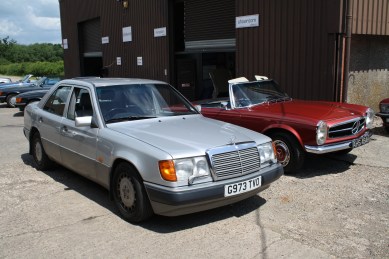
Merc pauses with some glamorous siblings

Merc pauses with some glamorous siblings

Above is the Merc having a rest between fettling sessions and next to one of its very glamorous siblings. I like to think that this is like a film star ending up stuck with an embarrassing sister, hoping that the paparazzi won’t pounce…

Showing the ol’ girl some love

“As soon as you get your new car home, give it a thorough checking over as you have no idea how well the car has been looked after.”

Wise words. At some point, I’ve probably written some advice like that for a magazine. Very sensible. And so easily ignored, even by me…

Naturally, I rarely do any such thing. In fact, I’m guilty of criminal neglect when it comes to the BX and Merc, both of which are still awaiting a service in my ownership. I really should do something about that…

But the Discovery came first in the queue, because it’s new and I’m still all excited about it. As a warm-up, I failed to change the gearbox oil due to a combination of unsuitable spanners and not enough oil. A poor start. Then I decided that new engine oil was a good idea.

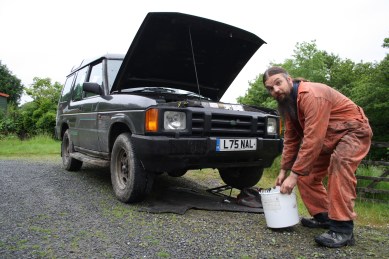
A dubious looking character steals a bucket of old engine oil

A dubious looking character steals a bucket of old engine oil

I’m very grateful for the fact that my wife has a large collection of buckets. With a 6.9-litre engine oil capacity, I’d need a pretty big bucket for the drain operation. I wasn’t too pleased to discover that both the sump plug and the oil filter were loose – both were leaking. Hopefully both are now tighter.

By the way, the above shows the advantage of an uneven driveway. By putting one front wheel on a ramp, the car is level but the ground sloped sufficiently to allow really quite good access to the underside. Brilliant. I also greased up the propshafts while I was under there, and admired how solid everything seems to be.

I then enjoyed a nice test drive in the pouring rain. Gearchange aside – it’s ever so vague and 2nd gear still crunches – I really do like spending time at the wheel of this thing. I’m tuning in to how it behaves now – it can’t match the majesty of a Citroen, with its independent springing – but it is comfortable. The torquey engine means its relaxing too, as there’s no point going beyond about 2500rpm. This is it’s biggest strength compared to the Maverick – the petrol engine in that had very poor low-down grunt and was frustrating to drive. It was almost as thirsty as a V8 too – not the right engine for a 4×4 at all. This didn’t seem to stop Land Rover putting a 2-litre, 4-cylinder engine into the Discovery for a time. The Mpi is not one of Land Rover’s best efforts. The Tdi is much more like a truck engine, which suits the slightly-agricultural Disco perfectly.

I digress. Once the weather improves, hopefully I can complete the service. Still some filters to replace, and the brakes need inspection.

Discovery gets to prove itself

I got the Discovery back today, after it went away for a new timing belt – needing a new water pump, thermostat and radiator in addition. It’s been very frustrating owning a car for almost a month, which I’ve barely driven. Therefore, attempting to shrug off a cold, I decided I had to get back out for a spell of greenlaning.

I had missed it. I love the countryside and like to use different methods to access it. Walking is great, but so is tackling the terrain in a 4×4. Mind you, I stuck to largely easy lanes today – some of which I’ve tackled in the 2CV. I wanted to get a feel for the Discovery before tackling anything severe.

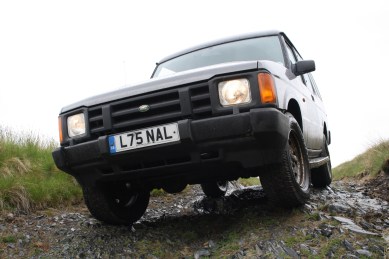
Discovery proves capable in the rough stuff

Discovery proves capable in the rough stuff

The lanes of Nant-y-Moch proved ideal. They’re not far from my house and apart from one or two tricky sections – which I didn’t venture near this trip – they’re very accessible. A soft-roader wouldn’t struggle to be honest. Another reason for keeping the difficulty level low is that I was heading out on my own. I let my wife know roughly how long it should take, but you can’t guarantee mobile reception when you’re out in the wilds, and should mechanical trauma or an accident halt my progress, I could be a long way from rescue.

I do like solo laning though. Heading out in big groups can be seen as very anti-social by others who love the countryside, though this is often without justification. Sadly you do get some groups who love chucking enough gear onto their 4x4s to survive a rainforest expedition, and I’ve seen plenty who love revving engines and deliberately getting stuck. There’s no need for that. If you want to play silly buggers, go and do it at a Pay and Play site.

Anyway. Now I was finally away from sealed surfaces, how did the Discovery fare? Pretty good. The low ratio gears worked, and they are much lower than my previous Budget 4×4 – the Ford Maverick. This gives much better control on descents and over rocky ground. Being a diesel helps too. I only engaged the diff lock briefly for one tricky climb, but it seemed to do its thing. It took a while to disengage though – I suspect it hasn’t had a lot of use. The diff lock is on the centre differential, which allows the front and rear axles to travel at independent speeds – essential for on-road use, but not always great when off-road.

The main difference compared to the Maverick is the suspension. With long-travel coil springs all-round (rather than just on the back of the Maverick, which uses torsion bars up front) and simple beam axles, the Discovery is far better equipped straight out of the box. Yes, it can feel a bit clumsy on the road, but I like that. A 4×4 should feel like an off-roader in my view! It still handles well and it really is a tribute to the cleverness of Spen King, the man behind the Range Rover of 1970 – and therefore the platform underneath the Discovery of 1989.

Discovery contemplates the view

Discovery contemplates the view

It isn’t just the ability that impresses though. I find the Discovery a great vehicle to sit in. I love the blue Conran-penned interior and the high driving position. It’s better than the Range Rover, because there’s more headroom. They may share a body structure, but the Range Rover always left me feeling like I’d been squashed against the ceiling. The interior is far, far better than that of my similarly aged Range Rover too. More cohesive and less rattly. Which one was the premium product again?

With the laning itch scratched, I can now focus on further improvements. A full service needs to happen, including fresh oil for the engine, gearbox, transfer box and both axles. That’ll keep me busy for a bit! So far, I’ve spent about £250 on the new purchase, so it stands me at £700. Still cheap motoring so far…


3500 miles in 17 days. In a 2CV.

One of the best things I’ve ever been involved with was a 2CVGB event called The Eight Ball Rally. It was a navigational scatter rally organised by an intensive care nurse with barely any relevant experience. It would see a gang of 2CVers cover 3500 miles in 17 days driving around the mainland UK in a figure of eight, searching for clues as we went.

It sounded like a bloomin’ good adventure, so Rachel and I packed the 2CV and headed for Leicestershire for the start. A sleepless night outside a very noisy pub then followed, before we dragged ourselves out of bed, packed up and headed for the first overnight halt in North Yorkshire. Over the next fortnight, we averaged over 200 miles a day. The route took us up to the North East of England, then across the border into Edinburgh, across the Forth and all the way up to John O’Groats.

John O'Groats by 2CV

John O’Groats by 2CV

The scenery was astonishing and as we were clue hunting as we went (trying to find eight clues a day), we saw little motorway. At Aviemore, we awoke to a light covering of snow – it being late April. We travelled across Scotland on tiny roads, with astonishing views of a sea that seemed almost tropical.

Stunning North Scotland views

Stunning North Scotland views

A 2CV is in its natural element up there. No motorways, not even much dual-width single carriageway to be honest. A really nice part of the event was meeting local 2CVers as we went. Being so far north, they don’t always find it easy to get to events, so for 2CVers to come to them was clearly appreciated! It is an incredibly remote part of the world. We could travel for hours and barely see another car. Because we were all travelling independently, we tended not to form groups. You could visit the clues in any order you wished, and we would take to trying to hide from other teams if we found ourselves near the same clues at the same time! Every evening, we’d get together to share our adventures of each day, forming friendships as we did so.

We then came down the west coast, through Paisley – which was something of a contrast to what we’d seen for the previous few days – and then through the Lake District, tackling the fabled Hardknott Pass. I had to be a bit careful here as I new the brake pads were getting a bit low. Going up the hills wasn’t a problem though, despite the odd tourist conspiring to rob me of much-needed momentum!

Then we headed back to Leicestershire. From here, we began the second leg, heading to the South East of England, before cutting across to Cornwall and Land’s End.
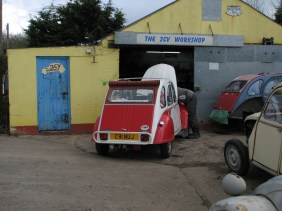
Problems strike in the south

Problems strike in the south

Sadly, all was not good here. For a start, the traffic levels were alarming after a week in the North. Then the 2CV started to lose power on the M27. We decided to push on, though others were having trouble too – a Mehari suffering clutch linkage failure on a very busy road in Bournemouth. I knew there was a well regarded 2CV specialist in Cornwall, so we limped onwards. The problem was odd. Nothing too severe, but a definite loss of power. She didn’t cut out at any point but it was clear all was not well.

Graham at The 2CV Workshop remove the Harley Davidson coil and DG Ignition and put Elly back on standard points and coil. This certainly did the trick, though there was now no way of knowing which had been at fault. That didn’t matter at the time. We had an urgent appointment with Land’s End and it was well into the afternoon. We had a long way to go.

Elly began pinking not far into the journey, so I soon had to undertake roadside repairs. It wasn’t the first time she’d done it on this trip, but clearly the factory settings were not working. If I recall correctly, she was on about 150,000 miles at the time, on her original engine. A worn points cam made it difficult to get the timing spot-on for both cylinders. I retarded it slightly and all was well.

After reaching the end of the land, we headed northwards and into Wales. This seemed incredibly lush after the wilds of Scotland. Again, I wasn’t happy with the way Elly was running, but it was hard to complain too much after 3000 miles covered in a fortnight. More roadside tinkering took place.
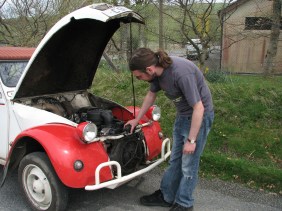
Running repairs, fortunately not more than tinkering

Running repairs, fortunately not more than tinkering

Returning to Leicestershire once more, there was a right mixed bag of emotions to wade through. We’d made it and had enjoyed a great adventure, but now it was over. The cars had performed magnificently, showing just how hardy the 2CV really is. I was a little upset at the minor ignition faults we’d experienced, but otherwise the 2CV gamely covered 200 miles every day without complaint.

Sadly, Roz who organised the event would lose her battle against personal demons a couple of years later. She will be sadly missed. It takes a very special sort of a person to manage to organise an event on that scale, almost single-handedly. I know she spent many days hurtling all around the country in order to set the clues and it remains a fine memorial to her. It remains one of the best driving adventures I have ever undertaken, all without having to leave the UK. Don’t assume you have to head overseas for a driving challenge. The UK is actually big enough to provide plenty of excitement itself!



Reality check – goodbye green 2CV

Despite my best intentions, the Seabrook Fleet this year has proved about as stable as a new born foal atop a giant jelly. I couldn’t resist when a 2CV restoration project came up for grabs locally. I had all manner of grand plans, and even managed to get it running after a ten year slumber. Sadly, my grand plans were not to be. The problem is funds. I’ve been too busy spending elsewhere – the 2CV’s £500 MOT bill, the BX’s £500 worth of maintenance and a £450 Land Rover Discovery. All have been deemed more important than the poor 2CV, which has been sitting in the garage awaiting salvation. No more!

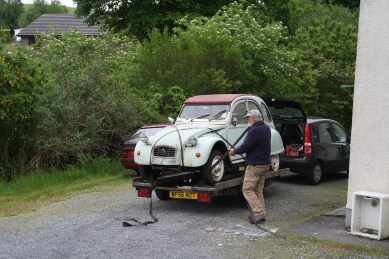
2CV off to a new life! Again.

2CV off to a new life! Again.

Yes, I thought it an ambitious tow car too but the trailer is super-lightweight, as is the 2CV. Note that the strapping across the bonnet is to stop it falling off. The axles are strapped to hold the car to the trailer. And yes, it is actually very nicely balanced!

Anyway, it’s off to its new life in Devon. I hope this time it’ll manage to reach the road by its own power.

I feel a bit rubbish about not getting this one completed, but restoration projects do eat up funds. The problem is, so does keeping cars on the road, and I still have four of those at the moment. Really, I need to sell more cars, but that’s mainly because I’ve identified an Austin Ambassador that needs saving. Given previous comments about restoration projects, maybe it’d be better to play the part of a broker and help it find a new home that isn’t my driveway…

The scariest cars to drive…

There’s been very little to report on the fleet this week, so I thought I’d put finger to keyboard to talk about cars that have scared me silly.

While driving a 440bhp Lola T70 replica on a damp December morning rates as one of the driving experiences most able to loosen the bowels, even that doesn’t come close to how terrified I was doing 40mph in an elderly British classic.

I remember it well. The car appeared to be trying to drive in two directions at once, the clutch pedal had about a millimeter of travel and the brakes seemed not to exist. Never has a straight road been such a shoulder-tearing challenge. Changing gear was akin to waving a wand at a bucket of cogs. There were no brake lights, no indicators and the headlamps redefined the word dim.

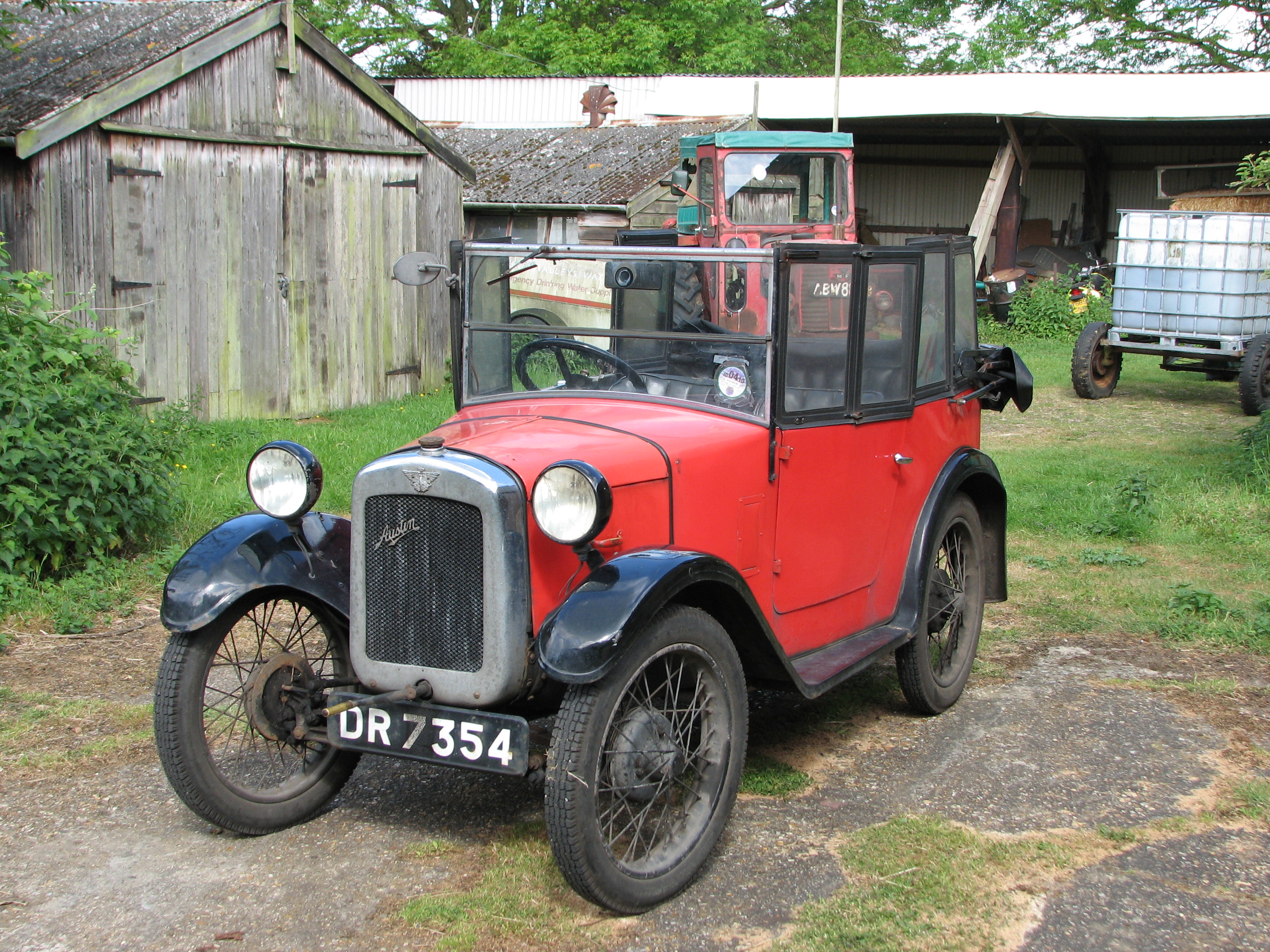
Terrifying isn't it?

Terrifying isn’t it?

Yes, the car in question is an Austin Seven. I’ve driven several of them and they’ve all been pretty scary. Look at that picture again and you can just see the front brakes in the middle of the wheels. I’ve seen larger flies. I once drove one with an SU carburettor which could apparently do 70mph! I had enough trouble stopping it from 20…

But there’s something absolutely magical about a Seven. You really, REALLY have to drive one. You don’t just hop in and set off. Just travelling to the end of the road can be an adventure. I have major respect for the members of the Austin Seven world who drove the entire length of Route 66 in America. That’s just incredible.

The Austin Seven was conceived and developed in secret by Herbert Austin and a 14-year old apprentice. The management board thought it was a really bad idea, so Austin took to designing the car at home. Thankfully, the board were convinced that it was a good idea once they saw an actual car, and the Seven hit the road in 1922. It really was a shrunken down proper car, with a tiny four-cylinder engine, three-speed gearbox and mechanical brakes – the handbrake operated the front wheels, the footbrake just the rears. In 1930, the front and rear were finally linked.

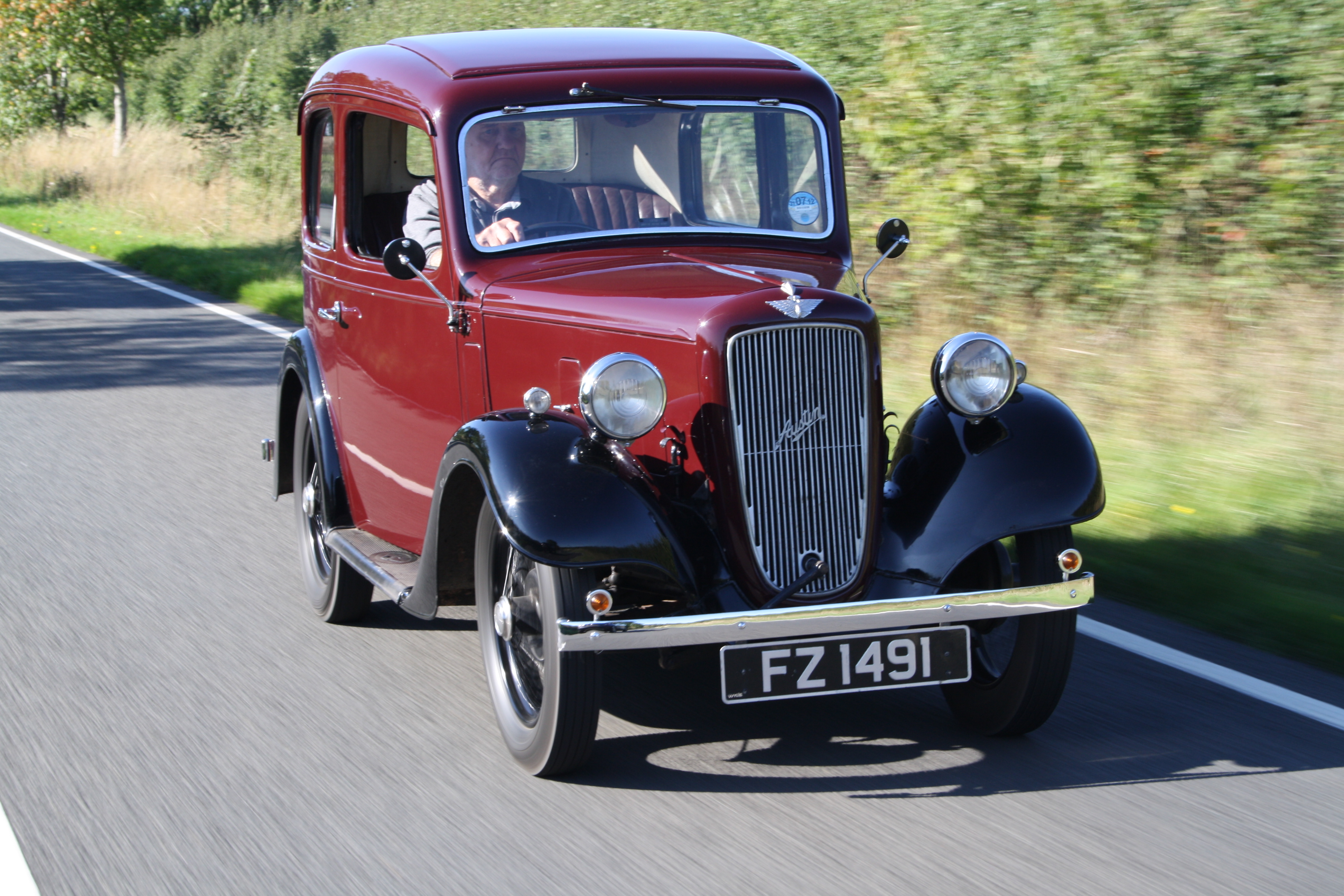
Sales were hugely strong, backing up Austin’s bravery in conceiving such a small design. The Seven was developed into the Ruby of 1934, which had a little more luxury. In fact, the Ruby is quite different to drive. Sure, it still fights all over the road, but the brakes are better and it steers with a little more accuracy. Still a shock to folk used to modern classics!

Ruby at speed. But not very much of it.

Ruby at speed. But not very much of it.

Really, everyone should be forced to learn how to drive an Austin Seven. You develop much more of an awareness of the world around you. Hills must be anticipated as must danger. You feel more like you’re wrestling a snake than driving, which keeps you awake! It isn’t a car that transports you with the minimum of fuss, it’s a car you must pilot with the care of an aeronaut.

Yes, they may be scary, but I still regard any opportunity to drive one as humbling and entertaining. It’s an experience to savour, all well within the speed limits of our time. If someone offers you the chance to try one, take it!


Disco enhancing

I still daren’t drive the Discovery, though the timing belt kit has now arrived and should be getting fitted next week. It will be very nice to be able to drive my new car again.

Instead, I’ve been carrying out further improvements. The boot floor has been treated to a coat of Rustoleum and the interior has been refitted. It’s a lot nicer in there now and smells much less of cigarette smoke and dog. Then I started getting all cosmetic. I told myself that the shabby looks didn’t matter, because I was going to use it for green laning and possibly for Pay-and-Play sessions and/or trialing. Then I made the mistake of parking it outside my office/dining room window. The faded grey plastics and rusty front bumper – ‘improved’ with aluminium tape – were starting to really annoy me.

Ugh. Unsightly and unpleasant.

Ugh. Unsightly and unpleasant.

So, it was out with the Rustoleum once more, to give the metal part of the bumper a good coat of fresh paint. Then I rooted about in the garage until I found my Meguiar’s Vinyl and Plastic cleaner. It’s good stuff, working even though the plastic container got smashed ages ago. I also tidied up the front and rear wiper arms while I was at it. The results have been impressive.

That's better! It's cleaned up nicely.

That’s better! It’s cleaned up nicely.

I’m thrilled with the difference. Ultimately, that bumper still needs replacing – I simply painted over the aluminium tape which masks the missing metal beneath – but it’ll do just dandy for now. It’s taken years off the car. Of course, it still has a whopping great dent in the back corner, so it won’t be winning any shows just yet – probably because I’d never enter a vehicle for one anyway. It does at least look a little more cared for.

Incidentally, I’m really not sure how Land Rover avoided a lawsuit with Ford when you consider how the Discovery seems to have taken the nose of a facelifted Mk2 Transit van. In actual fact, the headlamps come from the Leyland-Daf 200/400 van range, so there’s more than just one commercial light fact.

Land Rover Transit

Land Rover Discovery in a former life

In other fleet news, the 2CV is awaiting a front brake overhaul, the BX has had a brake fettling session and is busy covering tourists in soot (I suspect a boost problem with the turbo) and the Mercedes is remaining resolutely unsold. The Green 2CV will be off to a new home later in the month – I really do need to get this fleet back under control. How I’m ruing my words earlier in the year when I confidently predicted that I wouldn’t buy as many cars this year. Oh well! Perhaps now things will settle down – or is that too dangerous a statement to make?


Disco frustration

No, this isn’t a post about failing to be like John Travolta, nor about discovering that my Discovery is a heap of rubbish. No, the frustration stems from the fact that I dare not drive it! However, I would also like to officially relaunch Project Budget 4×4 – my attempts to prove that 4x4s need not be expensive to buy and own.

Disco three door with steel wheels

It’s great! But I can’t drive it…

Back to why I’m frustrated. Just driving the Discovery home was risky, as I’ve absolutely no idea when the timing belt was last replaced. The people selling the car certainly didn’t have a clue, though they did helpfully tell me that it looked to be in good condition – this belt that you can’t see without dismantling the front of the engine…

In short, the timing or cambelt transmits power from the crankshaft to the camshaft. The crankshaft is turned by the pistons as the engine fires, the camshaft opens and closes the valves at the right point. So, what’s so bad about a timing belt failing? The not insignificant problem caused by the fact that on most engines, the pistons and valves move in the same space. They overlap, but the way the timing works means that they’re never in the same space at the same time. Unless the timing is massively out – like if the belt has snapped or something…

If the pistons come up and smash into the valves, there’s going to be damage. It varies from engine to engine, but there’s a very good chance that a large number of valves will be bent and therefore useless, and you might have damage to the cylinder head as well. So, it needs replacing – and pretty darned soon.

I’ve booked the car in with a garage, because the job can be a mucky one and I’m very worried about further staining our already disgusting driveway – the BX’s various leaks allied to once owning a Mini have left it in a bit of a state. If I’m not careful, folk will be turning up wanting to frack my driveway…

There is also a requirement for tools I don’t own, and when you start adding up the price of things, farming the job out starts looking more sensible. Sadly I must wait for parts to arrive, so that leaves me with a Discovery I can’t drive. Not that I can’t meddle with it – the sun is shining, it’s on my driveway and the to do list is sizeable.

The first job was to clean up the interior. It was disgusting as the car had been used to ferry children, dogs and horse paraphernalia about the place. Scrubbing the seats, plastics and carpets with soapy water has improved things greatly, as has a session with Henry the vacuum cleaner. I then started getting a bit carried away and pulled out the rear carpet to find this.

Land Rover Discovery boot floor

Hardly surprising to find rot here, but it’s actually pretty solid! That is surprising…

Amazingly, there is metal there. It looks worse than it is really, thanks to bits of icky, rust-soaked foam. I scrubbed it down and gave it a coat of Rustoleum, so it looks alright now. The bigger problem is what to do with the boot floor. It was pretty wet, thanks to leaks from the rear alpine lights (at the sides of the roof) and possibly the rearmost side windows. There’s no point putting the mat back as it’ll just start trapping moisture again. Perhaps I’ll just leave it.

I also fiddled with the rear wiper, so it actually now clears the window – a bent arm and too-long wiper blade being the issues there. It’s all unimportant stuff really, but makes me feel better and gives me a chance to get a feel for the car. After all, I bought it, then disappeared off to a music festival for five days, so I’ve barely seen it since I got it home!

Looking much nicer inside after a good clean

Looking much nicer inside after a good clean

As you can see – my efforts have not been in vain. The interior has come along brilliantly. There is some damage to the driver’s seat, so I’ll leave the cover on it for now. The two front seats seem to have a bit of play in them too – they tilt forward in an unusual manner to allow access to the rear seat. An advisory on the most recently MOT.

I also inspected the damaged rear quarter more closely.

It's taken a beating

It’s taken a beating

I pulled off the gaffer tape and found some nasty damage. There’s nothing I can do about it so I set about covering it up with a combination of black gaffer tape and aluminium tape – which at least looks much nicer than the blue gaffer tape previously used! Ideally, it needs an entire rear side, but I can’t see that happening. The gaffer tape smooths over the sharp edges, and the aluminium tape hides a panel gap you can get your hand in!

Attempts to investigate a braking issue – it pulls to one side on heavy braking – were frustrated by the fact that I can’t find a suitable socket for the wheel nuts. I must own one as I managed to remove the Range Rover’s wheels. I wonder where it is?


I’m dreaming of a grey Disco…

I own a Land Rover Discovery. This is good!

Land Rover Discovery Series 1 pre-facelift

A flattering picture of my £450 Land Rover Discovery

It doesn’t look too bad in that photo, but it really isn’t a good one. What do you expect for £450 with tax and test? Yet, it isn’t too tired either. It has 179,000 miles on the clock and sure, the mechanicals aren’t entirely fresh, but I thought it drove quite nicely once I adjusted to the gearbox. Second-gear synchromesh seems long gone, and it’s tricky to find third. Double-declutching solved the first problem, while a bit of practice soon had me finding all of the gears, with only an occasional crunch…

I never expected to find a Discovery for so little. Even wrecks seem to fetch £500 or more, because they’re such good breakers. Defender owners want them for the engines and all Landy fans are eager to get the other bits. I struck gold because it was poorly listed in the parts section. A one-line description and hidden away so it was nigh on impossible to find. It’s a sign of just how many hours I spent trawling Ebay and other classified sites that I was able to find it at all.

The people selling it proved very pleasant. I negotiated a bit more off the asking price which went some way to helping with the massive costs to collect it. I hired a car (£80), put fuel in it (£20), caught a train (£12), caught a bus (£2.65) and drive it home (estimated £30). It’s probably cost me £150. I could have had it delivered for about £200, but where’s the fun in that?

As Collection Capers go, this one went entirely to plan. The journey to Leicester was free of traffic, the train was on time and the bus very nearly arrived when it should. The car was as described (including subsequent discussions on email as the original description didn’t amount to much) and seemed to be in relatively good working order – gearbox aside.

It’s still something of a leap of faith to trust such a completely unknown and very cheap vehicle for the 170-mile drive home though. I was quite nervous as I headed onto the A14. A cautious 60mph was necessary at first, partly so I could adjust to the car and partly because it was raining so hard that going faster was pure folly. 60mph kept me out of the way of the trucks and with some weather improvements, I could push up to the limit.

It didn’t take long for me to fall for this vehicle. Sure, it has issues, but not as many as it might have. The ridiculously chunky steering wheel, the commanding driving position and the fact that I’ve wanted a Discovery almost entirely like this one since I was 15 mean that even the M6 couldn’t depress me. Actually, I took the M6 Toll in the end as congestion was reported.

Motorways aren’t really what the Discovery was designed for, but it ate the miles with aplomb. I love the engine – it has superb torque characteristics and negligible turbo lag. Hard to believe it’s a design over 24 years in age.

I’m entirely realistic though. The To Do list is massive. A timing belt replacement is very necessary and as it ran hot at extended motorway speeds, a full coolant drain and flush is on the cars, with a new water pump and thermostat. There’s a slight steering shimmy at times and it’s cosmetically challenged in many ways. It would be nice to do something about that 2nd gear crunch too – perhaps a fluid change will help.

Quality car repair

Cosmetically challenged!

The MOT is up in September. By then hopefully I’ll know what the future of the car is. If it’s a good enough basis, it might find itself getting slowly restored or it’ll be so rotten that it’ll be broken for spares. I suppose I’d better admit that I might get bored with it. I’m not sure I will though. This is my kind of car. Simple, huge suspension travel and built like a Meccano kit. Hmmm. What else do I own like that?