After spending a full hour and a half having a test drive of the Tesla Model S, it’s taken some time to wade through the vast amounts of video. Here it in all its glory though. Certainly, it’s one of the most exciting cars currently for sale, but is the news all good?
EV Electrics
Strictly Stars and Electric Cars – Tesla Model S
Yesterday was one of those rather different days. The day began with me driving to Birmingham in my Citroen XM. The reason? I had an appointment with a Tesla Model S. Excited? You bet.

A very pretty electric car – the Tesla Model S
As I arrived rather sooner than was necessary, I headed to the Midlands Art Centre in Canon Hill Park – somewhere I spent a lot of time as a child. I thought I might grab a nice, quiet brew but the place was all of a bustle. Just to add to that, Strictly Come Dancing’s Alison Hammond was in the queue for coffee, having just finished with her day job on ITV’s This Morning. I used to work with Alison in a really boring office job. She always wanted to be on telly, and I always wanted to write about ‘boring old cars.’ It seems we both achieved our dream! I opted not to attempt a reintroduction (remember me? I’m that really boring car bloke you used to work with!) and went off to find a quiet spot for my brew.
But this celebrity nonsense was not the highlight of the day. No, that would come at the brand new Tesla showroom in Digbeth. I chatted with the staff, examined a bare chassis (briefly pondering what alternative bodies might be fitted on top) and then headed off for a 1.5hr drive. I filled the car with my video camera gear and quietly drove away, in a Tesla Model S with a list price (in this Performance model form) of £98,000.
I won’t go into too many details here, because the video review will contain much more. Certainly, it was exciting, even if comfort levels were rather lacking for a so-called executive car. Instead, I shall use my blog to challenge some perceptions.
For instance, a lot of petrolheads refuse to take electric cars seriously. Until a few years ago, they were probably right – electric cars were generally a bit rubbish. Those days are gone though. They are genuinely good motors and can be exciting to drive.
Yet, some petrolheads almost see it as insulting to consider liking electric. They see it as a sin to consider anything other than internal combustion. Sure, electric power may be quick, but you don’t get the excitement that comes from a screaming V8. This is true. But, I still liked it a lot.
For me, I think the genuine revolution is not actually in terms of power source. It’s the transmission of that power. The reason manual gearboxes remain popular is because the alternative has always been a rather poor compromise. Despite many advances, automatic gearboxes still leave people disappointed. They can be slow to react, or keep choosing the wrong gear. Modern ones, which can have eight speeds these days, then tend to want to change gear all of the time. I find this hugely frustrating.
But with electric power, there is only one gear. You just press the ‘quiet’ pedal, and you seamlessly gather speed. Around town, I found the Tesla astonishing. It has a really strong regenerative braking set-up, that means that you control pace almost exclusively with the throttle, and barely touch the brake pedal. Some automatics creep too quickly (you can turn off the creep function in the Tesla if you so wish) or require you to hammer the middle pedal to control the pace. You often feel like you’re fighting the power of the engine with the brake pedal, which feels hugely wasteful.
It led me to rethink just why I like manual gearboxes. In truth, I don’t think I do – I just consider if the least bad of the alternatives. The clutch in the XM is a pain, and the gearbox not entirely pleasant to use. But an automatic version would drink more fuel and they have a habit of developing faults. They also have a reputation for not choosing the right gear – 30mph tends to be done in third, so is noisy.
This is the point. With an electric motor, there is no battle to keep the motor in its happiest place for torque or power. There’s just grunt. An endless stream of it in the Tesla. When you mix in genuine range potential of 200 miles or more, you can see why the electric car is definitely here to stay. The only disappointment for me, asking price aside, was comfort. I got out of a £98,000 car into a £375 and it was an absolute pleasure. That’s a bit of a concern.
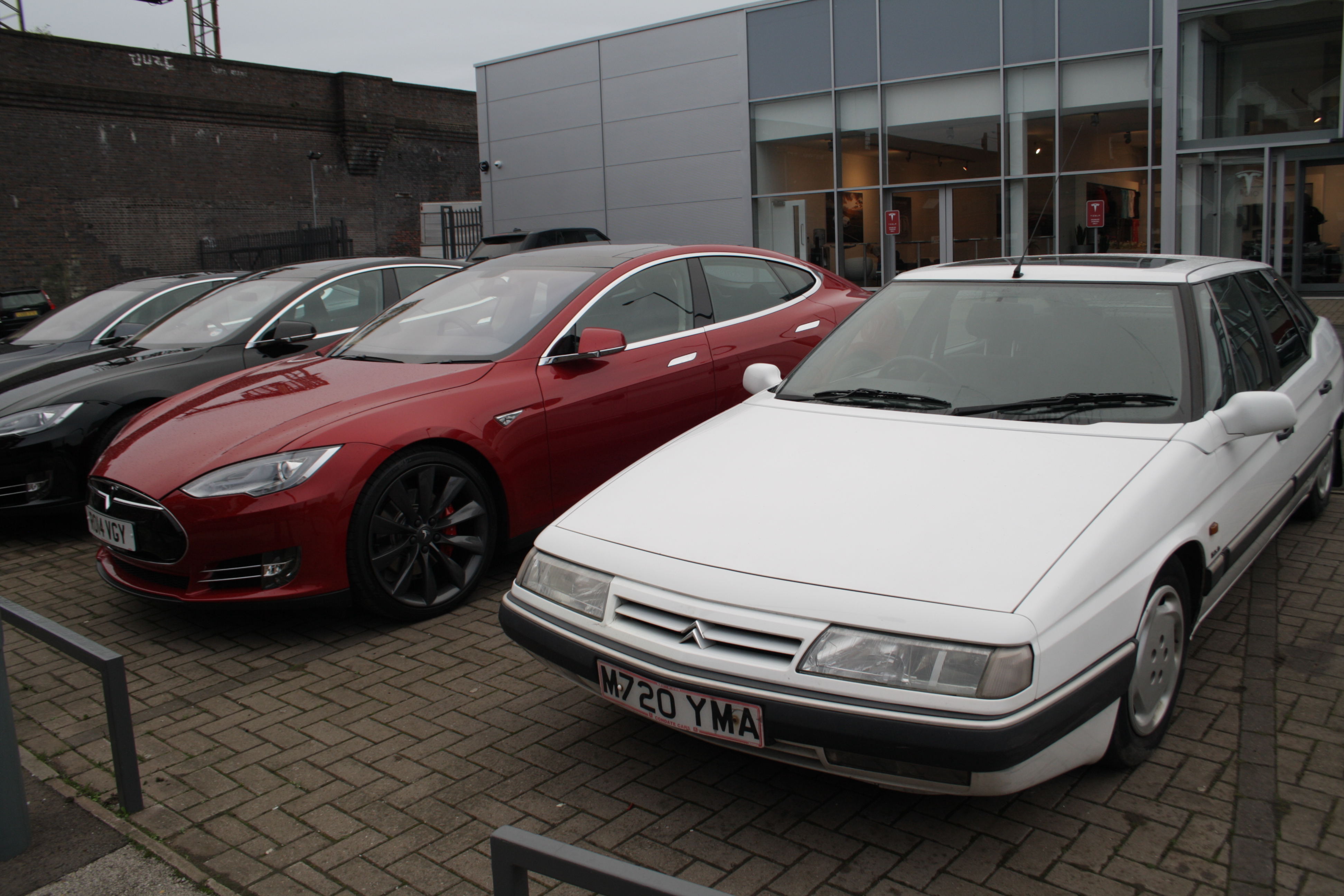
The future compared. The older ‘future’ is more comfortable
More thoughts on this will be revealed once I’ve edited the video. Stay tuned.
Unexpected electric – driving a Finnish EV
Today, I went to visit someone I know locally who owns a 1920s car. After playing with said old car for a bit, we then got discussing electric vehicles. A few minutes later, I was driving a Subaru Domingo, converted in Finland by a company called Elcat for the Finnish Post Office – or Posti – and other largely-Finnish companies. A Japanese electric van with a Finnish twist.

Japanese van with Finnish electrickery
You may be wondering why the Finnish Post Office needed right-hand drive vans. Well, when you think about it, in countries that drive on the right, it saves the postman having to step out into the road doesn’t it? That’s why Belgian Post Office 2CV vans were right-hand drive. Many Post vehicles in Scandinavia still are RHD.
Mr Postman got other benefits too. Like a lever control for the winding window, that allowed it to be rapidly lowered and raised – perfect for reaching an arm out to fill a postbox. Why even open the door? Well, Finland gets cold, so opening the door lets more heat out. That’s why despite being electric, this van actually has a petrol-burning heater. Still far fewer tailpipe emissions than if it was fully petrol-powered.
So, what’s it actually like to drive? Hop behind the wheel and all seems entirely normal. There is a key where you’d expect it. Turning the ignition on makes fans hum in the back. There’s a conventional gearlever too, connected to a conventional gearbox. There’s even a clutch pedal. To make the vehicle move, select a gear, then just press the throttle. You can use first, but second will do on the flat. Away you hum! Pick-up is brisk, as you’d expect as electric motors deliver all of their torque straight away. There’s no clutch-slipping needed – you use that pedal only to change gear. Apparently, third is as high as you should go, as the motor doesn’t have enough grunt for higher gears. That’s still enough for a top speed approaching 50mph on the flat. Trying to extract grunt out of an electric motor at low speeds will go horribly wrong – it’ll just burn the motor out. A display of LEDs indicates battery consumption. Red is bad, orange ok, green is better! Not as hi-tech as the Tree display in a Nissan Leaf, but better than nothing. Don’t forget – this vehicle was brand new in about 1995. It’s much older technology.
There is no battery read out, which seems a bit odd, but it does ‘misfire’ to warn you it’s getting low on juice. Just like a car running out of fuel! There’s a good engine braking effect, as a regeneration mode kicks in when you come off the throttle. This uses your momentum to put some energy back into the batteries. Conventional brakes are there if you need to stop more swiftly.
Sure, it’s a compromised vehicle. Hills slow it dramatically, there’s a hefty battery pack in the middle of the load bay and the range isn’t very high – 50 miles would probably be about it. But it’s still good fun to drive and I suspect very practical for a large percentage of journeys. I was intrigued. It was an unexpected driving experience but entertaining nonetheless. It hasn’t done anything to dampen my electric desires that’s for sure!
The van lives at Blaenglanhanog Cottage, a delightful self-catering abode hidden in the Welsh hills. The major bonus is that the cottage has dedicated charge points for electric cars! (as does the village of Carno itself) They get used too – apparently one owner visited in his Nissan Leaf from Croydon. Who says range is an issue?
Nissan Leaf: The Full Review
A short review of the Nissan Leaf has been written by me already, and published at NextGreenCar.com. What now follows is a more in-depth review of my week with a brand new electric car. Bear with me. It’s quite lengthy.

Not a classic, yet…
Electric cars are certainly not new. They’ve been around for almost as long as internal combustion-powered ones. The BBC is about to screen a show looking at one from the 1960s – the Enfield 8000. Like most electric cars, the Enfield suffered from a short range, much slowness and great heavyness. Heating is minimal, though the cars did include a heated windscreen, so you could at least see where you were going. Few were sold and sporadic attempts at electric power since have not come to much.
So, when Nissan decided to mass produce an electric car, launched in late 2010, it was a bold step indeed. I was curious and decided that now production was UK-based for the European market, it was about time I tried one. Who said us Brits don’t make anything these days?
The car was delivered early one winter’s day. If I was going to test an electric car, I wanted to do so in the most challenging conditions. There’s no point owning a car that’s only good in summer. Hopping aboard, it felt like pretty much any other modern car. There were lots of buttons, precious little visibility but the usual steering wheel and some pedals that we’ve come to expect from a car.
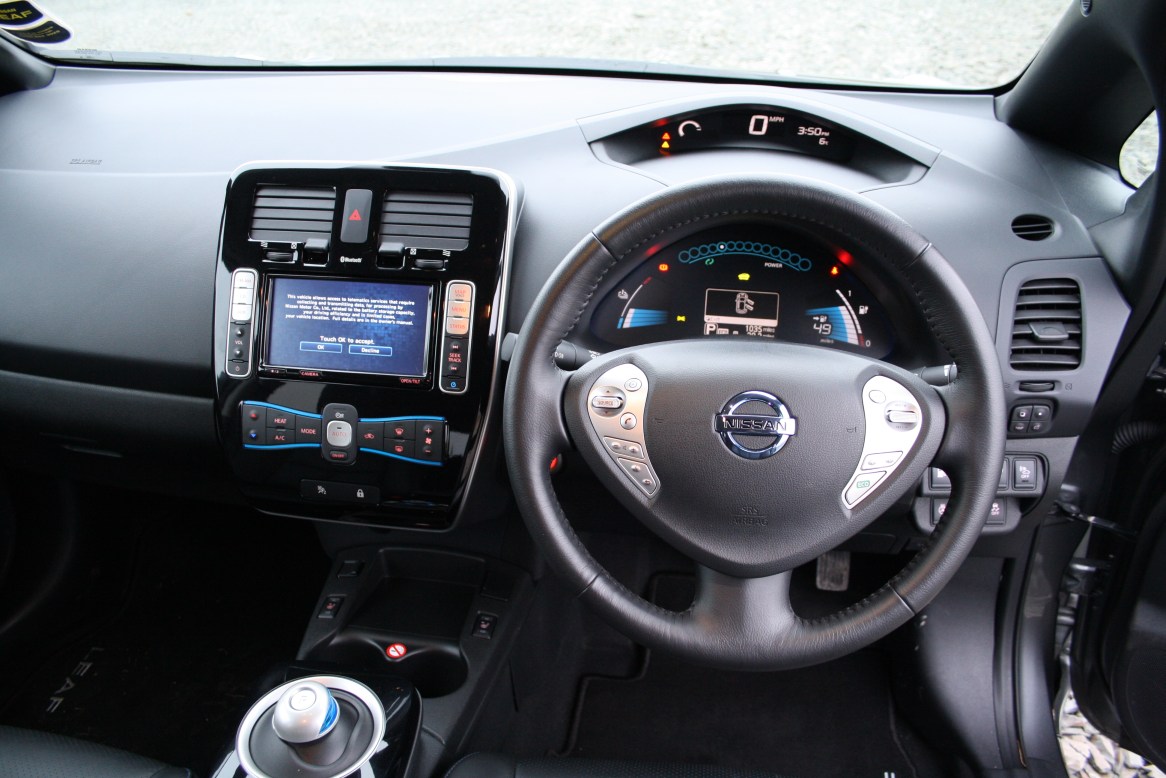
Buttons, many buttons
I put my foot on the brake as instructed and pressed the On button. An ‘intelligent’ key means you can clamber aboard and start up without removing the key from your pocket. Rather than growl into life, it played a little beepy tune that I feel could cause insanity after a few months of ownership. It was like turning on a smartphone. Then it was a case of selecting D with the nifty gearlever, releasing the foot-operated (and thankfully not electronic) parking brake and beginning the oddest driving experience of my life – this coming from someone who has driven a Scootacar.
A quiet, high-pitched whir is all you get by way of sound as the car creeps away. Throttle response is instant but easily moderated. The brakes are super-sharp, the electric power steering surprisingly pleasant. Coming to a halt is particularly odd as it all just goes very quiet indeed.
Over the next week, I drove over 250 miles in the Leaf, using it as daily transport. The range was typically 50-70 miles before charging was needed, though I never left it perilously low on ‘fuel.’ The ambient temperature was very low, so the climate control saw a lot of use, as did the heated seats and steering wheel. I also live in a very hilly part of Wales, so the battery pack really had its work cut out.
Being a top-spec Tekna model (with an eye-watering £32,000 list price) the Leaf had a B-mode as well as D for going forward. B gives more ‘engine’ braking, generating more power as you ease off the throttle. This gives the sort of lift-off retardation that you just don’t get with a conventional automatic, boosting confidence on twisty roads as well as generating power to keep the main battery topped up. I left it in B mode for almost all of the time. I also kept it in Eco mode a lot too. This gives you a ‘lazier’ throttle pedal to help stop you burning volts and restricts power to the heater. I would occasionally drop it out of Eco mode which to me felt like giving it a burst of nitrous oxide! Great for overtaking.
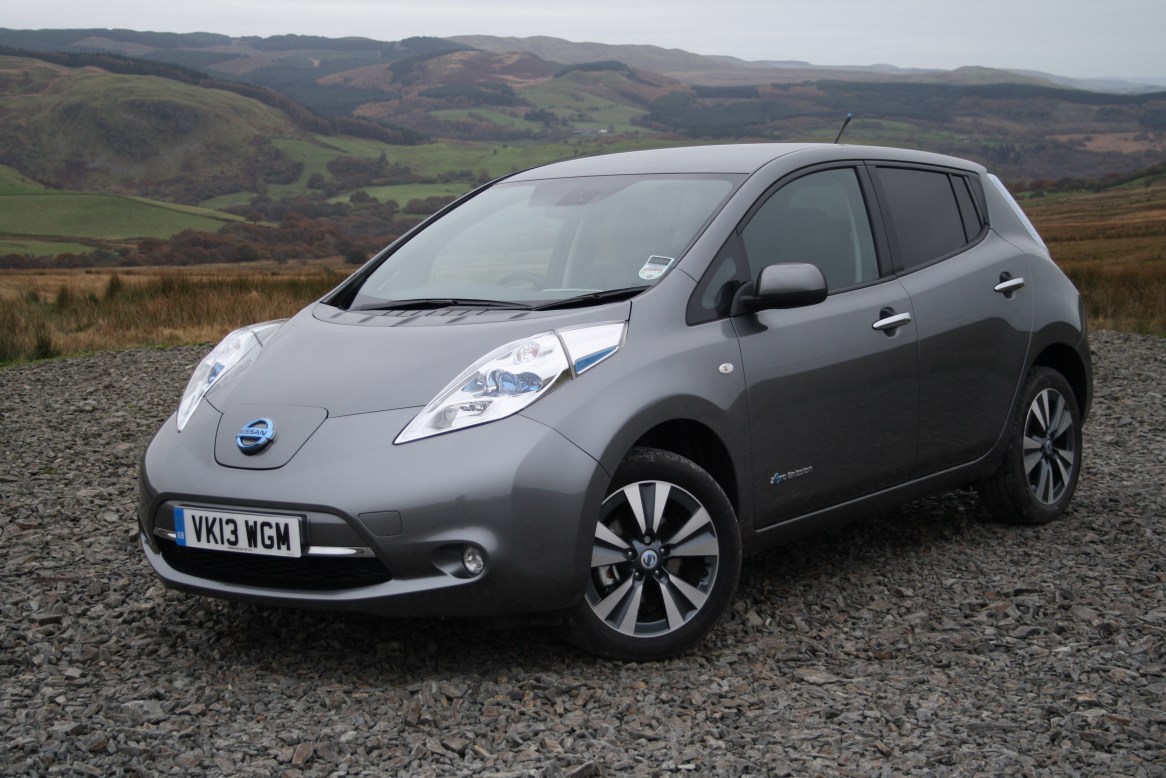
Actually bloomin’ good
I was absolutely amazed at how quickly I got used to it. The car had clearly been very well thought out and the comfortable ride was something I really didn’t expect from a Japanese car. Well, a modern car to be honest. Most are hopeless. But I found myself soon loving the seamless power delivery, the ease of driving around town and how relaxing and pleasant it was on the open road. Sure, it’s not engaging in the way a 2CV is, but it was quick, efficient and so simple.
Sure, it wasn’t all good. The automatic wipers were hopeless and the clever reversing camera – with four cameras all-around the car to give a view akin to Grand Theft Auto – was only good until the lenses got dirty. Minor switchgear was carelessly placed too. There’s that range too. When I needed to get to Birmingham and back, I was forced to use a petrol-powered car. It was the only realistic option.

A nice gimmick, until the lenses get dirty
But I don’t drive to Birmingham and back everyday. For pottering (or even blasting) around my local area, it was ideal. I was genuinely sad to see it go. I love quirky cars, and they don’t get much quirkier than one without a conventional engine. I was astonished at how competent, comfortable and enjoyable it was to drive. Even with its range limitations, it did feel like a car I’d be very happy to own.
Nissan has been working to address other concerns too. Battery life is the elephant in the room for electric cars, but you can now lease the batteries, so they’ll be replaced if their efficiency drops below a certain level. No-one really knows how long that will take, but the new breed of fast chargers will certainly eat into battery life. Trickle-charging overnight is still best.
And I found that no problem. I’m fortunate to have a private driveway and a power socket within easy reach of the car. A full charge cost me a few quid and got the car 70-ish miles. Of course there is no fuel duty to pay, no road tax (it’s free) and servicing should be cheaper too (every 18,000 miles). Sure, there are concerns about the capacity of the grid to supply enough power for electric cars, and other environmental concerns too – where does the electricity come from and what about the chemicals in those batteries? For sure, the electric car is not the absolute answer to environmentalists’ concerns.
But the Leaf does feel like an answer. Sure, it’s not perfect but it is a really nice car with genuine benefits. It is the first British mass-produced electric car and perhaps the first electric car that can be taken seriously.
What I really love though is that other manufacturers have joined the race to go electric. Hybrids have been around for a while, but the latest breed use petrol engines purely as generators. Some still use battery power to boost performance and efficiency – like a Formula One racing car. Others use the petrol engine purely to extend the range as battery power drops – the BMW i3 being a key example of this.
For the first time in decades, the new car market is awash with variety and I’m starting to take interest again. It raises some very interesting questions about the classics of the future and I feel genuine excitement about where the future will take us. Electric cars make more sense than they ever have done. Will they start to take over from petrol? Only time will tell.
Perhaps I’m not a petrolhead after all
A bold statement but after spending a week with an electric car (reviews of which will appear at a later date) I’ve been very, very surprised that I can enjoy a car with no engine.
An enjoyable car, with no engine…
To those who don’t understand such matters, perhaps that isn’t such a shock. I know that some people, including my good lady wife, just can’t really comprehend why the firing of a certain number of cylinder is preferable to a slightly different number of cylinders. You either ‘get’ engines or you don’t. Naturally, I do. Whether it’s a screaming V8 dragster or the lusty grumble of a truck-size turbo diesel, I love the way that an internal combustion engine provides fitting sounds while it works. Just starting a vehicle feels like actually bringing it to life. Turning the ignition key of my Citroen 2CV really does feel like grabbing a lead and shouting ‘walkies’ to your favourite pooch. Though of late, it often seems that the 2CV looks at the weather and decides that going out is a bad idea.
But, I found myself clocking up 300 miles in a Nissan Leaf and really enjoying myself as I did it. For all their benefits, internal combustion engines have many downsides. I love torque. Most petrol engines (this side of a meaty, fuel-slurping V8) don’t have any. So, you have to rag them silly. Quite enjoyable in a 2CV or Sirion, but about as relaxing as hosting a children’s party, with E-number loaded jelly.
Diesels aren’t much better. Oodles of torque yes, but accessing it isn’t always fun. Non-turbo diesels have linear power delivery, but not very much of it. Turbo diesels just don’t work. No, I’m right. They don’t. They’re almost always laggy and even with modern diesels, if you catch them off-boost, they display all the pace of Stonehenge. These days, they’re absolutely loaded with emissions kit and are highly stressed so things go wrong. Especially when you load them with Dual Mass Flywheels and Exhaust Gas Recirculation valves.
With the above in mind, perhaps it’s not so unusual that I found the power delivery of an electric motor really rather wonderful. Press the throttle and the response is, er, electric. Instant power, instant torque.
Transmissions are another problem. I like manuals, but there are times where a self-shifter is nice. The problem is, there isn’t an automatic out there that doesn’t get it wrong from time to time. Modern autos in particular are far too keen to kickdown, sometimes through several of their up-to-eight ratios. This leaves us trying to relax at kiddie party time again. Autos with manual control are no better because if I’m having to think about what gear to be in, I might as well just get a manual and enjoy better fuel economy. An electric motor effectively has no gears. There’s forward and there’s the other way. It took all of about five minutes for me to forget about gears. They suddenly seem rather quaint and old-fashioned.
It seems to have taken far too long for electric cars to get good, but they now seem to have done just that. Sure, range is still an issue but only for longer trips. I’m sure the batteries are not very environmentally friendly to make either, but sucking oil out of the ground didn’t seem all that friendly to Mother Nature the last time I looked, and where does all that platinum come from to make ‘green’ catalytic converters?
Now, my only problem is that, given the state of my fleet, I’m going to have to wait for 15-20 years for electric cars to fall within my price range/interest level. By which time the batteries will probably be junk and hydrogen fuel cells will have taken over. Oh well. The price I pay for being dangerously old-fashioned I guess. S’pose I could always consider converting the 2CV…
 HubNut - celebrating the average!