Maestro van – 500 miles later

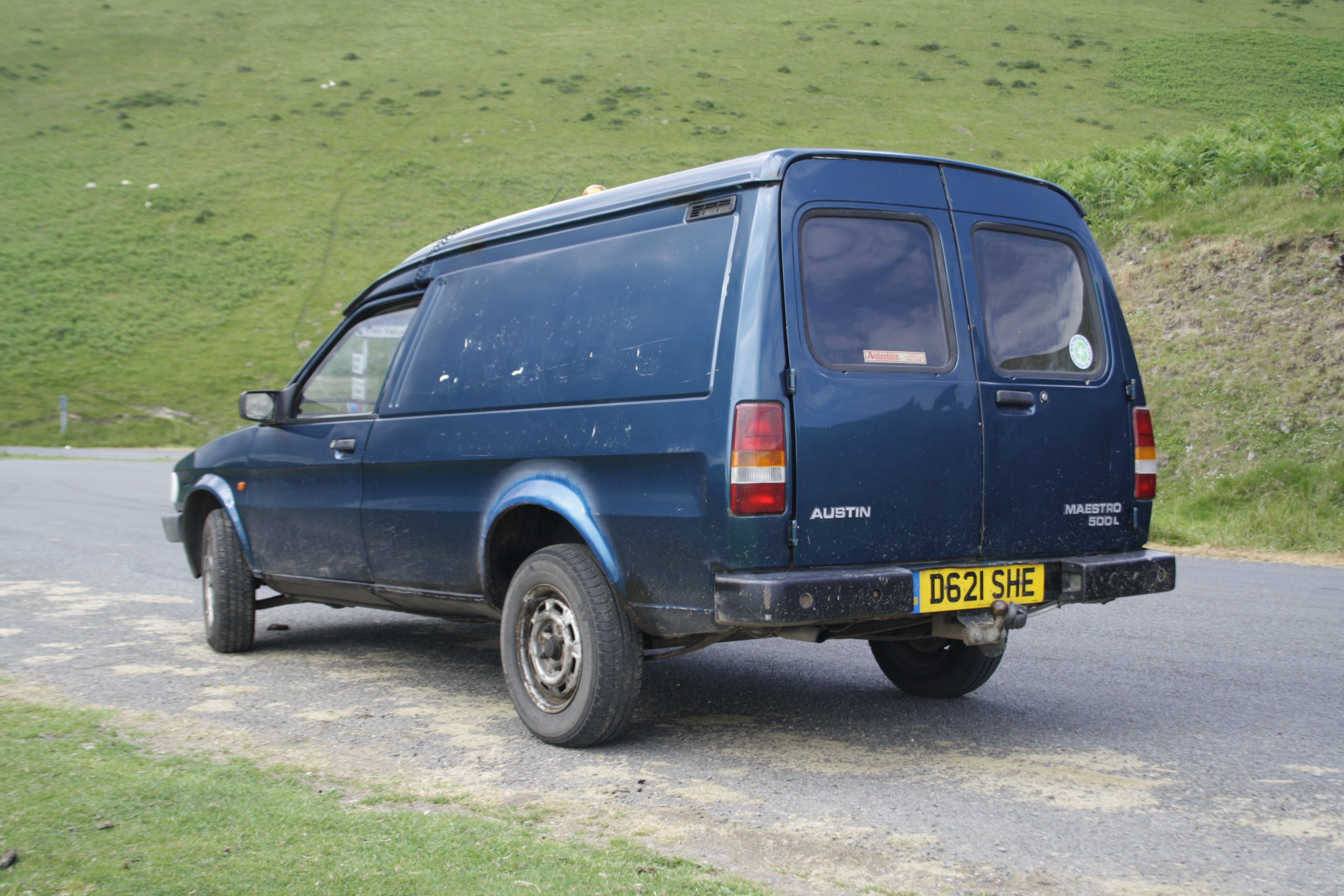
There’s nothing like a good road trip to form a lasting impression of a vehicle. Since Sunday, I’ve driven over 47o miles in the Maestro van, which is plenty of time to get a feel for it. I can’t say it’s necessarily good news either. Unsurprisingly, an unladen van is bouncy, noisy and those stupid Rover seats are uncomfortable. The handling is atrocious. Also, the worn gear linkages make fifth gear occasionally disappear, the brakes are awful, the wipers infuriating and the orange beacon fell off.

The mighty A-Series engine, from olden times

The mighty A-Series engine, from olden times

It wasn’t all bad news though. Far from it. On the run over to Luton (via Gaydon and Birmingham) it averaged 41mpg. (I’ve not calculated the return leg yet but it does still have fuel in it). It utterly failed to break down. It didn’t leave any puddles anywhere at all – owning an oil-tight European car is a bit of a novelty. The headlights proved surprisingly effective. It can be hustled quite quickly and doesn’t fall off the road (it just feels like it will). The heating/ventilation system can do heat to the windscreen and cool air to the face. Awesome!

But my main focus for this Blog will be the engine. By the time the Maestro was launched, the A-Series engine was already 30-years old. A lot happened in those 30 years to further engine design. In 1952 (and indeed until 1959), Ford still considered a side-valve engine good enough for a small car. Austin didn’t though, and the legendary A-Series was born. First fitted to the A30, it soon found its way into the Morris Minor – following the merger of car giants Austin and Morris. The engine found itself under more bonnets than a period actress over the decades that follows, often mounted transversely. From 803cc, the A-Series was stretched to 848, 948, 997, 998, 1071, 1098 and, ultimately in production form, 1275cc. It powered the giant-slaying Minis that triumphed on track and in rallying,  but it also powered the humble Austin A35 van, Marina van and Maestro van. From baby Austin A30 to Austin Montego, that engine saw a hell of a lot of use before finally retiring with the Mini in 2000 – almost half a century after the first A-series had been built.

On a road trip

On a road trip

It’s a good engine too. In the Maestro, it develops a healthy 68bhp. It also produces a lusty 75lb ft of torque at 3500rpm. The mid-range grunt is fabulous for its size. Ford, ever behind the times, was producing a 1.3-litre engine as late as 2002 that only produced 59bhp. It is also a very simple engine. There’s a timing chain, overhead valves and that’s about it in the complexity stakes.

Enough raw stats though. The real surprise for me is that the Maestro van is actually quite brisk. The engine sounds quite rorty too. It demonstrates that this engine really could still be competitive 30-years after it was first foisted upon the world. It’s pretty efficient too – I wasn’t expecting over 40mpg. If I was a more relaxed driver, I could probably nudge it closer to 45mpg.

I think it’s definitely the right engine choice. Much quieter than the diesel and not desperately more thirsty. Overall though, my advice has to be to not buy a Maestro van if you want a comfortable cruising machine. Perhaps this was already obvious…
The insanity of classic car prices

Last October, a Ferrari 250GTO sold for a record £32 million. Another one us due to go under the hammer next month. ‘Experts’ reckon it could achieve even more. Perhaps because it has a pantograph wiper.

This is just insanity. I actively hate the top end of the classic car market. It just reminds you how filthy, stinking rich some people are. Imagine having so much money that you’d be prepared to risk £32 million on a car.

It is a risk too. Like it was in the 1980s. A lot of people spent a lot of money buying cars, then suddenly discovered that they just owned cars. Not some financial package. No, something with four wheels and an engine. For the best part of two decades, those with money ran away from the classic scene crying. E-Type Jaguars became affordable again. Enthusiasts rejoiced.

But now it has happened again. A shambolic E-Type Series 1 can fetch £30,000 while a Ferrari Dino that requires collection with a dustpan and brush recently sold for over £132,000 including premium. Quite a premium that’s for sure. The auctioneers must be very happy as their percentage cut grows ever larger. It’s not their fault though, just like it’s not estate agents’ fault that they earn ever more vast amounts for doing absolutely sod all. At least auctioneers do stuff.

Don’t get me wrong – rising values can be a good thing. Would there be the massive investment in 2CV part remanufacturing if you could still buy a tidy one for less than a grand? No, there wouldn’t. But 2CV prices are at least rooted in some sort of reality. They still undercut Fiat 500s a lot of the time, which are inferior in every way apart from looks perhaps. No-one can deny that a Fiat 500 Nuova is the very epitomy of cute. It has no concessions to practicality at all (unlike a 2CV) but it does make you go ‘aw!’

But I seriously dislike it when enthusiasts get priced out of the market. The E-Type Jaguar was a cheap car back in its day. That’s what made Jaguar special. They sold knock-out looks and performance for not a lot of dosh. Just like TVR in the 1990s. Lots of people bought them and a lot of those people then got sensible, did family stuff and had to sell their E-Types.

I bet they wish they’d just stashed it in the garage to await better times. There’s a chance that E-Type might be worth more than their house. Even if they’d left it parked in the front garden, slowly getting buried by plantlife, they could probably indulge in archaeology, dig it out and sell it for enough to buy a brand new car.

Instead, these people are left realising they can’t afford their dream. Well, maybe they can if they went for a Series 2. 2+2. Automatic. In a horrible colour. In left-hand drive. With accident damage. It’s not exactly living the dream is it?

Then there’s sporty Escorts. I don’t care if it’s got a peppy engine. How can a bread and butter family car be worth £60,000 or more? It might be quick, and it may have rally pedigree – but the one you spy in the classifieds never won a rally or went sidewards in a Scandinavian forest. It’s just a shopping trolley with some grunt. On that basis, should I fit a V8 to a Peugeot 106 and make my fortune?

I shouldn’t mind really. I’ve always had humble dreams. At school, I wanted a Land Rover V8 and a 2CV. I’ve owned both and one of them proved to actually be good. But not everyone has such stupid dreams. Some actually have actual dream cars – ones with glorious styling and power and stuff. It seems a crying shame that so much genuinely exciting motoring is being priced ever more out  of reach of most of us.

For some, the burst of that bubble cannot come soon enough.

Maestro van: Dreadfully nice

There’s no escaping it. The Maestro van really is a bit rubbish. It’s very likeable rubbish though.

I’ve covered over 260 miles in it since purchase now. It is far nicer now I’ve sound-deadened the rear with carpet, though it still bangs a bit over bumps. It really isn’t exciting to drive though. The only buzz I get is that it’s all so simple, yet so effective. The driving experience is as awkward as the looks. The Maestro was never a pretty car, and it isn’t exactly a pretty drive either. The steering is nice and direct, but the front suspension geometry is such that it doesn’t encourage you to push it. A least, I think it’s the geometry. It just feels slightly like it’s going to fall over its front wheels if you push to hard. Or will just readily understeer. One of the two.

Awful, but I like it

Not too unpleasant

That’s ok though, as you can settle back and enjoy a fuss-free, if unexciting drive. It gets you where you want to go. It has a lot in common with my old Nissan Bluebird really. Comfortable, able but dynamically inferior to an equivalent French car. In the Bluebird’s case, the main problem was that I owned a Citroen BX, which trumped it entirely for both ride and handling. The Maestro is only competing with an ancient, peasant-wagon, so it stands a fair chance doesn’t it?

Er, no. It doesn’t. Driving the 2CV for the first time tonight since before purchasing the Maestro van reminded me entirely why I love the 2CV so much. It just responds so well to a damned good thrashing! Every corner is a joy. The screaming engine is tiring but hilarious. Ironically, it’s a car I just find impossible to drive slowly. Driving like that all the time isn’t that joyous though. It’s why I was tiring of the Sirion a bit. I had to frenetic little cars that always wanted to go out for a play on twisty roads. I actually quite like having something that is the opposite.

With the new quieter back end, the Maestro is certainly more relaxing to drive. That’s good as I’m planning to drive all the way to Bedfordshire in it, via Warwickshire and then Birmingham. Then back home. It’ll be a great test for the van and a chance to see whether we really bond. With that in mind, I thought a service might be on the cards, as the oil wouldn’t look out of place in a neglected diesel.

A trip to the motor factors provided oil and filter. Anything else would have to wait (air filter, spark plugs) until funds allow. Sadly, after I drained the oil, I discovered that I’d been supplied with the wrong oil filter. When you live 12 miles away from the motor factor, this is considered a pain in the arse. The van is currently sitting in my garage with no oil in it. I’ll have to try and get a replacement tomorrow. Annoying.

Racy binnacle in my dreadful van

Annoying wiper stalk just in shot. Maestro magnificence

Also annoying are the wipers. For a start, they’re very slow and don’t cover enough of the windscreen. Horrific spindle wear seems a large part of the problem here. I need new linkages etc. And possibly a motor. Things have been improved after I splashed out on a pair of new blades though. The second wiper-related issue is the stalk. It has three positions. Off, slow and slightly less slow. No flick wipe (a permanent bug-bear of mine) and worse, flicking to slow and back off turns on the intermittent setting! Unless you ‘flick’ very slowly. This is beyond annoying. I may well have to investigate fitting a different stalk/relay so I can have a proper intermittent setting and variable intermittent – something I had with the same sort of stalks in the Discovery.

Oh well. No vehicle is perfect, or if it is, I haven’t found it yet! So, I shall stick to my usual technique of why bother trying to own a good car? Crap can be a lot more fun, and easier on the wallet. Sure, the Maestro may have wiper issues and be a bit ponderous, but I still enjoy driving around in it. It’s different, efficient, practical and not too unpleasant. I could have got a job in sales with lines like that.